Page 333 of 444
11 - 8Maintenance and service
18 February 2004
Engine compartment overview"2.5-liter non-turbo models
13 1112 10 86 5 4 3 2 1
7
9
UGB090BB
1) Air cleaner element (page 11-
22)
2) Manual transmission oil level
gauge (MT) (page 11-28) or Dif-
ferential gear oil level gauge
(AT) (page 11-32)
3) Clutch fluid reservoir (page 11-
38)
4) Automatic transmission fluid lev-
el gauge (page 11-30)
5) Brake fluid reservoir (page 11-
37)
6) Fuse box (page 11-62)
7) Battery (page 11-60)
8) Windshield washer tank (page
11-52)
9) Engine oil filler cap (page 11-10)
10) Engine coolant reservoir (page
11-17)
11) Engine oil level gauge (page 11-
10)
12) Radiator cap (page 11-17)
13) Power steering fluid reservoir
(page 11-35)
ProCarManuals.com
Page 334 of 444
11 - 9
Maintenance and service
– CONTINUED –
11
18 February 2004
"2.0-liter turbo models
13 12 11 10 86 5 4 3 2 1
7
9
UGB091BB
1) Air cleaner element (page 11-
22)
2) Manual transmission oil level
gauge (MT) (page 11-28) or Dif-
ferential gear oil level gauge
(AT) (page 11-32)
3) Clutch fluid reservoir (page 11-
38)
4) Automatic transmission fluid lev-
el gauge (page 11-30)
5) Brake fluid reservoir (page 11-
37)
6) Fuse box (page 11-62)
7) Battery (page 11-60)
8) Windshield washer tank (page
11-52)
9) Engine oil filler cap (page 11-10)
10) Engine coolant reservoir (page
11-17)
11) Engine oil level gauge (page 11-
10)
12) Radiator cap (page 11-17)
13) Power steering fluid reservoir
(page 11-35)
ProCarManuals.com
Page 352 of 444
11 -2 7
Maintenance and service
– CONTINUED –
11
26 December 2003
Drive belts1) Power steering pump pulley
2) Air conditioner compressor pulley
3) Crank pulleyThe alternator, power steering pump, and air condi-
tioner compressor depend on drive belts. Satisfactory
performance requires that belt tension be correct.
To check belt tension, place a straightedge (ruler)
across two adjacent pulleys and apply a force of 22 lbs
(98 N, 10 kg) midway between the pulleys by using a
spring scale. Belt deflection should be the amountspecified. If a belt is loose, cracked, or worn, contact
your Saab dealer.
in (mm)
2
3A B 1
HSB033BB
Deflection
New belt Used belt
A 0.28 – 0.35 (7.0 – 9.0) 0.35 – 0.43 (9.0 – 11.0)
B 0.30 – 0.33 (7.5 – 8.5) 0.35 – 0.40 (9.0 – 10.0)
ProCarManuals.com
Page 360 of 444
11 -3 5
Maintenance and service
– CONTINUED –
11
26 December 2003
may be an oil leak. If you suspect a problem,have the vehicle checked at your Saab dealer."Recommended grade and viscosityEach oil manufacturer has its own base oils and addi-
tives. Never use different brands together.Oil grade:
API classification GL-5
SAE viscosity no. and applicable temperature
Power steering fluid"Checking the fluid level1) Reservoir tankThe power steering fluid expands greatly as its tem-
perature rises; the fluid level differs according to fluid
temperature. Therefore, the reservoir tank has two dif-
ferent checking ranges for hot and cold fluids.
Check the power steering fluid level monthly.
1. Park the vehicle on a level surface, and stop the en-
gine.
-30 -20 -10 0 10 20 30 40
-20 0 6020
80W
75W/9080 100 40
85W90
HSB036BA
1
UGB097BB
ProCarManuals.com
Page 361 of 444

11 - 3 6Maintenance and service
26 December 2003
1) Specified range2. Check the fluid level of the reservoir tank.
When the fluid is hot after the vehicle has been run:
Check that the oil level is between “HOT MIN” and
“HOT MAX” on the surface of the reservoir tank.
When the fluid is cool before the vehicle is run: Check
that the oil level is between “COLD MIN” and “COLD
MAX” on the surface of the reservoir tank.
3. If the fluid level is lower than the applicable “MIN”
line, add the recommended fluid as necessary to bring
the level between the “MIN” and “MAX” line.
If the fluid level is extreme low, it may indicate possible
leakage. Consult your Saab dealer for an inspection.
Be careful not to burn yourself because the flu-id may be hot.!When power steering fluid is being added,
use only clean fluid, and be careful not to allow
any dirt into the tank. And never use different
brands together.!Avoid spilling fluid when adding it in the tank."Recommended fluid“Dexron III” Type Automatic Transmission Fluid
1
1
HSB045BB
ProCarManuals.com
Page 368 of 444
11 -4 3
Maintenance and service
– CONTINUED –
11
18 February 2004
3. Drive the vehicle for about 220 yards (200 meters)
in this condition.
4. Wait 5 to 10 minutes for the parking brake to cool
down. Repeat this procedure.
5. Check the parking brake stroke. If the parking
brake stroke is out of the specified range, adjust it by
turning the adjusting nut located on the parking brake
lever.Parking brake stroke:
7 – 8 notches / 44 lbs (196 N, 20 kg)
A safe location and situation should be select-ed for break-in driving.Pulling the parking brake lever too forcefully
may cause the rear wheels to lock. To avoid
this, be certain to pull the lever up slowly andgently.
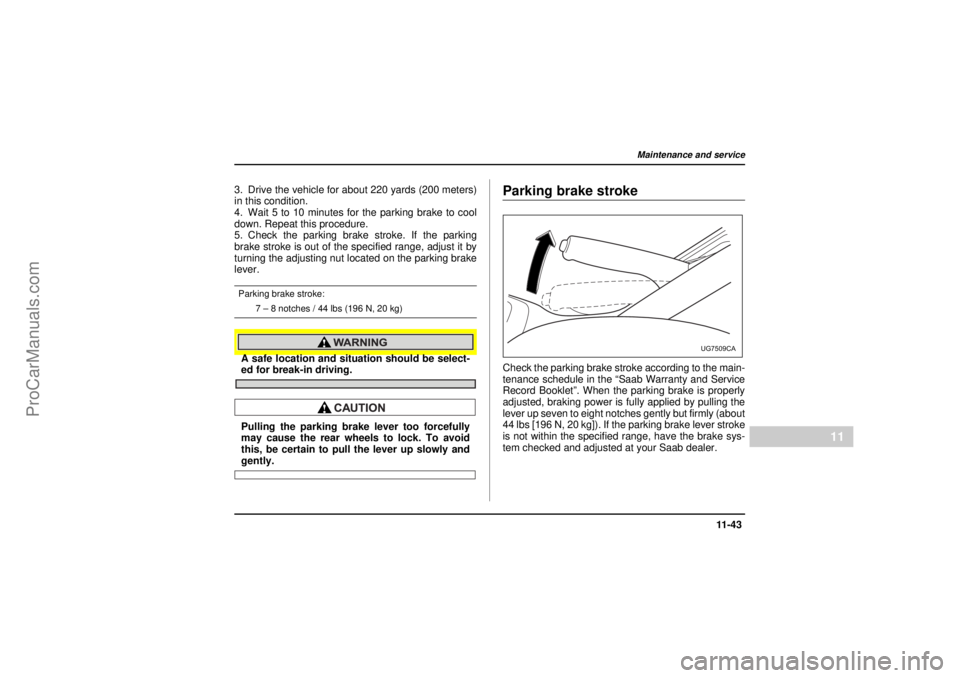
Parking brake strokeCheck the parking brake stroke according to the main-
tenance schedule in the “Saab Warranty and Service
Record Booklet”. When the parking brake is properly
adjusted, braking power is fully applied by pulling the
lever up seven to eight notches gently but firmly (about
44 lbs [196 N, 20 kg]). If the parking brake lever stroke
is not within the specified range, have the brake sys-
tem checked and adjusted at your Saab dealer.
UG7509CA
ProCarManuals.com
Page 375 of 444
11 - 5 0Maintenance and service
26 December 2003
NOTEUnidirectional tires: Some tires have a specified
direction of rotation. A tire of this type has an ar-
row or other mark on its side wall to indicate the
direction of rotation. Install it so that the direction
of rotation is correct when the vehicle is driven
forward.!All four tires must be the same in terms of
manufacturer, brand (tread pattern), construc-
tion, degree of wear, speed symbol, load index
and size. Mixing tires of different types, sizes ordegrees of wear can result in damage to vehi-
cle’s power train. Use of different types or sizes
of tires can also dangerously reduce controlla-
bility and braking performance and can lead to
an accident.
!Use only radial tires. Do not use radial tires
together with belted bias tires and/or bias-ply
tires. Doing so can dangerously reduce control-
lability, resulting in an accident.
UGB125BA
ProCarManuals.com


