Page 329 of 444

11 - 4Maintenance and service
26 December 2003
improperly used or handled, for example, bat-
tery acid.
!Your vehicle should only be serviced by per-
sons fully competent to do so. Serious person-
al injury may result to persons not experienced
in servicing vehicles.
!Always use the proper tools and make certain
that they are well maintained.
!Never get under the vehicle supported only
by a jack. Always use a safety stands to sup-
port the vehicle.
!Never keep the engine running in a poorly
ventilated area, such as a garage or other
closed areas.
!Do not smoke or allow open flames around
the fuel or battery. This will cause a fire.
!Because the fuel system is under pressure,
replacement of the fuel filter should be per-
formed only by your Saab dealer.
!Wear adequate eye protection to guard
against getting oil or fluids in your eyes. If
something does get in your eyes, thoroughly
wash them out with clean water.
!Do not tamper with the wiring of the SRS air-
bag system or seatbelt pretensioner system, or
attempt to take its connectors apart, as that
may activate the system or it can render it inop-erative. The wiring and connectors of these
systems are yellow for easy identification. NEV-
ER use a circuit tester for these wiring.
If your SRS airbag or seatbelt pretensioner
needs service, consult your nearest Saab deal-
er."Before checking or servicing in the en-
gine compartment!Always stop the engine and set the parking
brake firmly to prevent the vehicle from mov-
ing.
!Always let the engine cool down. Engine
parts become very hot when the engine is run-
ning and remain hot for some time after the en-
gine is stopped.
!Do not spill engine oil, engine coolant, brake
fluid or any other fluid on hot engine compo-
nents. This may cause a fire.
!Always remove the key from the ignition
switch. When the ignition switch is in the “ON”
position, the cooling fan may operate suddenlyeven when the engine is stopped.
ProCarManuals.com
Page 370 of 444
11 -4 5
Maintenance and service
– CONTINUED –
11
18 February 2004
!If you feel unusual vibration while driving or find
it difficult to steer the vehicle in a straight line, one
of the tires and/or wheels may be damaged. Drive
slowly to the nearest authorized Saab dealer and
have the vehicle inspected."Tire pressures and wearMaintaining the correct tire pressures helps to maxi-
mize the tires’ service lives and is essential for good
running performance. Check and, if necessary, adjust
the pressure of each tire (including the spare) at least
once a month (for example, during a fuel stop) and be-
fore any long journey.Check the tire pressures when the tires are cold. Use
a pressure gauge to adjust the tire pressures to the
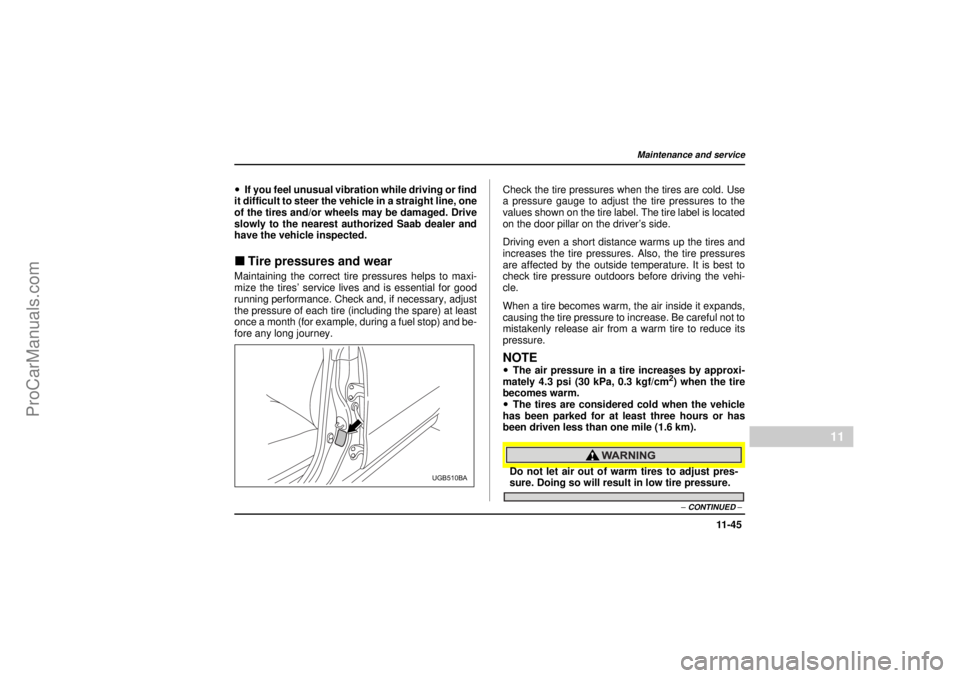
values shown on the tire label. The tire label is located
on the door pillar on the driver’s side.
Driving even a short distance warms up the tires and
increases the tire pressures. Also, the tire pressures
are affected by the outside temperature. It is best to
check tire pressure outdoors before driving the vehi-
cle.
When a tire becomes warm, the air inside it expands,
causing the tire pressure to increase. Be careful not to
mistakenly release air from a warm tire to reduce its
pressure.
NOTE!The air pressure in a tire increases by approxi-
mately 4.3 psi (30 kPa, 0.3 kgf/cm
2) when the tire
becomes warm.
!The tires are considered cold when the vehicle
has been parked for at least three hours or has
been driven less than one mile (1.6 km).
Do not let air out of warm tires to adjust pres-sure. Doing so will result in low tire pressure.
UGB510BA
ProCarManuals.com
Page 371 of 444
11 - 4 6Maintenance and service
26 December 2003
Incorrect tire pressures detract from controllability and
ride comfort, and they cause the tires to wear abnor-
mally.
!Correct tire pressure (tread worn evenly)
Roadholding is good, and steering is responsive. Roll-
ing resistance is low, so fuel consumption is also low-
er.!Abnormally low tire pressure (tread worn at
shoulders)
Rolling resistance is high, so fuel consumption is also
higher.
HSB052AA
HSB053AA
ProCarManuals.com
Page 443 of 444

Fuel octane ratingThis octane rating is the average of the Research Octane and Motor
Octane numbers and is commonly referred to as the Anti Knock
Index (AKI). Refer to “Fuel” section in this manual.Fuel capacity15.9 US gal (60 liters, 13.2 Imp gal)Engine oilUse only API classification SL with the words “ENERGY CON-
SERVING” and the New API certification mark (starburst mark) dis-
played on the container.Engine oil capacity4.2 US qt (4.0 liters, 3.5 Imp qt)
Gas station referenceFuel• 2.5-liter non-turbo models (Linear)
Use only unleaded gasoline with an octane rating of 87 AKI or
higher.
2.0-liter turbo models (Aero)
Use premium unleaded gasoline with an octane rating of 91 AKI or
higher. If premium unleaded gasoline is not available, regular
unleaded gasoline with octane rating of 87 AKI or higher may be
temporarily used. For optimum engine performance and driveabil-
ity, it is required that you use premium grade unleaded gasoline.Cold tire pressureNOTE:
Adjust the tire pressure to 36 psi (250 kPa, 2.5 kgf/cm
2) when driving the vehicle with five people and cargo inside and at speeds
exceeding 99.4 mph (160 km/h).Tire size P205/55R16 89V 215/45R17 91W
Wheel size 16 x 61/2 JJ 17 x 7 JJ
Pressure Front
32 psi (220 kPa, 2.2 kgf/cm
2) 33 psi (230 kPa, 2.3 kgf/cm
2)
Rear
29 psi (200 kPa, 2.0 kgf/cm
2) 32 psi (220 kPa, 2.2 kgf/cm
2)
Temporary spare tire Size T135/70 D16
Pressure
60 psi (420 kPa, 4.2 kgf/cm
2)
ProCarManuals.com
