2005 RENAULT MEGANE maintenance
[x] Cancel search: maintenancePage 111 of 250
Downloaded from www.Manualslib.com manuals search engine
NU761_2_G2-FRA.qxd 4/11/05 10:48 Page 2.11
ADVICE ON FUEL ECONOMY AND DRIVING
Maintenance
It should be noted that failure to
respect anti-pollution standards
may lead to legal action being taken
against the vehicle owner. In
addition, replacing engine, fuel
supply system and exhaust
components with parts other than
those originally recommended by
the manufacturer may alter your
vehicle so that it no longer complies
with anti-pollution standards.
Have your vehicle checked and
adjusted by your RENAULT Dealer
in accordance with the instructions
in the vehicle’s Warranty and
Services booklet.
Your RENAULT Dealer has all the
equipment necessary for ensuring
that your vehicle is maintained to its
original standard.
Engine adjustments
• ignition: this does not require
adjustment.
plugs: for optimum fuel
economy, efficiency and
performance the specifications laid
down by our Design Department
must be strictly applied.
If the spark plugs have to be
changed, use the make, type and
gap specified for your vehicle’s
engine. Contact your Renault
Dealer for this information.
this does not require
adjustment.
A clogged
cartridge hinders performance and
must be replaced.
RENAULT is actively striving to
reduce pollutant exhaust gas
emissions and to save energy.
By virtue of its design, moderate fuel
consumption and initial settings,
your RENAULT conforms to current
anti-pollution standards. Technical
design, however, cannot achieve all.
The fuel consumption of your
vehicle and the level of pollutant
exhaust gas emissions are also your
responsibility. Make sure that your
vehicle is maintained and used
correctly.
2.11
NU761_2_G2-ENG.qxp 03-Jan-06 20:48 Page 2.11 (Black/Process Black\
plate)
Page 114 of 250
Downloaded from www.Manualslib.com manuals search engine
NU761_2_G2-FRA.qxd 4/11/05 10:48 Page 2.14
2.14
ENVIRONMENT
Your vehicle has been designed with
the aim of caring for the
environment.
Manufacture:
RENAULT has manufactured your
vehicle to comply with the strictest
environmental standards.
Furthermore, RENAULT has
implemented a system for checking
all of the vehicle components.
Emissions:
Your vehicle is equipped with an
emission control system including a
catalytic converter, an oxygen
sensor and an active carbon filter
(the latter prevents vapour from the
petrol tank being released into the
open air).
Recycling:
RENAULT has used all its expertise
to reduce environmental impact as
far as possible at the end of the
service life of your vehicle. This vehicle is more than 95%
recyclable. To make recycling easier,
many innovations have been
updated in the design of the vehicle
and the materials used.
The vehicle contains many parts
made of recycled plastics or
renewable materials (wood, cotton,
natural rubber etc.).
Make your contribution towards
protection of the environment too.
of routine vehicle maintenance
(vehicle battery, oil filter, air filter,
batteries etc.) and oil containers
(empty or filled with used oil)
must be disposed of through
specialist organisations.
life, it should be sent to approved
centres to ensure that it is
recycled.
legislation.
NU761_2_G2-ENG.qxp 03-Jan-06 20:48 Page 2.14 (Black/Process Black\
plate)
Page 154 of 250
Downloaded from www.Manualslib.com manuals search engine
NU761_2_G3-FRA.qxd 4/11/05 10:51 Page 3.16
3.16
AIR CONDITIONING: information and operating advice
Fuel consumption
You will normally notice an
increase in fuel consumption
(especially in town) when the air
conditioning is operating.
For vehicles fitted with manual air
conditioning, switch off the system
when it is not required.
Some advice for reducing
consumption and therefore helping
to conserve the environment:
It is advisable to drive with the
vents open and the windows
closed.
If the vehicle has been parked in the
sun, open the doors for a few
moments to let the hot air escape
before starting the engine.Maintenance
Refer to the Warranty and Services
booklet for your vehicle for the
replacement frequency.
Operating faults
Generally, in the event of an
operating fault, consult your
RENAULT Dealer. - Reduction in de-icing, demisting
or air conditioning performance.
This may be caused by the
passenger compartment filter
cartridge becoming clogged.
- No cold air is being produced.
Check that the controls are set
correctly and that the fuses are
sound. Otherwise, switch off the
system.
- Presence of water under the
vehicle . After prolonged use of the
air conditioning system, it is
normal for water to be present
under the vehicle. This is caused
by condensation.
Do not open the refrigerant fluid
circuit. The fluid may damage the
eyes or skin.
NU761_2_G3-ENG.qxp 1/5/2006 5:28 PM Page 3.16 (Black plate)
Page 175 of 250
Downloaded from www.Manualslib.com manuals search engine
NU761_2_G4-FRA.qxd 14/11/05 10:10 Page 4.01
Section 4: Maintenance
Bonnet ........................................................................\
..............................................................................................4.02 - 4.03
Engine oil level/Oil change
........................................................................\
.......................................................4.04 ➟4.07
Levels : Engine coolant
........................................................................\
....................................................... .....................4.08
brake fluid
........................................................................\
....................................................... ............................4.09
Windscreen/headlight washer reservoir
........................................................................\
...............................4.10
Filters
........................................................................\
....................................................... ...................................................4.10
Battery
........................................................................\
....................................................... ..................................................4.11
Bodywork maintenance
........................................................................\
....................................................... ........4.12 - 4.13
Interior trim maintenance
........................................................................\
....................................................... ................4.14
4.01
NU761_2_G4-ENG.qxp 1/5/2006 5:29 PM Page 4.01 (Black plate)
Page 184 of 250
Downloaded from www.Manualslib.com manuals search engine
1
NU761_2_G4-FRA.qxd 14/11/05 10:11 Page 4.10
4.10
LEVELS (continued)FILTERS
The replacement of filter elements
(air filter, passenger compartment
filter, diesel filter, etc.) is scheduled
in the servicing and maintenance
operations for your vehicle.
Frequency for replacing filter
elements: refer to the Warranty and
Services booklet for your vehicle.
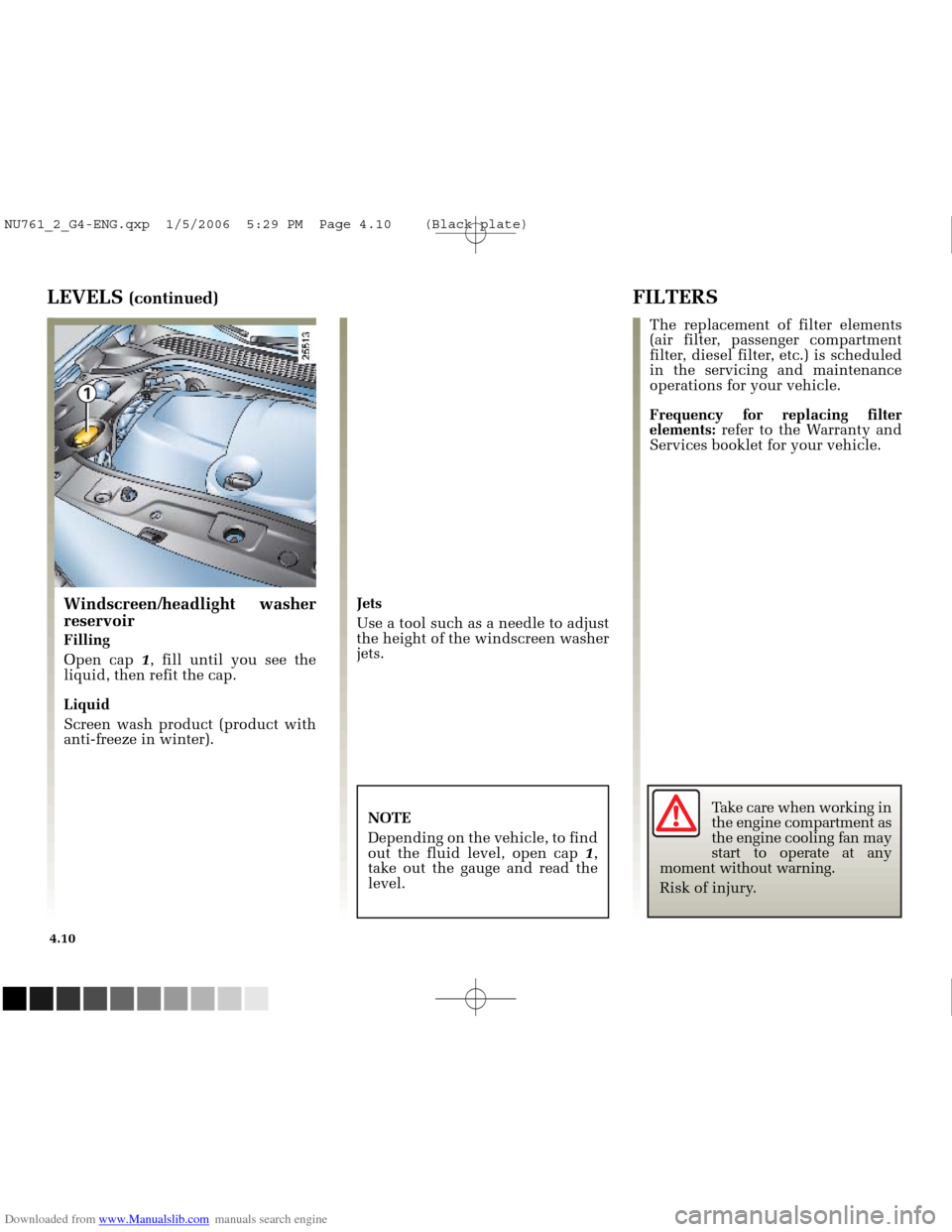
Windscreen/headlight washer
reservoir
Filling
Open cap 1, fill until you see the
liquid, then refit the cap.
Liquid
Screen wash product (product with
anti-freeze in winter). Jets
Use a tool such as a needle to adjust
the height of the windscreen washer
jets.
NOTE
Depending on the vehicle, to find
out the fluid level, open cap 1,
take out the gauge and read the
level.
Take care when working in
the engine compartment as
the engine cooling fan may
start to operate at any
moment without warning.
Risk of injury.
NU761_2_G4-ENG.qxp 1/5/2006 5:29 PM Page 4.10 (Black plate)
Page 185 of 250
Downloaded from www.Manualslib.com manuals search engine
1
NU761_2_G4-FRA.qxd 14/11/05 10:11 Page 4.11
4.11
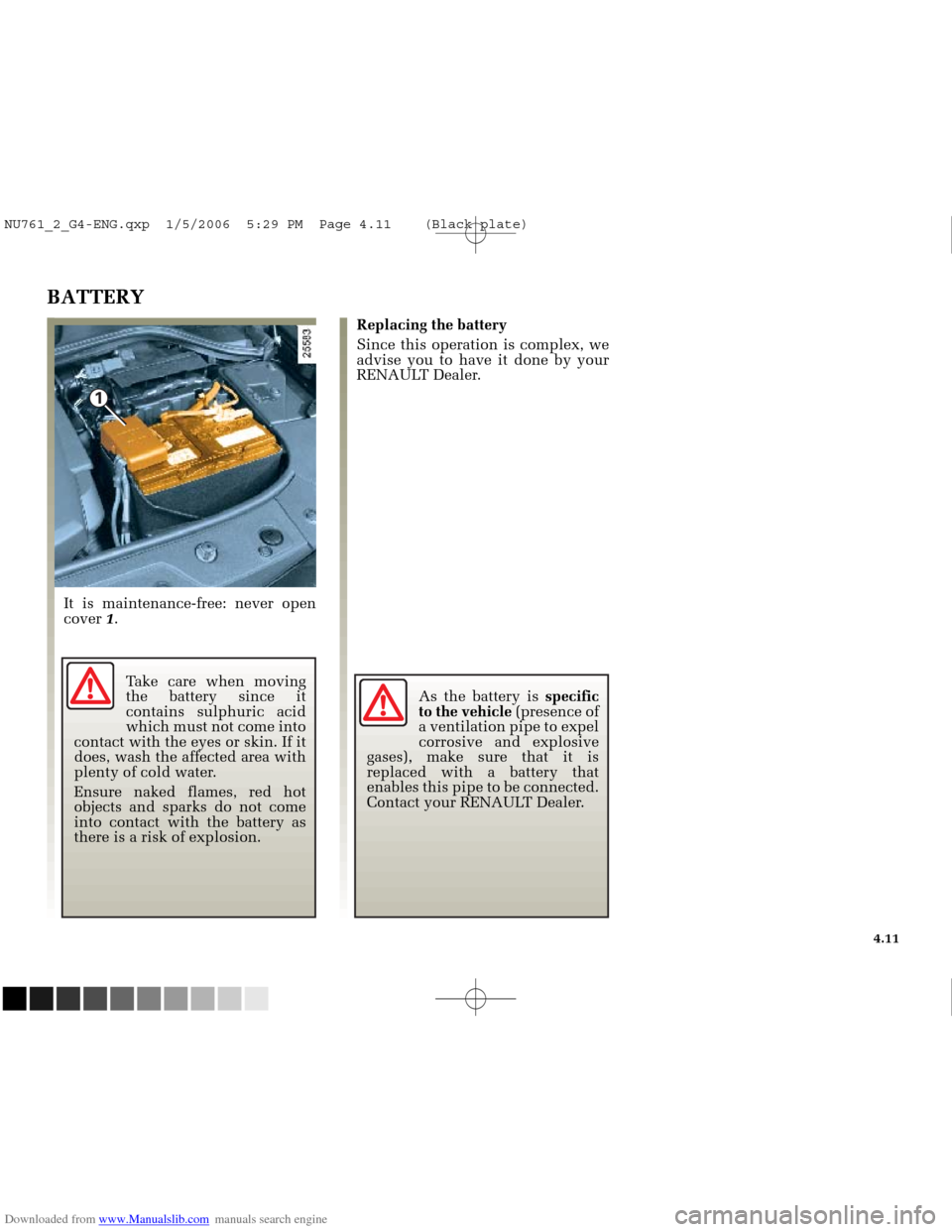
BATTERY
It is maintenance-free: never open
cover 1. Replacing the battery
Since this operation is complex, we
advise you to have it done by your
RENAULT Dealer.
Take care when moving
the battery since it
contains sulphuric acid
which must not come into
contact with the eyes or skin. If it
does, wash the affected area with
plenty of cold water.
Ensure naked flames, red hot
objects and sparks do not come
into contact with the battery as
there is a risk of explosion. As the battery is
specific
to the vehicle (presence of
a ventilation pipe to expel
corrosive and explosive
gases), make sure that it is
replaced with a battery that
enables this pipe to be connected.
Contact your RENAULT Dealer.
NU761_2_G4-ENG.qxp 1/5/2006 5:29 PM Page 4.11 (Black plate)
Page 186 of 250
Downloaded from www.Manualslib.com manuals search engine
NU761_2_G4-FRA.qxd 14/11/05 10:11 Page 4.12
4.12
BODYWORK MAINTENANCE
Protection against the effects of
corrosive agents
Although your vehicle has been
treated with very effective anti-
corrosion products, it nevertheless
remains subject to the effects of:
• corrosives in the atmosphere- atmospheric pollution (urbanand industrial areas).
- saline atmospheres (near the sea, particularly in hot weather),
- seasonal and damp climatic conditions, (e.g: road salt in
winter, water from road
cleaners).
abrasives Wind-borne dust and sand, mud,
road grit thrown up by other
vehicles.
minor impacts
You should take a number of minor
precautions in order to safeguard
your vehicle against such risks and
not to lose the benefit of your
vehicle’s anti-corrosion protection.
You should not
Wash the vehicle in bright
sunlight or freezing temperatures.
Scrape off mud or dirt without
pre-wetting.
Allow dirt to accumulate.
Allow rust to form following
minor impacts.
Use solvents not approved by
RENAULT’s Technical Department
to remove stains as this could
damage the paintwork.
Drive frequently in snow or
muddy conditions without
periodically washing the vehicle,
particularly under the wheel
arches and body.
Degrease or clean mechanical
components (e.g. engine
compartment), underneath the
bodywork, parts with hinges (e.g.
inside the fuel tank flap) and
painted plastic external fittings
(e.g. bumpers) using high pressure
cleaning apparatus or by spraying
on products not approved by
RENAULT’s Technical Department.
If adequate precautions are not
taken, this could give rise to
corrosion or operational faults.
NU761_2_G4-ENG.qxp 1/5/2006 5:29 PM Page 4.12 (Black plate)
Page 187 of 250
Downloaded from www.Manualslib.com manuals search engine
NU761_2_G4-FRA.qxd 14/11/05 10:11 Page 4.13
4.13
BODYWORK MAINTENANCE (continued)
You should
- Frequently wash your car, with the
engine off , with cleaning products
recommended by us (never use
abrasive products) and be sure to
rinse the wheel arches and
underneath the bodywork to
eliminate:
- spots of tree resin and industrial grime;
- bird droppings , which contain
chemicals that rapidly discolour
paintwork and may even cause
the paint to peel off;
The vehicle must bewashed
immediately to remove these
marks since it is impossible to
remove them by polishing.
- salt deposited in the wheel arches and the underside of the body
after driving in areas where the
roads have been gritted,
- mud in the wheel arches and the underside of the body which
forms damp patches. - Observe the vehicle stopping
distances when driving on gravelled
surfaces to prevent paint damage.
- Repair, or have repaired quickly, areas where the paint has been
damaged to prevent corrosion
spreading.
- Remember to visit the body shop periodically in order to maintain
your RENAULT anti-corrosion
warranty. Refer to the Warranty
and Services booklet.
- Respect local regulations about washing vehicles (e.g. do not wash
your vehicle on a public highway). - Before using a roller type car wash,
return the wiper stalk to the Stop
position (refer to the
Wipers/Washers information in
section 1). Check the mounting of
external accessories, additional
lights and rear-view mirrors and
take care to attach the wiper blades
and radio aerial with an adhesive.
Remove the car phone aerial if your
vehicle is fitted with this
equipment.
- Spray mechanical components, hinges, etc. with products
approved by RENAULT’s Technical
Department to protect them after
they have been cleaned.
We have selected special
products to care for your vehicle
and you can obtain these from
RENAULT accessory outlets.
NU761_2_G4-ENG.qxp 1/5/2006 5:29 PM Page 4.13 (Black plate)