Page 2813 of 3171
RSU-8
LEAF SPRING
CAUTION:
When installing the components with rubber bushings, the final tightening of the nuts and bolts must
be done with the vehicle in an unladen condition (the fuel, engine coolant, and engine oil full; the
spare tire, jack, hand tools and mats in their designated positions) with the tires on the ground.
REMOVAL
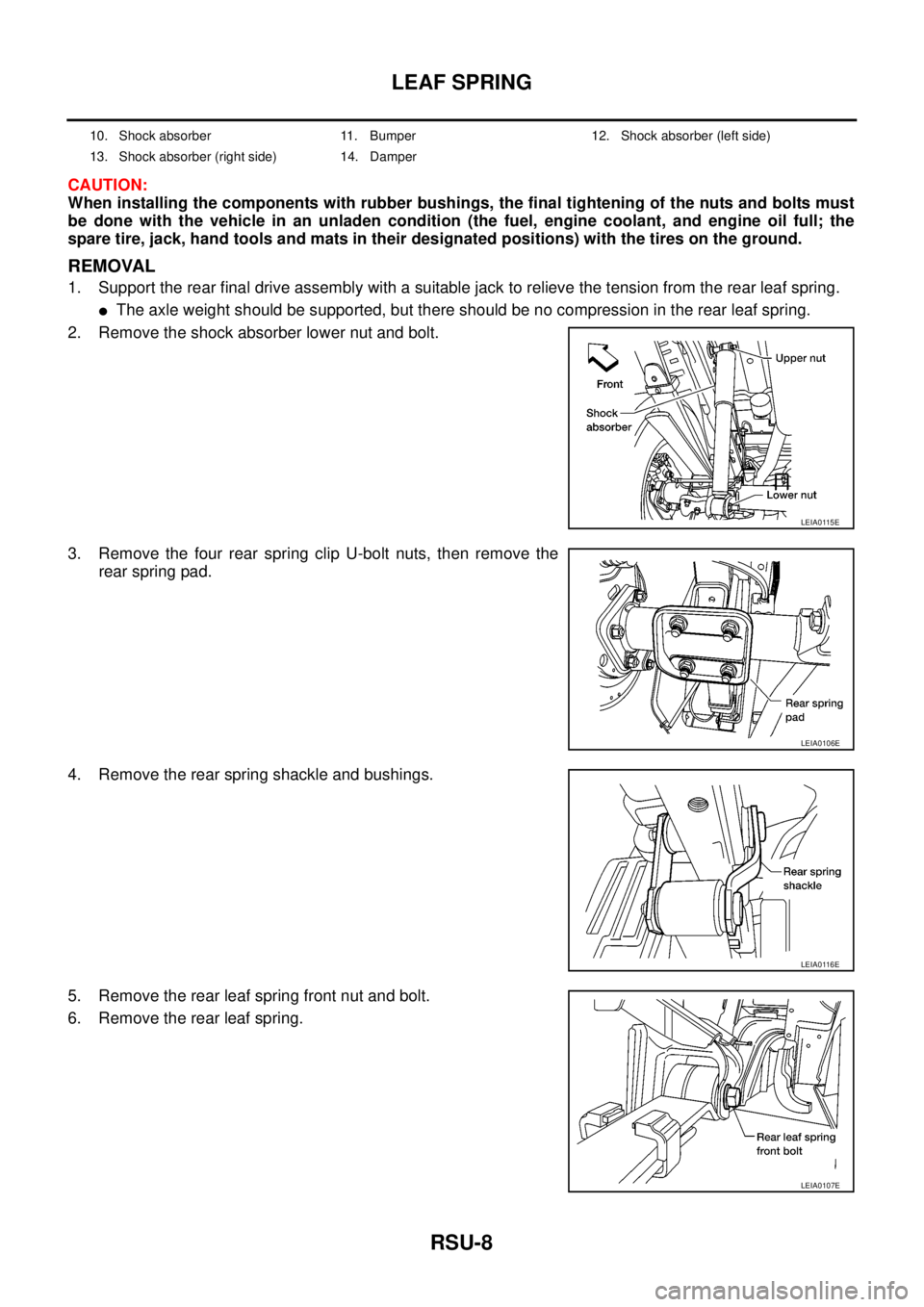
1. Support the rear final drive assembly with a suitable jack to relieve the tension from the rear leaf spring.
lThe axle weight should be supported, but there should be no compression in the rear leaf spring.
2. Remove the shock absorber lower nut and bolt.
3. Remove the four rear spring clip U-bolt nuts, then remove the
rear spring pad.
4. Remove the rear spring shackle and bushings.
5. Remove the rear leaf spring front nut and bolt.
6. Remove the rear leaf spring.
10. Shock absorber 11. Bumper 12. Shock absorber (left side)
13. Shock absorber (right side) 14. Damper
LEIA0115E
LEIA0106E
LEIA0116E
LEIA0107E
Page 2815 of 3171
RSU-10
LEAF SPRING
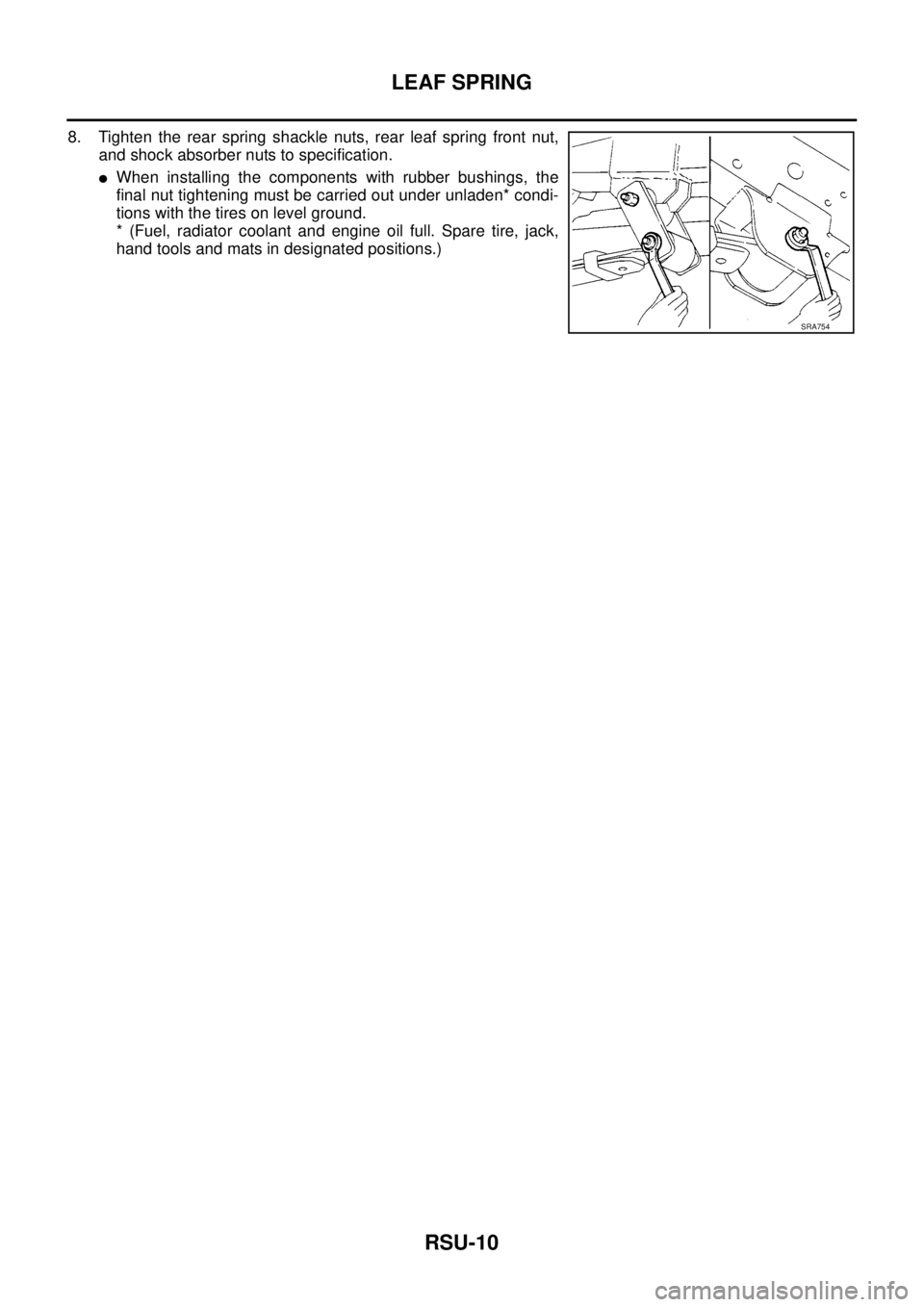
8. Tighten the rear spring shackle nuts, rear leaf spring front nut,
and shock absorber nuts to specification.
lWhen installing the components with rubber bushings, the
final nut tightening must be carried out under unladen* condi-
tions with the tires on level ground.
* (Fuel, radiator coolant and engine oil full. Spare tire, jack,
hand tools and mats in designated positions.)
SRA754
Page 2962 of 3171
![NISSAN NAVARA 2005 Repair Workshop Manual DISPOSAL OF AIR BAG MODULE AND SEAT BELT PRE-TENSIONER
SRS-53
C
D
E
F
G
I
J
K
L
MA
B
SRS
1. Cut the inflator from side curtain air bag module.
2. Connect deployment tool [SST: KV99106400] to the infla](/manual-img/5/57362/w960_57362-2961.png "NISSAN NAVARA 2005 Repair Workshop Manual DISPOSAL OF AIR BAG MODULE AND SEAT BELT PRE-TENSIONER
SRS-53
C
D
E
F
G
I
J
K
L
MA
B
SRS
1. Cut the inflator from side curtain air bag module.
2. Connect deployment tool [SST: KV99106400] to the infla")
DISPOSAL OF AIR BAG MODULE AND SEAT BELT PRE-TENSIONER
SRS-53
C
D
E
F
G
I
J
K
L
MA
B
SRS
1. Cut the inflator from side curtain air bag module.
2. Connect deployment tool [SST: KV99106400] to the inflator
using deployment tool adapter [SST: KV99110500].
3. Put the inflator connected with the deployment tool [SST:
KV99106400] into a tire without a wheel.
4. Put the tire with the inflator onto another tire without wheel. Add
an additional tire without a wheel and then a tire mounted on a
wheel on top.
CAUTION:
Tie all tires together with a strap in order to keep them
standing.
5. Connect red clip of deployment tool to battery positive terminal
and black clip to negative terminal.
6. The lamp on the right side of the tool, marked “deployment tool
power”, should glow green, not red.
7. Press the button on the deployment tool. The left side lamp on
the tool, marked “air bag connector voltage”, will illuminate and the air bag module will deploy.
CAUTION:
When deploying the side curtain air bag module, stand at least 5 m (16 ft) away from the side cur-
tain air bag module.
8. Repeat this procedure to deploy the second inflator.
SHIA0198E
PHIA0568E
PHIA0011E
PHIA0555E
Page 2984 of 3171

4WD SYSTEM
TF-17
C
E
F
G
H
I
J
K
L
MA
B
TF
4WD WARNING LAMP
Turns ON or flashes when there is a malfunction in 4WD system.
Also turns ON when ignition switch is turned ON, for purpose of lamp check. Turns OFF approximately 1 sec-
ond after the engine starts if system is normal.
4WD Warning Lamp Indication
NOTE:
4WD warning lamp is turned on when the following one or more parts are malfunctioning.
lVehicle speed signal
[from ABS actuator and electric unit (control unit)]
lCAN communication line
lAD converter
lEngine speed signal
l4WD shift switch
lWait detection switch
lActuator motor
lTransfer control device
lTransfer shut off relay
lTransfer shift relay
lPNP switch signal
ATP WARNING LAMP (A/T MODELS)
When A/T selector lever is in “P” position, vehicle may move because A/T parking mechanism does not oper-
ate when transfer is under neutral condition. ATP warning lamp is turned on to indicate this condition to the
driver.
Condition 4WD warning lamp
Lamp checkTurns ON when ignition switch is turned ON.
Turns OFF after engine start.
4WD system malfunctionON
(For indicated malfunction items, see the “NOTE”)
During self-diagnosis Flashes at malfunction mode.
Large difference in diameter of front/
rear tiresSlow flashing: 1 time/2 seconds
(Continues to flash until ignition switch is turned OFF)
Other than above (system normal) OFF
Page 3006 of 3171
![NISSAN NAVARA 2005 Repair Workshop Manual TROUBLE DIAGNOSIS
TF-39
C
E
F
G
H
I
J
K
L
MA
B
TF
2WDSWITCH[ON/
OFF]Input condition from 4WD
shift switch4WD shift switch: 2WD ON
4WD shift switch: 4H and 4LO OFF
4H SWITCH [ON/OFF]Input condition fro](/manual-img/5/57362/w960_57362-3005.png "NISSAN NAVARA 2005 Repair Workshop Manual TROUBLE DIAGNOSIS
TF-39
C
E
F
G
H
I
J
K
L
MA
B
TF
2WDSWITCH[ON/
OFF]Input condition from 4WD
shift switch4WD shift switch: 2WD ON
4WD shift switch: 4H and 4LO OFF
4H SWITCH [ON/OFF]Input condition fro")
TROUBLE DIAGNOSIS
TF-39
C
E
F
G
H
I
J
K
L
MA
B
TF
2WDSWITCH[ON/
OFF]Input condition from 4WD
shift switch4WD shift switch: 2WD ON
4WD shift switch: 4H and 4LO OFF
4H SWITCH [ON/OFF]Input condition from 4WD
shift switch4WD shift switch: 4H ON
4WD shift switch: 2WD and 4LO OFF
4L SWITCH [ON/OFF]Input condition from 4WD
shift switch4WD shift switch: 4LO ON
4WD shift switch: 2WD and 4H OFF
4L POSI SW [ON/OFF] Condition of 4LO switch
lVehicle stopped
lEngine running
lFor A/T models, A/T
selector lever “N” posi-
tion with brake pedal
depressed.
lFor M/T models, M/T
shift lever neutral posi-
tion with clutch and
brake pedal depressed.4WD shift switch: 4LO ON
Except the above OFF
ATP SWITCH [ON/OFF] Condition of ATP switch
lVehicle stopped
lEngine running
lA/T selector lever “N”
position with brake
pedal depressed.4WD shift switch:
4H to 4LO or 4LO to 4H
(While actuator motor is
operating.)ON
Except the above OFF
WAIT DETCT SW [ON/
OFF]Condition of wait detection
switch
lVehicle stopped
lEngine running
lFor A/T models, A/T
selector lever “N” posi-
tion with brake pedal
depressed.
lFor M/T models, M/T
shift lever neutral posi-
tion with clutch and
brake pedal depressed.4WD shift switch:
4H and 4LOON
4WD shift switch: 2WD OFF
4WD MODE [2H/4H/4L]Control status of 4WD
(Output condition of 4WD
shift indicator lamp and
4LO indicator lamp)4WD shift switch
(Engine running)2WD 2H
4H 4H
4LO 4L
VHCL/S COMP [km/h]
or [mph]Vehicle speedVehicle stopped 0 km/h (0 mph)
Vehicle running
CAUTION:
Check air pressure of tires under standard condi-
tion.Approximately
equal to the indica-
tion on speedome-
ter (Inside of±10%)
SHIFT ACT 1 [ON/OFF]Output condition to actua-
tor motor (clockwise)
lVehicle stopped
lEngine running
lFor A/T models, A/T
selector lever “N” posi-
tion with brake pedal
depressed.
lFor M/T models, M/T
shift lever neutral posi-
tion with clutch and
brake pedal depressed.4WD shift switch:
2WDto4Hor4Hto4LO
or 2WD to 4LOON
Except the above OFF Monitored item [Unit] Content Condition Display value
Page 3066 of 3171
TROUBLE DIAGNOSIS FOR SYMPTOMS
TF-99
C
E
F
G
H
I
J
K
L
MA
B
TF
5.CHECK TRANSFER CONTROL UNIT
Check transfer control unit input/output signal. Refer toTF-38, "
Transfer Control Unit Input/Output Signal Ref-
erence Values".
OK or NG
OK >> GO TO 6.
NG >> Check transfer control unit pin terminals for damage or loose connection with harness connector.
If any items are damaged, repair or replace damaged parts.
6.CHECK TRANSFER INNER PARTS
1. Disassemble transfer assembly. Refer toTF-112, "
Disassembly and Assembly".
2. Check transfer inner parts.
OK or NG
OK >>INSPECTION END
NG >> Repair or replace damaged parts.
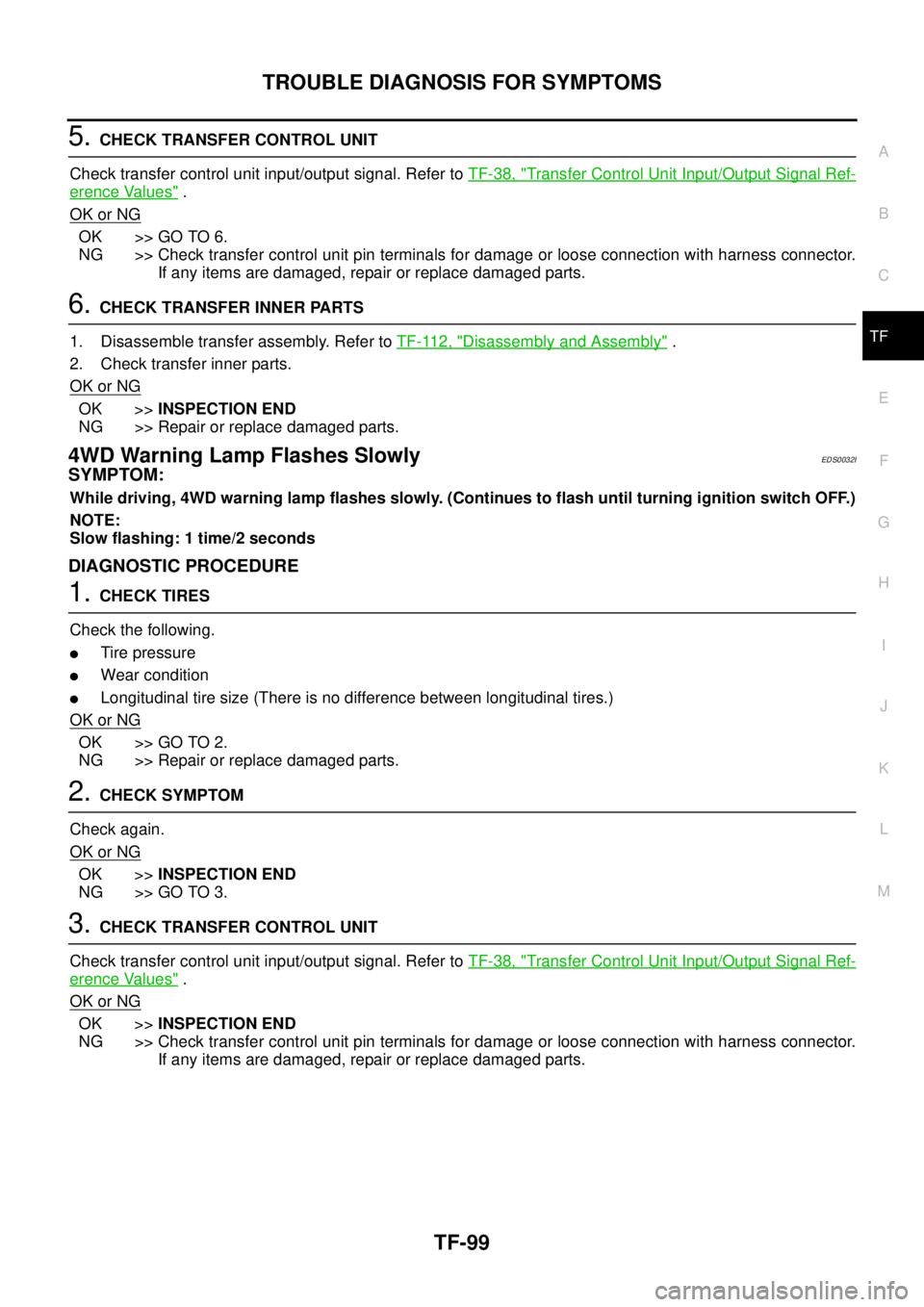
4WD Warning Lamp Flashes SlowlyEDS0032I
SYMPTOM:
While driving, 4WD warning lamp flashes slowly. (Continues to flash until turning ignition switch OFF.)
NOTE:
Slow flashing: 1 time/2 seconds
DIAGNOSTIC PROCEDURE
1.CHECK TIRES
Check the following.
lTire pressure
lWear condition
lLongitudinal tire size (There is no difference between longitudinal tires.)
OK or NG
OK >> GO TO 2.
NG >> Repair or replace damaged parts.
2.CHECK SYMPTOM
Check again.
OK or NG
OK >>INSPECTION END
NG >> GO TO 3.
3.CHECK TRANSFER CONTROL UNIT
Check transfer control unit input/output signal. Refer toTF-38, "
Transfer Control Unit Input/Output Signal Ref-
erence Values".
OK or NG
OK >>INSPECTION END
NG >> Check transfer control unit pin terminals for damage or loose connection with harness connector.
If any items are damaged, repair or replace damaged parts.
Page 3106 of 3171

WT-1
ROAD WHEELS & TIRES
E SUSPENSION
CONTENTS
C
D
F
G
H
I
J
K
L
M
SECTIONWT
A
B
WT
ROAD WHEELS & TIRES
NOISE, VIBRATION, AND HARSHNESS (NVH)
TROUBLESHOOTING ................................................ 2
NVH Troubleshooting Chart ..................................... 2
WHEEL ....................................................................... 3
Inspection ................................................................. 3
STEEL WHEEL ..................................................... 3
WHEEL AND TIRE ASSEMBLY ................................. 4Balancing Wheels ..................................................... 4
REMOVAL ............................................................. 4
WHEEL BALANCE ADJUSTMENT ....................... 4
Rotation .................................................................... 5
SERVICE DATA AND SPECIFICATIONS (SDS) ........ 6
Road Wheel .............................................................. 6
Tire ........................................................................... 6
Page 3107 of 3171
WT-2
NOISE, VIBRATION, AND HARSHNESS (NVH) TROUBLESHOOTING
NOISE, VIBRATION, AND HARSHNESS (NVH) TROUBLESHOOTING
PFP:00003
NVH Troubleshooting ChartEES002L1
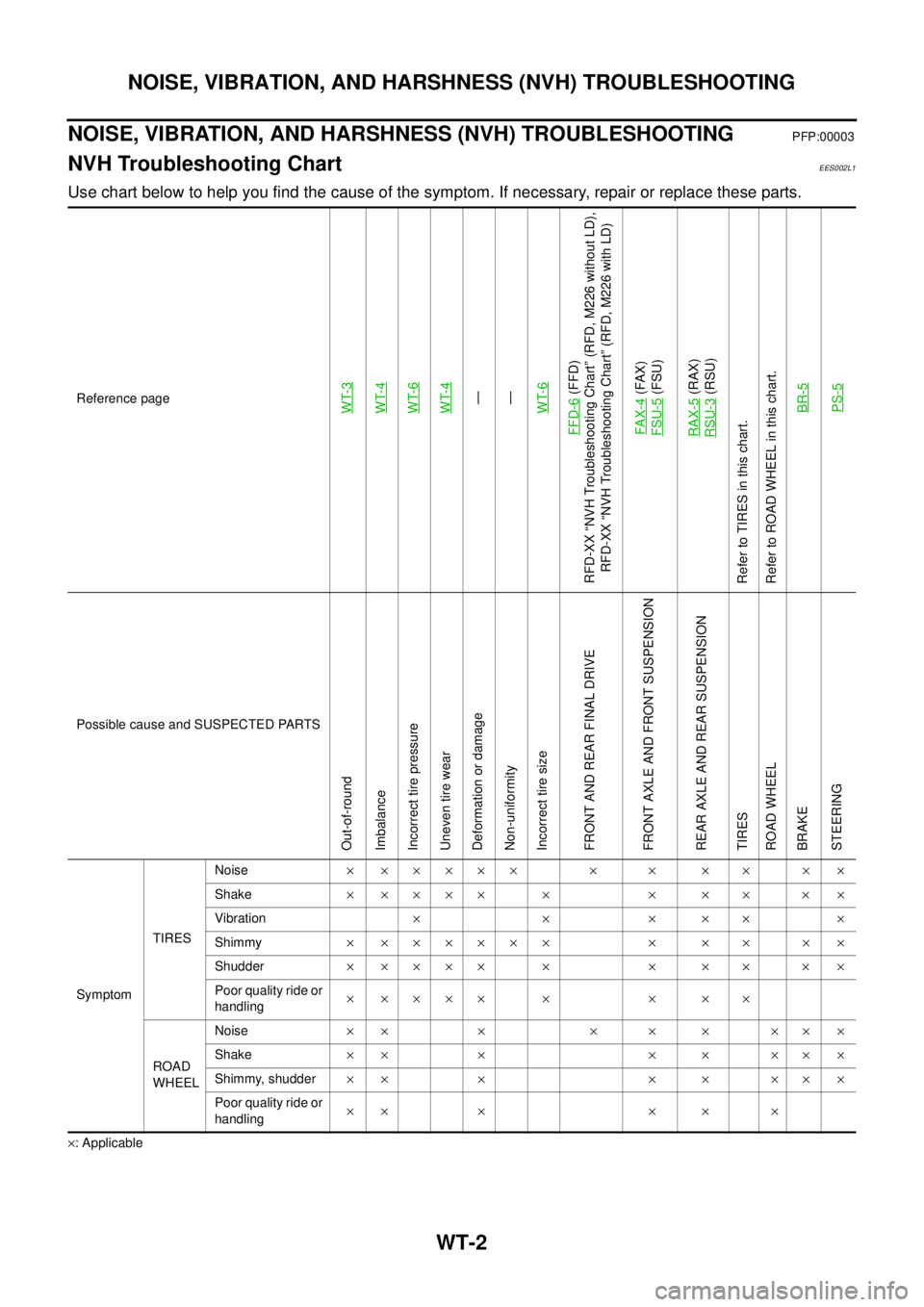
Use chart below to help you find the cause of the symptom. If necessary, repair or replace these parts.
´: ApplicableReference page
WT-3WT-4WT-6WT-4—
—
WT-6
FFD-6
(FFD)
RFD-XX “NVH Troubleshooting Chart” (RFD, M226 without LD),
RFD-XX “NVH Troubleshooting Chart” (RFD, M226 with LD)
FAX-4(FAX)
FSU-5(FSU)
RAX-5(RAX)
RSU-3(RSU)
Refer to TIRES in this chart.
Refer to ROAD WHEEL in this chart.
BR-5
PS-5
Possible cause and SUSPECTED PARTS
Out-of-round
Imbalance
Incorrect tire pressure
Uneven tire wear
Deformation or damage
Non-uniformity
Incorrect tire size
FRONT AND REAR FINAL DRIVE
FRONT AXLE AND FRONT SUSPENSION
REAR AXLE AND REAR SUSPENSION
TIRES
ROAD WHEEL
BRAKE
STEERING
SymptomTIRESNoise´ ´´´´´ ´ ´ ´ ´ ´ ´
Shake´´´´´ ´ ´ ´ ´ ´´
Vibration´´´´´´
Shimmy´ ´´´´´´ ´ ´ ´ ´ ´
Shudder´´´´´ ´ ´ ´ ´ ´´
Poor quality ride or
handling´´´´´ ´ ´ ´ ´
ROAD
WHEELNoise´´ ´ ´ ´ ´ ´´´
Shake´´ ´ ´ ´ ´´´
Shimmy, shudder´´ ´ ´ ´ ´´´
Poor quality ride or
handling´´ ´ ´ ´ ´