2005 NISSAN NAVARA belt
[x] Cancel search: beltPage 891 of 3171
ENGINE COOLANT
CO-7
C
D
E
F
G
H
I
J
K
L
MA
CO
ENGINE COOLANTPFP:KQ100
InspectionEBS01E6P
LEVEL CHECK
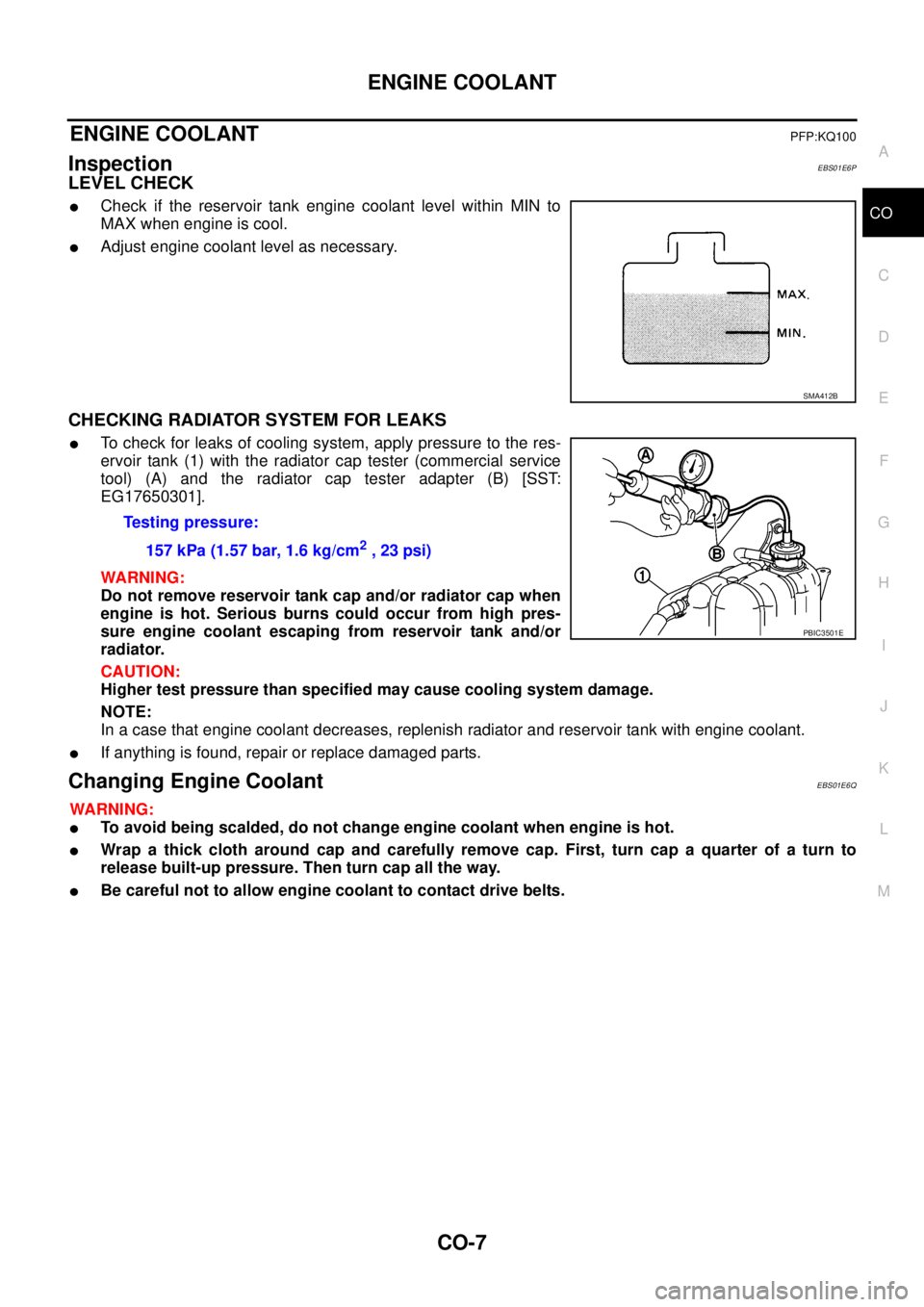
lCheck if the reservoir tank engine coolant level within MIN to
MAX when engine is cool.
lAdjust engine coolant level as necessary.
CHECKING RADIATOR SYSTEM FOR LEAKS
lTo check for leaks of cooling system, apply pressure to the res-
ervoir tank (1) with the radiator cap tester (commercial service
tool) (A) and the radiator cap tester adapter (B) [SST:
EG17650301].
WARNING:
Do not remove reservoir tank cap and/or radiator cap when
engine is hot. Serious burns could occur from high pres-
sure engine coolant escaping from reservoir tank and/or
radiator.
CAUTION:
Higher test pressure than specified may cause cooling system damage.
NOTE:
In a case that engine coolant decreases, replenish radiator and reservoir tank with engine coolant.
lIf anything is found, repair or replace damaged parts.
Changing Engine CoolantEBS01E6Q
WARNING:
lTo avoid being scalded, do not change engine coolant when engine is hot.
lWrap a thick cloth around cap and carefully remove cap. First, turn cap a quarter of a turn to
release built-up pressure. Then turn cap all the way.
lBe careful not to allow engine coolant to contact drive belts.
SMA412B
Testing pressure:
157 kPa (1.57 bar, 1.6 kg/cm
2,23psi)
PBIC3501E
Page 892 of 3171
CO-8
ENGINE COOLANT
DRAINING ENGINE COOLANT
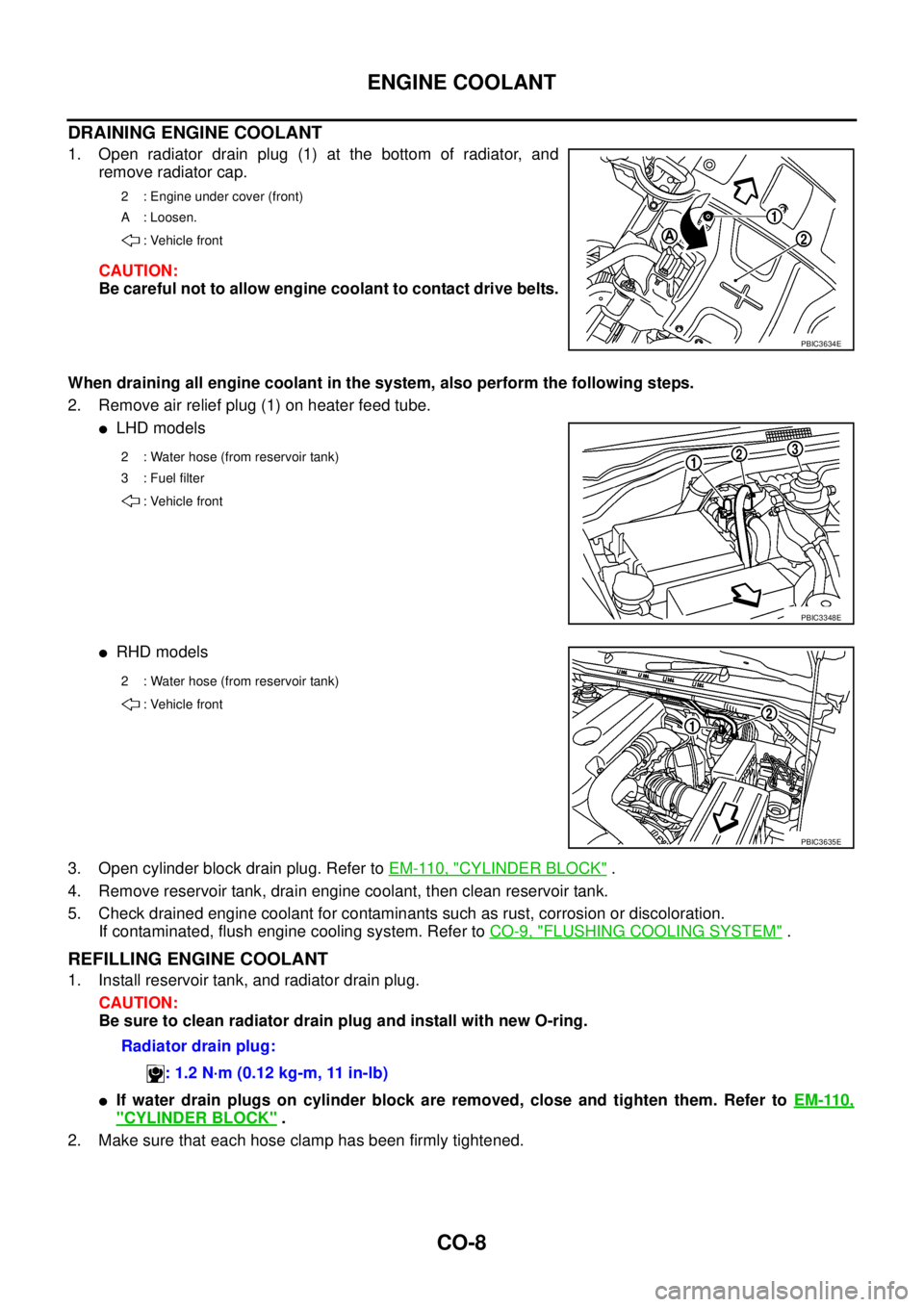
1. Open radiator drain plug (1) at the bottom of radiator, and
remove radiator cap.
CAUTION:
Be careful not to allow engine coolant to contact drive belts.
When draining all engine coolant in the system, also perform the following steps.
2. Remove air relief plug (1) on heater feed tube.
lLHD models
lRHD models
3. Open cylinder block drain plug. Refer toEM-110, "
CYLINDER BLOCK".
4. Remove reservoir tank, drain engine coolant, then clean reservoir tank.
5. Check drained engine coolant for contaminants such as rust, corrosion or discoloration.
If contaminated, flush engine cooling system. Refer toCO-9, "
FLUSHING COOLING SYSTEM".
REFILLING ENGINE COOLANT
1. Install reservoir tank, and radiator drain plug.
CAUTION:
Be sure to clean radiator drain plug and install with new O-ring.
lIf water drain plugs on cylinder block are removed, close and tighten them. Refer toEM-110,
"CYLINDER BLOCK".
2. Make sure that each hose clamp has been firmly tightened.
2 : Engine under cover (front)
A : Loosen.
: Vehicle front
PBIC3634E
2 : Water hose (from reservoir tank)
3 : Fuel filter
: Vehicle front
PBIC3348E
2 : Water hose (from reservoir tank)
: Vehicle front
PBIC3635E
Radiator drain plug:
: 1.2 N·m (0.12 kg-m, 11 in-lb)
Page 895 of 3171
RADIATOR
CO-11
C
D
E
F
G
H
I
J
K
L
MA
CO
RADIATORPFP:21400
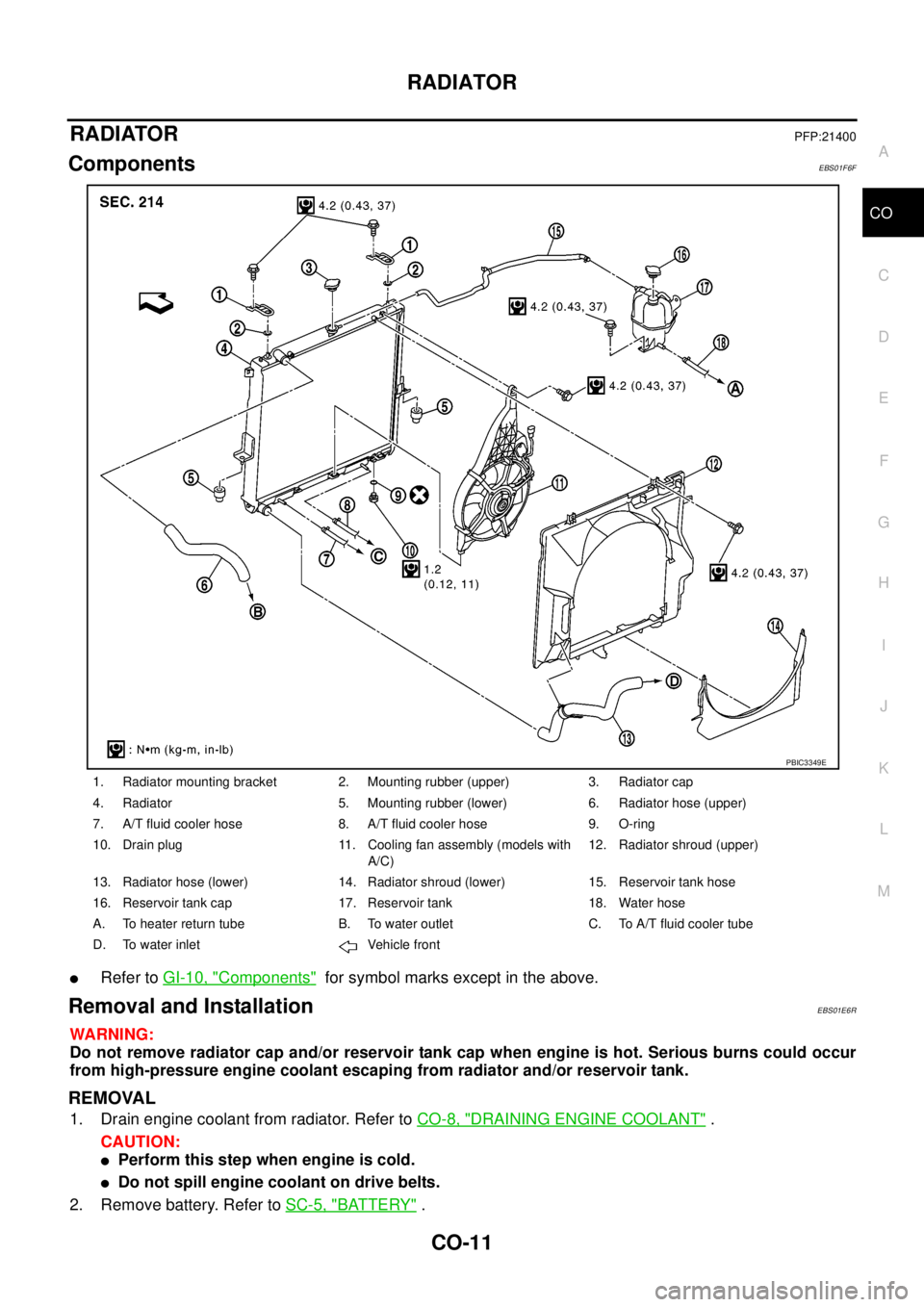
ComponentsEBS01F6F
lRefer toGI-10, "Components"for symbol marks except in the above.
Removal and InstallationEBS01E6R
WARNING:
Do not remove radiator cap and/or reservoir tank cap when engine is hot. Serious burns could occur
from high-pressure engine coolant escaping from radiator and/or reservoir tank.
REMOVAL
1. Drain engine coolant from radiator. Refer toCO-8, "DRAINING ENGINE COOLANT".
CAUTION:
lPerform this step when engine is cold.
lDo not spill engine coolant on drive belts.
2. Remove battery. Refer toSC-5, "
BATTERY".
1. Radiator mounting bracket 2. Mounting rubber (upper) 3. Radiator cap
4. Radiator 5. Mounting rubber (lower) 6. Radiator hose (upper)
7. A/T fluid cooler hose 8. A/T fluid cooler hose 9. O-ring
10. Drain plug 11. Cooling fan assembly (models with
A/C)12. Radiator shroud (upper)
13. Radiator hose (lower) 14. Radiator shroud (lower) 15. Reservoir tank hose
16. Reservoir tank cap 17. Reservoir tank 18. Water hose
A. To heater return tube B. To water outlet C. To A/T fluid cooler tube
D. To water inlet Vehicle front
PBIC3349E
Page 896 of 3171
CO-12
RADIATOR
3. Remove engine cover. Refer toEM-20, "INTAKE MANIFOLD".
4. Remove air inlet hoses between engine to charge air cooler. Refer toEM-18, "
CHARGE AIR COOLER".
5. Disconnect radiator hose (upper and lower) and reservoir tank hose.
CAUTION:
Be careful not to allow engine coolant to contact drive belts.
6. Remove reservoir tank.
7. Remove cooling fans (crankshaft driven type and motor driven type) and radiator shrouds (upper and
lower). Refer toCO-19, "
COOLING FAN".
8. Disconnect A/T fluid cooler hoses. (A/T models)
lInstall blind plug to avoid leakage of A/T fluid.
9. Remove radiator mounting brackets.
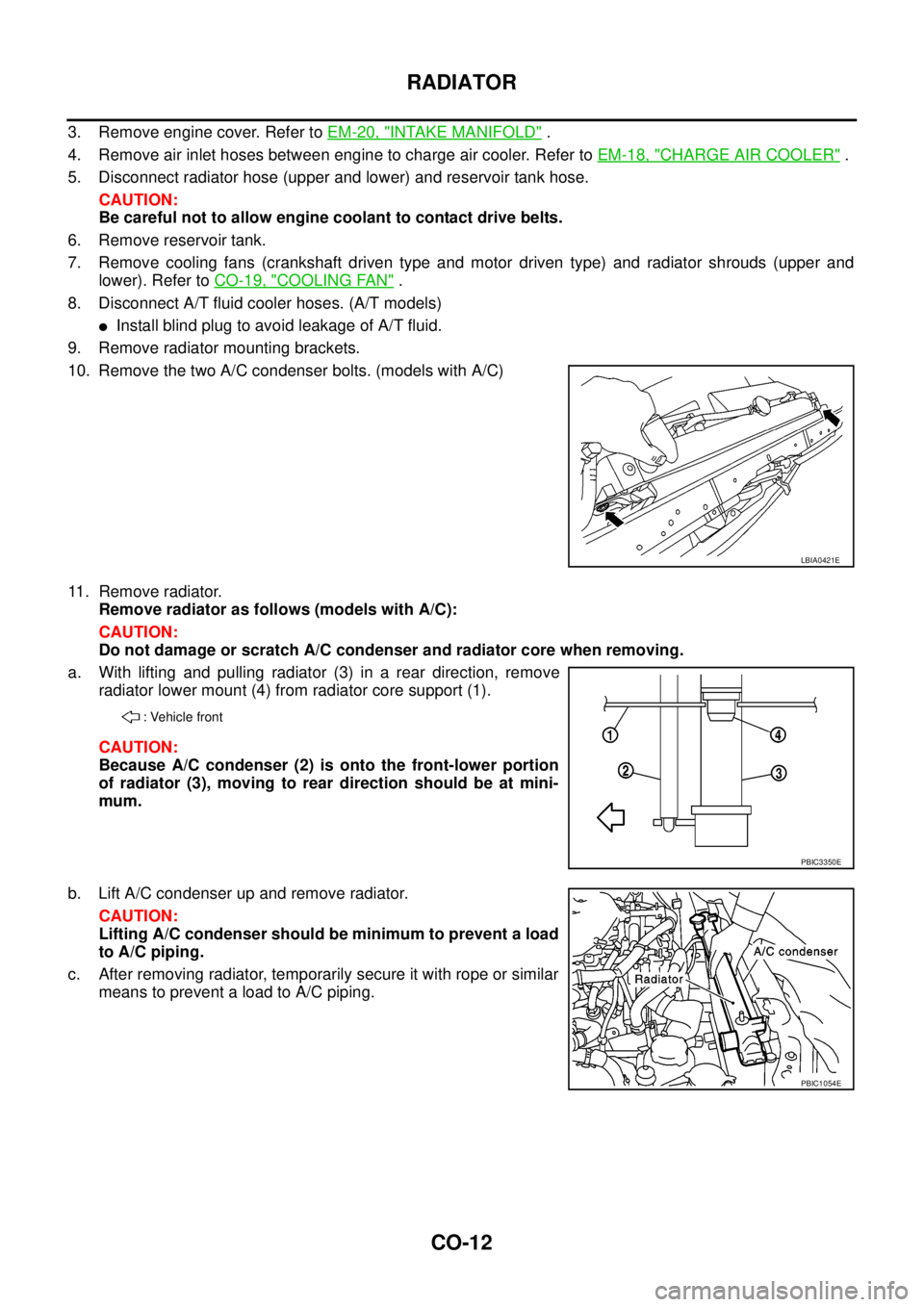
10. Remove the two A/C condenser bolts. (models with A/C)
11. Remove radiator.
Remove radiator as follows (models with A/C):
CAUTION:
Do not damage or scratch A/C condenser and radiator core when removing.
a. With lifting and pulling radiator (3) in a rear direction, remove
radiator lower mount (4) from radiator core support (1).
CAUTION:
Because A/C condenser (2) is onto the front-lower portion
of radiator (3), moving to rear direction should be at mini-
mum.
b. Lift A/C condenser up and remove radiator.
CAUTION:
Lifting A/C condenser should be minimum to prevent a load
to A/C piping.
c. After removing radiator, temporarily secure it with rope or similar
means to prevent a load to A/C piping.
LBIA0421E
: Vehicle front
PBIC3350E
PBIC1054E
Page 903 of 3171
COOLING FAN
CO-19
C
D
E
F
G
H
I
J
K
L
MA
CO
COOLING FANPFP:21140
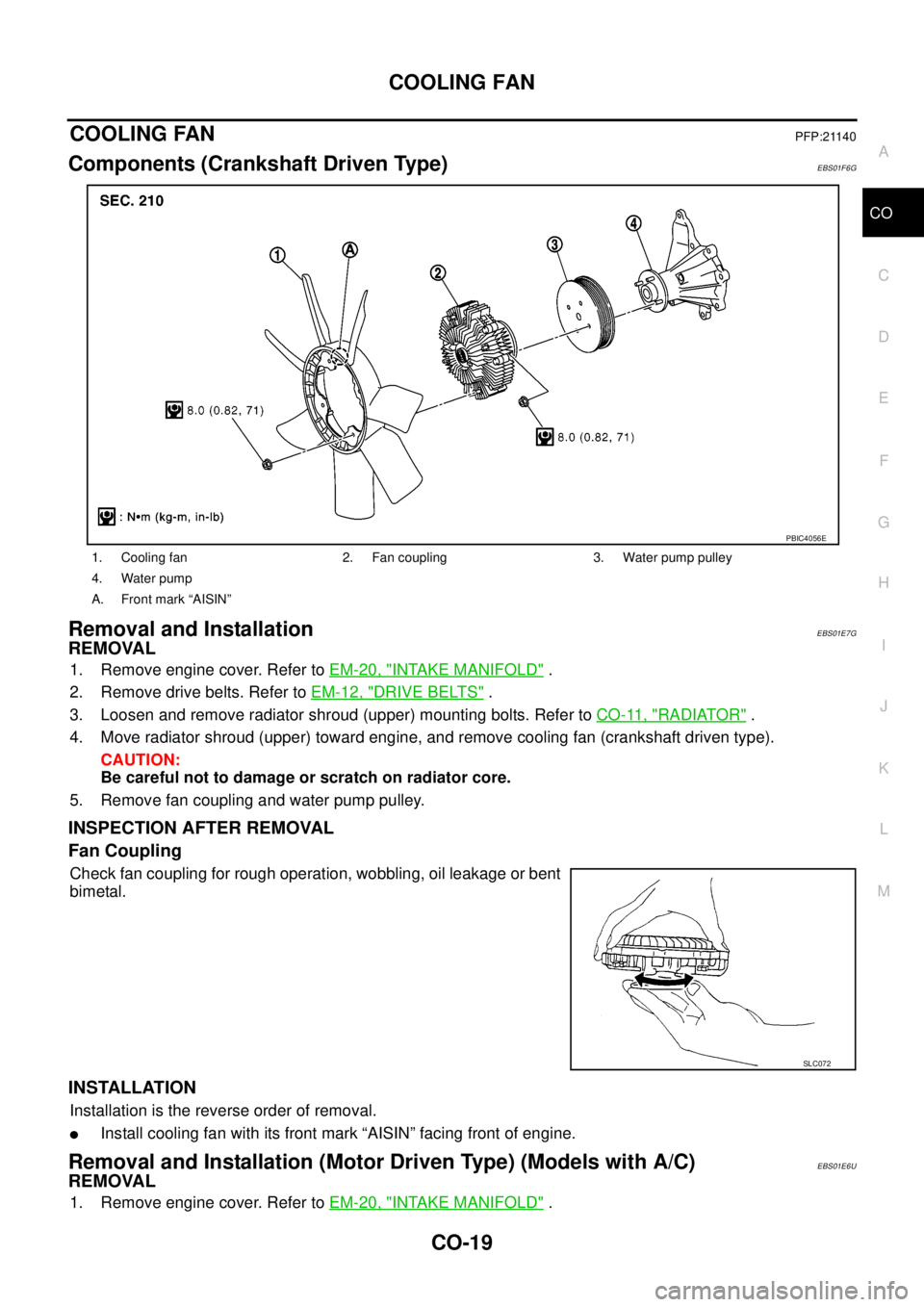
Components (Crankshaft Driven Type)EBS01F6G
Removal and InstallationEBS01E7G
REMOVAL
1. Remove engine cover. Refer toEM-20, "INTAKE MANIFOLD".
2. Remove drive belts. Refer toEM-12, "
DRIVE BELTS".
3. Loosen and remove radiator shroud (upper) mounting bolts. Refer toCO-11, "
RADIATOR".
4. Move radiator shroud (upper) toward engine, and remove cooling fan (crankshaft driven type).
CAUTION:
Be careful not to damage or scratch on radiator core.
5. Remove fan coupling and water pump pulley.
INSPECTION AFTER REMOVAL
Fan Coupling
Check fan coupling for rough operation, wobbling, oil leakage or bent
bimetal.
INSTALLATION
Installation is the reverse order of removal.
lInstall cooling fan with its front mark “AISIN” facing front of engine.
Removal and Installation (Motor Driven Type) (Models with A/C)EBS01E6U
REMOVAL
1. Remove engine cover. Refer toEM-20, "INTAKE MANIFOLD".
1. Cooling fan 2. Fan coupling 3. Water pump pulley
4. Water pump
A. Front mark “AISIN”
PBIC4056E
SLC072
Page 905 of 3171
WATER PUMP
CO-21
C
D
E
F
G
H
I
J
K
L
MA
CO
WAT E R P U MPPFP:21020
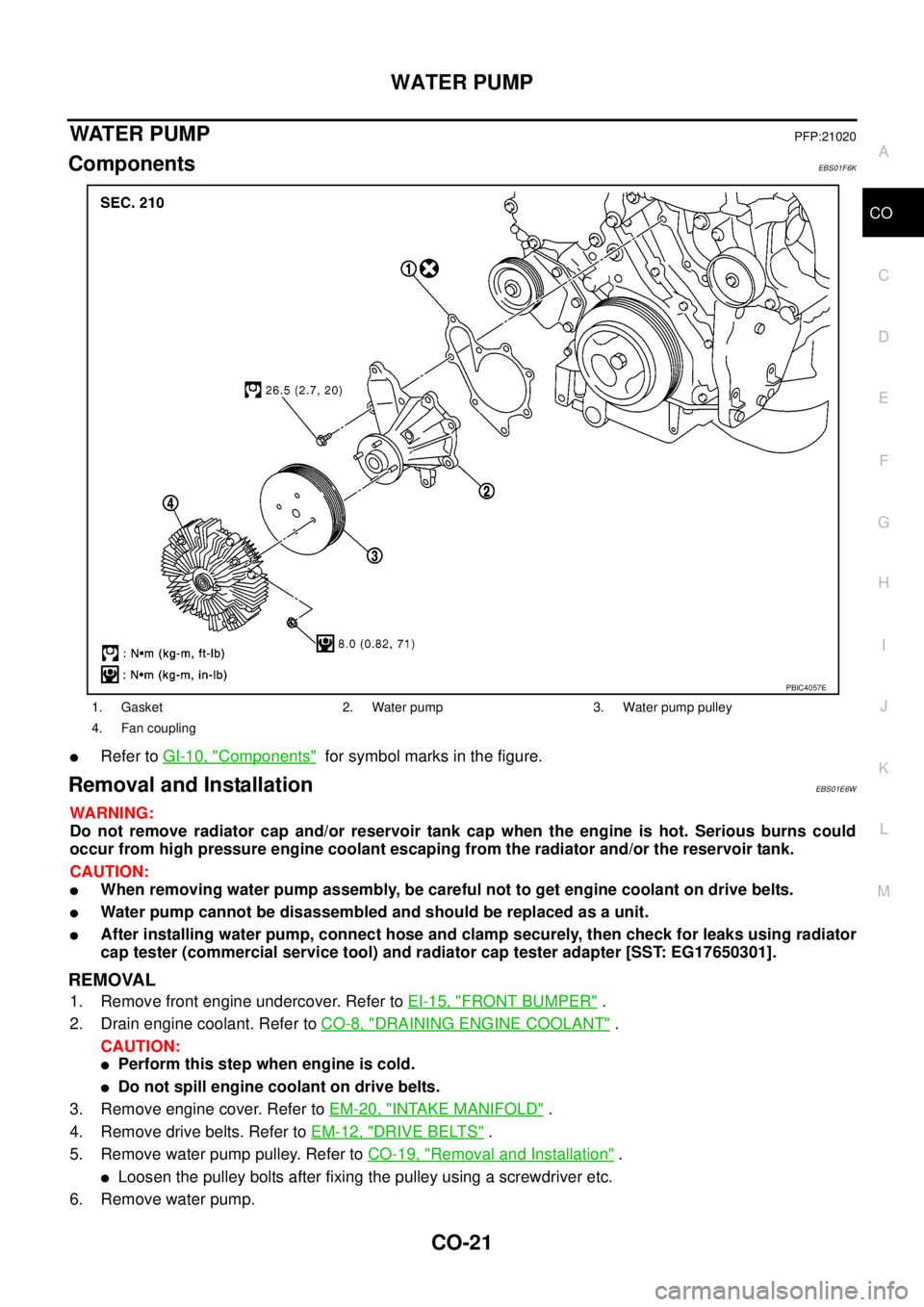
ComponentsEBS01F6K
lRefer toGI-10, "Components"for symbol marks in the figure.
Removal and InstallationEBS01E6W
WARNING:
Do not remove radiator cap and/or reservoir tank cap when the engine is hot. Serious burns could
occur from high pressure engine coolant escaping from the radiator and/or the reservoir tank.
CAUTION:
lWhen removing water pump assembly, be careful not to get engine coolant on drive belts.
lWater pump cannot be disassembled and should be replaced as a unit.
lAfter installing water pump, connect hose and clamp securely, then check for leaks using radiator
cap tester (commercial service tool) and radiator cap tester adapter [SST: EG17650301].
REMOVAL
1. Remove front engine undercover. Refer toEI-15, "FRONT BUMPER".
2. Drain engine coolant. Refer toCO-8, "
DRAINING ENGINE COOLANT".
CAUTION:
lPerform this step when engine is cold.
lDo not spill engine coolant on drive belts.
3. Remove engine cover. Refer toEM-20, "
INTAKE MANIFOLD".
4. Remove drive belts. Refer toEM-12, "
DRIVE BELTS".
5. Remove water pump pulley. Refer toCO-19, "
Removal and Installation".
lLoosen the pulley bolts after fixing the pulley using a screwdriver etc.
6. Remove water pump.
1. Gasket 2. Water pump 3. Water pump pulley
4. Fan coupling
PBIC4057E
Page 911 of 3171

DI-1
DRIVER INFORMATION SYSTEM
K ELECTRICAL
CONTENTS
C
D
E
F
G
H
I
J
L
M
SECTIONDI
A
B
DI
DRIVER INFORMATION SYSTEM
PRECAUTION ............................................................ 3
Precautions for Supplemental Restraint System
(SRS)“AIRBAG”and“SEATBELTPRE-TEN-
SIONER” .................................................................. 3
Wiring Diagrams and Trouble Diagnosis .................. 3
COMBINATION METERS ........................................... 4
System Description .................................................. 4
UNIFIED METER CONTROL UNIT ...................... 4
POWER SUPPLY AND GROUND CIRCUIT ........ 4
SPEEDOMETER ................................................... 4
TACHOMETER ..................................................... 4
WATER TEMPERATURE GAUGE ........................ 4
FUEL GAUGE ....................................................... 5
ODO/TRIP METER ............................................... 5
TRIP COMPUTER ................................................ 5
ENGINE OIL MAINTENANCE INFORMATION..... 6
METER ILLUMINATION CONTROL ..................... 6
CLOCK .................................................................. 6
AMBIENT AIR TEMPERATURE INDICATION ...... 6
Component Parts and Harness Connector Location..... 7
Arrangement of Combination Meter ......................... 8
Internal Circuit .......................................................... 9
Wiring Diagram — METER — ................................ 10
Terminals and Reference Value for Combination
Meter ...................................................................... 12
Self-Diagnosis Mode of Combination Meter ........... 13
FUNCTION .......................................................... 13
OPERATION PROCEDURE ............................... 13
TEST ITEM ......................................................... 13
CONSULT-II Function (METER) ............................. 15
CONSULT-II BASIC OPERATION ....................... 15
SELF-DIAG RESULTS ........................................ 16
DATA MONITOR ................................................. 17
Trouble Diagnosis .................................................. 18
HOW TO PERFORM TROUBLE DIAGNOSIS ... 18
PRELIMINARY CHECK ...................................... 19
Symptom Chart ...................................................... 19
Power Supply and Ground Circuit Inspection ........ 19
Vehicle Speed Signal Inspection ............................ 20
Engine Speed Signal Inspection ............................ 21Engine Coolant Temperature Signal Inspection ..... 21
Fuel Level Sensor Signal Inspection ...................... 22
Ambient Sensor Signal Inspection .......................... 24
Fuel Gauge Fluctuates, Indicates Wrong Value, or
Varies ...................................................................... 25
Fuel Gauge Does Not Move to Full position ........... 25
DTC [U1000] CAN Communication Circuit ............. 26
DTC [B2205] Vehicle Speed Circuit ........................ 26
Electrical Components Inspection .......................... 27
FUEL LEVEL SENSOR UNIT CHECK ................ 27
AMBIENT SENSOR CHECK ............................... 27
Removal and Installation of Combination Meter ..... 27
WARNING LAMPS .................................................... 28
System Description ................................................. 28
OIL PRESSURE WARNING LAMP ..................... 28
Component Parts and Harness Connector Location... 28
Schematic ............................................................... 29
Wiring Diagram — WARN — .................................. 30
A/T MODELS ....................................................... 30
M/T MODELS ...................................................... 37
Oil Pressure Warning Lamp Stays Off (Ignition
Switch ON) ............................................................. 44
Oil Pressure Warning Lamp Does Not Turn Off (Oil
Pressure Is Normal) ................................................ 45
Oil Pressure Warning Lamp Keeps Blinking (Oil
Level Is Normal) ..................................................... 46
Component Inspection ............................................ 47
OIL PRESSURE SWITCH ................................... 47
OIL LEVEL SENSOR .......................................... 47
A/T INDICATOR ........................................................ 48
System Description ................................................. 48
Wiring Diagram — AT/IND — ................................. 49
A/T Indicator Does Not Illuminate ........................... 50
WARNING CHIME ..................................................... 51
System Description ................................................. 51
POWER SUPPLY AND GROUND CIRCUIT ....... 51
LIGHT WARNING CHIME ................................... 51
KEY REMINDER WARNING CHIME .................. 51
LOW-FUEL WARNING CHIME ........................... 51
SEAT BELT WARNING CHIME ........................... 52
Page 912 of 3171

DI-2
Component Parts and Harness Connector Location... 52
Wiring Diagram — CHIME — ................................. 53
LHD MODELS ..................................................... 53
RHD MODELS ..................................................... 55
Terminals and Reference Value for BCM ................ 57
Terminals and Reference Value for Combination
Meter ...................................................................... 57
CONSULT-II Function (BCM) .................................. 58
DIAGNOSTIC ITEMS DESCRIPTION ................. 58
CONSULT-II BASIC OPERATION PROCEDURE
... 58
DATA MONITOR .................................................. 59
ACTIVE TEST ..................................................... 59
SELF-DIAG RESULTS ........................................ 60
Trouble Diagnosis ................................................... 60
HOW TO PERFORM TROUBLE DIAGNOSIS .... 60
PRELIMINARY INSPECTION ............................. 60
SYMPTOM CHART ............................................. 61
Meter Buzzer Circuit Inspection .............................. 61Lighting Switch Signal Inspection ........................... 62
Front Door Switch (Driver Side) Signal Inspection... 62
Seat Belt Buckle Switch Signal Inspection (Driver
Side) ........................................................................ 63
Electrical Component Inspection ............................ 64
FRONT DOOR SWITCH (DRIVER SIDE) ........... 64
SEAT BELT BUCKLE SWITCH (DRIVER SIDE)... 64
CAN COMMUNICATION ........................................... 65
System Description ................................................. 65
CAN Communication Unit ....................................... 65
COMPASS ................................................................. 66
System Description ................................................. 66
DIRECTION DISPLAY ......................................... 66
Zone Variation Change Procedure .......................... 66
Correction Functions of the Compass Display ........ 67
AUTOMATIC CORRECTION ............................... 67
MANUAL CORRECTION PROCEDURE ............. 67
Wiring Diagram — COMPAS — .............................. 68
Removal and Installation of Compass ..................... 69