2005 MITSUBISHI LANCER specification
[x] Cancel search: specificationPage 360 of 788

WINDSHIELD WIPER AND WASHER
EXTERIOR51-22
SERVICE SPECIFICATIONM1511000300325
TROUBLESHOOTINGM1511000700323
The windshield wiper and washer are controlled by
the Smart Wiring System (SWS). For
troubleshooting, refer to GROUP 54B,
Troubleshooting P.54B-17 or GROUP 54C,
Troubleshooting P.54C-4.
NOTE: Even when the ETACS-ECU has failed, the
windshield wiper can work at low speed as fail-safe
mode. (Normally, the windshield wiper operates
when the ignition switch is at the "ACC" position. But,
if it enters the fail-safe mode, the wiper can operate
only when the ignition switch is at the "ON" position.)
ON-VEHICLE SERVICEM1511000800461
WINDSHIELD INTERMITTENT WIPER
INSPECTION
1. If the windshield intermittent wiper interval
adjusting knob is operated, the wiper interval
should change.
2. Holding the windshield intermittent wiper interval
adjusting knob, input the simulated vehicle speed
with MUT-II MB991502 and check that the wiper
interval changes as the vehicle speed changes.
3. If not, carry out the troubleshooting (Refer to
GROUP 54B, Troubleshooting P.54B-17 or
GROUP 54C, Troubleshooting P.54C-4). ItemStandard value
Windshield wiper blade park position mm 34 ± 5
Page 366 of 788

REAR WIPER AND WASHER
EXTERIOR51-28
REAR WIPER AND WASHER
GENERAL INFORMATIONM1511000100525
REAR WIPER AND WASHER OPERATION
Rear Wiper Operation
•If the rear wiper and washer switch is turned to
"INT" position with the ignition switch at "ACC" or
"ON" position, the ETACS-ECU turns ON the rear
wiper drive signal for three seconds
(approximately two cycles), then 7.4 seconds
later the intermittent motion operates every eight
seconds. If the selector lever is moved to the "R"
position when the rear wiper and washer switch is
turned to the "INT" position and the ignition
switch is at the "ACC" or "ON" position, the inhibitor switch "R" turns ON. One second later,
the ETACS-ECU turns ON the rear wiper drive
signal for three seconds (approximately two
cycles). Then, 7.4 seconds later, the intermittent
motion of eight seconds' cycle is restored.
Rear Washer Operation
•If the rear wiper and washer switch is turned to
the ON (washer) position with the ignition switch
at the "ACC" or "ON" position, the rear washer
ON signal is sent to the ETACS-ECU, causing the
rear wiper signal to turn on after 0.3 second. After
the rear washer switch signal turns off, the rear
wiper signal turns off in three seconds. If the rear
washer switch is turned to the ON position while
the rear wiper is in intermittent mode, the rear
washer works for that period when the washer
switch remains on. Then the rear wipers return to
the intermittent mode.
SERVICE SPECIFICATIONM1511000300336
TROUBLESHOOTINGM1511000700334
The rear wiper and washer are controlled by the
Smart Wiring System (SWS). For troubleshooting,
refer to GROUP 54B, Troubleshooting P.54B-17 or
GROUP 54C, Troubleshooting P.54C-4.
ON-VEHICLE SERVICEM1511000800472
CHECK OF REAR WIPER OPERATION
WHEN SELECTOR LEVER IS AT THE "R"
POSITION
1. When the selector lever is moved to the "R"
position with the rear wiper switch at the "INT"
position, the wiper should operate twice or three
times at low speed after approximately one
second.
2. If not, carry out the troubleshooting (Refer to
GROUP 54B, Troubleshooting P.54B-17 or
GROUP 54C, Troubleshooting P.54C-4). ItemStandard value
Rear wiper blade park position mm 42 ± 5
Page 374 of 788

DOOR MIRROR
EXTERIOR51-36
DOOR MIRROR
GENERAL INFORMATIONM1511000100536
DOOR MIRROR OPERATION
Remote Controlled Mirror Operation
•The mirror on the door mirror moves up/down
and left/right by operating the remote controlled
door mirror switch when the ignition switch is in
the "ON" or "ACC" position.Heated Door Mirror operation
•The defogger relay switch is activated (ON) by
turning on the A/C-ECU built-in defogger switch
when the ignition switch is in the "ON" position.
When the defogger relay is turned ON, power is
supplied to the defogger and door mirror, and the
heater of the door mirror (heated door mirror)
starts operations. The defogger comes with a
timer function and will automatically turn OFF the
switch approximately 11 minutes after the
defogger switch is turned ON. The heated door
mirror operations are also terminated along with
the defogger, at this time.
SERVICE SPECIFICATIONM1511000300347
SPECIAL TOOLM1511000601103
TROUBLESHOOTING
DIAGNOSIS TROUBLESHOOTING FLOWM1511014600169
Refer to GROUP 00 − How to Use
Troubleshooting/Inspection Service Points P.00-5.
TROUBLE SYMPTOM CHARTM1511015000160
ItemStandard value
Heated door mirror operation current Ω5.9 − 7.8
Tool Number Name Application
MB990784 Ornament remover Removal of remote controlled
mirror switch
MB990784
Symptom Inspection
procedureReference
page
All heated door mirrors do not operate 1
P.51-37
The right or left heated door mirror does not operate 2
P.51-39
Page 389 of 788
54A-1
GROUP 54A
CHASSIS
ELECTRICAL
CONTENTS
BATTERY. . . . . . . . . . . . . . . . . .
54A-4
SERVICE SPECIFICATIONS. . . . .
54A-4
ON-VEHICLE SERVICE. . . . . . . . .54A-4
FLUID LEVEL AND SPECIFIC
GRAVITY CHECK . . . . . . . . . . . . . . . . . 54A-4
CHARGING . . . . . . . . . . . . . . . . . . . . . . 54A-4
BATTERY TEST . . . . . . . . . . . . . . . . . . 54A-5
IGNITION SWITCH* . . . . . . . . . .54A-6
GENERAL INFORMATION . . . . . .
54A-6
SPECIAL TOOLS. . . . . . . . . . . . . .54A-8
TROUBLESHOOTING . . . . . . . . . .54A-9
IGNITION KEY REMINDER BUZZER AND
DOOR LOCK PREVENTION FUNCTION
TROUBLESHOOTING . . . . . . . . . . . . . . 54A-9
IMMOBILIZER SYSTEM
TROUBLESHOOTING . . . . . . . . . .
54A-9
DIAGNOSIS CODE CHART . . . . . . . . . . 54A-9
DIAGNOSTIC TROUBLE CODE
PROCEDURES . . . . . . . . . . . . . . . .
54A-10
SYMPTOM CHART. . . . . . . . . . . . .54A-11
SYMPTOM PROCEDURES . . . . . .54A-12
DATA LIST REFERENCE TABLE .54A-19
CHECK IMMOBILIZER-ECU . . . . .54A-19
ON-VEHICLE SERVICE . . . . . . . . .54A-20
HOW TO REGISTER ENCRYPTED
CODE . . . . . . . . . . . . . . . . . . . . . . . . . . . 54A-20
IGNITION SWITCH . . . . . . . . . . . . . . . . 54A-27
REMOVAL AND INSTALLATION . . . . . . 54A-27
INSPECTION . . . . . . . . . . . . . . . . . . . . . 54A-28
Continued on next page
WARNINGS REGARDING SERVICING OF SUPPLEMENTAL RESTRAINT SYSTEM (SRS) EQUIPPED VEHICLES
WARNING
•Improper service or maintenance of any component of the SRS, or any SRS-related component, can lead to
personal injury or death to service personnel (from inadvertent firing of the air bag) or to the driver and
paassenger (from rendering the SRS inoperative).
•Service or maintenance of any SRS component or SRS-related component must be performed only at an
authorized MITSUBISHI dealer.
•MITSUBISHI dealer personnel must thoroughly review this manual, and especially its GROUP 52B - Supplemental
Restraint System (SRS) before beginning any service or maintenance of any component of the SRS or any
SRS-related component.
NOTE
The SRS includes the following components: SRS air bag control unit, SRS warning light, front impact sensors, air bag module,
clock spring, and interconnecting wiring. Other SRS-related components (that may have to be removed/installed in connection
with SRS service or maintenance) are indicated in the table of contents by an asterisk (*).
Page 390 of 788

54A-2
COMBINATION METER
ASSEMBLY . . . . . . . . . . . . . . . .
54A-29
SERVICE SPECIFICATIONS. . . . .
54A-29
SEALANT. . . . . . . . . . . . . . . . . . . .54A-29
SPECIAL TOOLS. . . . . . . . . . . . . .54A-29
TROUBLESHOOTING . . . . . . . . . .54A-31
SYMPTOM CHART . . . . . . . . . . . . . . . . 54A-31
SYMPTOM PROCEDURES . . . . . .54A-32
ON-VEHICLE SERVICE. . . . . . . . .54A-60
SPEEDOMETER CHECK . . . . . . . . . . . 54A-60
TACHOMETER CHECK . . . . . . . . . . . . 54A-60
FUEL TANK GAUGE UNIT CHECK . . . 54A-61
ENGINE COOLANT TEMPERATURE GAUGE
UNIT CHECK . . . . . . . . . . . . . . . . . . . . . 54A-61
COMBINATION METER ASSEMBLY54A-63
REMOVAL AND INSTALLATION . . . . . 54A-63
INSPECTION . . . . . . . . . . . . . . . . . . . . . 54A-64
DISASSEMBLY AND REASSEMBLY . . 54A-65
HEADLAMP . . . . . . . . . . . . . . . .54A-66
SERVICE SPECIFICATIONS. . . . .
54A-66
TROUBLESHOOTING . . . . . . . . . .54A-66
ON-VEHICLE SERVICE. . . . . . . . .54A-66
HEADLAMP AIMING . . . . . . . . . . . . . . . 54A-66
LUMINOUS INTENSITY
MEASUREMENT . . . . . . . . . . . . . . . . . . 54A-67
BULB REPLACEMENT . . . . . . . . . . . . . 54A-68
HEADLAMP . . . . . . . . . . . . . . . . . .54A-69
REMOVAL AND INSTALLATION . . . . . 54A-69
HEADLAMP LEVELING SWITCH .54A-70
REMOVAL AND INSTALLATION . . . . . 54A-70
INSPECTION . . . . . . . . . . . . . . . . . . . . . 54A-70
FOG LAMP . . . . . . . . . . . . . . . . 54A-71
SERVICE SPECIFICATION . . . . . .
54A-71
SPECIAL TOOL . . . . . . . . . . . . . . .54A-71
TROUBLESHOOTING . . . . . . . . . .54A-71
ON-VEHICLE SERVICE . . . . . . . . .54A-71
FRONT FOG LAMP AIMING CHECK . . 54A-71
FOG LAMP . . . . . . . . . . . . . . . . . . .54A-73
REMOVAL AND INSTALLATION . . . . . . 54A-73
FOG LAMP SWITCH . . . . . . . . . . .54A-74
REMOVAL AND INSTALLATION . . . . . . 54A-74
INSPECTION . . . . . . . . . . . . . . . . . . . . . 54A-74
REAR FOG LAMP . . . . . . . . . . 54A-75
TROUBLESHOOTING . . . . . . . . . .
54A-75
SPECIAL TOOL . . . . . . . . . . . . . . .54A-75
REAR FOG LAMP . . . . . . . . . . . . .54A-76
REMOVAL AND INSTALLATION . . . . . . 54A-76
REAR FOG LAMP SWITCH . . . . . .54A-76
REMOVAL AND INSTALATION . . . . . . . 54A-76
INSPECTION . . . . . . . . . . . . . . . . . . . . . 54A-76
SIDE TURN-SIGNAL LAMP. . . 54A-77
SPECIAL TOOL . . . . . . . . . . . . . . .
54A-77
SIDE TURN-SIGNAL LAMP . . . . . .54A-77
REMOVAL AND INSTALLATION . . . . . . 54A-77
ROOM LAMP . . . . . . . . . . . . . . 54A-78
TROUBLESHOOTING . . . . . . . . . . . . . . 54A-78
Continued on next page
Page 392 of 788
BATTERY
CHASSIS ELECTRICAL54A-4
BATTERY
SERVICE SPECIFICATIONSM1541000300209
ON-VEHICLE SERVICE
FLUID LEVEL AND SPECIFIC GRAVITY
CHECK
M1541001000438
CAUTION
•If the battery fluid is below the LOWER
LEVEL, the battery could explode in using.
•If the battery fluid is over the UPPER LEVEL,
leakage could result.
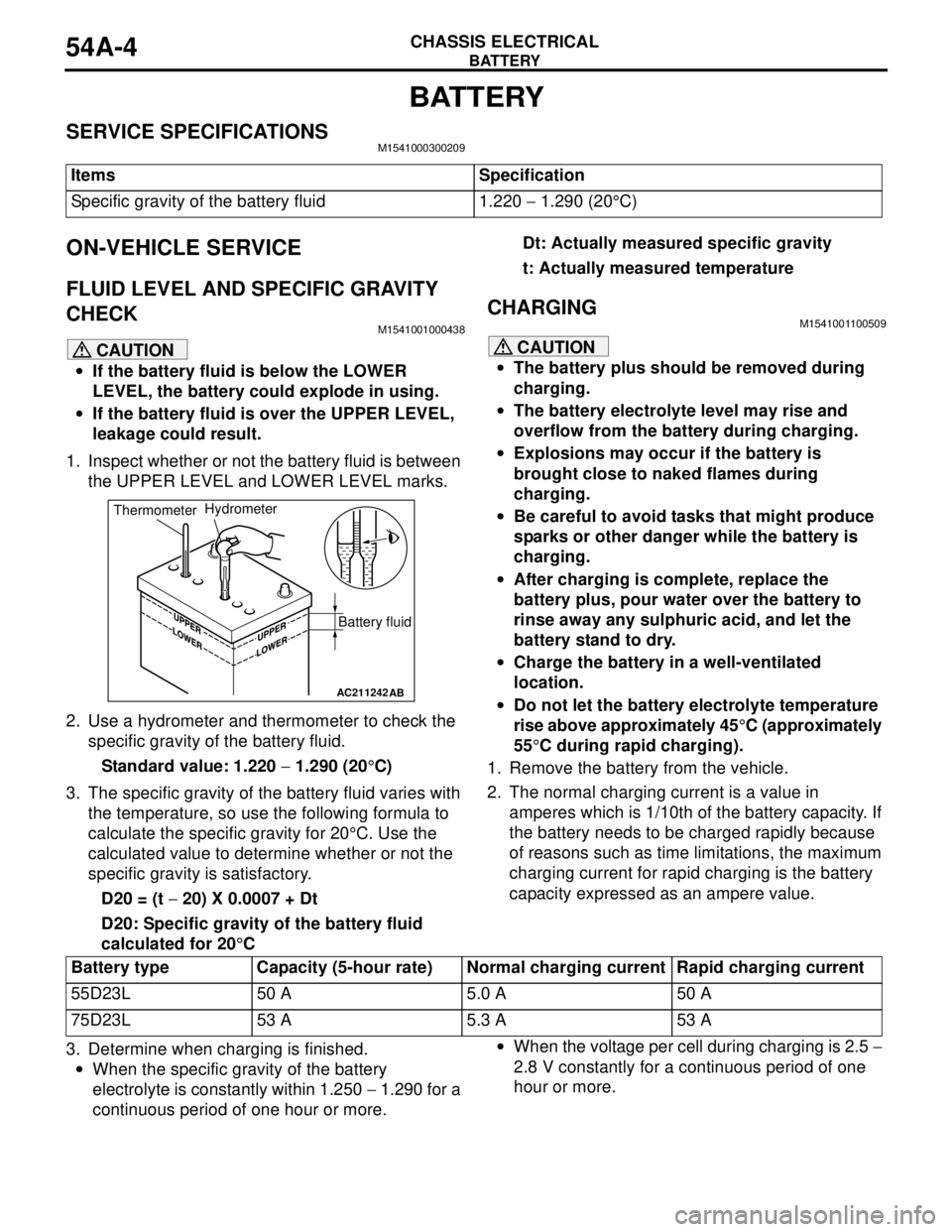
1. Inspect whether or not the battery fluid is between
the UPPER LEVEL and LOWER LEVEL marks.
2. Use a hydrometer and thermometer to check the
specific gravity of the battery fluid.
Standard value: 1.220 − 1.290 (20°C)
3. The specific gravity of the battery fluid varies with
the temperature, so use the following formula to
calculate the specific gravity for 20°C. Use the
calculated value to determine whether or not the
specific gravity is satisfactory.
D20 = (t − 20) X 0.0007 + Dt
D20: Specific gravity of the battery fluid
calculated for 20°CDt: Actually measured specific gravity
t: Actually measured temperature
CHARGINGM1541001100509
CAUTION
•The battery plus should be removed during
charging.
•The battery electrolyte level may rise and
overflow from the battery during charging.
•Explosions may occur if the battery is
brought close to naked flames during
charging.
•Be careful to avoid tasks that might produce
sparks or other danger while the battery is
charging.
•After charging is complete, replace the
battery plus, pour water over the battery to
rinse away any sulphuric acid, and let the
battery stand to dry.
•Charge the battery in a well-ventilated
location.
•Do not let the battery electrolyte temperature
rise above approximately 45°C (approximately
55°C during rapid charging).
1. Remove the battery from the vehicle.
2. The normal charging current is a value in
amperes which is 1/10th of the battery capacity. If
the battery needs to be charged rapidly because
of reasons such as time limitations, the maximum
charging current for rapid charging is the battery
capacity expressed as an ampere value.
3. Determine when charging is finished.
•When the specific gravity of the battery
electrolyte is constantly within 1.250 − 1.290 for a
continuous period of one hour or more.•When the voltage per cell during charging is 2.5 −
2.8 V constantly for a continuous period of one
hour or more. Items Specification
Specific gravity of the battery fluid 1.220 − 1.290 (20°C)
AC211242AB
Battery fluid ThermometerHydrometer
Battery type Capacity (5-hour rate) Normal charging current Rapid charging current
55D23L 50 A 5.0 A 50 A
75D23L 53 A 5.3 A 53 A
Page 417 of 788

COMBINATION METER ASSEMBLY
CHASSIS ELECTRICAL54A-29
COMBINATION METER ASSEMBLY
SERVICE SPECIFICATIONSM1543000300324
SEALANTM1543024600028
SPECIAL TOOLSM1543000601652
ItemStandard value
Speedometer indication error km/h (mph) 20 (12) 20 − 24 (12 − 15)
40 (25) 40 − 44 (25 − 28)
80 (50) 80 − 85 (50 − 53)
120 (75) 121 − 127 (75 − 79)
160 (100) 162 − 169 (100 − 105)
200 (125) 203 − 211 (126 − 131)
Tachometer indication error r/min 700
± 120
2,000
− 175 + 225
3,000
− 175 + 300
4,000
− 225 + 375
5,000
− 225 + 425
6,000
− 225 + 475
7,000
− 200 + 500
8,000
− 100 + 500
Fuel tank gauge unit resistance ΩFloat position F (highest) 3 ± 1
Float position E (lowest) 110 ± 1
Fuel gauge unit float height mm Float position F (A) 24.1 ± 2.0
Float position E (B) 151.6 ± 2.0
Engine coolant temperature gauge unit resistance Ω104 + 13.5 (at 70°C)
Item Specified sealant
Engine coolant temperature gauge unit 3M 1215 or equivalent
Tool Number Name Use
MB990784 Ornament remover Removal of meter bezel and
Instrument panel ornament
MB991502 MUT-II sub assembly Reading MPI system
diagnosis code
MB990784
B991502
Page 454 of 788

HEADLAMP
CHASSIS ELECTRICAL54A-66
HEADLAMP
SERVICE SPECIFICATIONSM1542000300332
TROUBLESHOOTING M1542000701281
Features the headlamp automatic shutdown function
to avoid battery drain when the headlamps are left
on. The main features are as follows:
•Extinguishes automatically in three minutes if the
ignition switch is turned off with the lighting switch
on.
•Extinguishes in one second if the driver's door is
opened within that 3-minute period.
•If the headlamps are turned on with the ignition
switch off, the headlamps and tail lamps will
extinguish in three minutes after the driver's door
is opened or closed.
The headlamps are controlled by the Smart Wiring
System (SWS). For troubleshooting, refer to
respective Groups below.
•Not using SWS monitor: GROUP 54B, SWS
Troubleshooting P.54B-38.
•Using SWS monitor: GROUP 54C, SWS
Troubleshooting P.54C-22.
ON-VEHICLE SERVICE
HEADLAMP AIMING
M1542000900538
PRE-AIMING INSTRUCTIONS
1. Inspect for badly rusted or faulty headlamp
assemblies.
2. These conditions must be corrected before a
satisfactory adjustment can be made.
3. Inspect tyre inflation, and adjust if it is necessary.
4. If the fuel tank is not full, place a weight in luggage
room of the vehicle to simulate weight of a full
tank (0.8 kg per litre).
5. There should be no other load in the vehicle other
than driver or substituted weight of approximately
75 kg placed in driver's position.
6. Thoroughly clean the headlamp lenses.7. Place the vehicle on a level floor, perpendicular to
a flat screen 10 m away from the bulb
centre-marks on the headlamp lens.
8. Rock vehicle sideways to allow vehicle to assume
its normal position.
9. Bounce the front suspension through three (3)
oscillations by applying the body weight to hood
or bumper.
10.Four lines of adhesive tape (or equivalent
markings) are required on screen or wall:
(1) Position a vertical tape or mark so that it is
aligned with the vehicle centre line.
(2) Measure the distance from the centre-marks
on the headlamp lens to the floor. Transfer the
measurement to the screen. Horizontal tape or
mark on the screen is for reference of vertical
adjustment. Item Standard value Limit
Headlamp aiming Low beam Vertical
direction0.69° below horizontal (H)
± 0.29° from the
standard value
Horizontal
directionPosition at which the stat up point
of 15° is crossed with vertical line
(V)± 0.5° from the
standard value
Measurement of headlamp illiminous intensity cd
−30,000 cd or more
per one headlamp
AC304804
(1)
(2)
(3)
Headlamp centre line
Vehicle crntre line Screen
(3)
10 m
In the centre
of headlamps
(1)
(2)
(3)(3)
In the centre
of headlamps
AB
Vehicle centre line
ScreenHeadlamp centre line
10 m