Page 134 of 1500

SYMPTOM PROCEDURES
SIMPLIFIED WIRING SYSTEM (SWS)54B-134
STEP 7. Check front door lock actuator (LH) connector
E-15 for loose, corroded or damaged terminals, or
terminals pushed back in the connector.
Q: Is front door lock actuator (LH) connector E-15 in good
condition?
YES : Go to Step 8.
NO : Repair or replace the damaged component(s). Refer
to GROUP 00E, Harness Connector Inspection
P.00E-2. Verify that all the doors can be locked and
unlocked normally.
STEP 8. Check the front door lock actuator (LH).
Remove the front door lock actuator (LH). The illustration
shows when the door lock actuator is viewed from inside the
door. Refer to GROUP 42
Door Handle and Latch P.42-46.
Q: Is the front door lock actuator (LH) normal?
YES : Go to Step 9.
NO : Replace the front door lock actuator (LH). Verify that
all the doors can be locked and unlocked normally.
LEVER
POSITIONBATTERY
CONNECTIONLEVER
OPERATION
At the "LOCK"
position
Connect terminal 4
to the negative
battery terminal
Connect terminal 6
to the positive
battery terminalThe lever moves
from the "LOCK"
position to the
"UNLOCK"
position.
At the
"UNLOCK"
position
Connect terminal 6
to the negative
battery terminal
Connect terminal 4
to the positive
battery terminalThe lever moves
from the
"UNLOCK" position
to the "LOCK"
position.
Page 137 of 1500
SYMPTOM PROCEDURES
SIMPLIFIED WIRING SYSTEM (SWS)54B-137
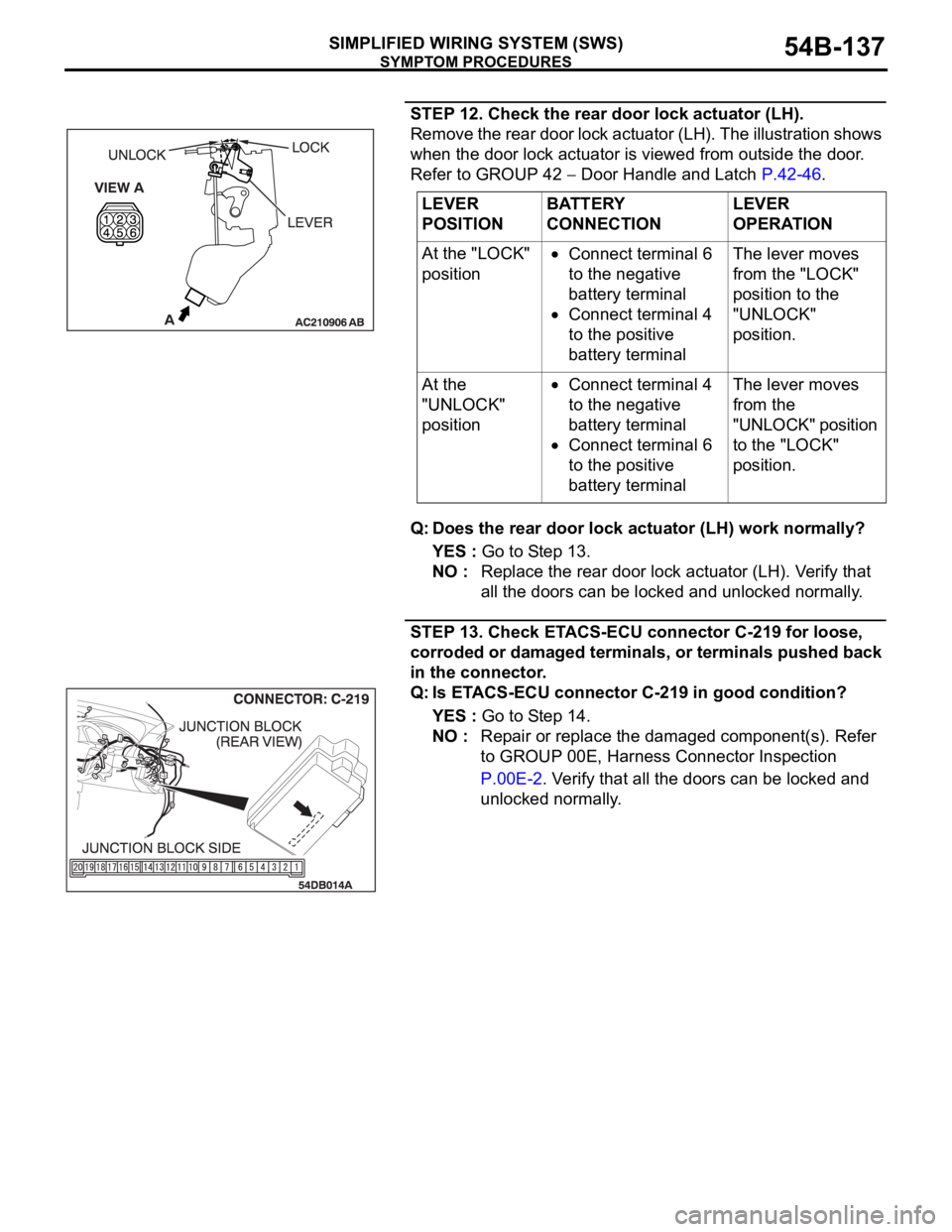
STEP 12. Check the rear door lock actuator (LH).
Remove the rear door lock actuator (LH). The illustration shows
when the door lock actuator is viewed from outside the door.
Refer to GROUP 42
Door Handle and Latch P.42-46.
Q: Does the rear door lock actuator (LH) work normally?
YES : Go to Step 13.
NO : Replace the rear door lock actuator (LH). Verify that
all the doors can be locked and unlocked normally.
STEP 13. Check ETACS-ECU connector C-219 for loose,
corroded or damaged terminals, or terminals pushed back
in the connector.
Q: Is ETACS-ECU connector C-219 in good condition?
YES : Go to Step 14.
NO : Repair or replace the damaged component(s). Refer
to GROUP 00E, Harness Connector Inspection
P.00E-2. Verify that all the doors can be locked and
unlocked normally. LEVER
POSITIONBATTERY
CONNECTIONLEVER
OPERATION
At the "LOCK"
position
Connect terminal 6
to the negative
battery terminal
Connect terminal 4
to the positive
battery terminalThe lever moves
from the "LOCK"
position to the
"UNLOCK"
position.
At the
"UNLOCK"
position
Connect terminal 4
to the negative
battery terminal
Connect terminal 6
to the positive
battery terminalThe lever moves
from the
"UNLOCK" position
to the "LOCK"
position.
Page 139 of 1500

SYMPTOM PROCEDURES
SIMPLIFIED WIRING SYSTEM (SWS)54B-139
STEP 15. Check rear door lock actuator (RH) connector
E-08 for loose, corroded or damaged terminals, or
terminals pushed back in the connector.
Q: Is rear door lock actuator (RH) connector E-08 in good
condition?
YES : Go to Step 16.
NO : Repair or replace the damaged component(s). Refer
to GROUP 00E, Harness Connector Inspection
P.00E-2. Verify that all the doors can be locked and
unlocked normally.
STEP 16. Check the rear door lock actuator (RH).
Remove the rear door lock actuator (RH). The illustration
shows when the door lock actuator is viewed from outside the
door. Refer to GROUP 42
Door Handle and Latch P.42-46.
Q: Does the rear door lock actuator (RH) work normally?
YES : Go to Step 17.
NO : Replace the rear door lock actuator (RH). Verify that
all the doors can be locked and unlocked normally.
LEVER
POSITIONBATTERY
CONNECTIONLEVER
OPERATION
At the "LOCK"
position
Connect terminal
4 to the negative
battery terminal
Connect terminal
6 to the positive
battery terminalThe lever moves
from the "LOCK"
position to the
"UNLOCK"
position.
At the
"UNLOCK"
position
Connect terminal
6 to the negative
battery terminal
Connect terminal
4 to the positive
battery terminalThe lever moves
from the
"UNLOCK" position
to the "LOCK"
position.
Page 154 of 1500
SYMPTOM PROCEDURES
SIMPLIFIED WIRING SYSTEM (SWS)54B-154
STEP 4. Check the power window relay.
Q: Is the power window relay normal?
YES : Go to Step 5.
NO : Replace the power window relay. Verify that the
power windows work normally.
STEP 5. Check the battery power supply circuit to the
power window relay. Measure the voltage at power window
relay connector C-203.
(1) Disconnect power window relay connector C-203 and
measure the voltage available at the junction block side of
the connector.
(2) Measure the voltage between terminal 5 and ground.
The voltage should measure approximately 12 volts
(battery positive voltage).
Q: Is the measured voltage approximately 12 volts (battery
positive voltage)?
YES : Go to Step 7.
NO : Go to Step 6. BATTERY
CONNECTIONTESTER
CONNECTIONSPECIFIED
CONDITION
Not applied 4
5 Open circuit
Connect terminal 1
to the positive
battery terminal
Connect terminal 3
to the negative
battery terminal4
5 Less than 2
ohms
Page 159 of 1500

SYMPTOM PROCEDURES
SIMPLIFIED WIRING SYSTEM (SWS)54B-159
Q: Is the wiring harness between power window main
switch connector E-04 (terminal 2) and ground in good
condition?
YES : No action is necessary and testing is complete.
NO : The wiring harness may be damaged or the
connector(s) may have loose, corroded or damaged
terminals, or terminals pushed back in the connector.
Repair the wiring harness as necessary. The power
windows function should now work normally.
STEP 12. Check the battery power supply circuit to the
power window main switch. Measure the voltage at power
window main switch connector E-04.
(1) Disconnect power window main switch connector E-04 and
measure the voltage available at the harness side of the
connector.
(2) Turn the ignition switch to "ON" position.
(3) Measure the voltage between terminal 10 and ground.
The voltage should measure approximately 12 volts
(battery positive voltage).
Q: Is the measured voltage approximately 12 volts (battery
positive voltage)?
YES : Replace the power window main switch. The power
windows function should now work normally.
NO : Go to Step 13.
STEP 13. Check ETACS-ECU connector C-219 for loose,
corroded or damaged terminals, or terminals pushed back
in the connector.
Q: Is ETACS-ECU connector C-219 in good condition?
YES : Go to Step 14.
NO : Repair or replace the damaged component(s). Refer
to GROUP 00E, Harness Connector Inspection
P.00E-2. The power windows function should now
work normally.
Page 166 of 1500

SYMPTOM PROCEDURES
SIMPLIFIED WIRING SYSTEM (SWS)54B-166
STEP 3. Check the front power window regulator motor
(RH).
(1) Remove the front power window regulator motor (RH).
Refer to GROUP 42, Door, Door Glass and Regulator
P.42-39.
(2) Connect a battery to the motor terminal, and check that the
motor runs freely.
Q: Is the front power window regulator motor (RH) normal?
YES : Go to Step 4.
NO : Replace the front power window regulator motor
(RH). When the power window main switch is
operated, the front power window (RH) should lower
or raise normally.
STEP 4. Check the wiring harness between power window
main switch connector E-04 (terminals 12 and 14) and front
power window regulator motor (RH) connector E-03
(terminals 2 and 1).
Q: Is the wiring harness between power window main
switch connector E-04 (terminals 12 and 14) and front
power window regulator motor (RH) connector E-03
(terminals 2 and 1) in good condition?
YES : No action is necessary and testing is complete.
NO : The wiring harness may be damaged or the
connector(s) may have loose, corroded or damaged
terminals, or terminals pushed back in the connector.
Repair the wiring harness as necessary. When the
power window main switch is operated, the front
power window (RH) should lower or raise normally. BATTERY CONNECTION SLIDER POSITION
Connect terminal 1 to the
negative battery terminal
Connect terminal 2 to the
positive battery terminalUP
Connect terminal 2 to the
negative battery terminal
Connect terminal 1 to the
positive battery terminalDOWN
Page 171 of 1500

SYMPTOM PROCEDURES
SIMPLIFIED WIRING SYSTEM (SWS)54B-171
STEP 7. Check the front power window regulator motor
(LH).
(1) Remove the front power regulator assembly (LH). Refer to
GROUP 42, Door, Door Glass and Regulator P.42-39.
(2) Connect a battery to the motor terminal, and check that the
motor runs freely.
Q: Is the front power window regulator motor (LH) normal?
YES : Go to Step 8.
NO : Replace the front power regulator assembly (LH).
When the front power window sub switch (LH) is
operated, the front power window (LH) should raise
and lower normally.
STEP 8. Check the battery power supply circuit to the front
power window sub switch. Measure the voltage at front
power window sub switch connector E-12.
(1) Disconnect front power window sub switch connector E-12
and measure the voltage available at the wiring harness
side of the connector.
(2) Measure the voltage between terminal 6 and ground.
The voltage should measure approximately 12 volts
(battery positive voltage).
Q: Is the measured voltage approximately 12 volts (battery
positive voltage)?
YES : Go to Step 11.
NO : Go to Step 9. BATTERY CONNECTION SLIDER POSITION
Connect terminal 1 to the
negative battery terminal
Connect terminal 2 to the
positive battery terminalUP
Connect terminal 2 to the
negative battery terminal
Connect terminal 1 to the
positive battery terminalDOWN
Page 176 of 1500

SYMPTOM PROCEDURES
SIMPLIFIED WIRING SYSTEM (SWS)54B-176
STEP 16. Check the rear power window regulator motor
(LH).
(1) Remove the rear power window regulator assembly (LH).
Refer to GROUP 42, Door, Door Glass and Regulator
P.42-39.
(2) Connect a battery to the motor terminal, and check that the
motor runs freely.
Q: Is the rear power window regulator motor (LH) normal?
YES : Go to Step 17.
NO : Replace the rear power regulator assembly (LH).
When the rear power window sub switch (LH) is
operated, the rear power window (LH) should raise
and lower normally.
STEP 17. Check the battery power supply circuit to the rear
power window sub switch (LH). Measure the voltage at rear
power window sub switch (LH) connector E-17.
(1) Disconnect rear power window sub switch (LH) connector
E-17 and measure the voltage available at the wiring
harness side of the connector.
(2) Measure the voltage between terminal 6 and ground.
The voltage should measure approximately 12 volts
(battery positive voltage).
Q: Is the measured voltage approximately 12 volts (battery
positive voltage)?
YES : Go to Step 20.
NO : Go to Step 18. BATTERY CONNECTION SLIDER POSITION
Connect terminal 1 to the
negative battery terminal
Connect terminal 2 to the
positive battery terminalUP
Connect terminal 2 to the
negative battery terminal
Connect terminal 1 to the
positive battery terminalDOWN
