Page 907 of 1500
HOW TO DIAGNOSE
GENERAL 00E-6
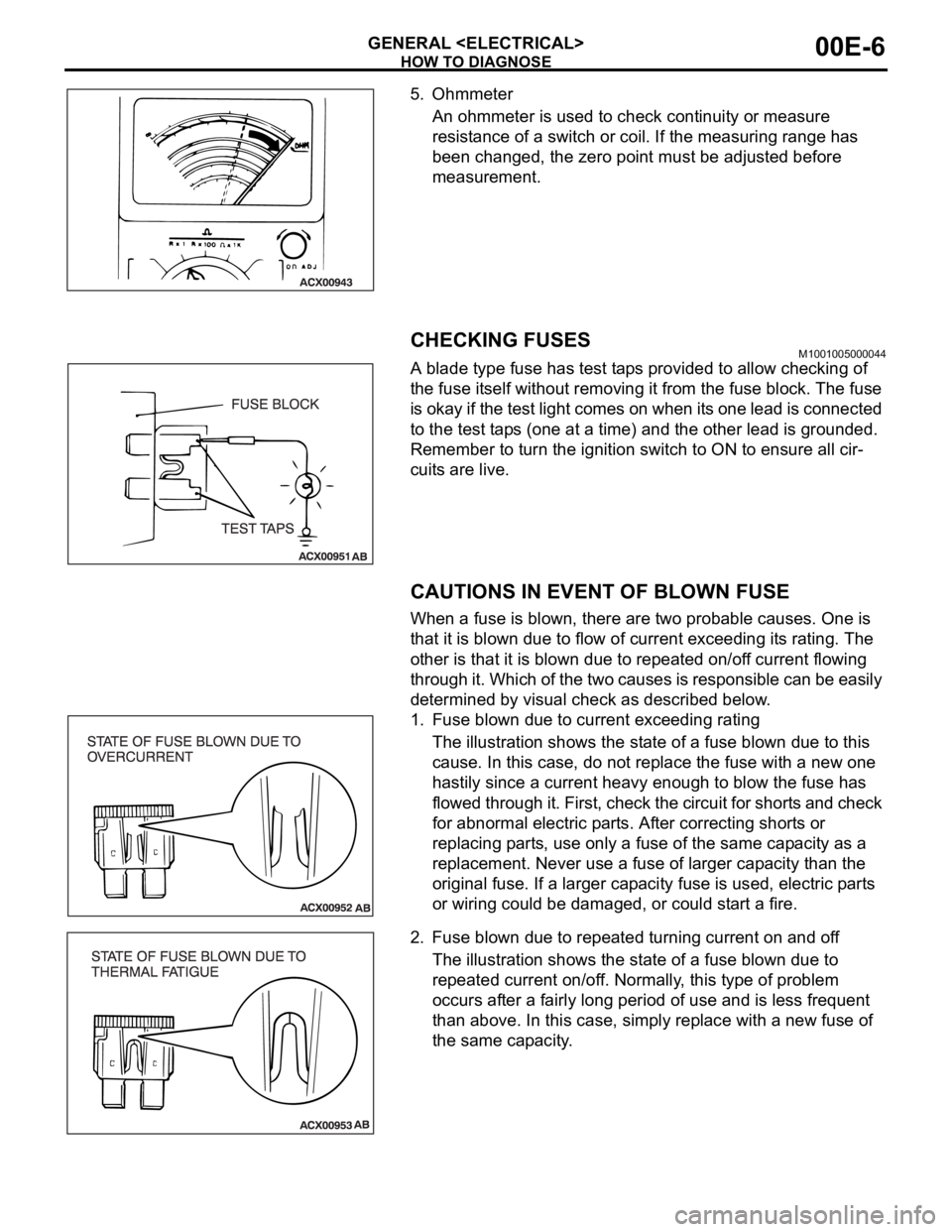
5. Ohmmeter
An ohmmeter is used to check continuity or measure
resistance of a switch or coil. If the measuring range has
been changed, the zero point must be adjusted before
measurement.
CHECKING FUSESM1001005000044
A blade type fuse has test taps provided to allow checking of
the fuse itself without removing it from the fuse block. The fuse
is okay if the test light comes on when its one lead is connected
to the test taps (one at a time) and the other lead is grounded.
Remember to turn the ignition switch to ON to ensure all cir-
cuits are live.
CAUTIONS IN EVENT OF BLOWN FUSE
When a fuse is blown, there are two probable causes. One is
that it is blown due to flow of current exceeding its rating. The
other is that it is blown due to repeated on/off current flowing
through it. Which of the two causes is responsible can be easily
determined by visual check as described below.
1. Fuse blown due to current exceeding rating
The illustration shows the state of a fuse blown due to this
cause. In this case, do not replace the fuse with a new one
hastily since a current heavy enough to blow the fuse has
flowed through it. First, check the circuit for shorts and check
for abnormal electric parts. After correcting shorts or
replacing parts, use only a fuse of the same capacity as a
replacement. Never use a fuse of larger capacity than the
original fuse. If a larger capacity fuse is used, electric parts
or wiring could be damaged, or could start a fire.
2. Fuse blown due to repeated turning current on and off
The illustration shows the state of a fuse blown due to
repeated current on/off. Normally, this type of problem
occurs after a fairly long period of use and is less frequent
than above. In this case, simply replace with a new fuse of
the same capacity.
Page 909 of 1500

HOW TO DIAGNOSE
GENERAL 00E-8
CHECKING RELAYSM1001004900152
1. By using a relay, a heavy current can be turned on and off by
a switch using much less current. For example, in the circuit
shown here, when the switch is turned on (closed), current
flows to the coil of the relay. Then, its contact is turned on
(closed) and the light comes on. The current flowing through
the switch is much less than that for the light.
2. When current flows through the coil of a relay, its core is
magnetized to attract the iron piece, closing (ON) the
contact at the tip of the iron piece. When the coil current is
turned off, the iron piece returns to its original position by a
spring, opening the contact (OFF).
3. Relays may be classified as the normally open-type or the
normally closed-type, depending on their contact
construction.
NOTE: The deenergised state means that no current is flow-
ing through the coil. The energised state means that current
is flowing through the coil.
(1) The normally open-type
When a normally open relay as illustrated here is
checked, there should be no continuity between terminals
3 and 4 when the relay is deenergised. There should be
continuity between terminals 3 and 4 when battery
voltage and ground are applied to terminals 1 and 2. The
relay condition is determined by this check.
NOTE: Check the relay in both situation which is
energised and is not energised.
(2) The normally closed-type
When a normally closed relay as illustrated here is
checked, there should be continuity between terminals 3
and 4 when the relay is deenergised. There should be no
continuity between terminals 3 and 4 when battery
voltage and ground are applied to terminals 1 and 2. The
relay condition is determined by this check.
NOTE: Check the relay in both situation which is
energised and is not energised.
Page 978 of 1500
16-1
GROUP 16
ENGINE
ELECTRICAL
CONTENTS
CHARGING SYSTEM . . . . . . . .
16-2
GENERAL DESCRIPTION . . . . . .
16-2
CHARGING SYSTEM DIAGNOSIS16-3
SPECIAL TOOL . . . . . . . . . . . . . . .16-6
ON-VEHICLE SERVICE. . . . . . . . .16-7
ALTERNATOR OUTPUT WIRE VOLTAGE
DROP TEST . . . . . . . . . . . . . . . . . . . . . 16-7
OUTPUT CURRENT TEST . . . . . . . . . . 16-8
REGULATED VOLTAGE TEST . . . . . . . 16-10
WAVE PATTERN CHECK USING AN
OSCILLOSCOPE . . . . . . . . . . . . . . . . . . 16-11
ALTERNATOR ASSEMBLY . . . . .16-14
REMOVAL AND INSTALLATION . . . . . 16-14
DISASSEMBLY AND ASSEMBLY. . . . . 16-15
INSPECTION . . . . . . . . . . . . . . . . . . . . . 16-17
STARTING SYSTEM . . . . . . . . .16-20
GENERAL DESCRIPTION . . . . . .
16-20
STARTING SYSTEM DIAGNOSIS . . . . 16-21
STARTER MOTOR ASSEMBLY . .16-23
REMOVAL AND INSTALLATION . . . . . 16-23
INSPECTION . . . . . . . . . . . . . . . . . . . . . 16-24
DISASSEMBLY AND ASSEMBLY. . . . . 16-26
INSPECTION . . . . . . . . . . . . . . . . . . . . . 16-28
IGNITION SYSTEM . . . . . . . . . . . . . .16-30GENERAL DESCRIPTION . . . . . . .
16-30
SPECIAL TOOLS . . . . . . . . . . . . . .16-30
ON-VEHICLE SERVICE . . . . . . . . .16-31
KNOCK CONTROL SYSTEM CHECK . . 16-31
IGNITION COIL CHECK. . . . . . . . . . . . . 16-31
SPARK PLUG TEST . . . . . . . . . . . . . . . 16-32
SPARK PLUG CHECK AND CLEANING16-32
CAMSHAFT POSITION SENSOR CHECK16-32
CRANKSHAFT POSITION SENSOR
CHECK . . . . . . . . . . . . . . . . . . . . . . . . . . 16-32
IGNITION COIL . . . . . . . . . . . . . . . .16-33
REMOVAL AND INSTALLATION . . . . . 16-33
CAMSHAFT POSITION SENSOR .16-34
REMOVAL AND INSTALLATION . . . . . 16-34
CRANKSHAFT POSITION SENSOR16-35
REMOVAL AND INSTALLATION . . . . . 16-35
KNOCK SENSOR . . . . . . . . . . . . . .16-36
REMOVAL AND INSTALLATION . . . . . 16-36
SPECIFICATIONS . . . . . . . . . . 16-38
FASTENER TIGHTENING
SPECIFICATIONS . . . . . . . . . . . . .
16-38
GENERAL SPECIFICATIONS . . . .16-38
SERVICE SPECIFICATIONS . . . . .16-39
Page 979 of 1500

16-2
CHARGING SYSTEM
GENERAL DESCRIPTIONM1161000100629
The charging system charges the battery with the
alternator output to keep the battery charged at a
constant level during varying electrical load.
OPERATION
Rotation of the excited field coil generates AC volt-
age in the stator.
This alternating current is rectified through diodes to
DC voltage having a waveform shown in the illustra-
tion above.
The average output voltage fluctuates slightly with
the alternator load condition.When the ignition switch is turned on, current flows in
the field coil and initial excitation of the field coil
occurs.
When the stator coil begins to generate power after
the engine is started, the field coil is excited by the
output current of the stator coil.
The alternator output voltage rises as the field cur-
rent increases and it falls as the field current
decreases. When the battery positive voltage
(alternator S terminal voltage) reaches a regulated
voltage of approximately 14.4 V, the field current is
cut off. When the battery positive voltage drops
below the regulated voltage, the voltage regulator
regulates the output voltage to a constant level by
controlling the field current.
In addition, when the field current is constant, the
alternator output voltage rises as the engine speed
increases.
Page 990 of 1500
CHARGING SYSTEM
ENGINE ELECTRICAL16-13
Example 2
PROBABLE CAUSE: Short-circuit in diode
Example 3
PROBABLE CAUSE: Open circuit in stator coil
Example 4
PROBABLE CAUSE: Short-circuit in stator coil
Page 993 of 1500
Page 994 of 1500
CHARGING SYSTEM
ENGINE ELECTRICAL16-17
ASSEMBLY SERVICE POINTS
.
>>A<< REGULATOR ASSEMBLY INSTALLATION
After installing the regulator assembly, insert a wire through the
hole provided on the rear bracket while pressing down on the
brush, and secure the brush.
NOTE: By inserting a wire, the brush will be secured in place,
and the installation of the rotor will be easier.
.
>>B<< ROTOR ASSEMBLY INSTALLATION
After installing the rotor, remove the wire used to secure the
brush.
INSPECTIONM1161001700099.
ROTOR CHECK
1. Check the continuity between the slip rings of the field coil. If
the resistance value is not within the standard value, replace
the rotor.
Standard value: approximately 2
5
Page 995 of 1500
CHARGING SYSTEM
ENGINE ELECTRICAL16-18
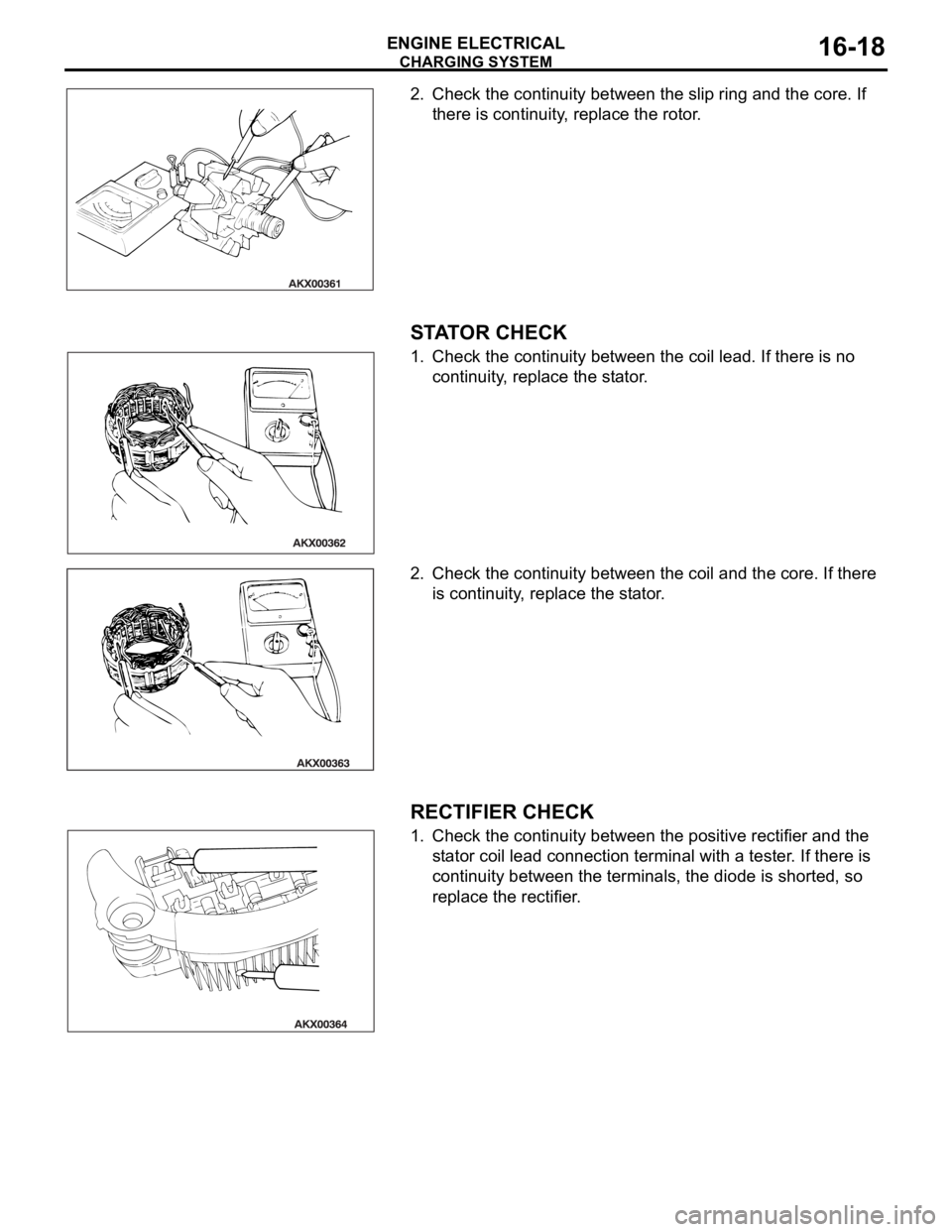
2. Check the continuity between the slip ring and the core. If
there is continuity, replace the rotor.
.
STATOR CHECK
1. Check the continuity between the coil lead. If there is no
continuity, replace the stator.
2. Check the continuity between the coil and the core. If there
is continuity, replace the stator.
.
RECTIFIER CHECK
1. Check the continuity between the positive rectifier and the
stator coil lead connection terminal with a tester. If there is
continuity between the terminals, the diode is shorted, so
replace the rectifier.