2005 MINI COOPER Page 68
[x] Cancel search: Page 68Page 102 of 165

100
TIRE CODING
TIRE CONDITION
Traction The traction grades, from highest to low
-
est, are AA, A, B, and C.
Those grades represent the tire's ability to
stop on wet pavement as measured under
controlled conditions on specified govern
-
ment test surfaces of asphalt and concrete.
A tire marked C may have poor traction per
-
formance.
The traction grade assigned to this tire is based on straight-ahead brak
-
ing traction tests, and does not include
acceleration, cornering, hydroplaning, or
peak traction characteristics.
to the generation of heat and its ability to
dissipate heat when tested under con
-
trolled conditions on a specified indoor lab
-
oratory test wheel.
Sustained high temperature can cause the
material of the tire to degenerate and
reduce tire life, and excessive temperature
can lead to sudden tire failure. The grade C
corresponds to a level of performance
which all passenger car tires must meet
under the Federal Motor Vehicle Safety
Standard No. 109. Grades B and A represent
higher levels of performance on the labora
-
tory test wheel than the minimum required
by law.
The temperature grade for this tire is established for a tire that is properly
inflated and not overloaded. Excessive
speed, underinflation, or excessive loading,
either separately or in combination, can
cause heat buildup and possible tire fail
-
ure.
lar symbol containing the letters RSC on
the side of the tire, refer to page
101
.
M+SWinter and all-season tires.
These have better winter performance
properties than summer tires.
Inspect your tires frequently for tread wear,
signs of damage and for foreign objects
lodged in the tread. Check the tread depth.Tire tread The tread depth should not fall below
ε in / 3 mm.
Below ε
in / 3 mm tread depth, there is a
very high danger of hydroplaning at higher
speeds even if there is only a small amount
of water on the road.
Below a tread depth of
1/6 in / 4 mm, win
-
ter tires display a perceptible decrease in
their ability to cope with winter driving
conditions, and should be replaced in the
interest of safety.
ProCarManuals.com
Page 104 of 165

102
RUN FLAT TIRES
*
NEW WHEELS AND TIRES
If there is a total loss of tire inflation pres
-
sure, 0
psi
/ 0 kPa, or obvious tire damage,
you can gauge the mileage for continued
driving on the basis of the following indica
-
tions:>With a light load:
1 to 2 persons without luggage:
approx. 155
miles
/ 250
km
>With a medium load:
2 persons, full luggage compartment, or
4 persons without luggage:
approx. 90 miles
/ 150 km.
>With a full load:
4 persons or more, full luggage compart
-
ment:
approx. 30
miles
/ 50 km.
Drive cautiously. Do not exceed a speed of 50
mph
/ 80
km/h. In case of
tire pressure loss you must expect changes
in vehicle handling such as lower track sta
-
bility during braking, longer braking dis
-
tances and changes in self-steering proper
-
ties when close to the handling limit.
For safety reasons, the manufacturer of
your vehicle recommends not having dam
-
aged Run Flat tires repaired. In this case,
consult your MINI dealer.<
Tire change set
In case of a flat tire, the tire change set is not needed, since your vehicle
has Run Flat tires.
When changing a tire, always observe the
safety measures and the procedure for
changing tires starting on page
125
.<
Your vehicle is additionally equipped with a
tire change set.In the MINI COOPER and MINI COOPER Con
-
vertible this is located in the luggage com
-
partment under the floor mat.
In the MINI COOPER
S and MINI COOPER S
Convertible, the tire change set is located in
a separate bag which is attached to the
lashing eyelets on the luggage compart
-
ment floor by means of tie-down straps.
Have new wheels and tires mounted only by a tire specialist. Work that is
improperly carried out could result in con
-
sequential damage and pose safety haz
-
ards.
-
tion for your vehicle.
Have the wheels balanced after each tire or
wheel replacement. The correct wheel and tire combination is
also important for various systems that
would otherwise be impaired, e.g. ABS or
DSC.
The manufacturer of your vehicle rec
-
ommends that you avoid using
retread tires, as this could impair driving
safety. This is due to the possible variations
in casing structures and, in some cases, to
their extreme age, which can lead to a
decrease in their durability.<
ProCarManuals.com
Page 106 of 165
104
SNOW CHAINS
*
Only certain types of snow chains have
been tested by the manufacturer of your
MINI, classified as road-safe and approved.
Contact your MINI Dealer for more details.
The manufacturer of your MINI recom
-
mends that you use only these approved
fine-link snow chains. Their use is only per
-
mitted in pairs on the front wheels on win
-
ter tires of the following types: >175/65 R 15 M+S>175/60 R 16 M+S.When fitting, comply with the manufac
-
turer's instructions. With chains, do not
exceed a speed of 30
mph
/ 50
km/h.
Do not initialize the Flat Tire Monitor after attaching snow chains to the
tires.
When driving with snow chains, it can be
helpful to switch off the ASC or DSC for a
brief period, refer to pages
68, 69
.<
ProCarManuals.com
Page 107 of 165
105
OVERVIEW REPAIRSOPERATIONCONTROLS DATA INDEX
BONNET
Do not attempt to service your vehi
-
cle if you do not have the required
technical background. If you are not famil
-
iar with the regulations to be observed,
have the necessary work on your vehicle
carried out only by a MINI Dealer or a work
-
shop that has specially trained personnel
working in accordance with the specifica
-
tions of the MINI manufacturer.
Work that is improperly carried out could
result in consequential damage and pose
safety hazards.<
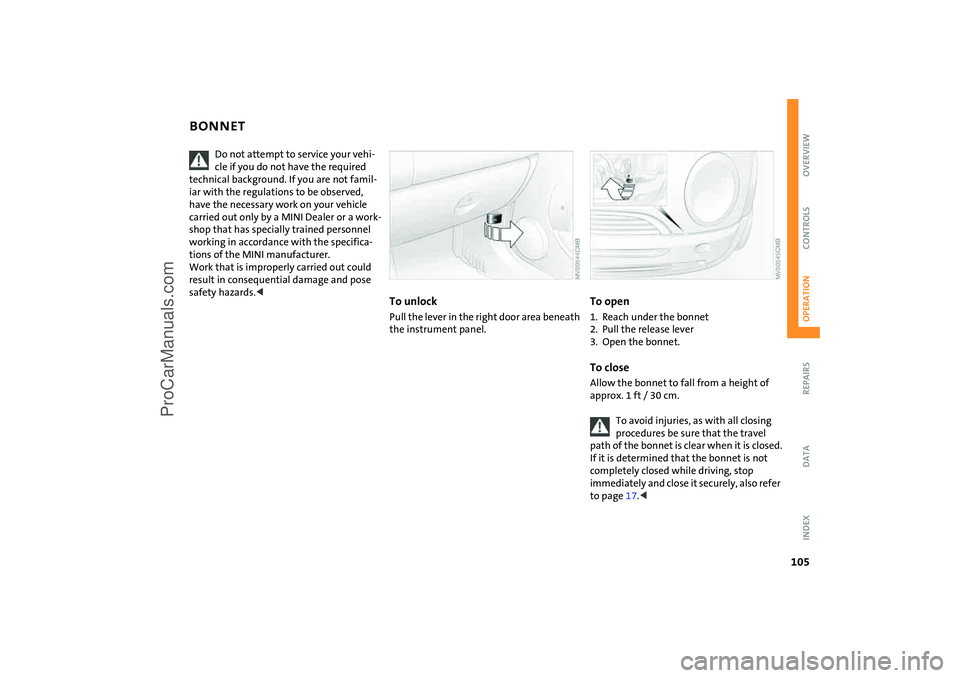
To unlockPull the lever in the right door area beneath
the instrument panel.
To open1. Reach under the bonnet2. Pull the release lever3. Open the bonnet.To closeAllow the bonnet to fall from a height of
approx.
1 ft / 30
cm.
To avoid injuries, as with all closing procedures be sure that the travel
path of the bonnet is clear when it is closed.
If it is determined that the bonnet is not
completely closed while driving, stop
immediately and close it securely, also refer
to page
17.<
ProCarManuals.com
Page 113 of 165

111
OVERVIEW REPAIRSOPERATIONCONTROLS DATA INDEX
BRAKE FLUIDWarning lamp
The warning lamp comes on although the parking brake is
released:
The brake fluid level in the reservoir is too
low, refer to page
16. At the same time,
brake pedal travel may become signifi
-
cantly longer.
Have the system checked immediately.
Display of the malfunction described above in Canadian mod
-
els.
Adding brake fluid To add brake fluid or to determine and cor
-
rect the cause of brake fluid loss, please
consult your MINI Dealer. Your MINI Dealer
is familiar with the specifications for fac
-
tory-approved brake fluids,
DOT
4.
Brake fluid loss may result in extended
brake pedal travel. If this occurs, refer to
the information on page
96.
Brake fluid is hygroscopic, that is, it absorbs moisture from the air over
time.
In order to ensure the brake system's safety
and reliability, have the brake fluid
changed every two years by a MINI Dealer
or a workshop that has specially trained
personnel working in accordance with the
specifications of the MINI manufacturer,
also refer to the Service and Warranty
Information Booklet for US
models or the
Warranty and Service Guide Booklet for
Canadian models. Brake fluid is toxic and
also damages vehicle paintwork. Always
store brake fluid in tightly closed original
containers kept well away from the reach
of children.
Do not spill the brake fluid and do not fill
the brake fluid reservoir beyond the MAX
mark. The brake fluid could ignite upon
contact with hot engine parts and cause
serious burns.<
Comply with the applicable environ
-
mental laws regulating the disposal
of brake fluid.<
ProCarManuals.com
Page 114 of 165

112
MINI MAINTENANCE SYSTEMThe MINI maintenance system helps main
-
tain your vehicle's road safety and opera
-
tional safety. Please bear in mind that regular mainte
-
nance is not only necessary for the safety of
your vehicle, but also plays a significant
role in maintaining the resale value of the
vehicle.
Service interval displayWhile conventional systems specify main
-
tenance according to fixed distances
driven, the MINI Maintenance System takes
account of the operating conditions of the
vehicle, for distances can be driven in many
different ways:
60,000
miles
/ 100,000
km short distance
operation can not be equated with
60,000
miles
/ 100,000
km long distance
operation from a maintenance standpoint.
The condition-based MINI Maintenance
System includes the Engine Oil Service and
Inspections I and II.Determining the maintenance intervals
according to the actual use of the vehicle
covers every kind of operating situation.
People who drive very little, i.e. much less
than 6,000
miles
/ 10,000
km per year,
should have the engine oil changed at least
every 2 years since oil deteriorates over
time, regardless of use.
For more information on the service inter
-
val display, refer to page
65.
Service and Warranty Information
Booklet for US models, Warranty and
Service Guide Booklet for Canadian
models For additional information on maintenance
intervals and procedures, please refer to
the Service and Warranty Information
Booklet for US
models or the Warranty and
Service Guide Booklet for Canadian models.
As a precaution against rust, it is advisable
to have the body checked for damage from
rocks or gravel at the same time, depending
upon operating conditions.
The manufacturer of your MINI rec
-
ommends having maintenance and
repair work carried out only by a MINI
Dealer or a workshop that has specially
trained personnel working in accordance
with the specifications of the MINI manu
-
facturer.
Make sure that maintenance work is con
-
firmed with an entry in the Service and
Warranty Information Booklet for
US
models or the Warranty and Service
Guide Booklet for Canadian models. These
entries are your proof that the vehicle has
received regular maintenance.<
ProCarManuals.com
Page 115 of 165

113
OVERVIEW REPAIRSOPERATIONCONTROLS DATA INDEX
OBD SOCKET
CARING FOR YOUR VEHICLE
The Onboard Diagnostic (OBD) interface socket is located on the left of the driver's
side under the instrument panel and under
a cover.
The cover has the letters OBD on it.The purpose of the OBD system is to ensure
proper operation of the emission control
system for the vehicle's lifetime. The sys
-
tem monitors emission-related compo
-
nents for deterioration and malfunction.
An illuminated lamp informs you of the need for service, not of the
need to stop the vehicle.
However, the system should be checked by
your MINI Dealer at the earliest possible
opportunity.
Display of the malfunction described above in Canadian mod
-
els.
Under certain conditions, the indicator will
blink or flash. This indicates a rather severe
level of engine misfire. When this occurs,
you should reduce speed and consult the
nearest MINI Dealer as soon as possible.
Severe engine misfire over only a short
period of time can seriously damage emis
-
sion control components, especially the
catalytic converter.
When the gas cap is not properly tightened, the OBD system can
detect the vapor leak and the indicator will
light up. If the cap is subsequently tight
-
ened, the indicator lamp should go out
within a few days.<
Suitable car-care products
Use the cleaning and car-care prod
-
ucts available at your MINI Dealer.<
Washing your vehicleYou can wash your new MINI or MINI Con
-
vertible in automatic car washes from the
beginning. Preference should be for cloth
car washes. If, due to lack of availability,
brush car washes must be used, modern
systems with soft brushes should be given
preference.
When using steam cleaners or high-pressure cleaners, maintain sufficient
distance to the vehicle and do not exceed a
maximum temperature of 140
7/ 60
6. If
the jet is too close or the pressure is too
high, this can lead to damage or initial
damage that can develop into more serious
damage. Water that enters vehicle compo
-
nents can lead to damage over the long
term.
After washing the vehicle, apply the brakes
briefly to dry them, otherwise water can
reduce braking efficiency over the short
term and the brake rotors can corrode.
Switch the rain sensor off when passing
through an automatic car wash, refer to
page
59. Failure to do so could result in
ProCarManuals.com
Page 127 of 165

125
OVERVIEW REPAIRSOPERATION CONTROLS DATA INDEX
REPAIRING A FLAT TIRE
SPACE-SAVER SPARE TIRE
*
Safety measures in the event of a flat tire:
Stop the vehicle as far as possible from
passing traffic. Switch on the hazard warn
-
ing flashers.
Turn the steering wheel to the straight-
ahead wheel position and engage the
steering lock. Engage the parking brake and
shift into 1st or reverse gear – selector lever
in P.
All passengers should be outside the vehi
-
cle and well away from your immediate
working area – behind a guardrail, for
instance.
If a portable hazard warning lamp is avail
-
able, set it up on the roadside at an appro
-
priate distance from the rear of the vehicle.
Comply with all safety guidelines and regu
-
lations.
dures should be followed depending on the
equipment included in your vehicle:>Vehicles with Run Flat tires, refer to
page
101
>Vehicles with a space-saver spare tire,
refer to the following section>Vehicles with MINI Mobility System,
refer to page
129
.
To change a space-saver spare tire, proceed
as follows:>Remove space-saver spare tire, refer to
the section after the next one>Prepare for tire change, refer to page
127
>Jack up the vehicle, refer to page
128
>Mount the space-saver spare tire, refer
to page
128
>Tighten the lug bolts, refer to page
128
>Drive with space-saver spare tire, refer to
page
127
.
Tire change setOn vehicles with a space-saver spare tire,
the tire change set with onboard tools is
stored in the luggage compartment under
the floor mat.1 Chock, folding2 Hubcap remover3 Wheel stud wrench4Jack5 Special wrench for removing the space-
saver spare tire6 Towing eyelet7 Lifting handleThe onboard tool kit includes a pouch with
a plastic bag in which you can place the
damaged wheel.
ProCarManuals.com