2005 MINI COOPER Page 68
[x] Cancel search: Page 68Page 129 of 165

127
OVERVIEW REPAIRSOPERATION CONTROLS DATA INDEX
SPACE-SAVER SPARE TIRE
*
CHANGING TIRES
9.
Pull out the space-saver spare tire towards the rear underneath the vehi
-
cle
10. Position the space-saver spare tire with
the valve facing upwards11. Unscrew the valve extension from the
valve of the space-saver spare tire12. Unscrew the dust cap from the exten
-
sion and place it on the valve of the
space-saver spare tire.Due to its different dimensions, the damaged wheel cannot be placed in
the recess for the space-saver spare tire.<
Driving with the space-saver spare tireDrive cautiously. Do not exceed a speed of
50 mph
/ 80
km/h.
You must expect changes in vehicle han
-
dling such as lower track stability during
braking, longer braking distances and
changes in self-steering properties when
close to the handling limit. These effects
are more pronounced when driving with
winter tires.
Only one space-saver spare tire may be mounted at one time. Reinstall a
wheel and tire of the original size as soon
as possible.
soon as possible and have the new wheel/
tire assembly balanced.<
Additional safety measures in the event of a tire change:
Change the tire only on a level, firm surface
which is not slippery.
The vehicle or the jack could slip sideways
on soft or slippery support surfaces, such as
snow, ice, flagstones, etc..
Do not use a wooden block or similar object
as a support base for the jack, as this would
prevent it from extending to its full support
height and reduce its load-carrying capac
-
ity.
Do not lie under the vehicle or start the
engine when the vehicle is supported by
the jack – risk of fatal injury.
125
.<
1. For vehicles with a space-saver spare
tire:
Place the folding chock behind the front
wheel on the other side of the vehicle;
on downward inclines, place it in front of
this wheel. If the wheel is changed on a
surface with a more severe slope, take
additional precautions to secure the
vehicle from rolling
2. Loosen the lug bolts by a half turn.
ProCarManuals.com
Page 131 of 165

129
OVERVIEW REPAIRSOPERATION CONTROLS DATA INDEX
MINI MOBILITY SYSTEM
*
MINI Mobility SystemThe MINI Mobility System is provided to
help you repair a flat tire. With the help of
this system you can apply a liquid sealant
on the inside of the tire, which seals the
damaged area and enables you to continue
to drive. Preparing for tire repair
Before using the MINI Mobility Sys
-
tem read the warning and danger
precautions on the equipment.<
If possible, leave objects in which have
been forced into the tire.Take off the tag regarding speed limits and
stick it onto the steering wheel.Using the MINI Mobility SystemIn order to repair a flat tire with the MINI
Mobility System, proceed as follows:>Pump in liquid sealant, refer to page
130
>Reinflate the tire, refer to page
130
>Distribute liquid sealant, refer to
page
131
>Check tire inflation pressure, refer to
page
131
>Drive on, refer to page
131
.
MINI Mobility System with onboard tools The MINI Mobility System with tire change
set and onboard tools is located in the lug
-
gage compartment under the floor mat:
1Jack2 Wheel stud wrench3 Hubcap remover4 Wrench, screwdriver/Phillips screw
-
driver, towing eyelet5 Compressor, hose with manometer and
plug for cigarette lighter socket6 Package with filling hose, valve remover
and valve core7 Filling canister8 Hex wrench/screwdriver9 Adapter for wheel lug lock
ProCarManuals.com
Page 132 of 165

130
MINI MOBILITY SYSTEM
*
Pumping in liquid sealant 1. Shake the filling canister2. Screw the filling hose onto the filling
canister3. Unscrew the dust protection cap from
the valve of the defective tire4. Screw out the valve core with the valve
remover. The valve remover is located in
a package with the filling hose.
Place the valve core and valve remover only on clean surfaces.<
5. Remove the cap from the filling hose6. Push the filling hose onto the tire valve
7. Hold the filling canister with the cap
down and squeeze.
Squeeze the entire contents of the canis
-
ter into the tire
8. Remove filling hose9. Screw valve core into the tire valve with
the valve remover.
In the event of a lost or dirty valve core you will find another valve core
in a package with the filling hose.
Please remember that the liquid canister
must be replaced every four years if the
equipment has not been used.<
Reinflating the tire1. Screw hose
1 with manometer onto the
tire valve
2. Connect plug
3 to the cigarette lighter
socket in the vehicle interior, refer to
page
82
3. Ignition key in position
1:
Turn on compressor
2
4. Inflate the tires to at least
26 psi /
180
kPa, but not to more than 36
psi /
250
kPa.
To check the current air pressure, shut
off the device for a short time.
Do not run the compressor for longer than 6 minutes, otherwise
the device will overheat and possibly be
damaged.<
ProCarManuals.com
Page 133 of 165

131
OVERVIEW REPAIRSOPERATION CONTROLS DATA INDEX
MINI MOBILITY SYSTEM
*
If an air pressure of
26 psi
/
180
kPa cannot be reached,
unscrew the hose
1 and drive back and
forth about
33 ft / 10
m so that the liq
-
uid sealant is distributed in the tire.
Afterwards repeat the procedure.
If an air pressure of 26
psi / 180
kPa is
still not reached, the tire is too badly
damaged. Please contact the nearest
MINI Dealer.<
5. Turn off compressor
2
6. Unscrew hose
1 from the tire valve
7. Store the MINI Mobility System back in
the vehicle.
The instructions for using the MINI Mobility System are also given on the
equipment.<
Distributing liquid sealantImmediately drive for approx. 10
minutes,
so that the liquid sealant is uniformly dis
-
tributed.
Do not exceed a speed of 40
mph
/
60 km/h.
If possible do not drive at a speed lower
than 10
mph
/ 20
km/h.<
Checking tire inflation pressure 1. After driving for approx. 10
minutes, pull
over at a suitable location
2. Screw hose with manometer back onto
the tire valve3. Check the tire inflation pressures.
The tire inflation pressure must be at least 18
psi / 130
kPa. If it is not,
do not continue driving.<
If 18
psi / 130
kPa are displayed:
4. Ignition key position 1:
Turn on compressor 2. Correct the tire
inflation pressure to the specified value,
refer to the tire inflation pressure table
on page
98
5. Replace the tire as soon as possible.
The use of the MINI Mobility System may be ineffective with tire damage
larger than approx.
1/6 in / 4 mm. Please
contact the nearest MINI Dealer if the tire
cannot be made drivable with the MINI
Mobility System.<
Driving on
Do not exceed the permitted maxi
-
mum speed of 50
mph
/ 80
km/h;
otherwise an accident could happen.<
Replace the defective tire as soon as possible and have the new wheel/tire
assembly balanced. Have the MINI Mobility
System refilled.<
Tire change setWhen changing a tire, always observe the
safety measures and the procedure for
changing tires starting on page
125
.
In case of a flat tire the tire change set is not needed due to the availabil
-
ity of the MINI Mobility System.<
ProCarManuals.com
Page 134 of 165

132
BATTERYStorage location MINI COOPER and MINI COOPER Convert
-
ible:The battery is located in the engine com
-
partment. Exact location, refer to page
106
.
MINI COOPER
S and MINI COOPER
S Con
-
vertible:The battery is located in the luggage com
-
partment under the floor mat.Battery careThe battery is absolutely maintenance-free,
that is, the original electrolyte will normally
last for the service life of the battery under
moderate climatic conditions. Your MINI
Dealer will be glad to advise you if you have
any questions regarding the battery. Charging the batteryOnly charge the battery in the vehicle via
the terminals in the engine compartment
with the engine switched off, refer to
'Jump-starting', page
134
ff.
Disposal
After replacing old batteries, return the used batteries to your MINI
Dealer or to a recycling point. Maintain the
battery in an upright position for transport
and storage. Secure the battery to prevent
it from tilting during transport.<
Power failure After a temporary power failure, e.g. due to
a discharged battery, some of your vehicle's
equipment will function only to a limited
extent and must be reinitialized or read
-
justed. Individual settings are also lost and
must be reprogrammed:>Time:
Must be reset, refer to page
63
>Electric power windows:
Must be reinitialized, refer to page
32
>Radio
*:
The stations must be reset, refer to the
Owner's Manual for Radio>Navigation system
*:
It may take some time for its operability
to be restored, refer to the Owner's Man
-
ual for Navigation System.
ProCarManuals.com
Page 136 of 165

134
JUMP-STARTINGWhen your battery is discharged, you can
use two jumper cables to start your vehicle
with power from the battery in a second
vehicle. Correspondingly you can help start
another vehicle. Only use jumper cables
with fully insulated handles on the termi
-
nal clamps.Preparing for jump-starting
Do not touch live wiring and cables on a running engine. There is a risk of
fatal injury if you do this. Carefully observe
the following instructions to avoid per
-
sonal injury and/or damage to either vehi
-
cle or both vehicles. Make sure that there is
no contact between the bodywork of the
two vehicles to avoid a short circuit haz
-
ard.<
1. Check whether the battery of the sup
-
port vehicle has 12
Volts and approxi
-
mately the same capacity measured in
Ah. These data are printed on the bat
-
tery
2. Switch off the engine of the support
vehicle3. Switch off any electrical systems and
components in both vehicles.Connect the jumper cables
Always adhere to this sequence when connecting the jumper cables; failure
to observe this procedure can lead to spark
-
ing and pose an injury hazard.<
The illustration shows the auxiliary jump-starting terminal on the MINI
COOPER S
and the MINI COOPER
S Convertible. In the
MINI COOPER
S and the MINI COOPER
S
Convertible, the auxiliary jump-starting
terminal, arrow
1, acts as the positive bat
-
tery terminal, refer to view of engine com
-
partment on page
107
. The cover is marked
with a
+.
1. Remove the cover of the battery or open
the cover of the auxiliary jump-starting
terminal:
>MINI COOPER and MINI COOPER Con
-
vertible:
Remove the battery cover.
To do so, press the two clips simulta
-
neously.
ProCarManuals.com
Page 138 of 165

136
TOWING AND TOW-STARTINGUsing the towing eyelet The screw-in towing eyelet is stored in the
onboard tool kit, refer to page
120
; be sure
that it remains with the vehicle at all times.
It can be attached at the front or rear of
your vehicle.
To prevent damage to the towing eyelet and the vehicle, please observe
the following instructions:
Use only the towing eyelet supplied with
the vehicle and screw it in firmly until it
stops. Use the towing eyelet for towing on
paved roads only. Avoid subjecting the
towing eyelet to lateral loads, e.g. do not
lift the vehicle using the towing eyelet.<
Access to the threaded socket The illustration shows by way of example
the MINI COOPER and the MINI COOPER
Convertible.Pry out the cover in the front or rear
bumper by inserting a screwdriver into the
recess.Being towed
Make sure that the ignition key is in position
1; otherwise the steering
lock could engage and prevent the vehicle
from being steered. There is no power
assist while the engine is off. Therefore,
you will need to exert more force to brake
and steer the vehicle.<
Turn on the hazard warning flashers, if
required by national regulations. If the
electrical system has failed, clearly identify
the vehicle being towed, e.g. by placing a
sign or a warning triangle in the rear win
-
dow.MINI or MINI Convertible with manual
transmission:Put the manual gearshift lever in Neutral.MINI or MINI Convertible with Continu
-
ously Variable automatic Transmission
(CVT):
Only tow vehicles with Continuously Variable automatic Transmission
(CVT) with a tow truck, otherwise the trans
-
mission can be damaged, refer to
page
137
.<
Towing methodsIn some countries, it is not permitted to
tow the vehicle with a tow bar or tow rope
on public roads.Familiarize yourself with the applicable
towing regulations for the country in which
you are driving.
ProCarManuals.com
Page 139 of 165
137
OVERVIEW REPAIRSOPERATION CONTROLS DATA INDEX
TOWING AND TOW-STARTINGWith a tow bar:
The towing vehicle must not be lighter than the vehicle being towed;
otherwise, vehicle handling can no longer
be controlled.<
The towing eyelets of both vehicles should
be on the same side. If the tow bar can only
be used in a diagonal position, please note
the following:>Clearance and maneuverability will be
strictly limited in corners>The inclination of the tow bar produces
lateral force.
Only attach the tow bar to the towing eyelets. Other parts of the vehicles
could otherwise be damaged.<
With a tow rope: When the towing vehicle is driving off,
make sure that the tow rope is taut.
Use nylon ropes or straps for towing because they prevent sudden jerking
movements. Attach the tow rope only to
the towing eyelets. Other parts of the vehi
-
cles could otherwise be damaged.<
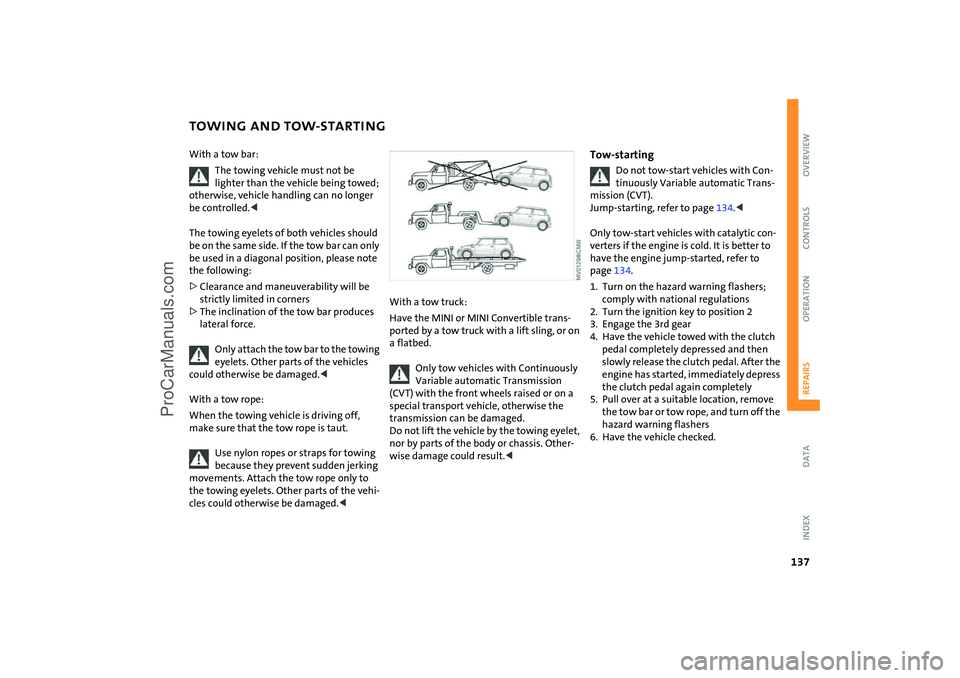
With a tow truck:Have the MINI or MINI Convertible trans
-
ported by a tow truck with a lift sling, or on
a flatbed.
Only tow vehicles with Continuously Variable automatic Transmission
(CVT) with the front wheels raised or on a
special transport vehicle, otherwise the
transmission can be damaged.
Do not lift the vehicle by the towing eyelet,
nor by parts of the body or chassis. Other
-
wise damage could result.<
Tow-starting
Do not tow-start vehicles with Con
-
tinuously Variable automatic Trans
-
mission (CVT).
Jump-starting, refer to page
134
.<
Only tow-start vehicles with catalytic con
-
verters if the engine is cold. It is better to
have the engine jump-started, refer to
page
134
.
1. Turn on the hazard warning flashers;
comply with national regulations2. Turn the ignition key to position
2
3. Engage the 3rd
gear
4. Have the vehicle towed with the clutch
pedal completely depressed and then
slowly release the clutch pedal. After the
engine has started, immediately depress
the clutch pedal again completely5. Pull over at a suitable location, remove
the tow bar or tow rope, and turn off the
hazard warning flashers6. Have the vehicle checked.
ProCarManuals.com