Page 29 of 474
27 At a glance
Center console
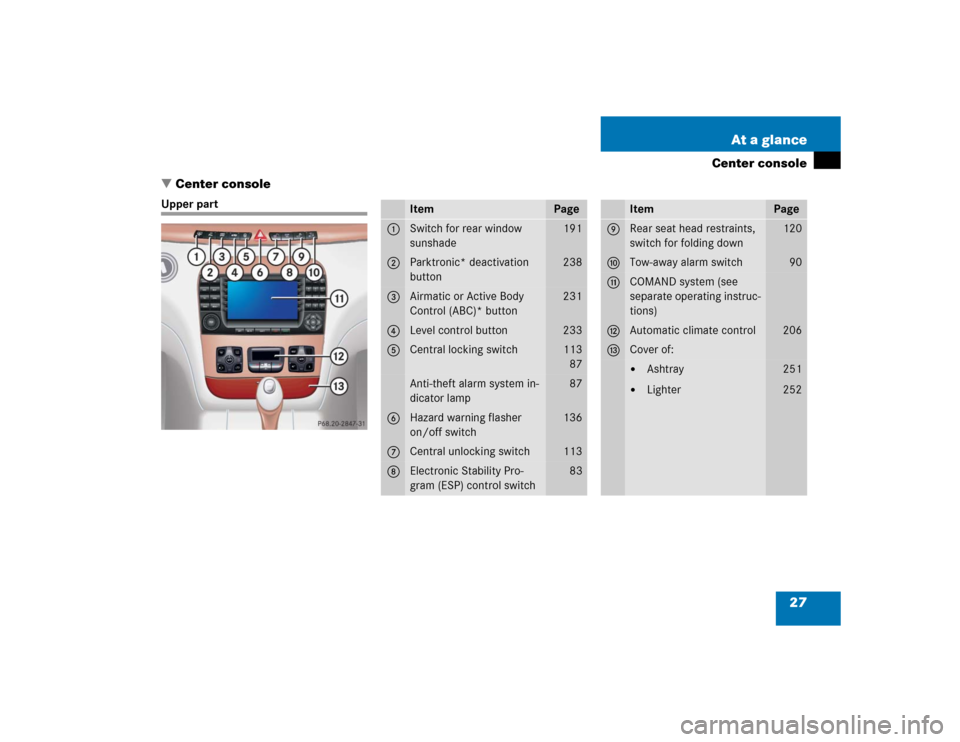
�Center console
Upper part
Item
Page
1
Switch for rear window
sunshade
191
2
Parktronic* deactivation
button
238
3
Airmatic or Active Body
Control (ABC)* button
231
4
Level control button
233
5
Central locking switch
113
87
Anti-theft alarm system in-
dicator lamp
87
6
Hazard warning flasher
on/off switch
136
7
Central unlocking switch
113
8
Electronic Stability Pro-
gram (ESP) control switch
83
Item
Page
9
Rear seat head restraints,
switch for folding down
120
a
Tow-away alarm switch
90
b
COMAND system (see
separate operating instruc-
tions)
c
Automatic climate control
206
d
Cover of:�
Ashtray
�
Lighter
251
252
Page 31 of 474
29 At a glance
Overhead control panel
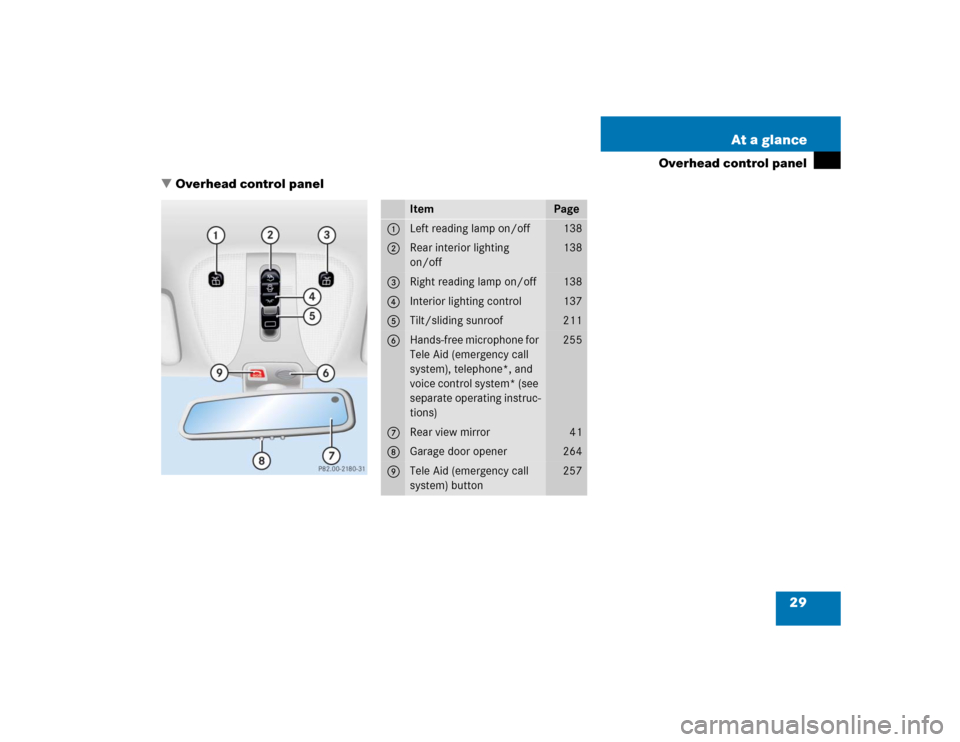
�Overhead control panel
Item
Page
1
Left reading lamp on/off
138
2
Rear interior lighting
on/off
138
3
Right reading lamp on/off
138
4
Interior lighting control
137
5
Tilt/sliding sunroof
211
6
Hands-free microphone for
Tele Aid (emergency call
system), telephone*, and
voice control system* (see
separate operating instruc-
tions)
255
7
Rear view mirror
41
8
Garage door opener
264
9
Tele Aid (emergency call
system) button
257
Page 51 of 474

49 Getting started
Driving
�
Release the brake pedal.
�
Carefully depress the accelerator
pedal.Once the vehicle is in motion, the automat-
ic central locking system engages and the
locking knobs drop down.
After a cold start, the automatic transmis-
sion shifts at a higher engine revolution.
This allows the catalytic converter to reach
its operating temperature earlier.
For more information, see “Driving instruc-
tions” (
�page 273).
Warning!
G
On slippery road surfaces, never downshift
in order to obtain braking action. This could
result in drive wheel slip and reduced vehi-
cle control. Your vehicle’s ABS will not pre-
vent this type of loss of control.!In order to avoid damaging the trans-
mission,�
wait for the gear selection process
to complete before setting the vehi-
cle in motion.
�
place the gear selector lever in
positionR only when the vehicle is
stopped.
!If you hear a warning signal and a mes-
sage appears in the multifunction dis-
play when driving off, you have
forgotten to release the parking brake.
Release the parking brake.!Do not run cold engine at high engine
speeds. Running a cold engine at high
engine speeds may shorten the service
life of the engine.
!Simultaneously depressing the acceler-
ator pedal and applying the brake re-
duces engine performance and causes
premature brake and drivetrain wear.iYou can open a locked door from the
inside. Open doors only when condi-
tions are safe to do so.
You can deactivate the automatic lock-
ing using the control system
(�page 168).
Page 86 of 474
84 Safety and SecurityDriving safety systemsWhen you switch off the ESP�
the ESP does not stabilize the vehicle
�
the engine output is not limited, which
allows the drive wheels to spin and
thus cut into surfaces for better grip
�
the traction control will still brake a
spinning wheel
�
the ESP continues to operate when you
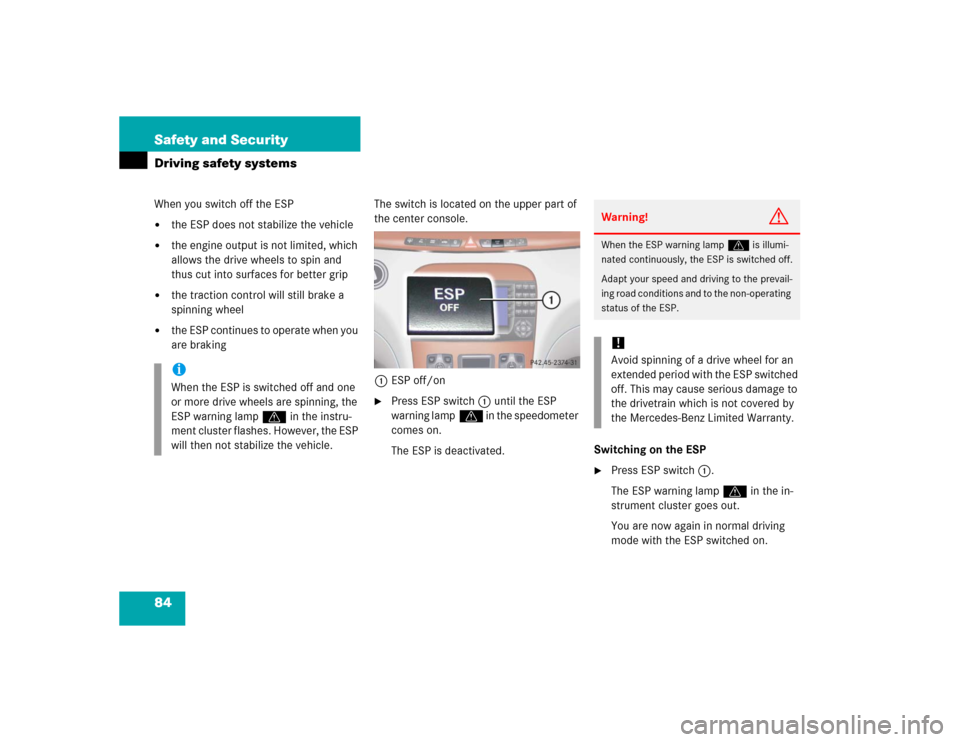
are brakingThe switch is located on the upper part of
the center console.
1ESP off/on
�
Press ESP switch1 until the ESP
warning lampv in the speedometer
comes on.
The ESP is deactivated.Switching on the ESP
�
Press ESP switch1.
The ESP warning lampv in the in-
strument cluster goes out.
You are now again in normal driving
mode with the ESP switched on.
iWhen the ESP is switched off and one
or more drive wheels are spinning, the
ESP warning lampv in the instru-
ment cluster flashes. However, the ESP
will then not stabilize the vehicle.
Warning!
G
When the ESP warning lampv is illumi-
nated continuously, the ESP is switched off.
Adapt your speed and driving to the prevail-
ing road conditions and to the non-operating
status of the ESP.!Avoid spinning of a drive wheel for an
extended period with the ESP switched
off. This may cause serious damage to
the drivetrain which is not covered by
the Mercedes-Benz Limited Warranty.
Page 107 of 474
105 Controls in detail
Locking and unlocking
Limiting opening height of trunk lid*
Vehicles with trunk lid opening/closing
system*:
The trunk lid opening height can be limited
when transporting goods on a roof rack
(e.g. presence of an MB sport luggage con-
tainer*). When activated, the trunk lid
opens to approximately the height of the
roof edge. �
Activate the limiting opening height of
trunk lid using the control system
(�page 169).
Closing the trunk
Closing the trunk from the inside auto-
matically*
In vehicles with trunk lid opening/closing
system* you can close the trunk from the
inside using the remote trunk lid switch.�
Press remote trunk lid switch
(�page 104) until the indicator lamp in
the switch goes out and trunk lid is
closed.
To interrupt the closing procedure:
�
Release remote trunk lid switch.iYou can also close the trunk by hand.
Warning!
G
Maintain sight of trunk area while operating
door mounted switch. Monitor the closing
procedure carefully to make sure no one is
in danger of being injured.
To interrupt the closing procedure, release
the door mounted remote trunk lid switch.
Even with the SmartKey or the SmartKey
with KEYLESS-GO* removed from the start-
er switch or the SmartKey with
KEYLESS-GO* removed from the vehicle,
the remote trunk lid switch can be operated.
Therefore, do not leave children unattended
in the vehicle, or with access to an unlocked
vehicle. Unsupervised use of vehicle equip-
ment may cause an accident and/or serious
personal injury.
��
Page 130 of 474

128 Controls in detailMemory function
You can store up to three different settings
per SmartKey or SmartKey with
KEYLESS-GO*.
The following settings are saved for each
stored position the driver's door: �
Driver’s seat and backrest position
�
Settings for the multicontour seat*
�
Steering wheel position
�
Exterior rear view mirror position
�
Automatic climate control
These key-dependent memory settings
can be deactivated if desired. For informa-
tion on key-dependent memory settings,
see “Setting key-dependency”
(
�page 169).The following settings are not key-depen-
dent. They are stored when using the but-
tons on the front passenger door:
�
Front passenger seat, backrest and
head restraint position, and settings for
multicontour seat*
!Prior to operating the vehicle, the driv-
er should check and adjust the seat
height, seat position fore and aft, and
seat backrest angle if necessary, to en-
sure adequate control, reach, and com-
fort. The head restraint should also be
adjusted for proper height. See also the
section on air bags (
�page 61) for
proper seat positioning.
In addition, adjust the steering wheel to
ensure adequate control, reach, opera-
tion and comfort. Both the inside and
outside rear view mirrors should be ad-
justed for adequate rear vision.
Fasten seat belts. Infants and small
children should be seated in a properly
secured restraint system that complies
with U.S. Federal Motor Vehicle Safety
Standards 213 and 225 and Canadian
Motor Vehicle Safety Standards 213
and 210.2.
Warning!
G
Do not activate the memory function while
driving. Activating the memory function
while driving could cause the driver to lose
control of the vehicle.
Page 143 of 474

141 Controls in detail
Instrument cluster
Coolant temperature gauge
During severe operating conditions,
e.g. stop-and-go traffic, the coolant tem-
perature may rise close to 248°F (120°C),
i.e. close to the red zone of the tempera-
ture gauge.
The engine should not be operated with
the coolant temperature above 248°F
(120°C), i.e. in the red zone of the coolant
temperature gauge. Doing so may cause
serious engine damage which is not cov-
ered by the Mercedes-Benz Limited War-
ranty.
Trip odometer�
Make sure you are viewing the trip
odometer display.
�
If it is not displayed, press the è or
ÿ button on the multifunction
steering wheel repeatedly until the trip
odometer appears (
�page 143).
�
Press and hold reset buttonJ
(�page 140) until the trip odometer is
reset.
Warning!
G
�
Driving when your engine is badly over-
heated can cause some fluids which
may have leaked into the engine com-
partment to catch fire. You could be se-
riously burned.
�
Steam from an overheated engine can
cause serious burns and can occur just
by opening the hood. Stay away from
the engine if you see or hear steam com-
ing from it.
Turn off the engine, get out of the vehicle
and do not stand near the vehicle until the
engine has cooled down.
iExcessive coolant temperature triggers
a warning in the multifunction display
(�page 359).
Page 144 of 474
142 Controls in detailInstrument clusterTachometer
The red marking on the tachometer de-
notes excessive engine speed.
To help protect the engine, the fuel supply
is interrupted if the engine is operated
within the red marking.
S 55 AMG
The tachometer of the S 55 AMG does not
have a red marking denoting excessive en-
gine speed.
To help protect the engine, the fuel supply
is interrupted if the engine is operated at
an excessive engine speed.
Outside temperature indicator
The outside temperature is displayed in
the instrument cluster (
�page 24). For in-
formation on how to select the unit of the
displayed temperature, i.e. degrees
Celsius (°C) or degrees Fahrenheit (°F),
see “Selecting temperature display mode”
(
�page 163).
The temperature sensor is located in the
front bumper area. Due to its location, the
sensor can be affected by road or engine
heat during idling or slow driving. There-
fore, the accuracy of the displayed temper-ature can only be verified by comparison to
a thermometer placed next to the sensor,
not by comparison to external displays
(e.g. bank signs, etc.).
When moving the vehicle into colder ambi-
ent temperatures (e.g. when leaving your
garage), you will notice a delay before the
lower temperature is displayed.
A delay also occurs when ambient temper-
atures rise. This prevents inaccurate tem-
perature indications caused by heat
radiated from the engine during idling or
slow driving.
Clock
The time is indicated in the instrument
cluster in the tachometer display.
You can adjust the clock using the
COMAND system. Refer to separate
COMAND operating instructions.
!Avoid driving at excessive engine
speeds, as it may result in serious en-
gine damage that is not covered by the
Mercedes-Benz Limited Warranty.
Warning!
G
The outside temperature indicator is not de-
signed to serve as an ice-warning device and
is therefore unsuitable for that purpose.
Indicated temperatures just above the freez-
ing point do not guarantee that the road sur-
face is free of ice. The road may still be icy,
especially in wooded areas or on bridges.