Page 193 of 474
192 Controls in detailAutomatic climate control*Deactivating�
Press buttone (
�page 183).
The indicator lamp on the button goes
out.
Air conditioning
The air conditioning is operational while
the engine is running and cools the interior
air to the temperature set by the operator. Deactivating
It is possible to deactivate the air condi-
tioning (cooling) function of the automatic
climate control system. The air in the
vehicle will then no longer be cooled or
dehumidified.
Automatic climate control panel
design A
�
Press button
° (
�page 183).
The indicator lamp on the button
comes on.
The cooling function switches off after
a short delay.
Automatic climate control panel
design B
�
Press button 2 (
�page 183).
The indicator lamp on the button goes
out.
The cooling function switches off after
a short delay.
iIf you keep button e pressed, the
side windows and panorama roof with
power tilt/sliding panel* will return to
their previous position.
iCondensation may drip out from under-
neath the vehicle. This is normal and
not an indication of a malfunction.Warning!
G
If you turn off the cooling function, the
vehicle will not be cooled when weather
conditions are warm. The windows can fog
up more quickly. Window fogging may
impair visibility and endanger you and
others.
Page 194 of 474

193
Controls in detail
Automatic climate control*
Activating
Moist air can fog up the windows. You can
dehumidify the air with the air condi-
tioning.
Automatic climate control panel
design A�
Press button
° (
�page 183) again.
The indicator lamp on the button goes
out.
The cooling function is switched on.
Automatic climate control panel
design B
�
Press button 2 (
�page 183) again.
The indicator lamp on the button
comes on.
The cooling function is switched on.
The air conditioning uses the refrigerant
R134a. This refrigerant is free of CFCs
which are harmful to the ozone layer. Residual heat and ventilation
(available on automatic climate control
panel design A only)
With the engine switched off, it is possible
to continue to heat or ventilate the interior
for up to 30 minutes. This feature makes
use of the residual heat produced by the
engine.
Activating�
Switch off the ignition (
�page 58).
�
Press button
° (
�page 183).
The indicator lamp on the button
comes on. Deactivating
�
Press button
° (
�page 183).
The indicator lamp on the button goes
out.
The residual heat is automatically turned
off:
�
when the ignition is switched on
�
after about 30 minutes
�
if the battery voltage drops
!If the air conditioning cannot be turned
on again, this indicates that the air
conditioning is losing refrigerant. The
compressor has turned itself off.
Have the air conditioning checked at
the nearest authorized Mercedes-Benz
Center.
iHow long the system will provide
heating depends on�
the coolant temperature
�
the temperature set by the operator
The blower will run at speed setting 1
regardless of the air distribution
control setting.
Page 200 of 474
199
Controls in detail
Audio system
Switching off�
Remove SmartKey from starter switch.
or
�
Press M button.
Adjusting the volume
�
Turn rotary control of N button.
The volume will increase or decrease
depending on the direction turned. Adjusting sound functions
The bass and treble functions are called up
by pressing the
O button.
Settings for bass and treble are stored sep-
arately for the AM and FM wavebands,
weather band, CD mode and telephone
mode.
Bass
�
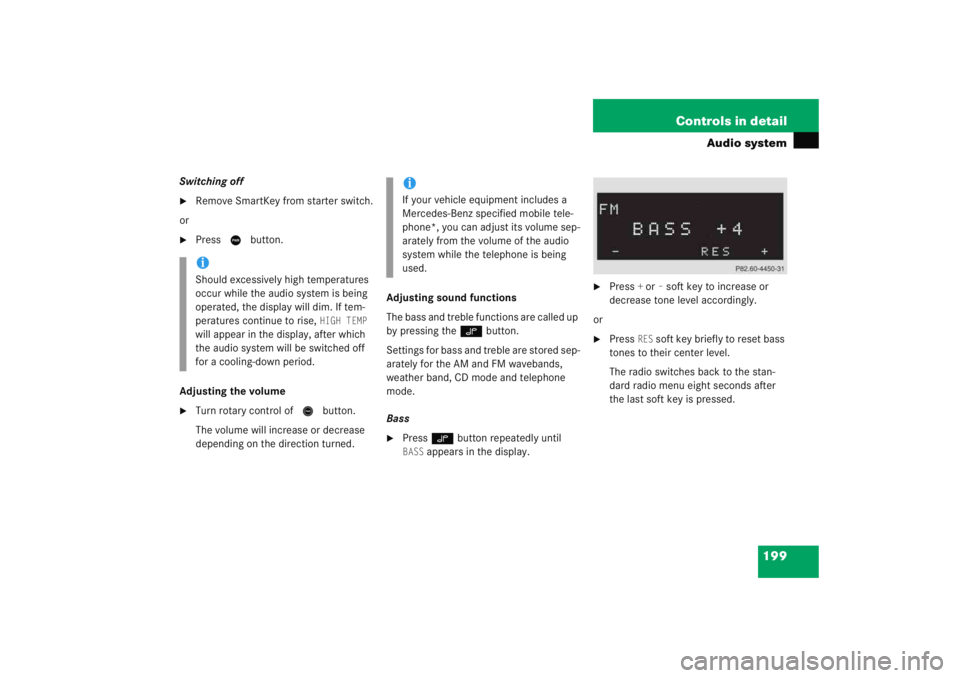
Press O button repeatedly until BASS
appears in the display.
�
Press
+ or
– soft key to increase or
decrease tone level accordingly.
or
�
Press
RES
soft key briefly to reset bass
tones to their center level.
The radio switches back to the stan-
dard radio menu eight seconds after
the last soft key is pressed.
iShould excessively high temperatures
occur while the audio system is being
operated, the display will dim. If tem-
peratures continue to rise,
HIGH TEMP
will appear in the display, after which
the audio system will be switched off
for a cooling-down period.
iIf your vehicle equipment includes a
Mercedes-Benz specified mobile tele-
phone*, you can adjust its volume sep-
arately from the volume of the audio
system while the telephone is being
used.
Page 297 of 474

296 OperationEngine compartmentTransmission fluid level
The transmission fluid level does not need
to be checked. If you notice transmission
fluid loss or gear shifting malfunctions,
have an authorized Mercedes-Benz Center
check the transmission.
Coolant level
The engine coolant is a mixture of water
and anticorrosion/antifreeze. To check
the coolant level, the vehicle must be
parked on level ground and the engine
must be cool.
For more information on coolant, see
“Coolants” (
�page 432).
Warning!
G
In order to avoid any possibly serious burns:�
Use extreme caution when opening the
hood if there are any signs of steam or
coolant leaking from the cooling system,
or if the coolant temperature display
indicates that the coolant is overheated.
�
Do not remove pressure cap on coolant
reservoir if coolant temperature is
above 158°F (70°C). Allow engine to
cool down before removing cap. The
coolant reservoir contains hot fluid and
is under pressure.
�
Using a rag, slowly open the cap
approximately
1/2 turn to relieve ex-
cess pressure. If opened immediately,
scalding hot fluid and steam will be
blown out under pressure.
�
Do not spill antifreeze on hot engine
parts. Antifreeze contains ethylene gly-
col which may ignite and burn if it comes
into contact with hot engine parts.
Page 360 of 474
359
Practical hints
What to do if …
Display symbol
Display message
Possible cause
Possible solution
B
Coolant
Check level
The coolant level is too low.
�
Add coolant (
�page 296).
�
If you have to add coolant frequently,
have the cooling system checked by
an authorized Mercedes-Benz Center.
Warning!
G
Do not spill antifreeze on hot engine parts.
Antifreeze contains ethylene glycol which
may burn if it comes into contact with hot
engine parts. You can be seriously burned.
!Do not ignore the low engine coolant
level warning. Extended driving with
the message and symbol displayed
may cause serious engine damage not
covered by the Mercedes-Benz Limited
Warranty.
Do not drive without sufficient amount
of coolant in the cooling system. The
engine will overheat causing major
engine damage.
Page 362 of 474
361
Practical hints
What to do if …
Display symbol
Display message
Possible cause
Possible solution
•
Coolant
Stop, engine off!
The poly-V-belt could be broken.
�
Stop immediately and check the
poly-V-belt.
If it is broken:
�
Do not continue to drive. Otherwise the
engine will overheat due to an
inoperative water pump which may
result in damage to the engine. Notify an
authorized Mercedes-Benz Center.
If it is intact:
�
Do not continue to drive the vehicle with
this message displayed. Doing so could
result in serious engine damage that is
not covered by the Mercedes-Benz
Limited Warranty.
�
Observe the coolant temperature gauge
(�page 24).
�
Drive immediately to the nearest
authorized Mercedes-Benz Center.
Coolant
Visit workshop.
The cooling fan for the coolant is
malfunctioning.
�
Observe the coolant temperature gauge.
�
Have the fan replaced as soon as
possible.
Page 427 of 474
426 Technical dataFuels, coolants, lubricants, etc.CapacitiesVehicle components and their respective
lubricants must match. Therefore use only
brands tested and approved by
Mercedes-Benz. Please refer to the Factory Approved Service Products
pamphlet, or inquire at your authorized
Mercedes-Benz Center.
Model
Capacity
Fuels, coolants, lubricants, etc.
Engine with oil filter
C230Kompressor
C320
5.8 US qt (5.5 l)
7.9 US qt (7.5 l)
approved engine oils
Automatic transmission
8.5 US qt (8.0 l)
MB Automatic Transmission Fluid
Manual transmission
1.3 US qt (1.2 l)
MB Manual Transmission Oil
Rear axle
1.2 US qt (1.1 l)
Hypoid gear oil SAE 85 W 90
Power steering
approx. 1.1 US qt (1.0 l)
MB Power Steering Fluid (Pentosin CHF 11S)
Front wheel hubs
approx. 2.1 oz (60 g) each
High temperature roller bearing grease
Cooling system
C230Kompressor
C320
approx. 5.9 US qt (5.6 l)
approx. 6.8 US qt (6.4 l)
MB 325.0 Anticorrosion/Antifreeze Agent
Page 433 of 474

432 Technical dataFuels, coolants, lubricants, etc.Hot weather performance
At ambient temperatures above 95°F
(35°C) start times may increase and be
accompanied by a rough idle following the
start.
Cruising range
E85 fuel contains less energy per gallon
than gasoline. To ensure that engine per-
formance with Ethanol fuel is similar to
that when using gasoline, the engine must
burn more Ethanol fuel. As a result, it is to
be expected that the fuel consumption will
increase when using E85 compared to
gasoline operation.
Maintenance
Please inform your authorized
Mercedes-Benz Center if you use or have
used E85 fuel when your vehicle is deliv-
ered for maintenance or repairs.
Coolants
The engine coolant is a mixture of water
and anticorrosion/antifreeze, which
provides:�
Corrosion protection
�
Freeze protection
�
Boiling protection (by increasing the
boiling point)
The cooling system was filled at the factory
with a coolant providing freeze protection
to approximately -22°F (-30°C) and corro-
sion protection.
If the antifreeze mixture is effective to
-22°F (-30°C), the boiling point of the cool-
ant in the pressurized cooling system is
reached at approximately 266°F (130°C). The coolant solution must be used
year-round to provide the necessary corro-
sion protection and increase boil-over pro-
tection. Refer to Maintenance Booklet for
replacement interval.
Coolant system design and coolant used
determine the replacement interval. The
replacement interval published in the
Maintenance Booklet is only applicable if
MB 325.0 anticorrosion/antifreeze solu-
tion or other Mercedes-Benz approved
products of equal specification (see Facto-
ry Approved Service Products pamphlet)
are used to renew the coolant concentra-
tion or bring it back up to the proper level.
To provide important corrosion protection,
the solution must be at least 45% anticor-
rosion/antifreeze (equivalent to freeze
protection to approximately - 22°F
[-30°C]).
iUse of E85 may reduce your driving
range.


