Driving tips28 5
1
2
3
4
5
6
7
8
9
Hard-packed snow and ice offer the
worst tire traction. On these surfaces,
it’s very easy to lose control. On wet
ice, for example, the traction is so
poor that you will even have difficulty
accelerating. And if you do get mov-
ing, poor steering and difficult brak-
ing can easily cause you to slide out
of control.
Driving in waterLight rain causes no special off-road
driving problems. However, heavy
rain can cause flash flooding, and
flood waters demand extreme cau-
tion.
Find out how deep the water is
before you drive through it. If it’s
deep enough to cover your wheel
bearing hubs, axles, or exhaust pipe,
don’t try it, You probably won’t get
through. Also, water that deep can
damage your axle and other vehicle
parts.
If the water isn’t too deep, then drive
through slowly. At fast speeds, water
can splash on your ignition system
and your vehicle can stall. Stalling
can also occur if your tailpipe goes
underwater. As long as your tailpipe
is underwater, you will not be able to
start your engine. When you go
through water, remember that it may
take you longer to stop when your
brakes are wet.If you have driven through water that
was deep enough to cover your
wheel bearing hubs, it may be a
good idea to have an Authorized Kia
dealer or other competent service
center repack your front wheel bear-
ings and examine your rear-end fluid
for evidence of water.
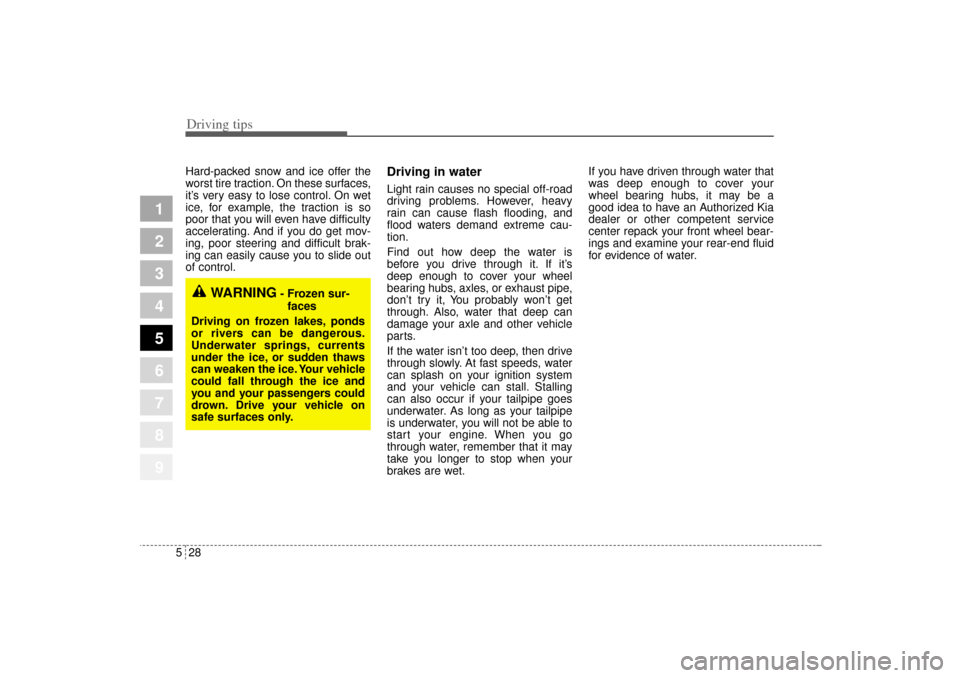
WARNING
- Frozen sur-
faces
Driving on frozen lakes, ponds
or rivers can be dangerous.
Underwater springs, currents
under the ice, or sudden thaws
can weaken the ice. Your vehicle
could fall through the ice and
you and your passengers could
drown. Drive your vehicle on
safe surfaces only.
KM CAN (ENG) 5.qxd 9/13/2004 4:48 PM Page 28
743
Maintenance
1
2
3
4
5
6
7
8
9
Tread wear
The tread wear grade is a compara-
tive rating based on the wear rate of
the tire when tested under controlled
conditions on a specified govern-
ment test course. For example, a tire
graded 150 would wear one-and-a-
half times as well on the government
course as a tire graded 100.
The relative performance of tires
depends upon the actual conditions
of their use. However, performance
may differ from the norm because of
variations in driving habits, service
practices and differences in road
characteristics and climate.
These grades are molded on the
side-walls of passenger vehicle tires.
The tires available as standard or
optional equipment on Kia vehicles
may vary with respect to grade.Traction - A, B & C
The traction grades, from highest to
lowest, are A, B and C. The grades
represent the tires ability to stop on
wet pavement as measured under
controlled conditions on specified
government test surfaces of asphalt
and concrete. A tire marked C may
have poor traction performance.
Temperature -A, B & C
The temperature grades are A (the
highest), B and C. The grades repre-
sent the tire’s resistance to the gener-
ation of heat and its ability to dissipate
heat when tested under controlled
conditions on a specified indoor labo-
ratory test wheel.
Sustained high temperature can
cause the material of the tires to
degenerate and reduce tires life, and
excessive temperature can lead to
sudden tires failure. Grade C corre-
sponds to a level of performance
which all passenger vehicle tires
must meet under the Federal Motor
Vehicle Safety Standard No. 109.
Grades A and B represent higher lev-
els of performance on the laboratory
test wheel than the minimum required
by the law.
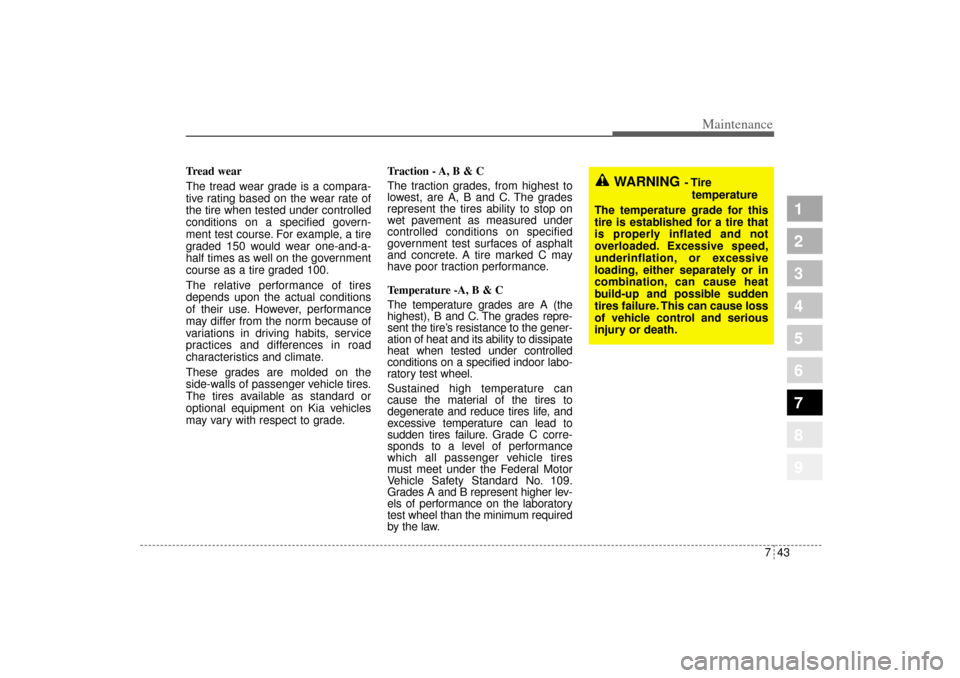
WARNING
- Tire
temperature
The temperature grade for this
tire is established for a tire that
is properly inflated and not
overloaded. Excessive speed,
underinflation, or excessive
loading, either separately or in
combination, can cause heat
build-up and possible sudden
tires failure. This can cause loss
of vehicle control and serious
injury or death.
KM CAN (ENG) 7.qxd 9/13/2004 4:47 PM Page 43