Page 217 of 318
Driving tips
20
5
1 23456789
Parking on hills
Generally, you should not park your
vehicle, with a trailer attached, on a
hill. People can be seriously or fatal-
ly injured, and both your vehicle and
the trailer can be damaged if they
begin a downhill trajectory. However, if you ever have to park
your trailer on a hill, here’s how to doit:
1. Apply your brakes, but don’t shift
into gear.
2. Have someone place chocks under the trailer wheels.
3. When the wheel chocks are in place, release the brakes until the
chocks absorb the load.
4. Reapply the brakes. Apply your parking brake, and then shift to R
(Reverse) for a manual transaxle
or P (Park) for an automatic
transaxle.
5. Release the brakes.
When you are ready to leave after parking on a hill
1. With the manual transaxle in Neutral or automatic transaxle in P
(Park), apply your brakes and hold
the brake pedal down while you:
and
2. Slowly remove your foot from the brake pedal.
3. Drive slowly until the trailer is clear of the chocks.
4. Stop and have someone pick up and store the chocks.
WARNING - Parking brake
It can be dangerous to get out of
your vehicle if the parking brake
is not firmly set.
If you have left the engine run-
ning, the vehicle can move sud-
denly. You or others could be
seriously or fatally injured.
WARNING - Parking on a
hill
Parking your vehicle on a hill
with a trailer attached could
cause serious injury or death,
should the trailer break lose.
Page 237 of 318
In case of an emergency
16
6
1 23456789
Towing with a vehicle other
than a tow truck
If towing is necessary, we recom-
mend you to have it done by an
Authorized Kia dealer or a commer-
cial tow truck service.
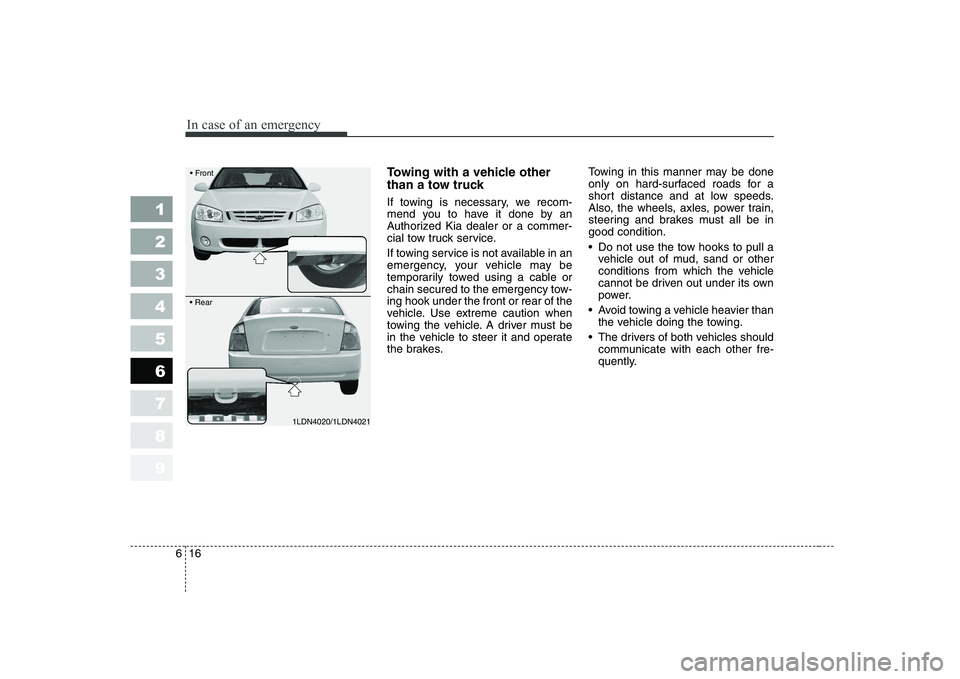
If towing service is not available in an
emergency, your vehicle may be
temporarily towed using a cable or
chain secured to the emergency tow-ing hook under the front or rear of the
vehicle. Use extreme caution when
towing the vehicle. A driver must be
in the vehicle to steer it and operate
the brakes. Towing in this manner may be done
only on hard-surfaced roads for a
short distance and at low speeds.
Also, the wheels, axles, power train,
steering and brakes must all be ingood condition.
Do not use the tow hooks to pull a
vehicle out of mud, sand or other
conditions from which the vehicle
cannot be driven out under its own
power.
Avoid towing a vehicle heavier than the vehicle doing the towing.
The drivers of both vehicles should communicate with each other fre-
quently.
1LDN4020/1LDN4021
Page 239 of 318
In case of an emergency
18
6
1 23456789
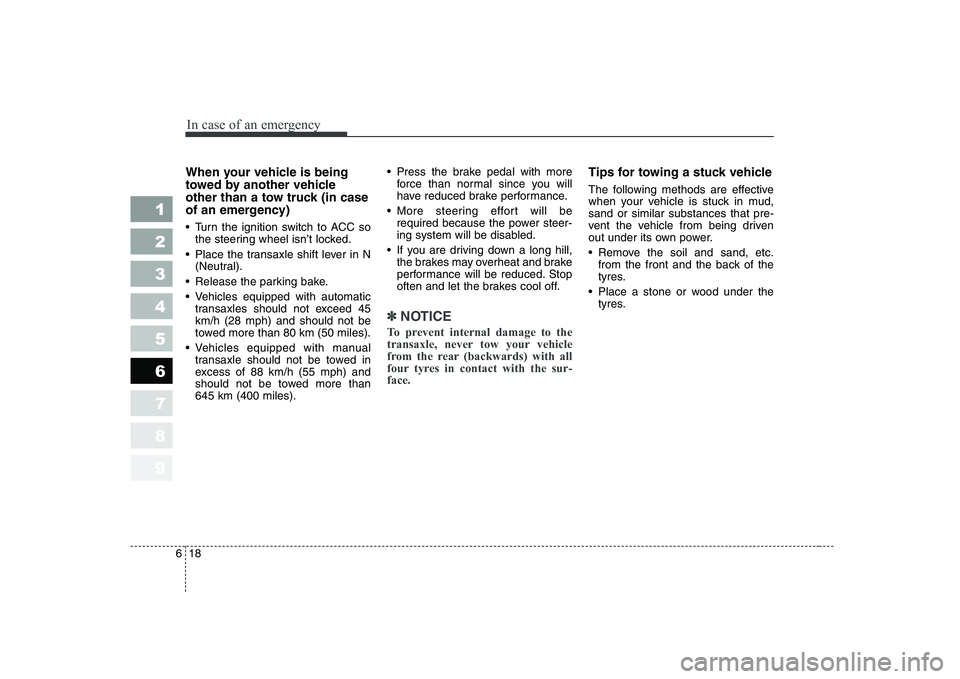
When your vehicle is being
towed by another vehicle
other than a tow truck (in case
of an emergency)
Turn the ignition switch to ACC so
the steering wheel isn’t locked.
Place the transaxle shift lever in N (Neutral).
Release the parking bake.
Vehicles equipped with automatic transaxles should not exceed 45 km/h (28 mph) and should not be
towed more than 80 km (50 miles).
Vehicles equipped with manual transaxle should not be towed in
excess of 88 km/h (55 mph) and
should not be towed more than645 km (400 miles). Press the brake pedal with more
force than normal since you will
have reduced brake performance.
More steering effort will be required because the power steer-
ing system will be disabled.
If you are driving down a long hill, the brakes may overheat and brake
performance will be reduced. Stop
often and let the brakes cool off.
✽✽ NOTICE
To prevent internal damage to the
transaxle, never tow your vehicle
from the rear (backwards) with all
four tyres in contact with the sur-face.
Tips for towing a stuck vehicle
The following methods are effective
when your vehicle is stuck in mud,sand or similar substances that pre-
vent the vehicle from being driven
out under its own power.
Remove the soil and sand, etc. from the front and the back of the
tyres.
Place a stone or wood under the tyres.
Page 245 of 318
1 234567891 23456789
10
Maintenance services / 7-3 Normal maintenance schedule / 7-5
Maintenance under severe usage conditions / 7-11
Owner maintenance / 7-13Engine compartment / 7-16
Engine oil and oil filter / 7-19Engine cooling system / 7-22Brakes and clutch / 7-25Parking brake / 7-26Drive belts / 7-27
Power steering / 7-28
Steering wheel / 7-29Manual transaxle / 7-30Automatic transaxle / 7-32Lubricants and fluids / 7-35
Fuel filter / 7-36
Air cleaner / 7-37
Air conditioner air filter / 7-39
Wiper blades / 7-41
Maintenance
Page 248 of 318
Maintenance
4
7
Scheduled maintenance serv- ice
Follow Normal Maintenance
Schedule if the vehicle is usually
operated where none of the following
conditions apply. If any of the following
conditions apply, follow Maintenance
Under Severe Usage Conditions.
Repeated short distance driving.
Driving in dusty conditions or
sandy areas.
Extensive use of brakes.
Driving in areas where salt or other corrosive materials are being used.
Driving on rough or muddy roads.
Driving in mountainous areas.
Extended periods of idling or low speed operation.
Driving for a prolonged period in cold temperatures and/or extreme-
ly humid climates.
More than 50% driving in heavy city traffic during hot weather
above 32°C (90°F).If your vehicle is operated under the
above conditions, you shouldinspect, replace or refill more fre-quently than the following Normal
Maintenance Schedule. After 96month or 120,000 km (80,000 miles)continue to follow the prescribed maintenance intervals.
1 23456789
Page 250 of 318

Maintenance
6
7
NORMAL MAINTENANCE SCHEDULE - FOR AUSTRALIA (cont.)
1 23456789
I : Inspect and if necessary, adjust, correct, clean or replace.
R : Replace or change. *3
: Inspect the cooling system every 500 km or before starting a long trip.
*4 : When adding coolant, use only a qualified coolant additive for your vehicle and never mix hard water in the
coolant filled at the factory. An improper coolant mixture can result in serious malfunction or engine damage.
MAINTENANCE
INTERVALSNumber of months or driving distance, whichever comes first
Months 12 24 36 48 60 72 84 96
Km×1,000 15 30 45 60 75 90 105 120
Cooling system* 3
(including hoses and cap) Engine coolant* 4
Battery condition I I I I I I I I
All electrical systems III IIIII
(including the light bulbs and switchs)
Brake lines, hoses and connections I I I I I I I I
Brake pedal, clutch pedal I I I I
Parking brake I I I I I I I I
Brake/clutch fluid I R I R I R I R
Disc brakes and pads I I I I I I I I
Drum brakes and linings I I I I I I I I
Inspect “Coolant level adjustment and leak” every day
Inspect “Water pump” when replacing the drive belt or timing belt
At first, replace at 90,000 km or 60 months:
after that, replace every 45,000 km or 24 months
MAINTENANCE ITEM
Page 253 of 318
79
Maintenance
1 23456789
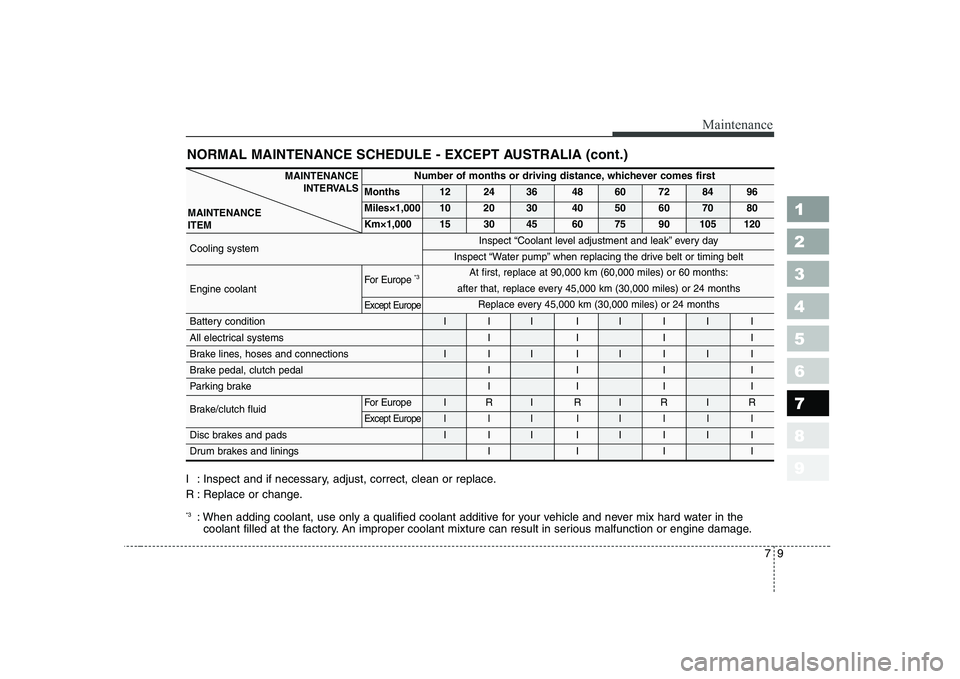
NORMAL MAINTENANCE SCHEDULE - EXCEPT AUSTRALIA (cont.)
I : Inspect and if necessary, adjust, correct, clean or replace.
R : Replace or change. *3: When adding coolant, use only a qualified coolant additive for your vehicle and never mix hard water in the
coolant filled at the factory. An improper coolant mixture can result in serious malfunction or engine damage.
MAINTENANCE
INTERVALS
MAINTENANCE ITEMNumber of months or driving distance, whichever comes first
Months 12 24 36 48 60 72 84 96
Miles×1,000 10 20 30 40 50 60 70 80
Km×1,000 15 30 45 60 75 90 105 120
Cooling system
For Europe *3
Engine coolant
Except Europe
Battery condition I I I I I I I I
All electrical systems I I I I
Brake lines, hoses and connections I I I I I I I I
Brake pedal, clutch pedal I I I I
Parking brake I I I I
Brake/clutch fluid
For EuropeIRI RIRIR
Except Europe I I I I I I I I
Disc brakes and pads I I I I I I I I
Drum brakes and linings I I I I
Inspect “Coolant level adjustment and leak” every day
Inspect “Water pump” when replacing the drive belt or timing belt
At first, replace at 90,000 km (60,000 miles) or 60 months:
after that, replace every 45,000 km (30,000 miles) or 24 months Replace every 45,000 km (30,000 miles) or 24 months
Page 256 of 318

Maintenance
12
7
1 23456789
Severe driving conditions
A : Repeated short distance driving
B : Extensive idling
C : Driving in dusty, rough roads
D : Driving in areas using salt or other corrosive
materials or in very cold weather
E : Driving in sandy areas F : More than 50 % driving in heavy city traffic during
hot weather above 32°C (90°F)
G : Driving in mountainous areas.
H : Towing a trailer
I : Driving for patrol car, taxi, commercial car or vehicle towing
J : Driving over 170km/h (106 mile/h)
Disc brakes and pads, calipers and rotors I C, D, E, G, H
Drum brakes and linings I C, D, E, G, H
Parking brake I C, D, G, H
Drive shaft and boots I C, D, E, F
Air conditioner air filter (if equipped) R C, E
MAINTENANCE ITEMMaintenance
operation Maintenance intervals
Driving condition
Inspect more frequently
depending on the condition
Inspect more frequently
depending on the condition
Inspect more frequently
depending on the condition
Inspect more frequently
depending on the condition
Replace more frequently
depending on the condition