Page 42 of 318
331
1 23456789
Knowing your vehicle
WARNING
To obtain maximum benefit from a pre-tensioner seat belt:
The seat belt must be worn correctly.
The seat belt must be adjusted to the correct position.CAUTION
When the pre-tensioner seat
belts are activated, a loud noise may be heard and fine dust,which may appear to be smoke,may be visible in the passenger compartment and are not toxic.
Although, it is harmless, the finedust may cause skin irritationand should not be breathed forprolonged periods. Wash your hands and face thoroughly afteran accident in which the airbagsand/or pre-tensioner seat belts were activated.
CAUTION
Because the sensor that acti- vates the SRS airbag is con-nected with pre-tensioner seatbelt, the SRS airbag warninglight on the instrument panel will blink or illuminate forapproximately 6 seconds afterthe ignition key has beenturned to the “ON” position, then the light should go off.
If the pre-tensioner seat belt is not working properly, thiswarning light will illuminateeven if there is no malfunction of SRS airbag system. If theSRS airbag warning light doesnot illuminate when the igni- tion key is turned to “ON” , orif it remains illuminated afterblinking or illuminating for approximately 6 seconds, or ifit illuminates while the vehicleis being driven, please have an authorized Kia dealerinspect the pre-tensioner seatbelt or SRS airbag system as soon as possible.
Page 44 of 318
333
1 23456789
Knowing your vehicle
We strongly recommend that the
driver and all passengers be proper-
ly restrained at all times by using the
safety belts provided with the vehi-
cle. Proper use of the safety belts
decreases the risk of severe injury or
death in accidents or sudden stops.
All seats (including or except the
centre rear seat) have lap/shoulder
belts. Inertial locks in the safety belt
retractors allow all of the lap/shoul-
der safety belts to remain unlocked
during normal vehicle operation. This
allows the occupants some freedom
of movement and increased comfort
while using the safety belts. If a force
is applied to the vehicle, such as a
strong stop, a sharp turn, or a colli-
sion, the safety belt retractors will
automatically lock the safety belts.Since the inertial locks do not require
a collision in order to lock up, you
may become aware of the safety
belts locking while braking or going
around sharp corners.
Always use the rear seat position(s)
to install your child restraint(s).
Never install a child restraint system in the front passenger position, as an
inflating airbag could cause serious
or fatal injury to a child in that posi-tion.
Safety belts provide the best restraintwhen:
The seatback is upright.
The occupant is sitting upright (not
slouched).
The lap belt is snug across the hips.
The shoulder belt is snug across the chest.
The knees are straight forward.
To help you remember to fasten your
safety belt, a warning light will come
on and a chime will sound. See
Safety Belt Warning Light and Chimeon page 3-36.
Page 47 of 318
Knowing your vehicle
36
3
1 23456789
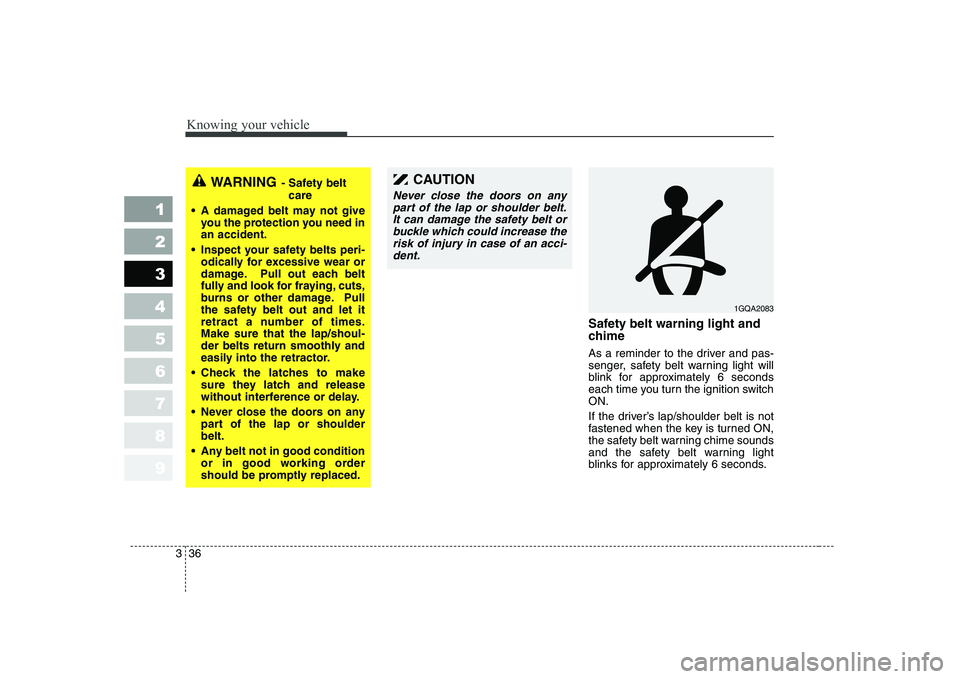
Safety belt warning light and
chime
As a reminder to the driver and pas-
senger, safety belt warning light will
blink for approximately 6 seconds
each time you turn the ignition switchON.
If the driver’s lap/shoulder belt is not
fastened when the key is turned ON,
the safety belt warning chime sounds
and the safety belt warning light
blinks for approximately 6 seconds.
1GQA2083
CAUTION
Never close the doors on any
part of the lap or shoulder belt.It can damage the safety belt orbuckle which could increase the risk of injury in case of an acci-dent.
WARNING - Safety belt
care
A damaged belt may not give you the protection you need in an accident.
Inspect your safety belts peri- odically for excessive wear or
damage. Pull out each belt
fully and look for fraying, cuts,
burns or other damage. Pull
the safety belt out and let it
retract a number of times.Make sure that the lap/shoul-
der belts return smoothly and
easily into the retractor.
Check the latches to make sure they latch and release
without interference or delay.
Never close the doors on any part of the lap or shoulderbelt.
Any belt not in good condition or in good working order
should be promptly replaced.
Page 58 of 318
347
1 23456789
Knowing your vehicle
Restraint of larger children
As children grow, they may need to
use new child-restraint systems,including larger child seats or boost-
er seats, which are appropriate for
their increased size.
A child who has outgrown available
child-restraint systems should use
the belts provided in the vehicle.When seated in the rear outboard
seats, the child should be restrained
by the lap/shoulder belt.
If the shoulder belt portion slightly
touches the child’s neck or face, tryplacing the child closer to the centre
of the vehicle. If the shoulder belt still
touches their face or neck they may
need to be returned to a child
restraint system. In addition, after-
market devices are available from
independent manufacturers which
help pull the shoulder belt down and
away from the child’s face or neck.Child restraint system (if equipped)
For small children and babies, the
use of a child seat or infant seat is
strongly recommended. This child
seat or infant seat should be of
appropriate size for the child andshould be installed in accordance
with the manufacturer's instructions.
It is further recommended that the
seat be placed in the vehicle's rear
seat since this can make an impor-
tant contribution to safety.
Children riding in the car should sit
on the rear seat and must always be
properly restrained to minimize the
risk of injury in an accident, sudden
stop or sudden maneuver. According
to accident statistics, children are
safer when properly restrained in therear seats than in the front seat.Larger children should use one of
the seat belts provided.WARNING
- Shoulder
belts on small children
Never allow a shoulder belt to be in contact with a child’s
neck or face while the vehicleis in motion.
If safety belts are not properly worn and adjusted, there is a
risk of death or serious injury
to such a child.
Page 68 of 318
357
1 23456789
Knowing your vehicle
➀Driver’s airbag
(see page 3- 59)
➁ Front passenger’s airbag
(if equipped, see page 3- 60)
➂ Side airbag
(if equipped, see page 3- 62)
➃ Curtain Airbag
(if equipped, see page 3- 62)
➄ Front impact sensor
(if equipped, see page 3- 64)
➅ Side impact sensor
(if equipped, see page 3- 64)
➆ SRS Control Module
(see page 3- 64)
■ Airbag inflation condition
(see page 3- 65)
■ Airbag non-inflation condition
(see page 3- 67)
■ Airbag warning light
(see page 3- 72)
■ Airbag service
(see page 3- 72)
■ Airbag warning label
(see page 3- 74) What your airbag system does
Driver’s airbag and front passenger’s airbag are designed to supplement
the protection offered by the safety
belt in certain frontal collisions.
Likewise, side airbag and curtainairbags are designed to supplement
the protection offered by the safety
belt in side collisions. Safety belts
are designed to reduce the injury of
the driver or passengers in case of
light impact or collision. However, to
help reduce impact on driver or pas-
sengers in a serious collision, seat
belts must also be correctly worn.
What your airbag system does not do The air bag system is designed to
supplement the protection offered by
the safety belt system. IT IS NOT A
SUBSTITUTE FOR THE SAFETY
BELT.
Page 70 of 318
359
1 23456789
Knowing your vehicle
Airbag system components
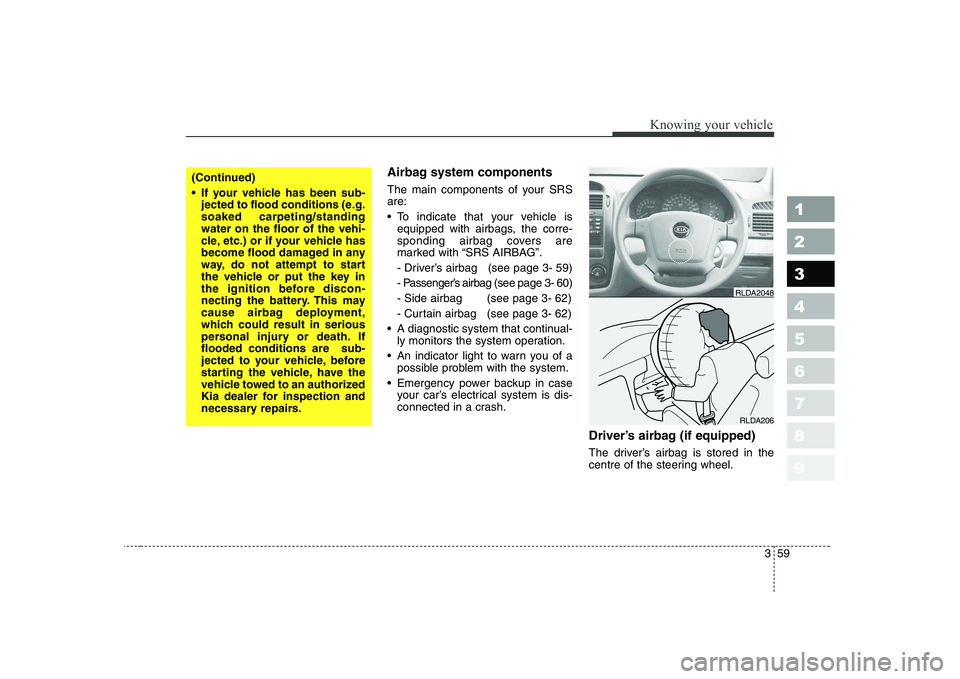
The main components of your SRS are:
To indicate that your vehicle isequipped with airbags, the corre-
sponding airbag covers are
marked with “SRS AIRBAG”.
- Driver’s airbag (see page 3- 59)
- Passenger’s airbag (see page 3- 60)
- Side airbag (see page 3- 62)
- Curtain airbag (see page 3- 62)
A diagnostic system that continual- ly monitors the system operation.
An indicator light to warn you of a possible problem with the system.
Emergency power backup in case your car’s electrical system is dis-
connected in a crash.
Driver’s airbag (if equipped)
The driver’s airbag is stored in the
centre of the steering wheel.
RLDA206
(Continued)
If your vehicle has been sub-jected to flood conditions (e.g. soaked carpeting/standingwater on the floor of the vehi-
cle, etc.) or if your vehicle has
become flood damaged in any
way, do not attempt to start
the vehicle or put the key in
the ignition before discon-
necting the battery. This may
cause airbag deployment,
which could result in serious
personal injury or death. Ifflooded conditions are sub-
jected to your vehicle, before
starting the vehicle, have the
vehicle towed to an authorized
Kia dealer for inspection and
necessary repairs.
RLDA2048
Page 78 of 318
367
1 23456789
Knowing your vehicle
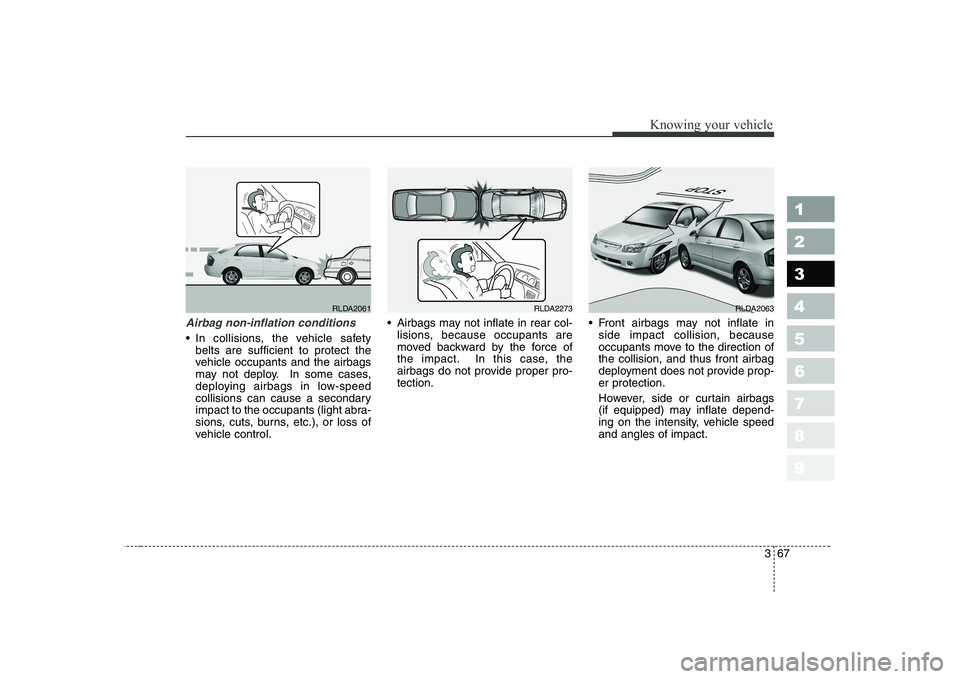
Airbag non-inflation conditions
In collisions, the vehicle safetybelts are sufficient to protect the
vehicle occupants and the airbags
may not deploy. In some cases,
deploying airbags in low-speed
collisions can cause a secondary
impact to the occupants (light abra-
sions, cuts, burns, etc.), or loss of
vehicle control. Airbags may not inflate in rear col-
lisions, because occupants are
moved backward by the force of
the impact. In this case, the
airbags do not provide proper pro-tection. Front airbags may not inflate in
side impact collision, because
occupants move to the direction ofthe collision, and thus front airbag
deployment does not provide prop-er protection.
However, side or curtain airbags
(if equipped) may inflate depend-
ing on the intensity, vehicle speedand angles of impact.
RLDA2273RLDA2061RLDA2063
Page 83 of 318

Knowing your vehicle
72
3
1 23456789
Airbag warning light
The purpose of airbag warning light
in your instrument panel is to alert
you of a potential problem with your
airbag - Supplemental RestraintSystem (SRS). When the ignition switch is turned
ON, the indicator light should blink or
illuminate for approximately 6 sec-
onds, then go off.
Have the system checked if:
The light does not turn on briefly
when you turn the ignition ON.
The light stays on after the engine starts.
The light comes on while the vehi- cle is in motion. Airbag (Supplemental
Restraint System) service
Your Supplemental Restraint System
is virtually maintenance-free. There
are no parts which you can service.
You must have the system serviced
under the following circumstances:
If an airbag ever inflates, the airbag
must be replaced. Do not try to
remove or discard the airbag by
yourself. This must be done by an
authorized Kia dealer.
If the airbag warning indicator light alerts you to a problem, have the
airbag system checked as soon as
possible. Otherwise, your airbag
system may be ineffective.
A-BAG-W