Page 219 of 318
Driving tips
22
5
LOADING YOUR VEHICLE - FOR AUSTRALIA
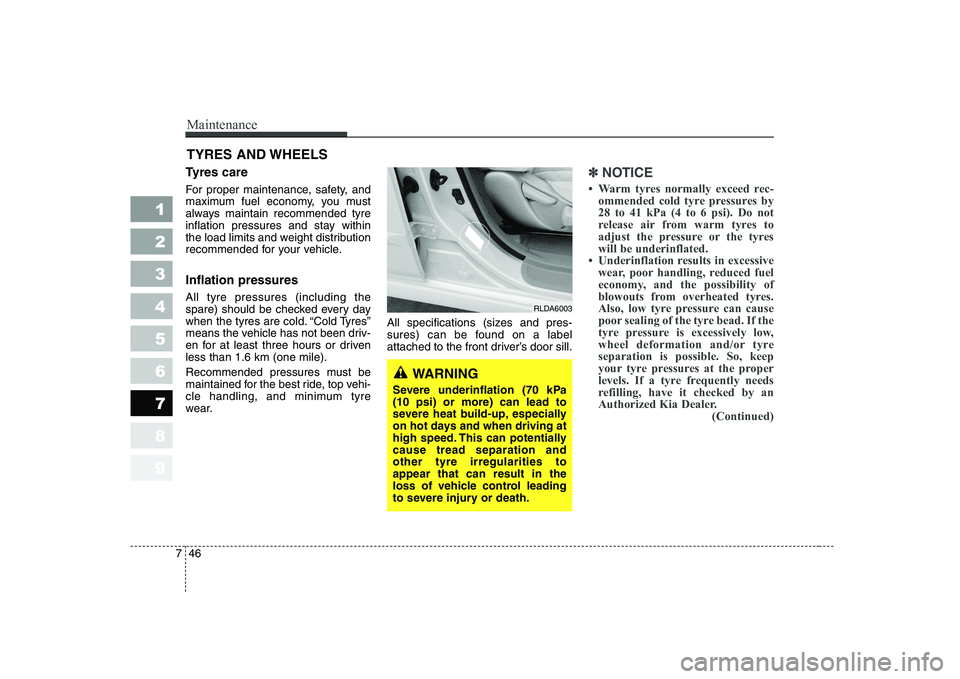
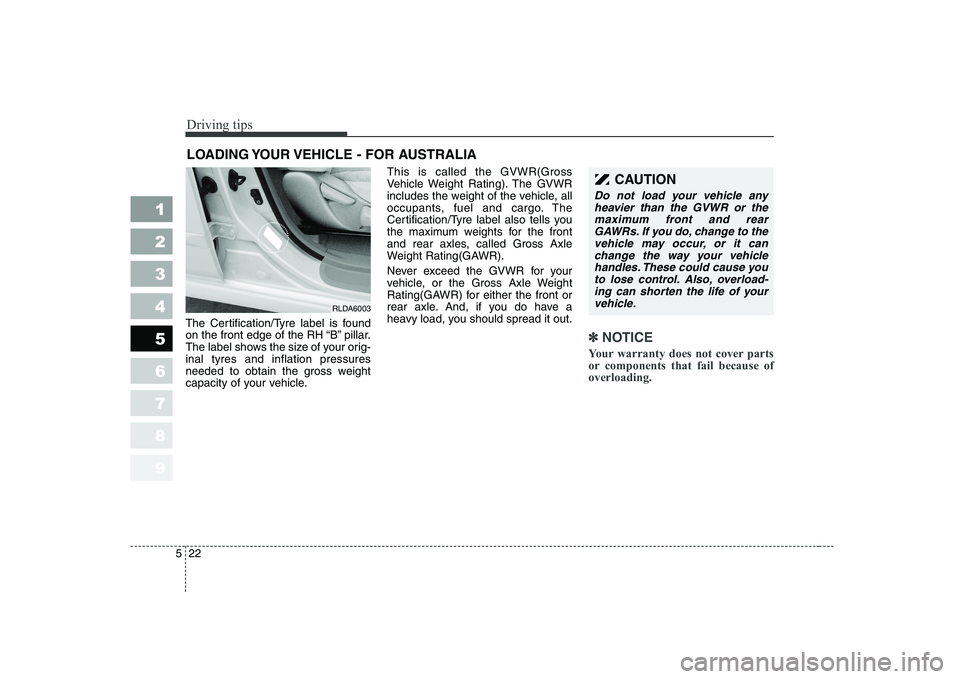
The Certification/Tyre label is found
on the front edge of the RH “B” pillar.
The label shows the size of your orig-inal tyres and inflation pressures
needed to obtain the gross weight
capacity of your vehicle. This is called the GVWR(Gross
Vehicle Weight Rating). The GVWR
includes the weight of the vehicle, all
occupants, fuel and cargo. The
Certification/Tyre label also tells you
the maximum weights for the front
and rear axles, called Gross Axle
Weight Rating(GAWR).
Never exceed the GVWR for your
vehicle, or the Gross Axle Weight
Rating(GAWR) for either the front or
rear axle. And, if you do have a
heavy load, you should spread it out.
✽✽
NOTICE
Your warranty does not cover parts
or components that fail because ofoverloading.
1 23456789
RLDA6003
CAUTION
Do not load your vehicle any heavier than the GVWR or themaximum front and rearGAWRs. If you do, change to the vehicle may occur, or it canchange the way your vehiclehandles. These could cause you to lose control. Also, overload-ing can shorten the life of yourvehicle.
Page 257 of 318
713
Maintenance
1 23456789
OWNER MAINTENANCE
Owner maintenance schedule
The following lists are vehicle checks and inspections that should be per-
formed by the owner or an
Authorized Kia Dealer at the fre-quencies indicated to help ensure
safe, dependable operation of your
vehicle.
Any adverse conditions should be
brought to the attention of your deal-
er as soon as possible.
These Owner Maintenance Checks
are generally not covered by war-
ranties and you may be charged for
labor, parts and lubricants used.
When you stop for fuel:
Check the engine oil level.
Check coolant level in coolant reservoir.
Check the windshield washer fluid level.
Look for low or under-inflated tyres.
While operating your vehicle:
Note any changes in the sound ofthe exhaust or any smell of
exhaust fumes in the vehicle.
Check for vibrations in the steering wheel. Notice any increased steer-
ing effort or looseness in the steer-
ing wheel, or change in its straight-ahead position.
Notice if your vehicle constantly turns slightly or “pulls” to one side
when traveling on smooth, levelroad.
When stopping, listen and check for strange sounds, pulling to one
side, increased brake pedal travel
or “hard-to-push” brake pedal.
If any slipping or changes in the operation of your transaxle occurs,
check the transaxle fluid level.
Check automatic transaxle P (Park) function.
Check parking brake.
Check for fluid leaks under your vehicle (water dripping from the air conditioning system after use is
normal).
WARNING
Be careful when checking your
engine coolant level when the
engine is hot. Scalding hot
coolant and steam may blow out
under pressure. This could
cause serious injury.
Page 290 of 318
Maintenance
46
7
1 23456789
TYRES AND WHEELS
Tyres care
For proper maintenance, safety, and
maximum fuel economy, you must
always maintain recommended tyre
inflation pressures and stay within
the load limits and weight distribution
recommended for your vehicle. Inflation pressures All tyre pressures (including the
spare) should be checked every day
when the tyres are cold. “Cold Tyres”
means the vehicle has not been driv-
en for at least three hours or drivenless than 1.6 km (one mile).
Recommended pressures must be
maintained for the best ride, top vehi-
cle handling, and minimum tyre
wear. All specifications (sizes and pres-
sures) can be found on a label
attached to the front driver’s door sill.
✽✽
NOTICE