2005 Hyundai Terracan automatic
[x] Cancel search: automaticPage 432 of 539
2
DRIVING YOUR HYUNDAI
19
!
(6) Since the driving torque is always
applied to the 4 wheels, the perfor- mance of the full-time 4WD vehicle is greatly affected by the condition of the tyres. Be sure to equip it withall four tyres of the same size and type.
o When replacement of any of the tyres or disc wheels is neces-sary, replace all of them.
o Rotate the tyres and check the tyre pressure at regular inter-vals.
WARNING:
Your vehicle is equipped with tyresdesigned to provide for safe ride and handling capability.Do not use a size and type of tyre and wheel that is different from the one that was originally installed on yourvehicle. It can affect the safety and performance of your vehicle, which could lead to handling failure orrollover and serious injury. When replacing the tyres, be sure to equip all four tyres with the tyre andwheel of the same size, type, tread, brand and load-carrying capacity. Ifyou nevertheless decide to equipyour vehicle with any tyre/wheel com- bination not recommended by Hyundai for off-road driving, youshould not use these tyres for high- way driving.
(7) The full-time 4WD vehicle cannot
be towed by an ordinary tow truck. Make sure that the vehicle is towedwith its four wheels raised off the ground.
o If the vehicle is towed with its
only two wheels raised off the ground, the 4WD system could be damaged.
o In unavoidable case, if the ve- hicle is being towed with all fourwheels on the ground, it shouldbe towed only forward direction with rope.
o Whilst towing, check the follow- ing items.
1. The ignition switch is in "ACC"
or "ON".
2. Place the shift lever in neutral (For Automatic Transmission, "N" position).
3. Release the parking brake. NOTE: To avoid serious damage to your 4WD vehicle, limit towing to 10 mph (15km/h) and not for more than 1mile (1.5km) at ANY TIME. (8) For speedometer test or inspection/
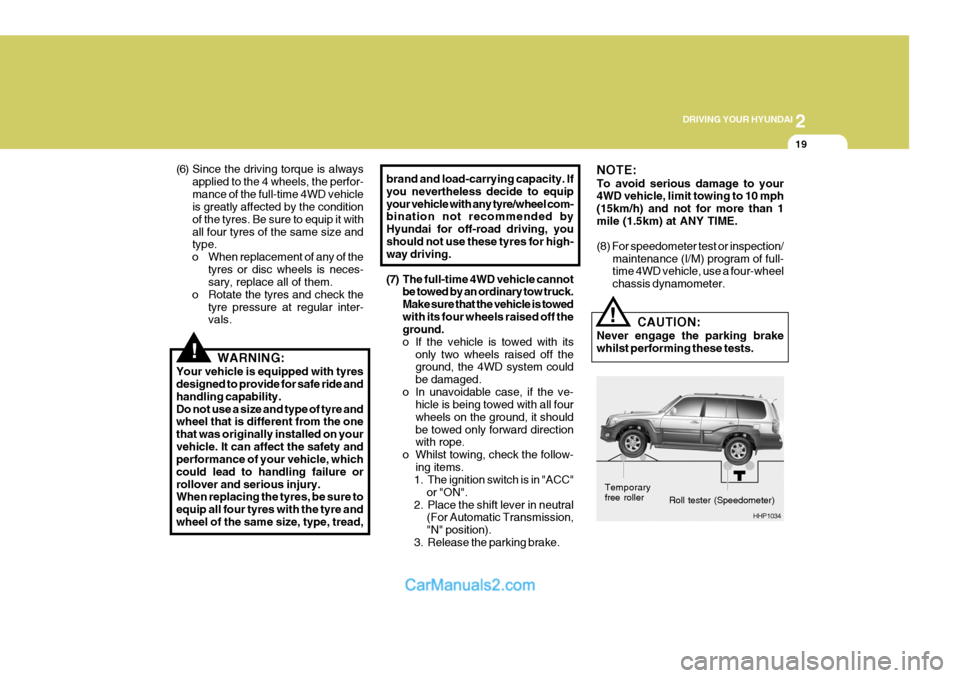
maintenance (I/M) program of full- time 4WD vehicle, use a four-wheel chassis dynamometer.
CAUTION:
Never engage the parking brakewhilst performing these tests.
Roll tester (Speedometer)
HHP1034
Temporary free roller
!
Page 443 of 539
2 DRIVING YOUR HYUNDAI
30
14. When going down a hill, shift into alower gear and use the engine brak- ing effect. When ascending a long grade, downshift the transmission to alower gear and reduce speed to reduce chances of engine over- loading and/or overheating.
15.If you have to stop whilst going uphill, do not hold the vehicle inplace by pressing on the accelera-tor. This can cause the automatic transmission to overheat. Use the parking brake or footbrake.
NOTE: When towing, check transmission fluid more frequently.
HPC200E1-E Trailer or Vehicle Towing Tips
1. Before towing, check towbar and
safety cable connections as well as proper operation of the trailer run- ning lights, brake lights, and turn signals.
2. Always drive your vehicle at a mod- erate speed (Less than 60 MPH).
3. Trailer towing requires more fuel than normal conditions.
4. To maintain engine braking effi-
ciency and electrical charging per-formance, do not use fifth gear (manual transmission).
5. Always secure items in the trailer to prevent load shift whilst driving.
6. Check the condition and air pres-
sure of all tyres on the trailer and your car. Low tyre pressure can seriously affect the handling. Also check the spare tyre.
7. The vehicle/trailer combination is more affected by crosswind andbuffeting.When being passed by a large ve- hicle, keep a constant speed and steer straight ahead. If there is toomuch wind buffeting slow down to get out of the other vehicle's air turbulence. 8. When parking your car and trailer,
especially on a hill, be sure to followall the normal precautions. Turn your front wheel into the curb, set the parking brake firmly, and putthe transmission in 1st or Reverse (manual) or Park (automatic). In addition, place wheel chocks at eachof the trailer's tyres.
9. If the trailer has electric brakes,
start your vehicle and trailer mov-ing, and then apply the trailer brake controller by hand to be sure the brakes are working. This lets youcheck your electrical connection at the same time.
10.During your trip, check occasion- ally to be sure that the load issecure, and that the lights and any trailer brakes are still working.
11.Avoid jerky starts, sudden accel- eration or sudden stops.
12.Avoid sharp turns and rapid lane changes.
13.Avoid holding the brake pedal down
too long or too frequently. This couldcause the brakes to overheat, re- sulting in reduced braking efficiency.
Page 446 of 539
3 IN CASE OF EMERGENCY
2
!WARNING:
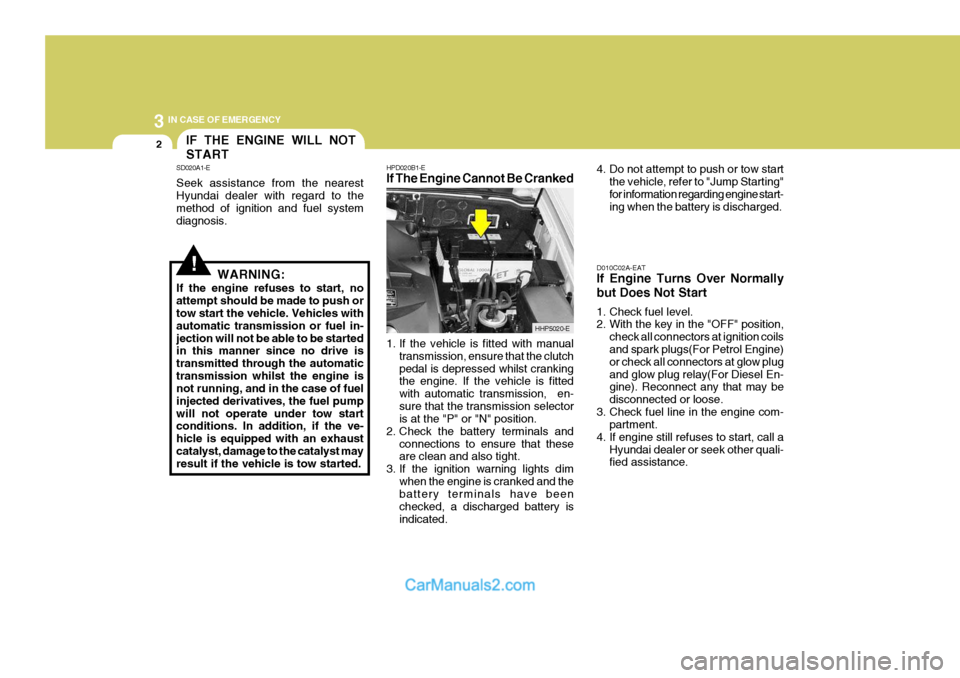
If the engine refuses to start, no attempt should be made to push or tow start the vehicle. Vehicles with automatic transmission or fuel in-jection will not be able to be started in this manner since no drive is transmitted through the automatictransmission whilst the engine is not running, and in the case of fuel injected derivatives, the fuel pumpwill not operate under tow start conditions. In addition, if the ve- hicle is equipped with an exhaustcatalyst, damage to the catalyst may result if the vehicle is tow started. HPD020B1-E If The Engine Cannot Be Cranked
1. If the vehicle is fitted with manual
transmission, ensure that the clutch pedal is depressed whilst cranking the engine. If the vehicle is fitted with automatic transmission, en-sure that the transmission selector is at the "P" or "N" position.
2. Check the battery terminals and
connections to ensure that theseare clean and also tight.
3. If the ignition warning lights dim
when the engine is cranked and thebattery terminals have been checked, a discharged battery isindicated. 4. Do not attempt to push or tow start
the vehicle, refer to "Jump Starting"for information regarding engine start- ing when the battery is discharged.
D010C02A-EAT If Engine Turns Over Normally but Does Not Start
1. Check fuel level.
2. With the key in the "OFF" position, check all connectors at ignition coilsand spark plugs(For Petrol Engine) or check all connectors at glow plugand glow plug relay(For Diesel En- gine). Reconnect any that may be disconnected or loose.
3. Check fuel line in the engine com- partment.
4. If engine still refuses to start, call a Hyundai dealer or seek other quali- fied assistance.
IF THE ENGINE WILL NOT START
SD020A1-E Seek assistance from the nearest Hyundai dealer with regard to the method of ignition and fuel system diagnosis.
HHP5020-E
Page 448 of 539

3 IN CASE OF EMERGENCY
4
!
1. Ensure that the booster battery is 12
volt type. If the booster battery is installed in another vehicle, ensure that the two vehicles are not touch- ing.
2. Turn off all unnecessary electrical equipment in both vehicles.
3. Ensure that the engine of the ve- hicle providing the jump start is run- ning prior to connection of the jump cables.
4. Connect the red jump cable to the positive (+) terminal of the boosterbattery and the other end to thepositive (+) terminal of the dis- charged battery.
5. Attach the black jump cable to the negative (-) terminal of the boosterbattery, and the other end to a ground point within the engine compartmentof the vehicle with the flat bat-tery. Do not connect to the negative bat- tery terminal of the flat battery sincesparks may be generated with the subsequent risk of explosion.
6. Raise the booster vehicle engine speed to 2,000 r.p.m. and start theengine of the vehicle with the flat battery. 7. Switch "ON" the main beam
headlamps before carefully remov-ing the jumper cables in the reverse order of attachment. Once the jumper cables have been removed,switch "OFF" the main beam headlamps.
CAUTION:
If the jump cable is incorrectly in- stalled, damage to the vehicle elec- trical system may occur, in particu- lar the electronic components suchas the Fuel Injection system com- puter and the Automatic transmis- sion computer. The battery mustnever be disconnected whilst the engine is running.
IF THE ENGINE OVERHEATS
HPD040A2-E If the temperature gauge indicates overheating:
1. Pull off the road and stop as soon as it is safe to do so.
2. Place the gear selector lever in "P"
(automatic), or neutral (manual trans- mission) and set the parking brake. If the air conditioning is on, turn it off.
3. If coolant is running out under the car or steam is coming out from underthe bonnet, stop the engine. Do not open the bonnet until the coolant hasstopped running or the steaming has stopped. If there is no visible loss of coolant and no steam, leave theengine running and check to be sure the engine cooling fan is operating. If the fan is not running, turn theengine off.
4. Check to see if the water pump drive
belt is missing. If it is not missing,check to see that it is tight. If the drive belt seems to be satisfactory, check for coolant leaking from theradiator, hoses or under the car. (If the air conditioning had been in use, it is normal for cold water to bedraining from it).
Page 451 of 539
3
IN CASE OF EMERGENCY
7
!
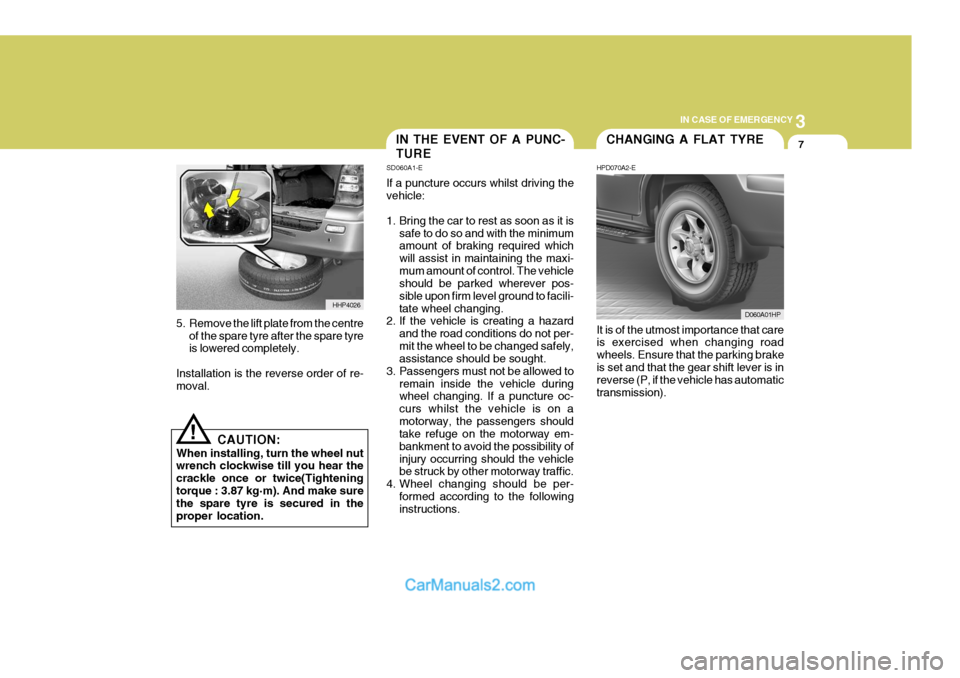
5. Remove the lift plate from the centre
of the spare tyre after the spare tyre is lowered completely.
Installation is the reverse order of re-moval.
CAUTION:
When installing, turn the wheel nutwrench clockwise till you hear the crackle once or twice(Tighteningtorque : 3.87 kg·m). And make sure the spare tyre is secured in the proper location. It is of the utmost importance that care is exercised when changing road wheels. Ensure that the parking brakeis set and that the gear shift lever is in reverse (P, if the vehicle has automatic transmission).
HHP4026
IN THE EVENT OF A PUNC- TURE
SD060A1-E If a puncture occurs whilst driving the vehicle:
1. Bring the car to rest as soon as it is
safe to do so and with the minimum amount of braking required which will assist in maintaining the maxi-mum amount of control. The vehicle should be parked wherever pos- sible upon firm level ground to facili-tate wheel changing.
2. If the vehicle is creating a hazard
and the road conditions do not per-mit the wheel to be changed safely, assistance should be sought.
3. Passengers must not be allowed to remain inside the vehicle duringwheel changing. If a puncture oc- curs whilst the vehicle is on amotorway, the passengers should take refuge on the motorway em- bankment to avoid the possibility ofinjury occurring should the vehicle be struck by other motorway traffic.
4. Wheel changing should be per- formed according to the followinginstructions.CHANGING A FLAT TYRE
HPD070A2-E
D060A01HP
Page 459 of 539
3
IN CASE OF EMERGENCY
15
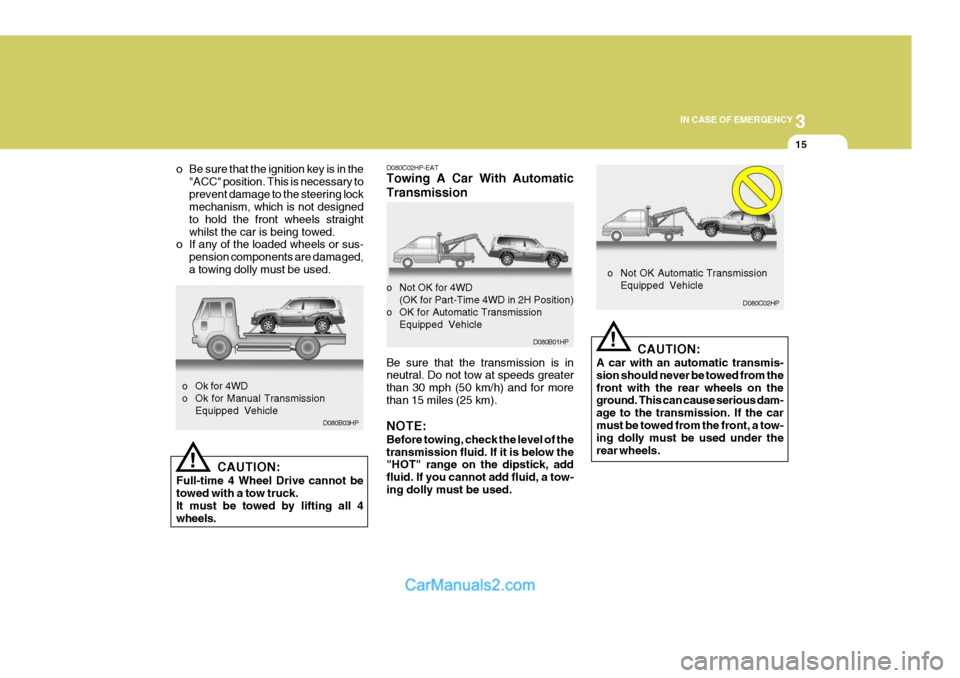
o Be sure that the ignition key is in the "ACC" position. This is necessary to prevent damage to the steering lock mechanism, which is not designed to hold the front wheels straightwhilst the car is being towed.
o If any of the loaded wheels or sus-
pension components are damaged,a towing dolly must be used. D080C02HP-EAT Towing A Car With Automatic Transmission Be sure that the transmission is in neutral. Do not tow at speeds greater than 30 mph (50 km/h) and for morethan 15 miles (25 km). NOTE: Before towing, check the level of the transmission fluid. If it is below the "HOT" range on the dipstick, add fluid. If you cannot add fluid, a tow-ing dolly must be used.
!
CAUTION:
A car with an automatic transmis- sion should never be towed from thefront with the rear wheels on the ground. This can cause serious dam- age to the transmission. If the carmust be towed from the front, a tow- ing dolly must be used under the rear wheels.
D080B03HP
o Ok for 4WD
o Ok for Manual Transmission
Equipped Vehicle
! CAUTION:
Full-time 4 Wheel Drive cannot be towed with a tow truck. It must be towed by lifting all 4 wheels.
o Not OK for 4WD (OK for Part-Time 4WD in 2H Position)
o OK for Automatic Transmission Equipped Vehicle
D080B01HP
o Not OK Automatic TransmissionEquipped Vehicle
D080C02HP
Page 460 of 539

3 IN CASE OF EMERGENCY
16
D080D02HP-EAT Emergency TowingFor emergency towing when no com- mercial yow vehicle is avaiable, attachchain or strap to one of the towing hooks under the front/rear of your car. Be very careful when attempting thisprocedure when the vehicle is on any unpaved surface to avoid damage to your vehicle.Nor should towing be attempted if the wheels, drive train, axles, steering or brakes are damaged. Before towing,be sure the transmission is in neutral and the key is in "ACC" (with the engine off) or in the "ON" position (withthe engine running). A driver must be in the towed car to steer it and operate the brakes.
D080B03HP
o Ok for 4WD
o Ok for Automatic or Manual Trans- mission Equipped Vehicle
!
CAUTION:
Full-time 4 Wheel Drive cannot be towed with a tow truck. It must be towed by lifting all 4wheels.
Front
HHP4035
HHP4036
Rear
Page 469 of 539
5VEHICLE MAINTENANCE REQUIREMENTS
2
NOTE:The inspection and testing of cer-
tain electronic fuel injection/engine management and automatic trans- mission control systems requirespecialised electronic equipment specifically designed for Hyundai vehicles. The use of general pur-pose electrical test equipment may result in damage to the control unit microprocessors.
DF020C2-E
Specified Scheduled Procedures
The specified scheduled procedures
are listed in the maintenance chartsbeginning at page 5-3. The operationsspecified must be performed at the time or mileage intervals shown irre- spective of whether the mileage inter-val has been reached before the speci- fied time interval.
Certain lubricants and components
degrade with both time and mileage(eg, engine oil and brake fluid) and therefore it is not permissable to basethe maintenance schedule upon mile- age alone. It is strongly recommended DF020F1-E
SERVICE HISTORY
It is important that all scheduled main-
tenance services are recorded in the warranty and service passport to en- sure that proof of maintenance is avail- able when warranty service is required.
that the maintenance operations areperformed by a Hyundai dealer be-cause of the need for specialized knowl- edge and tooling and to ensure that no possibility of invalidating the manufac-turers warranty exists.
The maintenance schedules relate to
vehicles operated under normal condi-tions, vehicles which are operated under adverse conditions will require more frequent maintenance which isdescribed at page 5-6. NOTE:
Service schedules may change de-
pending on individual country needs. Please ask your localHyundai dealer for a copy of the service schedule that relates to that country.MAINTENANCE AND SER- VICING REQUIREMENTS
DF020A1-E To ensure the continued reliability and safety of the vehicle, certain routine maintenance operations are requiredat specific mileage or time intervals.It is the responsibility of the vehicleowner to ensure that the maintenanceschedules shown in both this Owner's Manual and the Warranty and Service Passport are adhered to.The new vehicle warranty may beinvalidated if the routine maintenanceoperations are not performed in line with the recommendations outlined and the safety and durability of the vehicleadversely affected.It is recommended that all mainte-nance operations with the exception ofthe daily operating checks are en- trusted to a Hyundai dealer to ensure that the latest repair and maintenanceprocedures and specialized servicing tools are employed. In addition, the use of genuine Hyundai replacementparts will ensure that the vehicle safety and performance will not be compro- mised.