2005 Hyundai Matrix diesel
[x] Cancel search: dieselPage 86 of 407
DRIVING YOUR HYUNDAI
2- 14 NOTE:
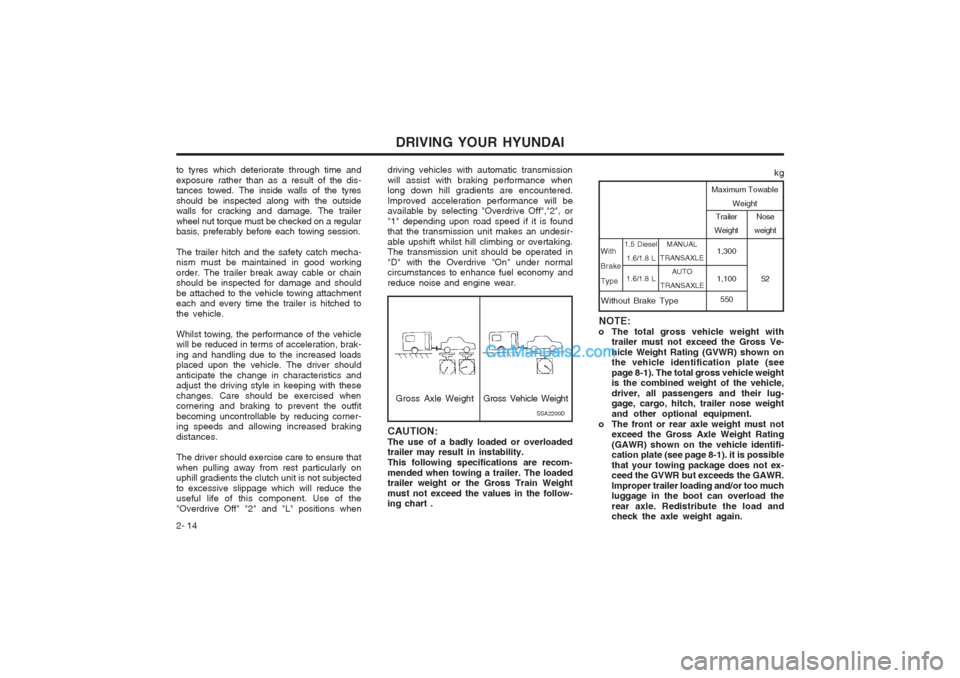
o The total gross vehicle weight with trailer must not exceed the Gross Ve- hicle Weight Rating (GVWR) shown on the vehicle identification plate (see page 8-1). The total gross vehicle weight is the combined weight of the vehicle, driver, all passengers and their lug- gage, cargo, hitch, trailer nose weight and other optional equipment.
o The front or rear axle weight must not exceed the Gross Axle Weight Rating(GAWR) shown on the vehicle identifi- cation plate (see page 8-1). it is possible that your towing package does not ex- ceed the GVWR but exceeds the GAWR. Improper trailer loading and/or too much luggage in the boot can overload the rear axle. Redistribute the load and check the axle weight again. MANUAL
TRANSAXLE AUTO
TRANSAXLE Trailer
Weight
1,300 1,100 550 Nose
weight
52
kg
Maximum Towable Weight
With Brake Type
1.5 Diesel 1.6/1.8 L
1.6/1.8 L
Without Brake Type
driving vehicles with automatic transmission will assist with braking performance when long down hill gradients are encountered. Improved acceleration performance will be available by selecting "Overdrive Off","2", or "1" depending upon road speed if it is found that the transmission unit makes an undesir- able upshift whilst hill climbing or overtaking. The transmission unit should be operated in "D" with the Overdrive "On" under normal circumstances to enhance fuel economy and reduce noise and engine wear.
Gross Axle Weight
CAUTION: The use of a badly loaded or overloaded trailer may result in instability. This following specifications are recom-mended when towing a trailer. The loaded trailer weight or the Gross Train Weight must not exceed the values in the follow- ing chart . SSA2200DGross Vehicle Weight
to tyres which deteriorate through time and exposure rather than as a result of the dis- tances towed. The inside walls of the tyres should be inspected along with the outside walls for cracking and damage. The trailer wheel nut torque must be checked on a regular basis, preferably before each towing session. The trailer hitch and the safety catch mecha- nism must be maintained in good working order. The trailer break away cable or chain should be inspected for damage and should be attached to the vehicle towing attachment each and every time the trailer is hitched to the vehicle. Whilst towing, the performance of the vehicle will be reduced in terms of acceleration, brak- ing and handling due to the increased loads placed upon the vehicle. The driver should anticipate the change in characteristics and adjust the driving style in keeping with these changes. Care should be exercised when cornering and braking to prevent the outfit becoming uncontrollable by reducing corner- ing speeds and allowing increased braking distances. The driver should exercise care to ensure that when pulling away from rest particularly on uphill gradients the clutch unit is not subjected to excessive slippage which will reduce the useful life of this component. Use of the "Overdrive Off" "2" and "L" positions when
Page 88 of 407

3-1
IN CASE OF EMERGENCY
SD000A1-E
3. IN CASE OF EMERGENCY
SD020A1-E IF THE ENGINE WILL NOT START Seek assistance from the nearest Hyundai authorised repairer with regard to the method of ignition and fuel system diagnosis. CAUTION: If the engine refuses to start, no attemptshould be made to push or tow start the vehicle. Vehicles with automatic transaxle or fuel injection will not be able to be started in this manner since no drive is transmitted through the automatic transaxle whilst the engine is not running, and in the case of fuel injected derivatives, the fuel pump will not operate under tow start con- ditions. In addition, if the vehicle is equipped with an exhaust catalyst, dam- age to the catalyst may result if the vehicle is tow started. SD020B1-E
If the Engine Cannot be Cranked
D010C02A-EAT If Engine Turns Over Normally but Does Not Start
SSA3020C
1. Check fuel level.
2. With the key in the "OFF" position, check all connectors at ignition coils and spark plugs(For Petrol Engine) or check all con- nectors at glow plug and glow plug relay(For Diesel Engine). Reconnect any that may be disconnected or loose.
3. Check fuel line in the engine compartment.
4. If engine still refuses to start, call a Hyundai authorised repairer or seek other qualifiedassistance.
1. If the vehicle is fitted with manual transaxle,
ensure that the clutch pedal is depressed whilst cranking the engine. If the vehicle is fitted with automatic transaxle, ensure that the transaxle selector is at the "P" or"N" position.
2. Check the battery terminals and connec-
tions to ensure that these are clean andalso tight.
3. If the ignition warning lights dim when the engine is cranked and the battery termi- nals have been checked, a discharged battery is indicated.
4. Do not attempt to push or tow start the vehicle, refer to "Jump Starting" for infor-mation regarding engine starting when the battery is discharged. AD020D1-E
If Engine Stalls Whilst Driving
1. Reduce your speed gradually, keeping a straight line. Move cautiously off the road to a safe place.
2. Turn on your emergency flashers.
3. Try starting the engine again. If your ve-
hicle will not start, see "IF THE ENGINE WILL NOT START"
3
D010B01FC
Page 90 of 407
3-3
IN CASE OF EMERGENCY
If the drive belt seems to be satisfactory, check for coolant leaking from the radiator, hoses or under the car. (If the air condi- tioning had been in use, it is normal for cold water to be draining from it).
WARNING: Whilst the engine is running, keep hands and clothing away from moving parts such as the fan and drive belts to prevent injury. WARNING (Diesel only): Never work on injection system with en-gine running or within 30 seconds after shutting off engine. High pressure pump, rail, injectors and high pressure pipes are subject to high pressure even after the engine stopped. The fuel jet produced by fuel leaks may cause serious injury, if it touch the body. People using pacemak- ers should ensure that they keep a dis- tance of 30cm from the ECU or wiring harness within the engine room whilst engine is running, since the high currents in the Common Rail system produce con- siderable magnetic fields.
5. If the water pump drive belt is broken or coolant is leaking out, stop the engine immediately and call the nearest Hyundai authorised repairer for assistance. WARNING:Do not remove the radiator cap when theengine is hot since steam and boiling water may be ejected from the radiator resulting in burns or scalding.
6. If the cause of the overheating cannot be found, wait until the engine temperature has returned to normal. Then, if coolant has been lost, carefully remove the radia- tor cap and add water to bring the fluid level in the reservoir up to the base of the radiator fill opening. Fill the coolant expan- sion tank to the halfway mark.
7. Proceed with caution until it is established that the engine is operating normally. If theengine overheats repeatedly, the advice of a Hyundai authorised repairer should be sought.
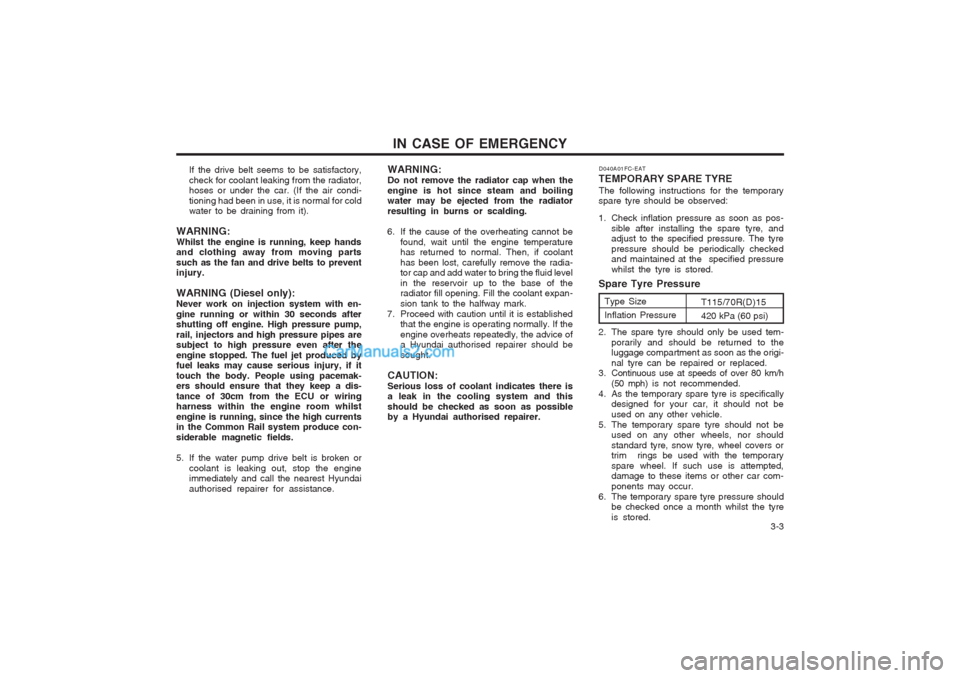
CAUTION:Serious loss of coolant indicates there is a leak in the cooling system and this should be checked as soon as possible by a Hyundai authorised repairer. D040A01FC-EAT
TEMPORARY SPARE TYRE The following instructions for the temporary
spare tyre should be observed:
1. Check inflation pressure as soon as pos-
sible after installing the spare tyre, and adjust to the specified pressure. The tyre pressure should be periodically checked and maintained at the specified pressure whilst the tyre is stored.
2. The spare tyre should only be used tem- porarily and should be returned to the luggage compartment as soon as the origi- nal tyre can be repaired or replaced.
3. Continuous use at speeds of over 80 km/h
(50 mph) is not recommended.
4. As the temporary spare tyre is specifically designed for your car, it should not beused on any other vehicle.
5. The temporary spare tyre should not be used on any other wheels, nor shouldstandard tyre, snow tyre, wheel covers or trim rings be used with the temporary spare wheel. If such use is attempted, damage to these items or other car com- ponents may occur.
6. The temporary spare tyre pressure should be checked once a month whilst the tyreis stored.
Spare Tyre Pressure
Type Size Inflation Pressure T115/70R(D)15420 kPa (60 psi)
Page 102 of 407

VEHICLE MAINTENANCE REQUIREMENTS 5-3
F030D01FC-EAT R : REPLACE I : INSPECT AND, AFTER INSPECTION, CLEAN, ADJUST, REPAIR OR REPLACE IF NECESSARY.
ENGINE CONTROL SYSTEM MAINTENANCE (DIESEL)
ENGINE OIL & FILTER (API Class: CH-4 or ABOVE) See Note(1)
(ACEA Class: B4 or ABOVE)
AIR CLEANER FILTERFUEL FILTER CARTRIDGETIMING BELT DRIVE BELT (FOR P/STR'G PUMP, ALTERNATOR & A/CON) ALTERNATOR VACUUM PUMPALTERNATOR OIL HOSE & VACUUM HOSE FUEL LINES, FUEL HOSE & CONNECTIONS
NO. DESCRIPTION
1 2 34 5 67 8 60 72
R R R R I I I50 60
R I I I I40 48
R I
R
II I I30 36
R R
I I I20 24R I
R
II I I
1012
R I I I IMILES X 1,000 MONTHS70 84
R I
R I I I
Note : (1) ON A DAILY BASIS, WHENEVER THE VEHICLE IS REFUELLED OR BEFORE STARTING A LONG TRIP :"I"
Page 103 of 407

VEHICLE MAINTENANCE REQUIREMENTS
5- 4 F030C01E-EAT
R : REPLACE I : INSPECT AND, AFTER INSPECTION, CLEAN, ADJUST, REPAIR OR REPLACE IF NECESSARY
GENERAL MAINTENANCE COOLING SYSTEMCOOLANT PETROL ENGINEDIESEL ENGINE
ENGINE COOLANT SPECIFIC GRAVITYMANUAL TRANSAXLE OILAUTOMATIC TRANSAXLE FLUIDBRAKE PIPES, HOSES, AND CONNECTIONSBRAKE FLUIDCLUTCH FLUIDREAR BRAKE LININGS AND CYLINDERSBRAKE PADSSUSPENSION AND STEERING SYSTEMFRONT SUSPENSION BALL JOINTSPOLLEN FILTER (IN FRONT OF BLOWER UNIT)REAR WHEEL BEARINGSTYRE CONDITION AND PRESSURE (incl. Spare)LUBRICATE LOCKS AND HINGESCHECK ALL ELECTRICAL SYSTEMSROAD TESTCHECK ALL SYSTEMS WITH HI-SCAN
60 72
50 60
4048
I
R R
I I
R I
R R I I II
R
IIIII I
I I IIII I I I I
R I III I I
I
R IIII
R R I I I I
R I III I I
30 36
2024
I
R
I IIII I I II
R IIIIII
I
R IIII
R R I I I I
R I III I I
10 12
I I IIII I I I I
R I III I I
MILES X 1,000 MONTHS
NO. DESCRIPTION
1 2 3 456789
10111213141516171819
Page 104 of 407

VEHICLE MAINTENANCE REQUIREMENTS 5-5
R R RR
I I I
R R R A, B,C, D, E, F, G, H, I, KA, B, C, D, F, H, I, J C, E B, HD, E, F, GC, D, G, H C, D, G, H C, D, E, FA, C, D, E, F, G, H, I, J A, C, E, F, G, H, I C,E
MAINTENANCE UNDER SEVERE USAGE CONDITIONS
The following items must be serviced more frequently on cars normally used under severe driving conditions. Refer to the chart below for the
appropriate maintenance intervals.
R : REPLACE I : INSPECT AND, AFTER INSPECTION, CLEAN, ADJUST, REPAIR OR REPLACE IF NECESSARY
F040A02FC-EAT
SEVERE DRIVING CONDITIONS
A - Repeatly driving short distance of less than 5miles(8km) in normal tempera ture or less than 10miles(16km) in freezing temperature
B - Extensive engine idling or low speed driving for long distances
C - Driving on rough, dusty, muddy, unpaved, graveled or salt-spread roads
D - Driving in areas using salt or other corrosive materials or in very cold weather
E - Driving in sandy areas ENGINE OIL AND FILTER Petrol engine
Diesel engine
AIR CLEANER FILTER SPARK PLUGS TIMING BELT BRAKE PADSREAR BRAKE LININGS AND CYLINDERSSUSPENSION AND STEERING SYSTEMMANUAL TRANSAXLE OILAUTOMATIC TRANSAXLE FLUIDPOLLEN FILTER(IN FRONT OF BLOWER UNIT) EVERY 4,500MILES OR 6 MONTHS MORE FREQUENTLY MORE FREQUENTLYEVERY 37,000MILES OR 48 MONTHS MORE FREQUENTLY MORE FREQUENTLYMORE FREQUENTLY EVERY 60,000MILES EVERY 27,000MILESMORE FREQUENTLY
MAINTENANCE
OPERATIONMAINTENANCE ITEM MAINTENANCE INTERVALSDRIVING
CONDITION
F - Driving in heavy traffic area over 90°F(32°C) G - Driving on uphill, downhill, or mountain roadH - Towing a Trailer, or using a camper, or roof rack
I - Driving as a patrol car, taxi, other commercial use or vehicle towing
J - Driving over 100 MPH(170 Km/h)K - Frequently driving in stop-and-go conditions
Page 105 of 407

VEHICLE MAINTENANCE REQUIREMENTS
5- 6 6ZF060D2-A
o Fuel lines, Fuel Hoses and
Connections
Check the fuel lines, fuel hoses and connec- tions for leakage and damage. Replace anydamaged or leaking parts immediately.
WARNING (Diesel only): Never work on injection system with en-gine running or within 30 seconds aftershutting off engine. High pressure pump,rail, injectors and high pressure pipes aresubject to high pressure even after theengine stopped. The fuel jet produced byfuel leaks may cause serious injury, if itcontacts the body. People using pace-makers should ensure that they keep adistance of 30cm from the ECU or wiringharness within the engine room whilstengine is running, since the high currentsin the Common Rail system produce con-siderable magnetic fields. 6ZF060E1-A
o Timing Belt Replace timimg belt and inspect all associated parts related for damage and deformation.Replace any damaged parts immediately. 6ZF060G1-A
o Vapour Hose and Fuel Filler Cap The vapour hose and fuel filler cap should be inspected at those intervals specified in themaintenance schedule. Make sure that a newvapour hose or fuel filler cap is correctlyreplaced. 6ZF060F1-A
o Vacuum, Crankcase
Ventilation Hoses
Inspect the surface of hoses for evidence of heat and/or mechanical damage. Hard andbrittle rubber, cracking, tears, cuts, abra-sions, and excessive swelling indicate dete-rioration. Particular attention should be paid toexamining those hose surfaces nearest tohigh heat sources, such as the exhaustmanifold.Inspect the hose routing to assure that thehoses do not come in contact with any heatsource, sharp edges or moving componentwhich might cause heat damage or mechani-cal wear. Inspect all hose connections, suchas clamps and couplings, to make sure theyare secure, and that no leaks are present.Hoses should be replaced immediately if thereis any evidence of deterioration or damage.
6ZF060A1-A
EXPLANATION OF SCHEDULED MAINTENANCE ITEMS
6ZF060M1-A
o Engine Oil and Filter The engine oil and filter should be changed at
the intervals specified in the maintenance schedule. If the car is being driven in severeconditions, more frequent oil and filter changesare required.
6ZF060B1-A
o Drive Belts Inspect all drive belts for evidence of cuts,
cracks, excessive wear or oil contaminationand replace if necessary. Drive belts shouldbe checked periodically for proper tensionand adjusted as necessary.
6ZF060C1-A
o Fuel Filter A clogged filter can limit the speed at which the
vehicle may be driven, damage the emissionsystem and cause hard starting. If an exces-sive amount of foreign matter accumulates inthe fuel tank, the filter may require replace-ment more frequently.
After installing a new filter, run the engine for
several minutes, and check for leaks at theconnections.
Page 110 of 407

OWNER MAINTENANCE 6-3
G010E02FC
G010E02FC-EAT
ENGINE COMPARTMENT Diesel (1.5 CRDi)
1. Air filter element
2. Engine oil filler cap
3. Brake fluid and clutch fluid reservoir
4. Fuel filter 5. Relay box
6. Power steering fluid reservoir
7. Engine oil level dipstick
8. Engine coolant reservoir
9. Radiator cap
10.Battery
11.Windscreen washer fluid reservoir capCAUTION:When inspecting or servicing the
engine, you should handle tools and other heavy objects care-fully so that the plastic cover ofthe engine is not damaged.