2005 Hyundai Getz coolant
[x] Cancel search: coolantPage 341 of 437

2- 18 DRIVING YOUR HYUNDAI
C190C03S-GAT Trailer Brakes If your trailer is equipped with a braking system, make sure it conforms to fed-eral and/or local regulations and that it is properly installed and operating cor- rectly. NOTE: If you tow a trailer or vehicle, your car will require more frequent main- tenance due to the additional load.See "Maintenance Under Severe Usage Conditions" on page 5-5.
CAUTION:
o Never connect a trailer brake sys- tem directly to the vehicle brake system.
o When towing a trailer on steep
grades (in excess of 12%) payclose attention to the engine cool- ant temperature gauge to ensure the engine does not overheat. Ifthe needle of the coolant tem- perature gauge moves across the dial towards "H" (HOT), pull overand stop as soon as it is safe to do so, and allow the engine to
!
C180A01A-AAT USE OF LIGHTS Check your lights regularly for correct operation and always keep them clean.When driving during the day in condi- tions of poor visibility, it is helpful to drive with headlights on low beam.This enables you to be seen as well as to see. C190A02A-GAT TRAILER OR VEHICLE TOWING If you are considering towing with your car, you should first check with your Province Department of Motor Vehicles to determine their legal requirements.Since laws vary from province to prov- ince, the requirements for towing trail- ers, cars, other types of vehicles, orapparatus may differ. Ask your Hyundai dealer for further details before towing. C190B01S-AAT Trailer Hitches Select the proper hitch and ball combi- nation, making sure that it's location iscompatible with that of the trailer or vehicle being towed. Use a quality non-equalizing hitch whichdistributes the tongue load uniformly throughout the chassis. The hitch should be bolted securely to the car and installed by a qualified technician. DO NOT USE A HITCHDESIGNED FOR TEMPORARY IN- STALLATION AND NEVER USE ONE THAT ATTACHES ONLY TO THEBUMPER.
!
CAUTION
Do not do any towing with your car during its first 2,000 km (1,200 miles) in order to allow the engine to prop- erly break in. Failure to heed thiscaution may result in serious en- gine or transaxle damage.
TBENG_2.P65 3/9/2005, 5:00 PM
18
Page 348 of 437

3- 4 WHAT TO DO IN AN EMERGENCY
D030A02TB-AAT IF THE ENGINE OVERHEATS If your temperature gauge indicates overheating, you experience a loss of power, or hear loud pinging or knock- ing, the engine is probably too hot. Ifthis happens to you, you should:
1. Pull off the road and stop as soon as
it is safe to do so.
2. Place the gear selector lever in "P"
(automatic), or neutral (manual transaxle) and set the parking brake. If the air conditioning is on, turn it off.
6. Carefully remove the jumper cables
in the reverse order of attachment.
If you do not know why your battery became discharged (because the lights were left on, etc.), have the chargingsystem checked by your Hyundai dealer. 3. If engine coolant is running out un-
der the car or steam is coming out from the hood, stop the engine. Donot open the hood until the engine coolant has stopped running or the steaming has stopped. If there is novisible loss of engine coolant and no steam, leave the engine running and check to be sure the enginecooling fan is operating. If the fan is not running, turn the engine off.
4. Check to see if the water pump drive
belt is missing. If it is not missing,check to see that it is tight. If the drive belt seems to be satisfactory,check for coolant leaking from the radiator, hoses or under the car. (If the air conditioning had been in use,it is normal for cold water to be draining from it when you stop). WARNING (Diesel only):
Never work on injection system with engine running or within 30 sec- onds after shutting off engine. High pressure pump, rail, injectors andhigh pressure pipes are subject to high pressure even after the engine stopped. The fuel jet produced byfuel leaks may cause serious in- jury, if it touch the body. People using pacemakers should not movethan 30cm closer to the ECU or wiring harness within the engine room while engine is running, sincethe high currents in the Common Rail system produce considerable magnetic fields.
WARNING:
While the engine is running, keep hair, hands, and clothing away from moving parts such as the fan anddrive belts to prevent injury.
!
!
5. If the water pump drive belt is bro- ken or coolant is leaking out, stop the engine immediately and call the nearest Hyundai dealer for assis-tance.
TBENG_3.P65 3/9/2005, 5:01 PM
4
Page 349 of 437

WHAT TO DO IN AN EMERGENCY 3- 5
Inflation Pressure
Tire Size
T105/70D14 420 kPa (60 psi)
2. The spare tire should only be used temporarily and should be returned to the luggage compartment as soonas the original tire can be repaired or replaced.
3. Continuous use at speeds of over 80 km/h (50 mph) is not recom-mended.
4. As the temporary spare tire is spe-
cifically designed for your car, itshould not be used on any other vehicle.
D040A01TB-GAT TEMPORARY SPARE TIRE The following instructions for the tem- porary spare tire should be observed:
1. Check inflation pressure as soon as
practical after installing the spare tire, and adjust to the specified pres- sure. The tire pressure should be periodically checked and maintainedat the specified pressure while the tire is stored.
Spare Tire Pressure
WARNING:
Do not remove the radiator cap whenthe engine is hot. This can allow coolant to be blown out of the open-ing and cause serious burns.
6. If you cannot find the cause of the overheating, wait until the engine temperature has returned to nor- mal. Then, if the engine coolant hasbeen lost, carefully add coolant to the reservoir (page 6-14) to bring the fluid level in the reservoir up to the halfway mark.
7. Proceed with caution, keeping alert for further signs of overheating. Ifoverheating happens again, call a Hyundai dealer for assistance.
!
!
!
CAUTION:
Serious loss of engine coolant indi- cates there is a leak in the cooling system and this should be checked as soon as possible by a Hyundaidealer. 5. The temporary spare tire should not
be used on any other wheels, norshould standard tires, snow tires,wheel covers or trim rings be used with the temporary spare wheel. If such use is attempted, damage tothese items or other car compo- nents may occur.
6. The temporary spare tire pressure should be checked once a monthwhile the tire is stored.
CAUTION:
o Do not use snow chains with your temporary spare tire.
o Do not use more than one tempo-
rary spare tire at a time.
TBENG_3.P65 3/9/2005, 5:01 PM
5
Page 366 of 437

5- 2 VEHICLE MAINTENANCE REQUIREMENTS
F010C01A-GAT
Specified Scheduled Procedures
These are the procedures such as
inspections, adjustments and replace- ments that are listed in the mainte- nance charts starting on page 5-4.These procedures must be performed at the intervals shown in the mainte- nance schedule to assure that yourwarranty remains in effect. Although it is strongly recommended that they be performed by the factory-trained ordistributor-trained technicians at your Hyundai dealer, these procedures may be performed at any qualified servicefacility. It is suggested that genuine Hyundai F010D01A-GAT
General Checks
These are the regular checks youshould perform when you drive your Hyundai or you fill the fuel tank. A list of these items will be found on page6-6.
F010A01A-GAT MAINTENANCE INTERVALS Service Requirements To assure that you receive the great- est number of kilometers of satisfyingoperation from your Hyundai, certain maintenance procedures must be performed. Although careful designand engineering have reduced these to a minimum, those that are required are of the utmost importance.It is your responsibility to have thesemaintenance procedures performedto comply with the terms of the war- ranties covering your new Hyundai. The Service Passport supplied withyour new vehicle provides further in- formation about these warranties.
F010B01A-AAT
Maintenance Requirements
The maintenance required for your
Hyundai can be divided into threemain areas:
o Specified scheduled procedures
o General checks
o Do-it-yourself maintenance service parts be used for any required repairs or replacements. Other parts of equivalent quality such as engineoil, engine coolant, manual or auto transaxle oil, brake fluid and so on which are not supplied by HyundaiMotor Company or its distributor may be used without affecting your war- ranty coverage but you should alwaysbe sure these are equivalent to the quality of the original Hyundai parts. Your Service Passport provides fur-ther information about your warranty coverage.
TBENG_5.P65
3/9/2005, 5:03 PM
2
Page 370 of 437

5- 6 VEHICLE MAINTENANCE REQUIREMENTS
GENERAL MAINTENANCE COOLING SYSTEMCOOLANTMANUAL TRANSAXLE OILAUTOMATIC TRANSAXLEFLUIDBRAKE HOSES AND LINESBRAKE FLUIDREAR BRAKE DRUMS/LININGS, PARKING BRAKEBRAKE PADS, CALIPERS AND ROTORSEXHAUST PIPE AND MUFFLERSUSPENSION MOUNTING BOLTSSTEERING GEAR BOX, LINKAGE & BOOTS/LOWER ARM BALL JOINTPOWER STEERING PUMP, BELT AND HOSESDRIVE SHAFTS AND BOOTSAIR CONDITIONING REFRIGERANTAIR CONDITIONER FILTER (FOR EVAPORATOR AND BLOWER UNIT)
1234 5 6789
101112131415
Note : FOR THE FIRST TIME, REPLACE THE COOLANT 100,000 KM OR 60 MONTHS. AFTER THAT, REPLACE IT EVERY 45,000 KM OR 24 MONTHS.
F030C04TB-GAT R : Replace I : Inspect and, after inspection, clean, adjust, repair or replace if necessary
120
96
I I I IIII I IIIII I
R
105
84
I I I II
IIIII I
R
90 72
75 60
6048
I I
R
I III I IIIII I
R
I I II I
I I I II I
R
I I II I IIII I IIII
R
45 36
3024
I I I II
IIIII I
R
I I IIIII I IIIII I
R
15 12
I I III I IIII I
R
KILOMETERS X 1000 MONTHS
NO. DESCRIPTION
European Community Only Except European Community
See Note
TBENG_5.P65
3/9/2005, 5:03 PM
6
Page 373 of 437

VEHICLE MAINTENANCE REQUIREMENTS 5- 9
F060H01A-AAT
o Air Cleaner Filter
A Genuine Hyundai air cleaner filter is recommended when filter is replaced. F060J01A-AAT
o Spark Plugs
Make sure to install new spark plugs
of the correct heat range. F070C01A-AAT o Engine Coolant The coolant should be changed at the intervals specified in the mainte- nance schedule. F070D01A-AAT
o Manual Transaxle Oil Inspect the manual transaxle oil ac- cording to the maintenance schedule. NOTE: If the oil level is low, check for possible leaks before adding oil. Do not overfill. F070E05A-AAT
o Automatic Transaxle Fluid The fluid level should be in the "HOT" range of the dipstick, after the engineand transaxle are at normal operating temperature. Check the automatic transaxle fluid level with the enginerunning and the transaxle in neutral, with the parking brake properly ap- plied. Use Hyundai Genuine ATF SP-III, DIAMOND ATF SP-III, SK ATF SP-III or other brands appraoved by Hyundai Motor Co., when adding orchanging fluid.
F060F01A-AAT
o Vacuum, Crankcase Ventila-
tion Hoses
Inspect the surface of hoses for evi-dence of heat and/or mechanical dam-age. Hard and brittle rubber, cracking, tears, cuts, abrasions, and excessive swelling indicate deterioration. Partic-ular attention should be paid to exam- ine those hose surfaces nearest to high heat sources, such as the ex-haust manifold.Inspect the hose routing to assurethat the hoses do not come in contact with any heat source, sharp edges or moving component which might causeheat damage or mechanical wear. Inspect all hose connections, such as clamps and couplings, to make surethey are secure, and that no leaks are present. Hoses should be replaced immediately if there is any evidenceof deterioration or damage. F070B01A-GAT
o Cooling System
Check the cooling system part, such
as radiator, coolant reservoir, hosesand connections for leakage and dam- age. Replace any damaged parts. F060N01X-GAT
o Valve clearances (1.1 L)
Incorrect valve clearance will not only
result in unsteady engine operation,but will also cause excessive noise and reduced engine performance. In-spect valve clearance and adjust as required while the engine is hot.
Valve-to-rocker arm clearance Intake valves ..... 0.2 mm (0.008 in.) Exhaust valves ... 0.25 mm (0.010 in.)
TBENG_5.P65 3/9/2005, 5:03 PM
9
Page 376 of 437

6. Do-It-Yourself Maintenance
Engine compartment ...................................................................... 6-2
General checks ................................................................................ 6-6
Checking the engine oil .................................................................... 6-7
Changing the oil and filter ................................................................. 6-9
Checking and changing the engine coolant....................................6-13
Spark plugs .................................................................................... 6-15
Changing the air cleaner filter ......................................................... 6-17
Checking the transaxle oil (Manual)............................................... 6-18
Checking the transaxle fluid (Automatic)....................................... 6-19
Checking the brakes ...................................................................... 6-21
Air conditioning care ....................................................................... 6-22
Checking drive belts ...................................................................... 6-25
Checking and replacing fuses ........................................................ 6-26
Power steering fluid level ............................................................... 6-30
Replacement of bulbs .................................................................... 6-32
Fuse panel description ................................................................... 6-38
6
TBENG_6.P65 3/9/2005, 5:03 PM
1
Page 377 of 437
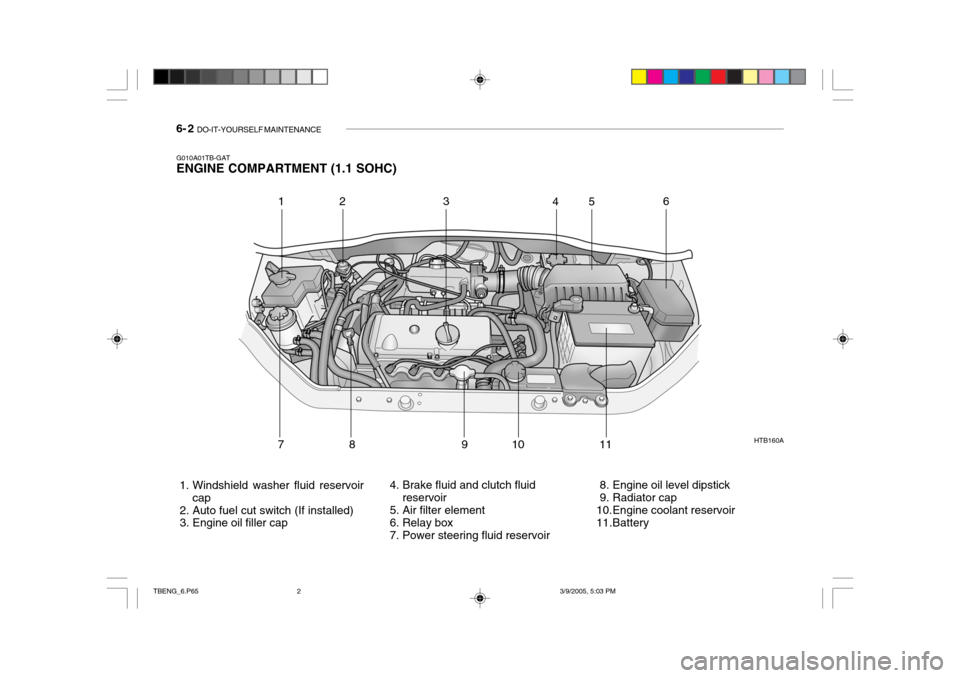
6- 2 DO-IT-YOURSELF MAINTENANCE
HTB160A
1. Windshield washer fluid reservoir cap
2. Auto fuel cut switch (If installed)
3. Engine oil filler cap 4. Brake fluid and clutch fluid
reservoir
5. Air filter element
6. Relay box
7. Power steering fluid reservoir 8. Engine oil level dipstick
9. Radiator cap
10.Engine coolant reservoir
11.Battery
G010A01TB-GAT ENGINE COMPARTMENT (1.1 SOHC)
12 3
456
78 9 10 1 1
TBENG_6.P65 3/9/2005, 5:03 PM
2