2005 Hyundai Azera engine
[x] Cancel search: enginePage 30 of 297
1
FEATURES OF YOUR HYUNDAI
13THEFT-ALARM SYSTEM
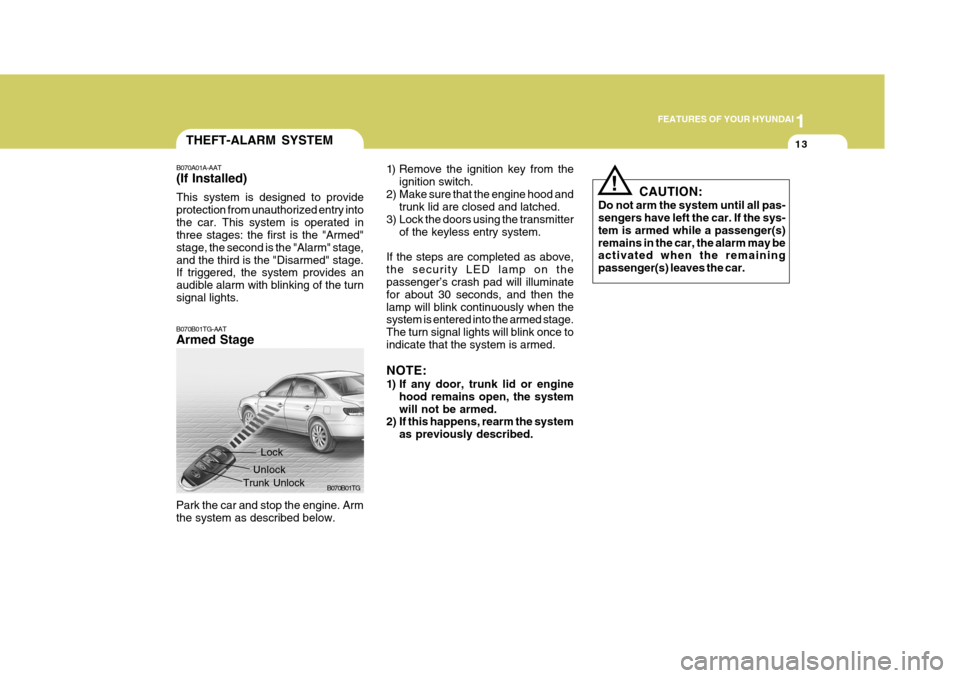
B070A01A-AAT (If Installed) This system is designed to provide protection from unauthorized entry intothe car. This system is operated in three stages: the first is the "Armed" stage, the second is the "Alarm" stage,and the third is the "Disarmed" stage. If triggered, the system provides an audible alarm with blinking of the turnsignal lights.
B070B01TG-AAT Armed Stage
B070B01TG1) Remove the ignition key from the
ignition switch.
2) Make sure that the engine hood and trunk lid are closed and latched.
3) Lock the doors using the transmitter
of the keyless entry system.
If the steps are completed as above, the security LED lamp on the passenger’s crash pad will illuminate for about 30 seconds, and then thelamp will blink continuously when the system is entered into the armed stage. The turn signal lights will blink once toindicate that the system is armed. NOTE:
1) If any door, trunk lid or engine hood remains open, the system will not be armed.
2) If this happens, rearm the system
as previously described.
Lock
Unlock
Trunk Unlock
Park the car and stop the engine. Arm the system as described below.
! CAUTION:
Do not arm the system until all pas- sengers have left the car. If the sys- tem is armed while a passenger(s)remains in the car, the alarm may be activated when the remaining passenger(s) leaves the car.
Page 31 of 297
1FEATURES OF YOUR HYUNDAI
14
CAUTION:
Only the transmitter can disarm the armed stage. If the transmitter doesnot disarm the system, it is neces- sary to take the following steps;
1. Unlock the door with the key, which will cause the alarm to be activated.
2. Insert the key in the ignition key cylinder and turn the ignition keyto "ON" position.
3. Wait for 30 seconds. After completing the steps above, the system will be disarmed.
!
! CAUTION:
Avoid trying to start the engine while the system is armed. B070D01TG-GAT Disarmed Stage The system will be disarmed when the driver's or passeng er's door is un-
locked by depressing the "UNLOCK
( )" button on the transmitter. After completion of the step above, the turn signal lights will blink twice to indicate that the system is disarmed. NOTE: Although the system is disarmed, the security LED lamp will blink con- tinuously. Insert the key in the igni-tion key cylinder to turn off the lamp. If any door, trunk lid or engine hood is not opened or the ignition key is not inserted in the ignition switch within 30 seconds, the system will be rearmed.
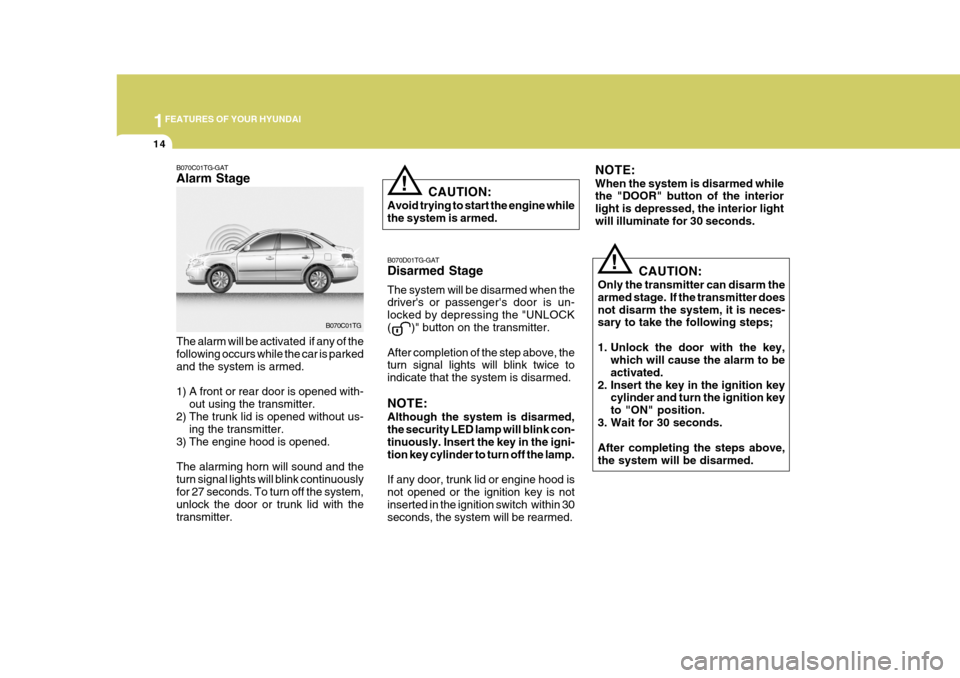
B070C01TG-GAT Alarm Stage The alarm will be activated if any of the following occurs while the car is parked and the system is armed.
1) A front or rear door is opened with-
out using the transmitter.
2) The trunk lid is opened without us- ing the transmitter.
3) The engine hood is opened.The alarming horn will sound and the turn signal lights will blink continuouslyfor 27 seconds. To turn off the system, unlock the door or trunk lid with the transmitter. B070C01TG
NOTE: When the system is disarmed while the "DOOR" button of the interior light is depressed, the interior lightwill illuminate for 30 seconds.
Page 66 of 297

1
FEATURES OF YOUR HYUNDAI
49
B240B03L
Upon deployment, tear seams molded directly into the pad covers will sepa-rate under pressure from the expan- sion of the airbags. Further opening of the covers then allows full inflation ofthe airbags.
B240B02L
The SRS service reminder indicator(SRI) on the instrument panel will illu-minate for about 6 seconds after the ignition key is turned to the "ON" posi- tion or after the engine is started, afterwhich the SRI should go out. The airbag modules are located both in the center of the steering wheel and in the front passenger's panel above the glove box. When the SRSCM detects aconsiderable impact to the front of the vehicle, it will automatically deploy the airbags.
A fully inflated airbag in combination with a properly worn seat belt slows the driver's or the passenger's forwardmotion, thus reducing the risk of head or chest injury. After complete inflation, the airbag immediately starts deflating, enabling the driver to maintain forward visibility.
B240B01NF-GAT SRS Components and Functions
The SRS consists of the following com- ponents:
- Driver's Front Airbag Module
- Passenger's Front Airbag Module
- Knee bolster
- SRS Service Reminder Indicator (SRI)
- SRS Control Module (SRSCM) The SRSCM continually monitors all elements while the ignition is "ON" todetermine if a frontal or near-frontal impact is severe enough to require airbag deployment. B240B01L
Page 67 of 297
1FEATURES OF YOUR HYUNDAI
50
!
However, the fine dust generated during airbag deployment may cause skin irritation. Wash all exposed skin areas thoroughlywith lukewarm water and a mild soap after an accident in which the airbags were deployed.
o The SRS can function only when the ignition key is in the "ON"position.If the SRS is not working prop- erly,
(1)The SRS SRI does not come on when the ignition key isturned to the "ON" position or after the engine is started.
(2)The SRS SRI blinks for a sec- ond and remains on after illu-minating for about 6 secondswhen the ignition key is turned to the "ON" position or after he engine is started.
(3)The SRS SRI illuminates while driving.
If this occurs, have your vehicleimmediately inspected by your Hyundai dealer.
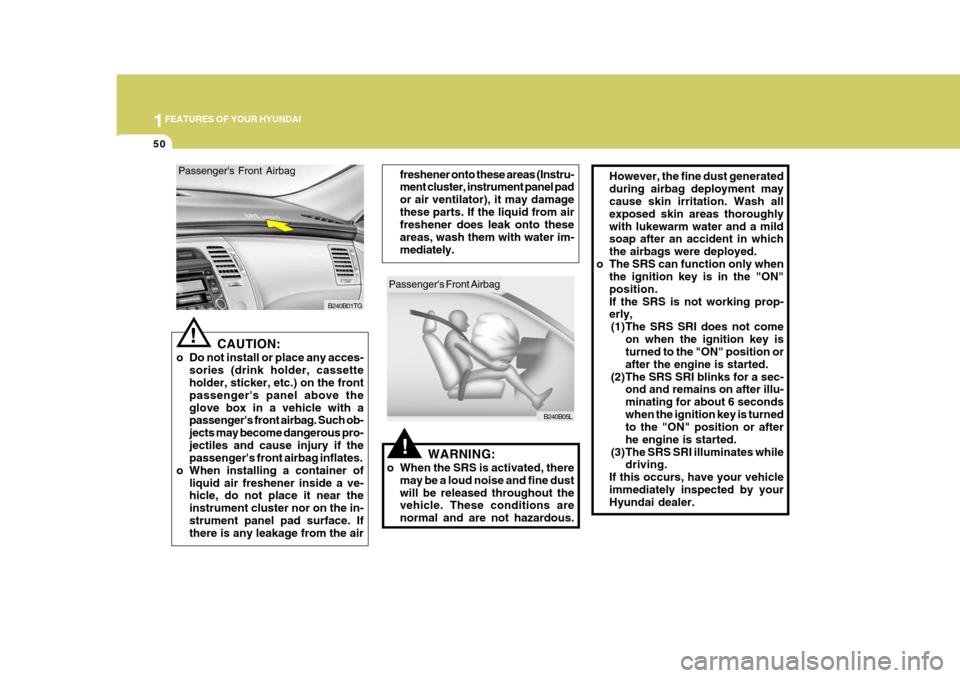
Passenger's Front Airbag
B240B05L
freshener onto these areas (Instru-ment cluster, instrument panel pad or air ventilator), it may damagethese parts. If the liquid from air freshener does leak onto these areas, wash them with water im-mediately.
WARNING:
o When the SRS is activated, there may be a loud noise and fine dustwill be released throughout the vehicle. These conditions are normal and are not hazardous.
CAUTION:
o Do not install or place any acces- sories (drink holder, cassette holder, sticker, etc.) on the front passenger's panel above theglove box in a vehicle with a passenger's front airbag. Such ob- jects may become dangerous pro-jectiles and cause injury if the passenger's front airbag inflates.
o When installing a container of
liquid air freshener inside a ve-hicle, do not place it near the instrument cluster nor on the in-strument panel pad surface. If there is any leakage from the air B240B01TG
Passenger's Front Airbag!
Page 72 of 297
1
FEATURES OF YOUR HYUNDAI
55
o The built in coat hooks should
only be used for light weight cloth- ing, ensure that pockets are free of any heavy or sharp objects. When using coat hooks, do not hangclothes on coat hangers.
o The space between the occupant
and the curtain airbag must neverbe occupied by children, passen- gers or pets. Occupants should never lean out or have any parts oftheir body protruding from the window while the engine is run- ning.
o Do not move the sun visor out to cover the side window if there isan item attached to it such asgarage door remote control, pens, air fresheners or the like. These objects may cause injury if theCurtain Airbag is deployed.
o Where sun blinds are fitted to the
rear doors, these must not ob-struct or impair the airbag in any way. o Do not install any accessories or
children’s toys in the Curtain Airbag deployment zones, as thismay impair the operation of the system or throw parts of them into the vehicle cabin causing injury tooccupants if the system is de- ployed.
o To maintain the integrity of the Curtain Airbag system, any work,removal or installation of the airbag and associated compo-nents (such as roof lining and side trims) should always be performed by an authorized Hyundai dealer.
!WARNING:
o Before installing child restraints , always refer to “Child Restraint System” to ensure correct instal- lation and occupant protection is maximized.
o Make sure that the occupant does not have any body parts (head,arms & legs) protruding outsidethe restraining system. If an inflat- ing airbag was to strike an infant child on the head, it may causeserious injury.
o Ensure the opening for the Cur-
tain Airbag System remains unob-structed at all times, so that the airbags can inflate properly if needed.
Important Safety Notes for Cur- tain Airbag Systems Following is a number of safety points concerning this system which shouldalways be observed to ensure risk of injury is reduced in an accident.
Page 74 of 297
1
FEATURES OF YOUR HYUNDAI
57
o Do not tamper with or disconnect
SRS wiring, or other components of the SRS system. Doing so couldresult in injury, due to accidental firing of the airbags or by render- ing the SRS inoperative.
o If components of the airbag sys- tem must be discarded, or if thevehicle must be scrapped, cer-tain safety precautions must be observed. Your Hyundai dealer knows these precautions and cangive you the necessary informa- tion. Failure to follow these pre- cautions and procedures could increase the risk of personal in- jury.
o If you sell your vehicle, make cer- tain that this manual is transferredto the new owner.
o If your car was flooded and has soaked carpeting or water on floor-ing, you shouldn't try to start theengine; have the car towed to an authorized Hyundai dealer.
Page 79 of 297

1FEATURES OF YOUR HYUNDAI
62
B260F01A-AAT High Beam Indicator Light
The high beam indicator light comes on whenever the headlights areswitched to the high beam or flash position.
If your vehicle is equipped with the supervision type cluster, the warning text is double informed on the dot ma-trix display. The warning text comes on for about 20 seconds. If you push the RESET button behind the steeringwheel, the warning text will go out.
CAUTION:
If the low oil pressure warning lightstays on while the engine is running, serious engine damage may result. The low oil pressure warning lightcomes on whenever there is insuffi- cient oil pressure. In normal opera- tion, it should come on when the ignition switch is turned on, then go out when the engine is started. If thelow oil pressure warning light stays on while the engine is running, there is a serious malfunction.If this happens, stop the car as soon as it is safe to do so, turn off the engine and check the oil level. If theoil level is low, fill engine oil to the proper level and start the engine again. If the light stays on with theengine running, turn the engine off immediately. In any instance where the oil light stays on when the engineis running, the engine should be checked by an authorized Hyundai dealer before the car is driven again.
!
B260G01TG
WARNING AND INDICATOR LIGHTS
B260D01A-AAT Turn Signal Indicator
Lights
The blinking green arrows on the in- strument panel show the direction indi-cated by the turn signals. If the arrow comes on but does not blink, blinks more rapidly than normal, or does notilluminate at all, a malfunction in the turn signal system is indicated. Your dealer should be consulted for repairs.
B260G01TG-AAT Low Oil Pressure Warn-
ing Light
Page 80 of 297

1
FEATURES OF YOUR HYUNDAI
63
!
Your Hyundai is equipped with dual- diagonal braking systems. This meansyou still have braking on two wheels even if one of the dual systems should fail. With only one of the dual systemsworking, more than normal pedal travel and greater pedal pressure are re- quired to stop the car. Also, the car willnot stop in as short a distance with only half of the brake system working. If the brakes fail while you are driving, shiftto a lower gear for additional engine braking and stop the car as soon as it is safe to do so.
B260H02A-GAT
Parking Brake/Low Brake
Fluid Level Warning Light
WARNING:
If you suspect brake trouble, haveyour brakes checked by a Hyundai dealer as soon as possible. Driving your car with a problem in either thebrake electrical system or brake hydraulic system is dangerous, and could result in a serious injury or death.Warning Light Operation The parking brake/low brake fluid level warning light should come on when theparking brake is applied and the igni- tion switch is turned to "ON" or "START". After the engine is started,the light should go out when the park- ing brake is released. If the parking brake is not applied, thewarning light should come on when the ignition switch is turned to "ON" or "START", then go out when the enginestarts. If the light comes on at any other time, you should slow the vehicle and bring it to a complete stop in a safelocation off the roadway. The brake fluid level warning light indi- cates that the brake fluid level in thebrake master cylinder is low and hy- draulic brake fluid conforming to DOT 3 or DOT 4 specifications should beadded. After adding fluid, if no other trouble is found, the car should be immediately and carefully driven to aHyundai dealer for inspection. If fur- ther trouble is experienced, the vehicle should not be driven at all but taken toa dealer by a professional towing ser- vice or some other safe method.