Page 14 of 273

�µ
The rest of this section gives more
detailed inf ormation about how you
can maximize your saf ety.
Remember however, that no saf ety
system can prevent all injures or
deaths that can occur in a severe
crash, even where seat belts are
properly worn and the airbags deploy.
After everyone has entered the
vehicle, be sure the doors and
tailgate are closed and locked.
Locking the doors reduces the
chance of someone being thrown out
of the vehicle during a crash, and it
helps prevent passengers f rom
accidentally opening a door and
f alling out.Your vehicle has a door and
tailgate monitor indicator
on the instrument panel to indicate
when a specif ic door or the tailgate is
not tightly closed.
The f ollowing pages provide
instructions on how to properly
protect the driver, adult passengers,
and teenage children who are large
enough and mature enough to drive
or ride in the f ront.
See pages f or important
guidelines on how to properly
protect inf ants, small children, and
larger children who ride in your
vehicle.
5234 Close and L ock the Doors
Protecting A dults and T eens
Introduction 1.
Your Vehicle’s Saf ety Features, Protecting A dults and Teens
12
Page 40 of 273

�µ
During a crash, the
belt could press deep into the child
and cause serious or fatal injuries.
If they do, they
could be very seriously injured in a
crash. If you are not wearing a
seat belt in crash, you could be
thrown f orward and crush the
child against the dashboard or a
seat-back. If you are wearing a
seat belt, the child can be torn
from your arms and be seriously
hurt or killed. This can prevent children
f rom accidentally f alling out (see
page ).
Leaving children without
adult supervision is illegal in most
states and Canadian provinces,
and can be very hazardous.
For example, infants and small
childrenleftinavehicleonahot
day can die f rom heatstroke. A
child lef t alone with the key in the
ignition can accidentally set the
vehicle in motion, possibly injuring
themselves or others. Children who play in vehicles can
accidentally get trapped inside.
Teach your children not to play in
or around vehicles.
Even very young
children learn how to unlock
vehicle doors, turn on the ignition
switch, and open the trunk, which
can lead to accidental injury or
death.
79
Additional Saf ety Precautions
Protecting Children General Guidelines
Never put a seat belt over yourself
and a child.
Never let two children use thesame seat belt .
Neverholdaninfantorchildon
your lap. Use childproof door locks t o
prevent children f rom opening t hedoors.
Do not leave children alone in avehicle. Lock all doors and the tailgate
when your vehicle is not in use.
K eep vehicle keys and remot etransmitters out of the reach ofchildren.
38
Page 49 of 273
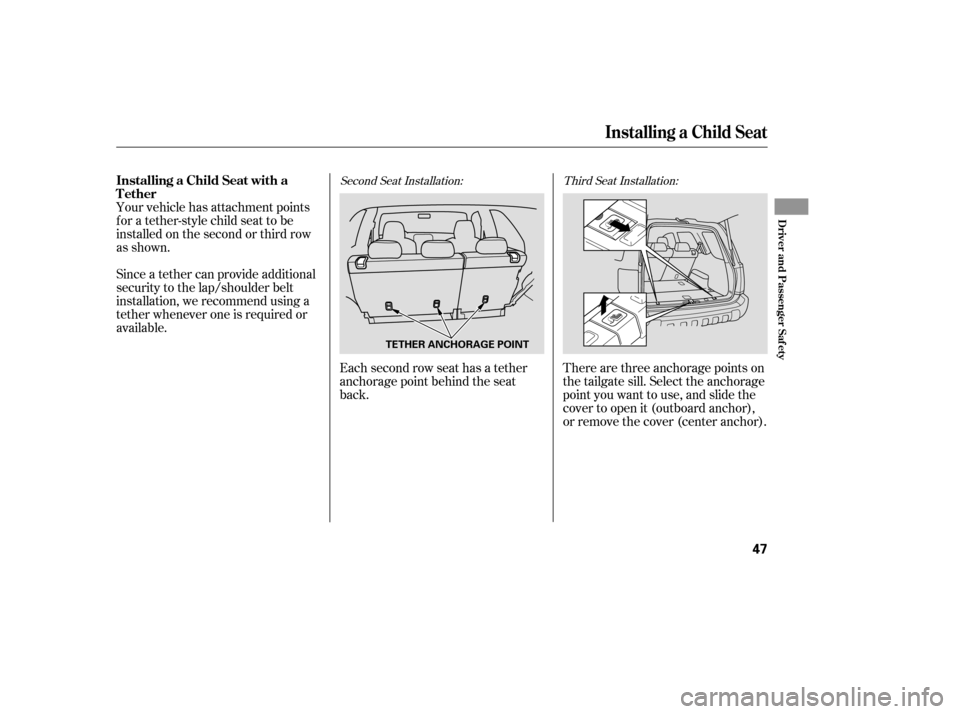
Your vehicle has attachment points
for a tether-style child seat to be
installed on the second or third row
as shown.Each second row seat has a tether
anchorage point behind the seat
back.There are three anchorage points on
the tailgate sill. Select the anchorage
point you want to use, and slide the
cover to open it (outboard anchor),
or remove the cover (center anchor).
Since a tether can provide additional
security to the lap/shoulder belt
installation, we recommend using a
tether whenever one is required or
available.
Second Seat Installation:
Third Seat Installation:
Installing a Child Seat
Installing a Child Seat with a
Tether
Driver and Passenger Saf ety
47
TETHER ANCHORAGE POINT
Page 55 of 273

Your vehicle’s exhaust contains
carbon monoxide gas. You should
have no problem with carbon
monoxide entering the vehicle in
normal driving if you maintain your
vehicle properly.High levels of carbon monoxide can
collect rapidly in enclosed areas,
such as a garage. Do not run the
engine with the garage door closed.
Even with the door open, run the
engine only long enough to move the
vehicle out of the garage.
Have the exhaust system inspected
f or leaks whenever:
With the tailgate open, air flow can
pull exhaust gas into your vehicle’s
interior and create a hazardous
condition. If you must drive with the
tailgate open, open all the windows
and set the heating and cooling
system/climate control system as
shown below.
If you must sit in your parked vehicle
with the engine running, even in an
unconf ined area, adjust the heating
and cooling system/climate control
system as f ollows:
Select the f resh air mode.
Select the mode.
Turn the f an on high speed.
Set the temperature control to a
comfortable setting.
The vehicle is raised f or an oil
change.
You notice a change in the sound
of the exhaust.
The vehicle was in an accident
that may have damaged the
underside.
1.
2.
3.
4.
Carbon Monoxide Hazard
Driver and Passenger Saf ety
53
Carbon monoxide gas is toxic.
Breathing it can cause
unconsciousness and even kill
you.
Avoid any enclosed areas or
activities that expose you to
carbon monoxide.
Page 59 of 273

�Î
�Î
�Î�Î
�Î
�Î
CONT INUED
The U.S. instrument panel is shown. Dif f erences f or the Canadian models are noted in the text.
Canadian models only1
2
Instrument Panel
Inst rument s and Cont rols
57
MALFUNCTION INDICATOR
LAMP
LOW OIL PRESSURE
INDICATOR
CHARGING SYSTEM
INDICATOR
DOOR AND TAILGATE
OPEN MONITOR
SUPPLEMENTAL RESTRAINT
SYSTEM INDICATOR
VTM- 4INDICATOR HIGH BEAM
INDICATOR
A/T TEMPERATURE
INDICATOR CRUISE CONTROL
INDICATOR
BRAKE LAMP INDICATOR
LOW FUEL
INDICATOR
SEAT BELT REMINDER INDICATOR
IMMOBILIZER SYSTEM INDICATOR
TIRE PRESSURE
MONITOR
TPMS INDICATORVSA ACTIVATION INDICATOR
LOW TIRE PRESSURE
INDICATOR
MAINTENANCE REQUIRED
INDICATOR VEHICLE STABILITY
ASSIST SYSTEM (VSA)
INDICATOR
PARKING BRAKE
AND BRAKE SYSTEM
INDICATOR
ANTI-LOCK BRAKE SYSTEM
INDICATORWASHER LEVEL
INDICATOR
SIDE AIRBAG
CUTOFF INDICATOR
(P.59)
(P.58) (P.58)
(P.58)
(P.58)(P.62)
(P.61)
(P.58)
(P.64)
(P.59)
(P.61)
(P.63)
(P.64) (P.59)(P.
65)(P.
63)
(P.63)
(P.
60)
(P.61)
(P.
63) (P.62)
(P.
60)
(P.58)
‘‘DAYTIME RUNNING LIGHTS’’ INDICATOR (P.63)
1 2
1
2
Page 64 of 273

The lef t or right turn signal indicator
blinks when you signal a lane change
or turn. If the indicators do not blink
or blink rapidly, it usually means one
of the turn signal bulbs is burned out
(see page ). Replace the bulb as
soon as possible, since other drivers
cannot see that you are signaling.If a brake light does not work, the
indicator comes on
when you push the brake pedal with
the ignition switch in the ON (II)
position.
A burned out brake light is a hazard
when drivers behind you cannot tell
you are braking. Have your brake
lights repaired right away. All the indicators in the monitor
come on f or a f ew seconds when you
turn the ignition switch to ON (II).
When you push the Hazard Warning
button, both turn signal indicators
blink. All turn signals on the outside
of the vehicle should f lash. The appropriate indicator comes on
in this monitor if the trunk or either
door is not closed tightly.
209 Turn Signal and
Hazard Warning
Indicators
Brake L amp Indicator Door and Tailgate Open Monitor
Instrument Panel
62
BRAKE LAMP
Page 80 of 273

To open the tailgate, pull the handle,
then lif t up. To close the tailgate, use
the inner handle to pull it down, then
press down on the back edge.
Keep the tailgate and the hatch glass
closed at all times while driving to
avoid damaging the tailgate and the
hatch glass, and to prevent exhaust
gas from getting into the interior.
Seeon
page .
To lock the doors and the tailgate,
press the master door lock switch on
either f ront door, press the lock tab
down on the driver’s door, or use the
keyontheoutsidelockonthedriver’s
door.
Pressing up on either master door
lock switch will unlock all of the
doors and the tailgate. The lock tab on any door locks and
unlocks that door. To unlock the
driver’s door f rom the outside, turn
the key and release it. If you turn
and hold it, all doors and the tailgate
unlock.
With the driver’s door open and the
key in the ignition, both master door
lock switches are disabled. They are
not disabled if the driver’s door is
closed. Pushing the switch down on
the open passenger’s door will lock
all doors and the tailgate.
53
Power Door L ocks
Tailgate
Carbon Monoxide Hazard
Door L ocks
L ockout Prevent ion
78
MASTER DOOR LOCK SWITCH
LOCK TAB
Page 81 of 273

�µ
�µ
The childproof door locks are
designed to prevent children seated
in the rear f rom accidentally opening
the rear doors. Each rear door has a
lock lever near the edge. With the
lever in the LOCK position, the door
cannot be opened f rom the inside
regardless of the position of the lock
tab. To open the door, pull the lock
tab up, and use the outside door
handle. Pressthisbuttononce
to unlock the driver’s door. Push it
twice to unlock the other doors and
the tailgate. Some exterior lights will
f lash twice each time you press the
button.
The ceiling light (if the ceiling light
switch is in the center position) will
come on when you press the
UNLOCK button. If you do not open
any door, the light stays on f or about
30 seconds, then f ades out. If you
relock the doors with the remote
transmitter before 30 seconds have
elapsed, the light will go of f
immediately.
If you do not open any door within 30
seconds, the doors automatically
relock and the security system sets.
Press this button once to
lock all doors and the tailgate. Some
exterior and interior lights will f lash.
When you push LOCK twice within 5
seconds, you will hear a beep to
verify that the security system has
set. You cannot lock it if any door is
not f ully closed or the key is in the
ignition switch.
Childproof Door L ocks
UNL OCK
LOCK Remote Transmitter
Childproof Door L ocks, Remot e T ransmit t er
Inst rument s and Cont rols
79
LOCK COVER PANIC
BUTTON
LOCK
BUTTON UNLOCK
BUTTON
LED