Page 169 of 273
Always use the parking brake when
you park your vehicle. Make sure
the parking brake is set f irmly or
your vehicle may roll if it is on an
incline.
Set the parking brake bef ore you put
the transmission in Park. This keeps
the vehicle from moving and putting
pressure on the parking mechanism
in the transmission.Make sure the windows are closed.
Turn of f the lights.
Place any packages, valuables, etc.
in the cargo area, or take them
with you.
Lock the doors.
Never park over dry leaves, tall
grass, or other f lammable
materials. The hot three way
catalytic converter could cause
these materials to catch on fire.
If the vehicle is f acing uphill, turn
the f ront wheels away f rom the
curb.
If the vehicle is f acing downhill,
turn the front wheels toward the
curb.Make sure the parking brake is
f ully released bef ore driving away.
Driving with the parking brake
partially set can overheat or
damage the rear brakes.
Parking T ips
Parking T ips
Driving
167
Page 170 of 273

Check the brakes after driving
through deep water. Apply the
brakes moderately to see if they f eel
normal. If not, apply them gently and
f requently until they do. Be extra
cautious in your driving.
Resting your f oot on the pedal keeps
the brakes applied lightly, builds up
heat, and reduces their ef f ectiveness.
It also keeps your brake lights on all
the time, conf using drivers behind
you.
Constant application of the brakes
when going down a long hill builds
up heat and reduces their ef f ective-
ness. Use the engine to assist the
brakes by taking your f oot of f the
accelerator and downshif ting to a
lower gear. Your vehicle is equipped with disc
brakes at all f our wheels. A power
assist helps reduce the ef f ort needed
on the brake pedal. The ABS helps
you retain steering control when
braking very hard. The hydraulic system that operates
the brakes has two separate circuits.
Each circuit works diagonally across
the vehicle (the lef t-f ront brake is
connected with the right-rear brake,
etc.). If one circuit should develop a
problem, you will still have braking
at two wheels. Braking System Design
Braking System
168
Page 181 of 273
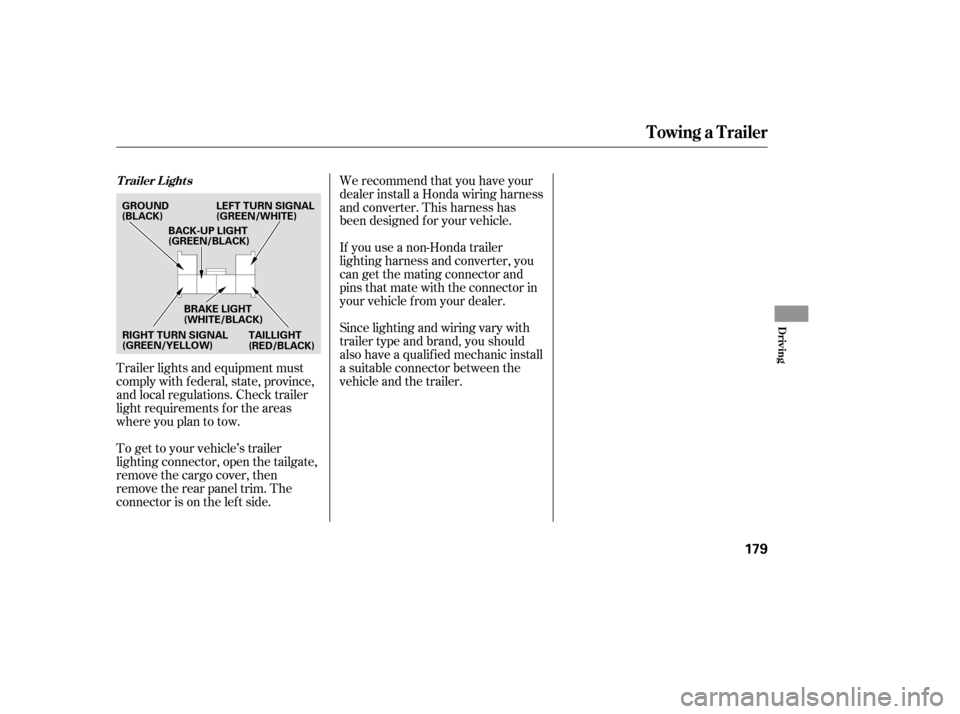
Trailer lights and equipment must
comply with f ederal, state, province,
and local regulations. Check trailer
light requirements f or the areas
where you plan to tow.
To get to your vehicle’s trailer
lighting connector, open the tailgate,
remove the cargo cover, then
remove the rear panel trim. The
connector is on the lef t side.We recommend that you have your
dealer install a Honda wiring harness
and converter. This harness has
been designed f or your vehicle.
If you use a non-Honda trailer
lighting harness and converter, you
cangetthematingconnectorand
pins that mate with the connector in
your vehicle f rom your dealer.
Since lighting and wiring vary with
trailer type and brand, you should
also have a qualif ied mechanic install
a suitable connector between the
vehicleandthetrailer.
T railer L ights
Towing a Trailer
Driving
179
GROUND
(BLACK)
BACK-UP LIGHT
(GREEN/BLACK) LEFT TURN SIGNAL
(GREEN/WHITE)
RIGHT TURN SIGNAL
(GREEN/YELLOW) BRAKE LIGHT
(WHITE/BLACK)
TAILLIGHT
(RED/BLACK)
Page 182 of 273

Your vehicle tires and spare are in
good condition and properly
inf lated.
The trailer tires and spare are in
good condition and inf lated as
recommended by the trailer
maker.Foryoursafetyandthesafetyof
others, take time to practice driving
maneuvers bef ore heading f or the
open road, and f ollow the guidelines
below.
Avoid towing a trailer during your
vehicle’s f irst 600 miles (1,000 km)
(see page ).
Drive slower than normal in all
driving situations, and obey posted
speed limits f or vehicles with trailers.
When towing a f ixed-sided trailer (e.
g., camper), do not exceed 55 mph
(88 km/h). At higher speeds, the
trailer may sway or affect vehicle
handling.
To prevent the transmission f rom
shif ting f requently, drive in the D
position.
The added weight, length, and
height of a trailer will af f ect your
vehicle’s handling and perf ormance,
so driving with a trailer requires
some special driving skills and
techniques. Towing perf ormance can be
af f ected by high altitude, high
temperature, or when climbing
steep grades. Theref ore, premium
fuelisrecommendedwhentowing
more than 3,500 lbs (1,590 kg).
When preparing to tow, and bef ore
driving away, be sure to check the
f ollowing:
The vehicle has been properly
serviced, and the tires, brakes,
suspension, cooling system, and
lights are in good operating
condition.
If you tow f requently, f ollow the
Severe Conditions maintenance
schedule.
The trailer has been properly
serviced and is in good condition.
All weights and loads are within
limits.
Thehitch,safetychains,andany
other attachments are secure.
All items in or on the trailer are
properly secured and cannot shif t
while you drive. 146
Trailer Driving Tips
Break-In Period
T owing Speeds and Gears
Driving Saf ely With a T railer
180
Page 188 of 273
You should never use a jack to try to
get unstuck. Your vehicle could
easily slip of f the jack and hurt you
or someone else.You may be able to safely tow a
lightweight trailer (such as a
motorcycle or small tent trailer) of f -
road if you f ollow these guidelines.
Do not exceed 1,000 lbs (450 kg)
or a tongue weight of 100 lbs (45
kg).
Trytostayonsmooth,leveldirt
roads, and avoid driving in hilly
terrain.
Allow extra room f or starting,
stopping, and turning.
Slow down if you encounter bumps
or other obstacles.
Of f -Highway Driving Guidelines
Towing a Trailer Off-Road
186
Page 189 of 273

This section also includes
Maintenance Schedules f or normal
driving and severe driving conditions,
a Maintenance Record, and instruc-
tions f or simple maintenance tasks
you may want to take care of
yourself .
If you have the skills and tools to per-
f orm more complex maintenance
tasks on your vehicle, you may want
to purchase the Service Manual. See
page f or inf ormation on how to
obtain a copy, or see your dealer. This section explains why it is
important to keep your vehicle well
maintained and how to f ollow basic
maintenance saf ety precautions.......................
Maintenance Saf ety .188
.................
Maintenance Schedule . 189
....................
Maintenance Record .195
..............................
Fluid Locations .198
........................
Adding Engine Oil .199
.........
Changing the Oil and Filter . 200
..............................
Engine Coolant .202
....................
Windshield Washers .203
.....
Automatic Transmission Fluid . 204
...............................
Dif f erential Oil .205
....................................
Timing Belt .205
....................................
Brake Fluid .206
....................
Power Steering Fluid . 207
.............................................
Lights .208
.....................................
Floor Mats .213
.......................
Cleaning Seat Belts .213
.................................
Wiper Blades .214
...............................................
Tires .216
...................
Checking the Battery . 221
.............................
Vehicle Storage .222
261
Maintenance
Maint enance
187
Page 193 of 273
�µ�µ �µ
�µ
�µ
�µ �µ
Youshouldcheckthefollowing
items at the specif ied intervals. If
you are unsure of how to perf orm
any check, turn to the appropriate
page listed.
Engine oil level Check every
time you fill the fuel tank. See
page .
Engine coolant level Check the
radiator reserve tank every time
you f ill the f uel tank. See page . Brakes Check the f luid level
monthly. See page .
Tires Check the tire pressure
monthly. Examine the tread f or
wear and foreign objects. See page
.
Automatic transmission Check
the f luid level monthly. See pages . Lights Check the operation of
the headlights, parking lights,
taillights, high-mount brake light,
and license plate lights monthly.
See page .
149
149
204 205 210
216
208
Maintenance Schedule
Owner’s Maintenance Checks
Maint enance
191
Page 195 of 273
![HONDA PILOT 2005 1.G Owners Manual �µ
�Ì�Ì
�Î�Î
�Ì�Î
Follow the Severe Maintenance
Schedule if you drive your vehicle
MAINLY under one or more of the
f ollowing conditions:
Driving in extremely hot [over 90°F
(32°C)] condition](/manual-img/13/6000/w960_6000-194.png "HONDA PILOT 2005 1.G Owners Manual �µ
�Ì�Ì
�Î�Î
�Ì�Î
Follow the Severe Maintenance
Schedule if you drive your vehicle
MAINLY under one or more of the
f ollowing conditions:
Driving in extremely hot [over 90°F
(32°C)] condition")
�µ
�Ì�Ì
�Î�Î
�Ì�Î
Follow the Severe Maintenance
Schedule if you drive your vehicle
MAINLY under one or more of the
f ollowing conditions:
Driving in extremely hot [over 90°F
(32°C)] conditions.
Extensive idling or long periods of
stop and go driving, such as a taxi or
a commercial delivery vehicle.
T railer towing, driving with a roof
rack, or driving in mountainous
conditions. Follow the
Maintenance Schedule f or Severe
Conditions. Driving on muddy, dusty, or de-iced
roads.
Drivinglessthan5miles(8km)per
trip or, in f reezing temperatures,
driving less than 10 miles (16 km) per
trip.
Canadian Owners
193
Check oil and coolant at each fuel stop
Check inflation and condition once a month
Every 3,750 miles (6,000 km) or every 6 months, whichever comes first
Every 7,500 miles (12,000 km)
Every 7,500 miles (12,000 km) or every 6 months, whichever comes first
( (O
O r
re
ev
ve
er
ry
y 1
1y
ye
ea
ar
r,
, w
w h
hi
ic
ch h e
ev
ve
er
r c
coo m
m e
es
s f
fi
ir
r s
st t)
)
(
( O
O r
re
ev
ve
er
ry
y 2
2y
ye
ea
ar
rs
s, , w
w h
hi
ic
ch h e
ev
ve
er
r c
coo m
m e
es
s f
fi
ir
r s
st t)
)
Every 15,000 miles (24,000 km) (Use normal schedule
except in dusty conditions)
(
(O
O t
th
h e
er
rw
w i
is
se e a
ad
d j
ju
u s
stt o
o n
nl
ly
y i
if
f n
n o
oi
is
sy y )
)
(
( O
O r
re
ev
ve
er
ry
y 7
7y
ye
ea
ar
rs
s, , w
w h
hi
ic
ch h e
ev
ve
er
r c
coo m
m e
es
s f
fi
ir
r s
st t)
)
miles x 1,000
km x 1,000
( (O
O r
re
ev
ve
er
ry
y 2
2y
ye
ea
ar
rs
s, , w
w h
hi
ic
ch h e
ev
ve
er
r c
coo m
m e
es
s f
fi
ir
r s
st t)
)
15
24 30
4845
72 75
120 90
144 105
168120
192 150
240
Service the items listed at the indicated distance (or time, if given).
Every 3 years (independent of mileage)
120,000 miles (192,000 km) or 10 years, then every
60,000 miles (96,000 km) or 5 years 60
96
135
216
7.5
12
Check engine oil and coolant
Check tires
Replace engine oil filter
Rotate tires (follow pattern on page 190)
Check front and rear brake wear
Inspect the following items: Tie-rod ends, steering gearbox, and boots
Suspension components
Driveshaft boots
Check parking brake adjustment
Lubricate all hinges, locks and latches
Inspect the following items: Brake hoses and lines (including ABS)
All fluid levels and condition of fluids
Lights and controls/vehicle underbody
Inspect drive belts
Replace dust and pollen filter
Replace air cleaner element
Replace spark plugs
Inspect valve clearance
Replace automatic transmission fluid
Replace VTM-4 rear differential fluid
Inspect idle speed
Replace timing belt and inspect water
pump
Replace engine coolant
Replace brake fluid
Exhaust system , Fuel lines and connections
1, 2
,3
Maintenance Schedule for Severe Conditions