Page 162 of 273
If the malf unction indicator lamp
comes on along with the ‘‘D’’
indicator, there is a problem in the
automatic transmission control
system. Avoid rapid acceleration, and
have the transmission checked by
your dealer as soon as possible.
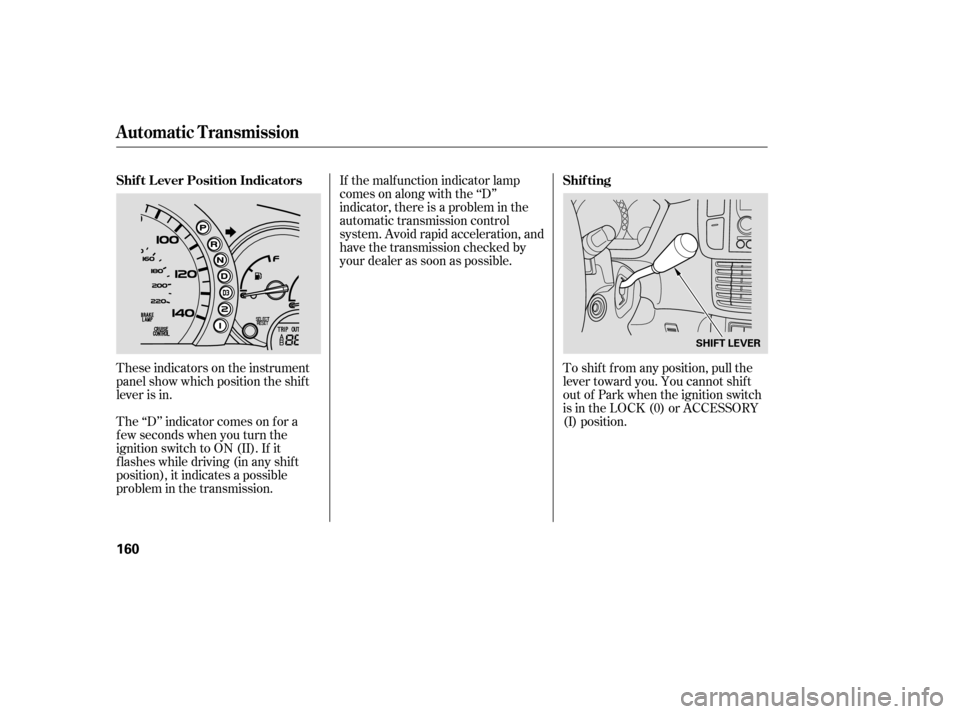
These indicators on the instrument
panel show which position the shif t
lever is in.
The ‘‘D’’ indicator comes on f or a
f ew seconds when you turn the
ignition switch to ON (II). If it
f lashes while driving (in any shif t
position), it indicates a possible
problem in the transmission. To shif t f rom any position, pull the
lever toward you. You cannot shif t
out of Park when the ignition switch
is in the LOCK (0) or ACCESSORY
(I) position.
Automatic Transmission
Shif t L ever Position Indicators
Shif ting
160
SHIFT LEVER
Page 163 of 273

�µ�µ �µ
�µTo shift from: PtoR
RtoP
NtoR
Dto2 2to1
1to2
2toD
DtoD DtoN
DtoD NtoDRtoN Do this:
Press the brake pedal and
pull the shift lever towards
you.
Pull the shift lever towards
you.
Move the lever.
3
3
3
3
This position mechani-
cally locks the transmission. Use
Park whenever you are turning of f or
starting the engine. To shif t out of
Park, you must press on the brake
pedal and have your f oot of f the
accelerator pedal.
If you have done all of the above and
still cannot move the lever out of
Park, see on
page .
To avoid transmission damage, come
to a complete stop bef ore shif ting
into Park. The shif t lever must be in
Park bef ore you can remove the key
from the ignition switch.
Press the brake
pedal and pull the shif t lever towards
you to shift from Park to Reverse. To
shif t f rom Reverse to Neutral, come
to a complete stop and then shift. Use Neutral if you
need to restart a stalled engine, or if
it is necessary to stop brief ly with
the engine idling. Shif t to the Park
position if you need to leave your
vehicle for any reason. Press on the
brake pedal when you are moving
the shift lever from Neutral to
another gear.
Use this position f or
your normal driving. The
transmission automatically selects a
suitable gear for the vehicle speed
and acceleration. You may notice the
transmission shif ting up at higher
speeds when the engine is cold. This
helps the engine warm up f aster.
163
CONT INUED
Park (P)
Shif t L ock Release
Reverse (R) Neutral (N)
Drive (D)
Automatic Transmission
Driving
161
Page 165 of 273
Do this if pushing on the brake pedal
and pulling the shif t lever does not
shif t the transmission out of Park:Set the parking brake. Push down on the key while you
pull the shif t lever towards you
and move it out of Park to Neutral.
Remove the key from the Shift
Lock Release slot, then install the
cover. Press the brake pedal, and
restart the engine.
If you need to use the Shif t Lock
Release, it means your vehicle is
developing a problem. Have the
vehicle checked by your dealer.
Put a cloth on the edge of the Shif t
Lock Release slot cover next to
theshiftlever.Useasmallflat-
tipped screwdriver or f inger nail
f ile to remove the cover. Caref ully
pryoff theedgeof thecover.
Insert the key in the Shift Lock
Release slot.
Remove the key from the ignition
switch.
3.
4. 5.
6.
1.
2. Shif t L ock Release
Automatic Transmission
Driving
163
Page 166 of 273

The variable torque management
4WD (VTM-4) system automatically
transf ers varying amounts of engine
torque to the rear wheels under
lower traction conditions.
If more traction is needed when your
vehicle is stuck, or is likely to
become stuck, you can use the
VTM-4 lock button to increase
torque to the rear wheels.The vehicle must be stopped with
the engine running.
do
one of the f ollowing: Press the VTM-4 lock button.
Move the shift lever to D or D .
Turn the ignition to LOCK (0).
The VTM-4 lock will temporarily
disengage when the vehicle speed
exceeds 18 mph (30 km/h). It will
automatically engage again as the
speed slows below 18 mph (30
km/h). The indicator in the button
will remain on.
Move the shift lever to first (1),
second (2), or reverse (R) gear.
Press the VTM-4 lock button. The
indicator in the button comes on.
To get unstuck, apply light pressure
to the accelerator pedal. Do not spin
the f ront tires f or more than a f ew
seconds. Because of the amount of
torque applied to the rear tires, they
should not spin. This is normal. If
you are not able to move the vehicle,
stop and reverse direction. 1.
2.
3.
3
To Engage the VTM-4 Lock To Disengage the VTM-4 lock,
VTM-4 System
164
Do not continually spin the f ront tires
of your vehicle. Continuously spinning
the f ront tires can cause transmission
or rear dif f erential damage.
Do not use the VTM-4 lock button on
dry, paved roads. Driving on dry,
paved roads with VTM-4 lock ON may
damage the rear dif f erential when
making a turn. Strange noise and
vibration can also result.
Page 174 of 273

If the indicator does not come on
when the ignition switch is turned to
ON(II),theremaybeaproblem
with the VSA system. Have your
dealer inspect your vehicle as soon
as possible.
Without VSA, your vehicle will have
normal braking and cornering ability,
but it will not have VSA traction and
stability enhancement.This switch is under the lef t vent.
Press it to turn the vehicle stability
assist system on and of f .VSA is turned on every time you
start the engine, even if you turned it
off the last time you drove the
vehicle.
Driving with varying tire or wheel
sizes may cause the VSA to
malf unction. When replacing tires,
make sure they are of the same size
and type as your original tires (see
page ).
Deactivate the VSA system if you
need to drive with the compact spare
tire installed (see page ).
If you install winter tires, make sure
they are the same size as those that
were originally supplied with your
vehicle. Exercise the same caution
during winter driving as you would if
your vehicle was not equipped with
VSA.
When VSA is off, the VSA activation
indicator comes on as a reminder. 217
224
VSA Of f Switch
VSA and Tire Sizes
Vehicle Stability Assist (VSA) System
172
Page 184 of 273

Your vehicle can be towed behind a
motorhome at legal highway speeds
up to 65 mph (100 km/h). Do not
exceed 65 mph (100 km/h) or severe
transmission damage will occur. To
avoid damage to the 4WD system, it
must be towed with all f our wheels
on the ground (f lat towing).
When purchasing a tow bar, make
sure you select a reputable
manuf acturer. Follow the
manufacturer’s attachment
instructions caref ully.
Perf orm the f ollowing procedure
everyday immediately bef ore you
begin towing. Otherwise severe
automatic transmission damage will
occur.Check the transmission f luid level
(see page ).
Start the engine. Press on the brake pedal. Move
the shif t lever through all its
positions.
ShifttoD,thentoN.Letthe
engine run f or three minutes, then
turn it off.
Release the parking brake.
Leave the ignition switch in the
ACCESSORY (I) position so the
steering wheel does not lock.
Make sure the radio and any
items plugged into the
accessory power sockets are
turned of f so you do not run
down the battery.
If you tow more than 8 hours in one
day, you should repeat the above
procedure at least every 8 hours
(when you stop f or f uel, etc.)
204
Do not overf ill. Ext ended T owing
Towing Your Vehicle Behind a Motorhome
182
Improper towing preparation will
damage the transmission. Follow the
above procedure exactly. If you cannot
shif t the transmission or start the
engine, your car must be transported
on a f lat-bed or trailer.
The steering system can be damaged if
the steering wheel is locked. Leave the
ignition switch in the ACCESSORY (I)
position, and make sure the steering
wheel turns f reely bef ore you begin
towing.
Page 227 of 273
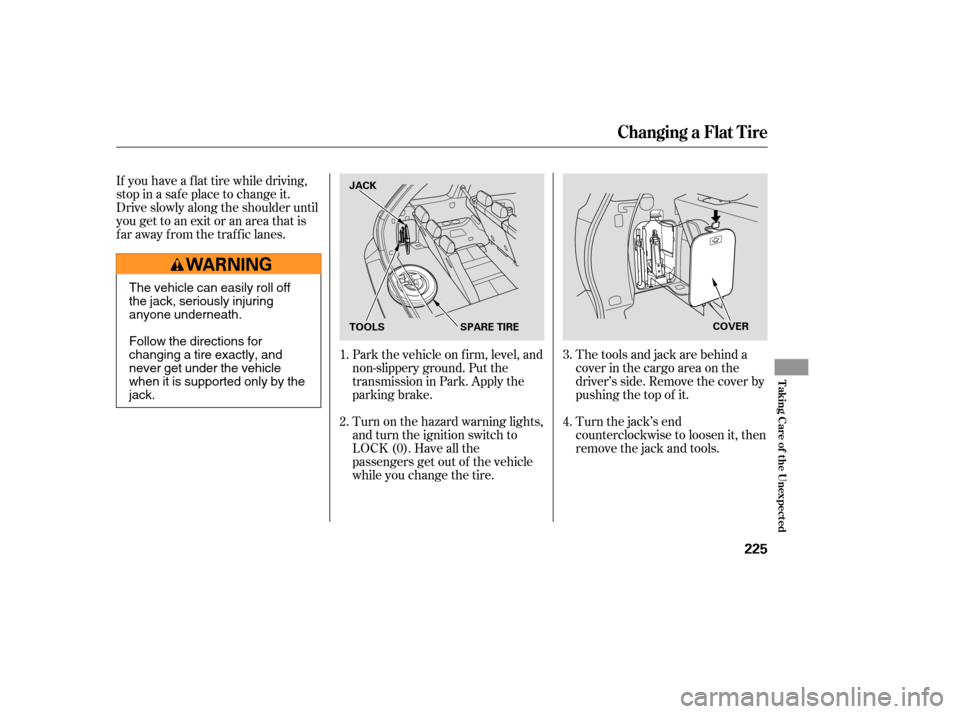
Park the vehicle on f irm, level, and
non-slippery ground. Put the
transmission in Park. Apply the
parking brake.
Turn on the hazard warning lights,
and turn the ignition switch to
LOCK (0). Have all the
passengers get out of the vehicle
while you change the tire.Thetoolsandjackarebehinda
cover in the cargo area on the
driver’s side. Remove the cover by
pushing the top of it.
Turn the jack’s end
counterclockwise to loosen it, then
remove the jack and tools.
If you have a f lat tire while driving,
stop in a saf e place to change it.
Drive slowly along the shoulder until
you get to an exit or an area that is
far away from the traffic lanes.
2. 1.3.
4.
Changing a Flat T ire
T aking Care of t he Unexpect ed
225
JACK
SPARE TIRE
TOOLS COVER
The vehicle can easily roll off
the jack, seriously injuring
anyone underneath.
Follow the directions for
changing a tire exactly, and
never get under the vehicle
when it is supported only by the
jack.
Page 231 of 273

Diagnosing why the engine won’t
start f alls into two areas, depending
on what you hear when you turn the
key to START (III):You hear nothing, or almost
nothing. The engine’s starter
motor does not operate at all, or
operates very slowly.
You can hear the starter motor
operating normally, or the starter
motor sounds like it is spinning
f aster than normal, but the engine
does not start up and run.
When you turn the ignition switch to
START (III), you do not hear the
normal noise of the engine trying to
start. You may hear a clicking sound
or series of clicks, or nothing at all.
Check these things: Check the transmission interlock.
The transmission must be in Park
orNeutralorthestarterwillnot
operate.
Turn the ignition switch to ON (II).
Turn on the headlights, and check
their brightness. If the headlights
areverydimordonotcomeonat
all, the battery is discharged. See
on page .
Turn the ignition switch to START
(III). If the headlights do not dim,
check the condition of the f uses. If
thefusesareOK,thereis
probably something wrong with
the electrical circuit f or the
ignition switch or starter motor.
You will need a qualif ied
technician to determine the
problem (see
on page ). If the headlights dim noticeably or
go out when you try to start the
engine, either the battery is dis-
charged or the connections are
corroded. Check the condition of
the battery and terminal connec-
tions (see page ). You can
then try jump starting the vehicle
f rom a booster battery (see page
).
Are you using the proper starting
procedure? Ref er to on page .
In this case, the starter motor’s
speed sounds normal, or even f aster
than normal, when you turn the
ignition switch to START (III), but
the engine does not run.
230
237 221
230
159
Nothing Happens or the Starter
Motor Operates Very Slowly Jump Starting
Emergency T owing Starting the
Engine
T he Starter Operates Normally
If theEngineWon’tStart
T aking Care of t he Unexpect ed
229