Page 188 of 273
You should never use a jack to try to
get unstuck. Your vehicle could
easily slip of f the jack and hurt you
or someone else.You may be able to safely tow a
lightweight trailer (such as a
motorcycle or small tent trailer) of f -
road if you f ollow these guidelines.
Do not exceed 1,000 lbs (450 kg)
or a tongue weight of 100 lbs (45
kg).
Trytostayonsmooth,leveldirt
roads, and avoid driving in hilly
terrain.
Allow extra room f or starting,
stopping, and turning.
Slow down if you encounter bumps
or other obstacles.
Of f -Highway Driving Guidelines
Towing a Trailer Off-Road
186
Page 191 of 273

�µ�µ
Follow the
Maintenance Schedule f or Severe
Conditions if you drive your vehicle
MAINLY under one or more of the
f ollowing conditions.
Driving less than 5 miles (8 km)
per trip or, in f reezing
temperatures, driving less than 10
miles (16 km) per trip.
Driving in extremely hot [over
90°F (32°C)] conditions.
Used primarily as a delivery
vehicle or taxi that is driven
mostly in stop-and-go traf f ic and/
or parked with the engine idling.
Service your vehicle according to the
time and mileage periods on one of
the Maintenance Schedules on the
f ollowing pages.
Always use unleaded gasoline with
theproperoctanerating(seepage ).
Drive your vehicle regularly over a
distance of several miles
(kilometers). Operate your vehicle on
reasonable roads within the legal
speed limit. Avoid exceeding your vehicle’s
load limit. This puts excess stress
on the engine, brakes, and many
other vehicle parts. The load limit
is shown on the tire inf ormation
label on the driver’s doorjamb.
The maintenance schedule assumes
you will use your vehicle as normal
transportation for passengers and
their possessions. You should also
f ollow these recommendation:
Trailer towing, driving with a roof
top carrier, or driving in
mountainous conditions.
Driving on muddy, dusty, or de-
iced roads.
If you only
drive under a ‘‘severe’’ condition, you
should f ollow the Normal Conditions
Maintenance Schedule.
Follow the
Maintenance Schedule f or Severe
Conditions.
146
OCCASIONALLY
Maintenance Schedule
Which Schedule to Follow
U.S. Owners
Maintenance Schedule
Canadian Owners
Maint enance
189
NOTE:
Page 195 of 273
![HONDA PILOT 2005 1.G Owners Manual �µ
�Ì�Ì
�Î�Î
�Ì�Î
Follow the Severe Maintenance
Schedule if you drive your vehicle
MAINLY under one or more of the
f ollowing conditions:
Driving in extremely hot [over 90°F
(32°C)] condition](/manual-img/13/6000/w960_6000-194.png "HONDA PILOT 2005 1.G Owners Manual �µ
�Ì�Ì
�Î�Î
�Ì�Î
Follow the Severe Maintenance
Schedule if you drive your vehicle
MAINLY under one or more of the
f ollowing conditions:
Driving in extremely hot [over 90°F
(32°C)] condition")
�µ
�Ì�Ì
�Î�Î
�Ì�Î
Follow the Severe Maintenance
Schedule if you drive your vehicle
MAINLY under one or more of the
f ollowing conditions:
Driving in extremely hot [over 90°F
(32°C)] conditions.
Extensive idling or long periods of
stop and go driving, such as a taxi or
a commercial delivery vehicle.
T railer towing, driving with a roof
rack, or driving in mountainous
conditions. Follow the
Maintenance Schedule f or Severe
Conditions. Driving on muddy, dusty, or de-iced
roads.
Drivinglessthan5miles(8km)per
trip or, in f reezing temperatures,
driving less than 10 miles (16 km) per
trip.
Canadian Owners
193
Check oil and coolant at each fuel stop
Check inflation and condition once a month
Every 3,750 miles (6,000 km) or every 6 months, whichever comes first
Every 7,500 miles (12,000 km)
Every 7,500 miles (12,000 km) or every 6 months, whichever comes first
( (O
O r
re
ev
ve
er
ry
y 1
1y
ye
ea
ar
r,
, w
w h
hi
ic
ch h e
ev
ve
er
r c
coo m
m e
es
s f
fi
ir
r s
st t)
)
(
( O
O r
re
ev
ve
er
ry
y 2
2y
ye
ea
ar
rs
s, , w
w h
hi
ic
ch h e
ev
ve
er
r c
coo m
m e
es
s f
fi
ir
r s
st t)
)
Every 15,000 miles (24,000 km) (Use normal schedule
except in dusty conditions)
(
(O
O t
th
h e
er
rw
w i
is
se e a
ad
d j
ju
u s
stt o
o n
nl
ly
y i
if
f n
n o
oi
is
sy y )
)
(
( O
O r
re
ev
ve
er
ry
y 7
7y
ye
ea
ar
rs
s, , w
w h
hi
ic
ch h e
ev
ve
er
r c
coo m
m e
es
s f
fi
ir
r s
st t)
)
miles x 1,000
km x 1,000
( (O
O r
re
ev
ve
er
ry
y 2
2y
ye
ea
ar
rs
s, , w
w h
hi
ic
ch h e
ev
ve
er
r c
coo m
m e
es
s f
fi
ir
r s
st t)
)
15
24 30
4845
72 75
120 90
144 105
168120
192 150
240
Service the items listed at the indicated distance (or time, if given).
Every 3 years (independent of mileage)
120,000 miles (192,000 km) or 10 years, then every
60,000 miles (96,000 km) or 5 years 60
96
135
216
7.5
12
Check engine oil and coolant
Check tires
Replace engine oil filter
Rotate tires (follow pattern on page 190)
Check front and rear brake wear
Inspect the following items: Tie-rod ends, steering gearbox, and boots
Suspension components
Driveshaft boots
Check parking brake adjustment
Lubricate all hinges, locks and latches
Inspect the following items: Brake hoses and lines (including ABS)
All fluid levels and condition of fluids
Lights and controls/vehicle underbody
Inspect drive belts
Replace dust and pollen filter
Replace air cleaner element
Replace spark plugs
Inspect valve clearance
Replace automatic transmission fluid
Replace VTM-4 rear differential fluid
Inspect idle speed
Replace timing belt and inspect water
pump
Replace engine coolant
Replace brake fluid
Exhaust system , Fuel lines and connections
1, 2
,3
Maintenance Schedule for Severe Conditions
Page 196 of 273
�Î
�Î
�Î
�Ì
194
At every 7,500 miles (12,000 km) up to 15,000 miles (24,000 km) or every 6 months, then every 15,000 miles (24,000
km) or 1 year.
Follow this schedule for rear differential fluid replacement if you use your vehicle for off-highway driving, trailer
towing, mainly in stop-and-go driving. Otherwise, use the fluid replacement schedule in the Maintenance Schedule
for Normal Conditions.
See timing belt on page for replacement information under special driving conditions.
See information on maintenance and emissions warranty, page .
1:
2:
3:
:
190
205
Maintenance Schedule for Severe Conditions
Page 207 of 273
�µ�µ
To thoroughly f lush the
transmission, the technician
should drain and ref ill it with
Honda ATF-Z1 (Automatic
Transmission Fluid), then drive
the vehicle f or a short distance.
Do this three times. Then drain
and ref ill the transmission a f inal
time.
Insert the dipstick all the way back
into the transmission.
The transmission should be drained
and ref illed with new f luid according
to the time and distance recommen-
dations in the maintenance schedule.
If you are not sure how to add f luid,
contact your dealer. Put a new washer on the f iller bolt,
then reinstall the f iller bolt and
tighten it securely. Tightening
torque:
The dif f erential should be drained
and ref illed with new f luid according
to the time and distance recommen-
dations in the maintenance schedule.
The timing belt should be replaced
at the intervals shown in the
maintenance schedule. Replace the
belt at 60,000 miles (100,000 km) if
you regularly drive your vehicle in
one or more of these conditions:
In very high temperatures
(over 110°F, 43°C).
In very low temperatures
(under 20°F, 29°C).
Frequently tow a trailer.
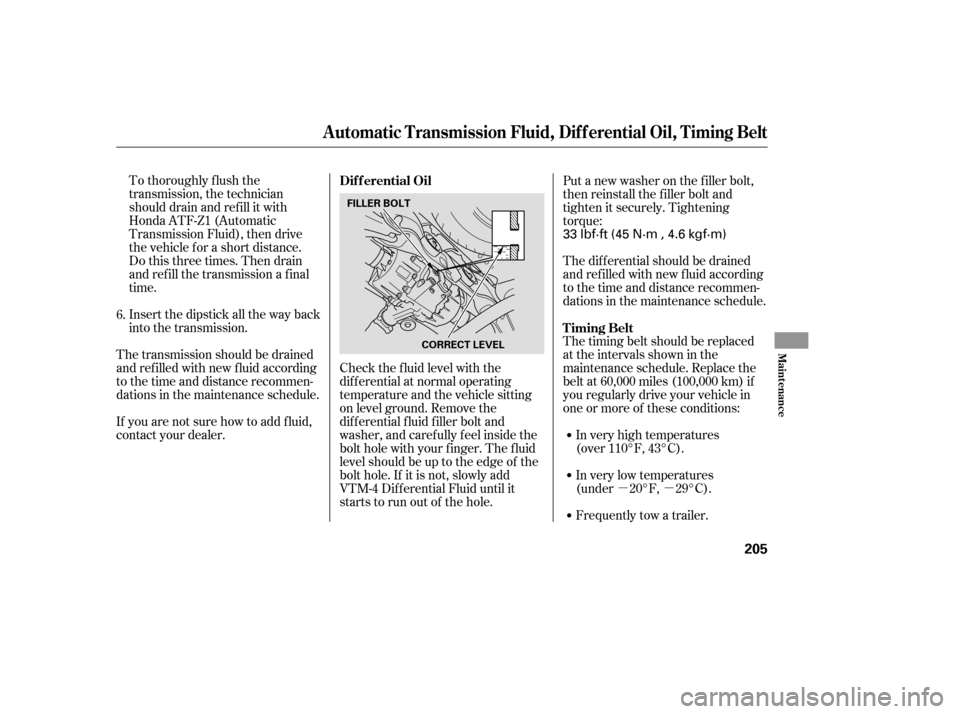
Check the f luid level with the
dif f erential at normal operating
temperature and the vehicle sitting
on level ground. Remove the
dif f erential f luid f iller bolt and
washer, and caref ully f eel inside the
bolt hole with your f inger. The f luid
level should be up to the edge of the
bolt hole. If it is not, slowly add
VTM-4 Dif f erential Fluid until it
starts to run out of the hole.
6.
Timing Belt
Dif f erential Oil
A utomatic T ransmission Fluid, Dif f erential Oil, T iming Belt
Maint enance
205
FILLER BOLT
CORRECT LEVEL
33 lbf·ft (45 N·m , 4.6 kgf·m)
Page 216 of 273
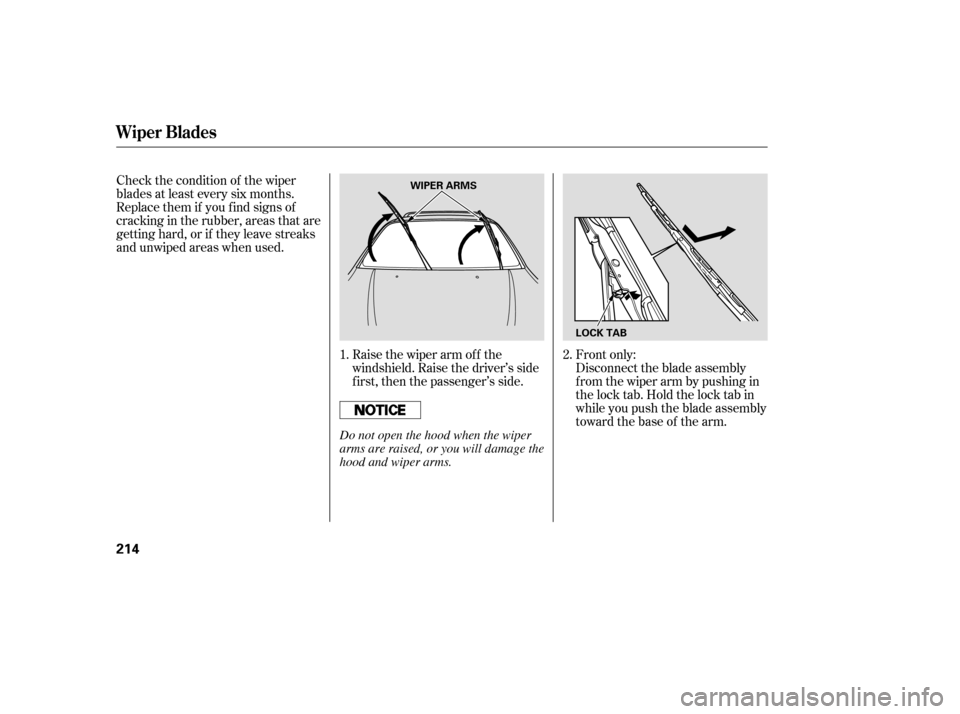
Raise the wiper arm of f the
windshield. Raise the driver’s side
first, then the passenger’s side.
Check the condition of the wiper
blades at least every six months.
Replace them if you f ind signs of
cracking in the rubber, areas that are
getting hard, or if they leave streaks
and unwiped areas when used.
Disconnect the blade assembly
fromthewiperarmbypushingin
the lock tab. Hold the lock tab in
while you push the blade assembly
toward the base of the arm.
1.
2. Front only:
Wiper Blades
214
WIPER ARMS
LOCK TAB
Do not open the hood when the wiper
arms are raised, or you will damage the
hood and wiper arms.
Page 223 of 273
�µ
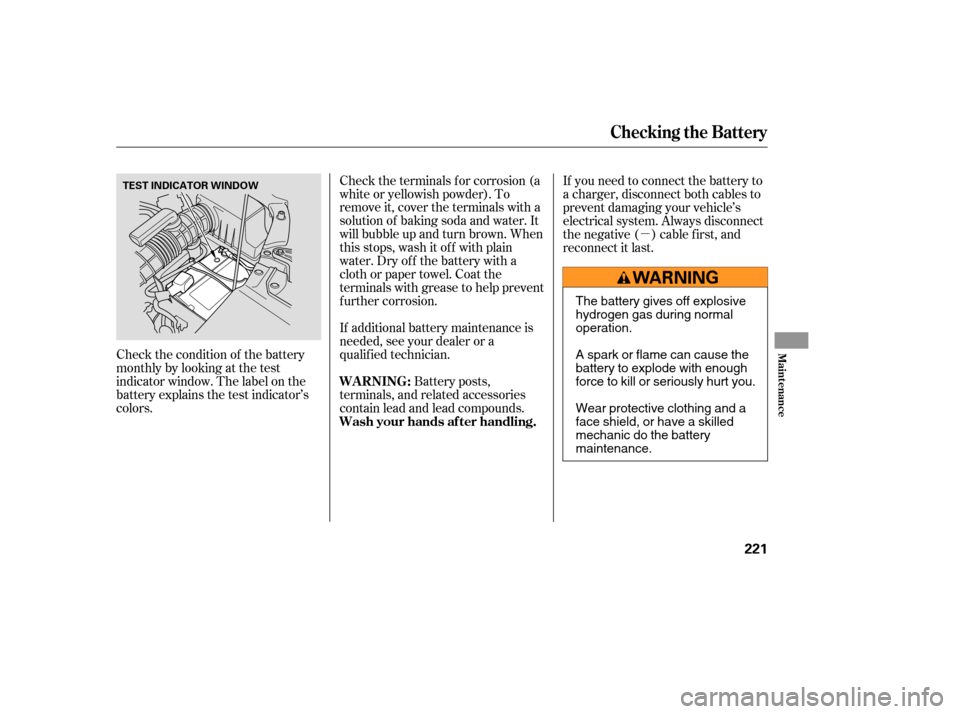
Check the condition of the battery
monthlybylookingatthetest
indicator window. The label on the
battery explains the test indicator’s
colors. If additional battery maintenance is
needed, see your dealer or a
qualif ied technician.
Battery posts,
terminals, and related accessories
contain lead and lead compounds. Check the terminals f or corrosion (a
white or yellowish powder). To
remove it, cover the terminals with a
solution of baking soda and water. It
will bubble up and turn brown. When
this stops, wash it of f with plain
water. Dry off the battery with a
cloth or paper towel. Coat the
terminals with grease to help prevent
f urther corrosion. If you need to connect the battery to
a charger, disconnect both cables to
prevent damaging your vehicle’s
electrical system. Always disconnect
the negative ( ) cable first, and
reconnect it last.
WARNING:
Wash your hands af ter handling.
Checking the Battery
Maint enance
221
TEST INDICATOR WINDOW
The battery gives off explosive
hydrogen gas during normal
operation.
A spark or flame can cause the
battery to explode with enough
force to kill or seriously hurt you.
Wear protective clothing and a
face shield, or have a skilled
mechanic do the battery
maintenance.
Page 224 of 273

Fill the f uel tank.
Change the engine oil and f ilter.Block the rear wheels.
If the vehicle is to be stored f or a
longer period, it should be
supported on jackstands so the
tires are of f the ground.
Wash and dry the exterior
completely.
Cleantheinterior.Makesurethe
carpeting, floor mats, etc., are
completely dry.
If you need to park your vehicle f or
an extended period (more than one
month), there are several things you
should do to prepare it f or storage.
Proper preparation helps prevent
deterioration and makes it easier to
get your vehicle back on the road. If
possible, store your vehicle indoors. Leave one window open slightly (if
the vehicle is being stored
indoors).Cover the vehicle with a
‘‘breathable’’ cover, one made
f rom a porous material such as
cotton. Non-porous materials, such
as plastic sheeting, trap moisture,
which can damage the paint.
Support the f ront wiper blade
arms with a f olded towel or rag so
they do not touch the windshield. Disconnect the battery.
Leave the parking brake off. Put
the transmission in Park. To minimize sticking, apply a
silicone spray lubricant to all door
and tailgate seals. Also, apply a
vehiclebodywaxtothepainted
surfaces that mate with the door
and tailgate seals.If possible periodically run the
engine until it reaches normal
operating temperature (the
cooling f ans cycle twice).
Pref erably, do this once a month.
If you store your vehicle f or 12
months or longer, have your dealer
perf orm the inspections called f or in
the 24 months/30,000 miles
(48,000 km) maintenance schedule
(Normal Conditions) as soon as you
take it out of storage (see page ).
The replacements called f or in the
maintenance schedule are not
needed unless the vehicle has
actually reached that time or mileage. 192
Vehicle Storage
222