Page 225 of 273
......................
Compact Spare Tire .224
....................
Changing a Flat Tire .225
.............
If the Engine Won’t Start . 229
................................
Jump Starting .230
..............
If the Engine Overheats . 232
.........
Low Oil Pressure Indicator . 234
..........
Charging System Indicator . 234
..................
Malf unction Indicator . 235
...............
Brake System Indicator . 236
......................
Emergency Towing .237
..............................................
Fuses .238
..............................
Fuse Locations .241
Taking Care of the Unexpected
T aking Care of t he Unexpect ed
223
Page 226 of 273
Use the compact spare tire as a
temporary replacement only. Get
your regular tire repaired or replaced,
and put it back on your vehicle as
soon as you can.
Check the inf lation pressure of the
compact spare tire every time you
check the other tires. It should be
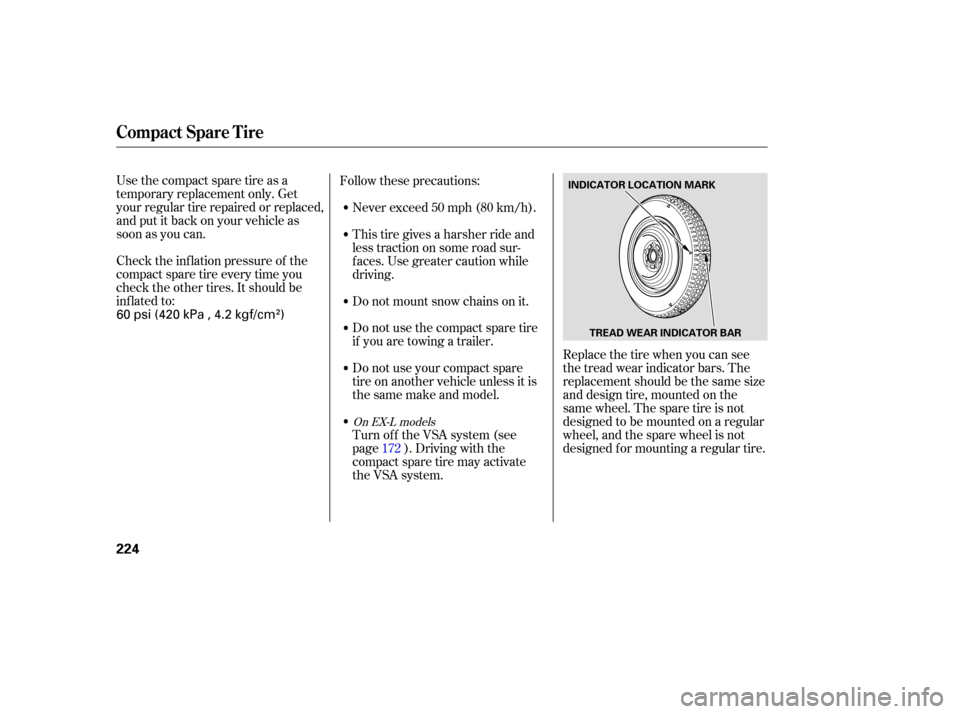
inf lated to:Replace the tire when you can see
the tread wear indicator bars. The
replacement should be the same size
and design tire, mounted on the
same wheel. The spare tire is not
designed to be mounted on a regular
wheel, and the spare wheel is not
designed f or mounting a regular tire.
Follow these precautions:
Never exceed 50mph ( 80km/h).
This tire gives a harsher ride and
less traction on some road sur-
f aces. Use greater caution while
driving.
Do not mount snow chains on it.
Do not use the compact spare tire
if you are towing a trailer.
Do not use your compact spare
tire on another vehicle unless it is
thesamemakeandmodel.
Turn of f the VSA system (see
page ). Driving with the
compact spare tire may activate
the VSA system. 172
On EX-L models
Compact Spare Tire
224
INDICATOR LOCATION MARK
TREAD WEAR INDICATOR BAR
60 psi (420 kPa , 4.2 kgf/cm)
Page 230 of 273
Insert the hoist bracket into the
center hole of the f lat tire.
Slowly turn the wheel nut wrench
clockwisetotakeuptheslackof
the hoist cable. Make sure the
bracketisseatedinthecenter
hole of the spare tire.Store the jack in its holder. Turn
the jacks’ end bracket to lock it in
place and replace the tools and
cover. Turn the wheel nut wrench
clockwise until the f lat tire rests
against the underbody of the
vehicle and you hear the hoist
click.
17. 18. 19.
20.
Changing a Flat T ire
228
Loose items can fly around the
interiorinacrashandcould
seriously injure the occupants.
Store the wheel, jack, and tools
securely before driving.
Always raise the spare tire hoist, even
if you are not stowing a tire. If the
hoist is lef t down, it will be damaged
during driving and need to be replaced.
Page 232 of 273

�´�´
There may be an electrical
problem, such as no power to the
f uel pump. Check all the f uses
(see page ).
If youfindnothingwrong,youwill
need a qualif ied technician to f ind
the problem. See on page . Although this seems like a simple
procedure, you should take several
precautions.
Open the hood, and check the
physical condition of the battery.
In very cold weather, check the
condition of the electrolyte. If it
seems slushy or f rozen, do not try
jump starting until it thaws.
Are you using a properly coded
key? An improperly coded key will
cause the immobilizer system
indicator in the dash panel to blink
rapidly(seepage ).
Connect one jumper cable to the
positive ( ) terminal on your
battery. Connect the other end to
the positive ( ) terminal on the
booster battery. Turn of f all the electrical acces-
sories: heater, A/C, climate
control, stereo system, lights, etc.
Put the transmission in Neutral or
Park, and set the parking brake.
Do you have f uel? Check the f uel
gauge; the low f uel indicator may
not be working.
You cannot start your vehicle by
pushing or pulling it. 1.
2.
3.
59
238 237Emergency
Towing Jump Starting
To Jump Start Your Vehicle:
If the Engine Won’t Start, Jump Starting
230
A battery can explode if you do
not follow the correct procedure,
seriously injuring anyone
nearby.
Keep all sparks, open flames,
and smoking materials away
from the battery.
If a battery sits in extreme cold, the
electrolyte inside can f reeze.
Attempting to jump start with a f rozen
battery can cause it to rupture.
Page 234 of 273

The pointer of the vehicle’s
temperature gauge should stay in
the midrange. If it climbs to the red
mark, you should determine the
reason (hot day, driving up a steep
hill, etc.).
If the vehicle overheats, you should
take immediate action. The only
indication may be the temperature
gauge climbing to or above the red
mark. Or you may see steam or
spray coming f rom under the hood.If you do not see steam or spray,
leave the engine running, and
watch the temperature gauge. If
the high heat is due to overloading,
the engine should start to cool
down almost immediately. If it
does, wait until the temperature
gauge comes down to the midpoint,
then continue driving.
If the temperature gauge stays at
the red mark, turn of f the engine.
Look f or any obvious coolant leaks,
such as a split radiator hose.
Everything is still extremely hot,
so use caution. If you f ind a leak, it
must be repaired bef ore you
continue driving (see
on page ).
If you do not f ind an obvious leak,
check the coolant level in the
radiator reserve tank. Add coolant
if the level is below the MIN mark.
Saf ely pull to the side of the road.
Put the transmission in Neutral or
Park, and set the parking brake.
Turn of f all the accessories, and
turn on the hazard indicator.
If you see steam and/or spray
coming f rom under the hood, turn
of f the engine. Wait until you see
no more signs of steam or spray,
then open the hood.
5.
6. 4.
1.
2. 3.
237
If theEngineOverheats
Emergency
Towing
232
Steam and spray from an
overheated engine can
seriously scald you.
Do not open the hood if steam
is coming out.
Driving with the temperature gauge
pointer at the red mark can cause
serious damage to your engine.
Page 235 of 273

If there was no coolant in the
reserve tank, you may need to add
coolant to the radiator. Let the
engine cool down until the pointer
reaches the middle of the tempera-
ture gauge, or lower, bef ore check-
ing the radiator.
Using gloves or a large heavy
cloth, turn the radiator cap
counterclockwise, without pushing
down, to the f irst stop. Af ter the
pressure releases, push down on
the cap, and turn it until it comes
off.Start the engine and set the
temperature control dial to
maximum (climate control to
FULL AUTO at 90°F/32°C). Add
coolant to the radiator up to the
base of the f iller neck. If you do
not have the proper coolant
mixture available, you can add
plain water. Remember to have
the cooling system drained and
ref illed with the proper mixture as
soon as you can.
Put the radiator cap back on
tightly. Run the engine, and watch
the temperature gauge. If it goes
back to the red mark, the engine
needs repair (see
on page ).
If the temperature stays normal,
check the coolant level in the
radiator reserve tank. If it has
gone down, add coolant to the
MAX mark. Put the cap back on
tightly.
7.
8.
9.
11. 10.
237Emergency
Towing
If theEngineOverheats
T aking Care of t he Unexpect ed
233
Removing the radiator cap
while the engine is hot can
cause the coolant to spray out,
seriously scalding you.
Always let the engine and
radiator cool down before
removing the radiator cap.
Page 238 of 273

However, if the brake pedal does not
f eel normal, you should take
immediate action. A problem in one
part of the system’s dual circuit
design will still give you braking at
two wheels. You will f eel the brake
pedal go down much f arther bef ore
the vehicle begins to slow down, and
you will have to press harder on the
pedal.Slow down by shif ting to a lower
gear, and pull to the side of the road
when it is saf e. Because of the long
distance needed to stop, it is
hazardous to drive the vehicle. You
should have it towed and repaired as
soon as possible (see
on page ).
If you must drive the vehicle a short
distance in this condition, drive
slowly and caref ully.
If this indicator comes on
while driving, the brake
f luid level is probably low in the
reservoir. Press lightly on the brake
pedal to see if it f eels normal. If it
does, check the brake f luid level the
next time you stop at a service
station (see page ). If the f luid
level is low, take the vehicle to your
dealer and have the brake system
inspected f or leaks or worn brake
pads. 237
206
Brake System Indicator
Emergency
Towing
Brake System Indicator
236
Page 239 of 273
If your vehicle needs to be towed,
call a prof essional towing service or
organization. Never tow your vehicle
with just a rope or chain. It is very
dangerous.The operator will load
your vehicle on the back of a truck.
Any other method of towing will
damage the drive system. When you
contact the towing agency, inf orm
them a f lat-bed is required. Refer to
on page
for non-emergency towing
inf ormation. 182
Emergency T owing
Emergency T owing
The only way you can saf ely tow
your vehicle is with f lat-bed
equipment. Towing Your Vehicle
Behind a Motorhome
T aking Care of t he Unexpect ed
237
Towing with only two tires on the
ground will damage parts of the 4WD
system. It should be transported on a
f lat-bed truck or trailer.