2005 HONDA ODYSSEY display
[x] Cancel search: displayPage 357 of 414
Your vehicle is equipped with the
Michelin PAX system. Since each
Michelin PAX system tire has an
inner support ring that allows it to
continue running without air, it may
be dif f icult to immediately judge
f rom its appearance if a tire is
punctured. Your vehicle is also
equipped with a tire pressure
monitoring system (TPMS), and this
system may be your f irst detection of
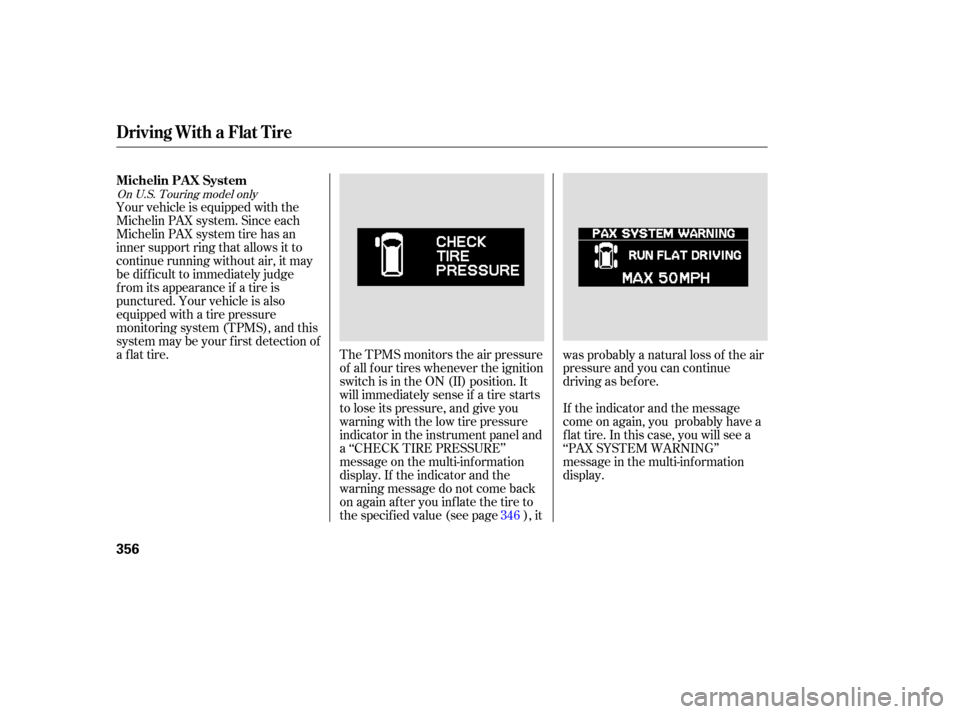
a f lat tire.The TPMS monitors the air pressure
of all f our tires whenever the ignition
switch is in the ON (II) position. It
will immediately sense if a tire starts
to lose its pressure, and give you
warning with the low tire pressure
indicator in the instrument panel and
a ‘‘CHECK TIRE PRESSURE’’
message on the multi-inf ormation
display. If the indicator and the
warning message do not come back
on again af ter you inf late the tire to
the specif ied value (see page ), it was probably a natural loss of the air
pressure and you can continue
driving as bef ore.
If the indicator and the message
come on again, you probably have a
flat tire. In this case, you will see a
‘‘PAX SYSTEM WARNING’’
message in the multi-inf ormation
display.
346
On U.S. Touring model only
Driving With a Flat Tire
Michelin PA X System
356
Page 358 of 414
With the PAX system tires, you can
drive up to about 125 miles (200 km)
even if one or more of your tires are
punctured. This allows you to drive
to the nearest Honda dealer or
authorized Michelin PAX system
dealer to have the tire(s) repaired.
If you get a f lat tire, never try to
repair it yourself , and never replace a
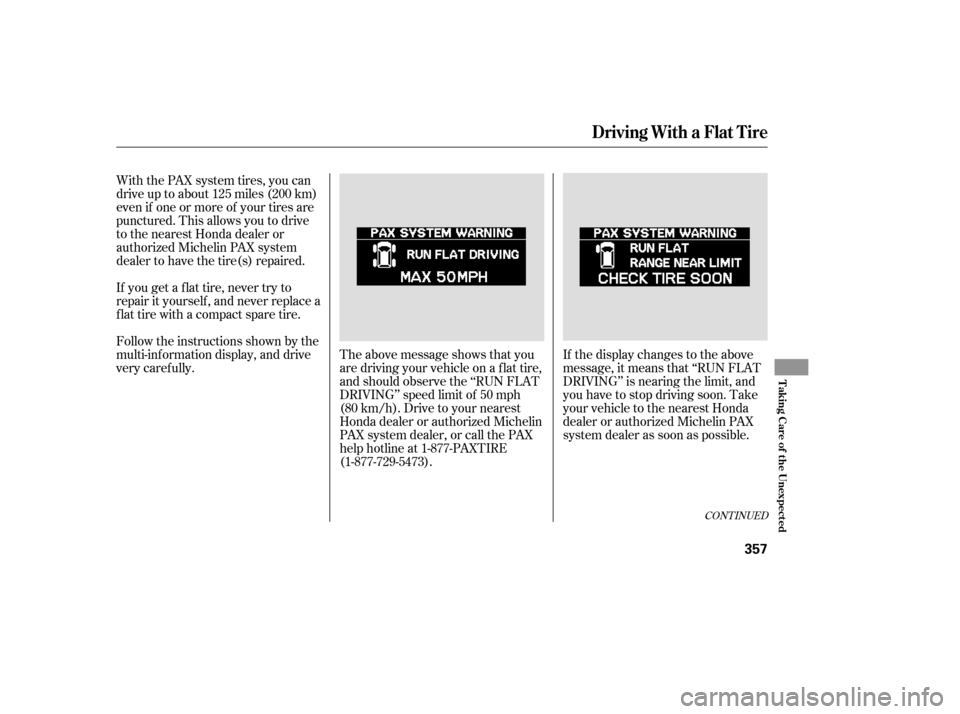
flat tire with a compact spare tire.The above message shows that you
are driving your vehicle on a flat tire,
andshouldobservethe‘‘RUNFLAT
DRIVING’’ speed limit of 50 mph
(80 km/h). Drive to your nearest
Honda dealer or authorized Michelin
PAX system dealer, or call the PAX
help hotline at 1-877-PAXTIRE
(1-877-729-5473).If the display changes to the above
message, it means that ‘‘RUN FLAT
DRIVING’’ is nearing the limit, and
you have to stop driving soon. Take
your vehicle to the nearest Honda
dealer or authorized Michelin PAX
system dealer as soon as possible.
Follow the instructions shown by the
multi-inf ormation display, and drive
very caref ully.
CONT INUED
Driving With a Flat Tire
T aking Care of t he Unexpect ed
357
Page 359 of 414
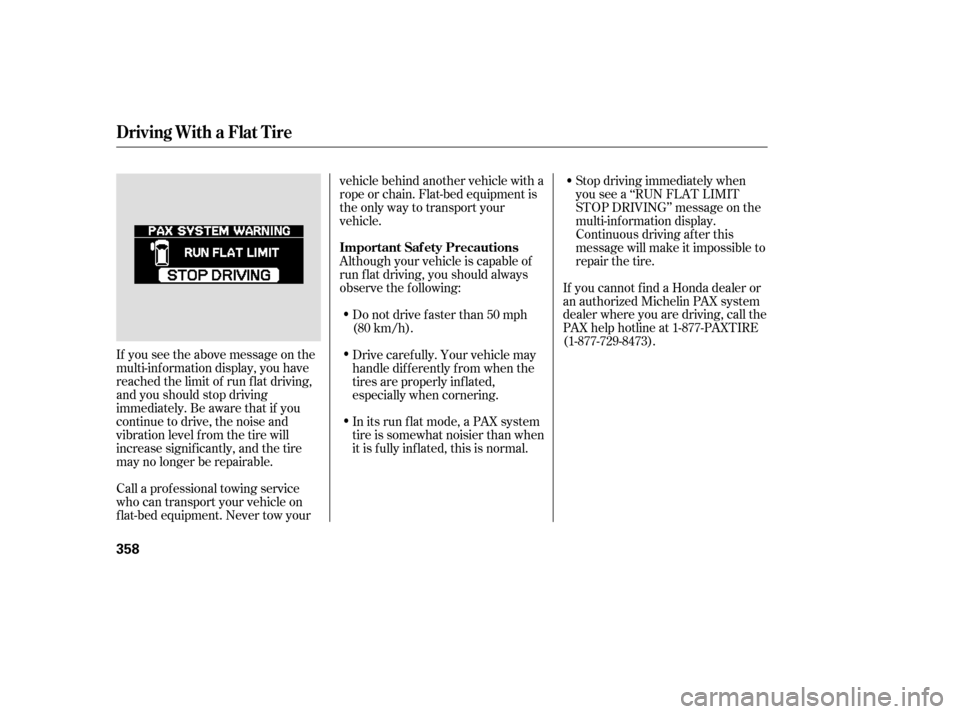
If you see the above message on the
multi-inf ormation display, you have
reached the limit of run f lat driving,
and you should stop driving
immediately. Be aware that if you
continue to drive, the noise and
vibration level f rom the tire will
increase signif icantly, and the tire
may no longer be repairable.Stop driving immediately when
you see a ‘‘RUN FLAT LIMIT
STOP DRIVING’’ message on the
multi-inf ormation display.
Continuous driving af ter this
message will make it impossible to
repair the tire.
If you cannot f ind a Honda dealer or
an authorized Michelin PAX system
dealer where you are driving, call the
PAX help hotline at 1-877-PAXTIRE
(1-877-729-8473).
Call a prof essional towing service
who can transport your vehicle on
f lat-bed equipment. Never tow your vehicle behind another vehicle with a
rope or chain. Flat-bed equipment is
the only way to transport your
vehicle.
Do not drive f aster than 50 mph
(80 km/h).
Drive caref ully. Your vehicle may
handle dif f erently f rom when the
tires are properly inf lated,
especially when cornering.
In its run f lat mode, a PAX system
tire is somewhat noisier than when
it is f ully inf lated, this is normal.
Although your vehicle is capable of
runflatdriving,youshouldalways
observe the f ollowing:
Driving With a Flat Tire
Important Saf ety Precautions
358
Page 372 of 414

Saf ely pull of f the road, and shut
of f the engine. Turn on the hazard
warning indicators.
Let the vehicle sit f or a minute.
Open the hood, and check the oil
level (see page ). An engine
very low on oil can lose pressure
during cornering and other driving
maneuvers.
If necessary, add oil to bring the
level back to the full mark on the
dipstick (see page ).
Start the engine, and watch the oil
pressure indicator. If it does not go
out within 10 seconds, turn of f the
engine. There is a mechanical
problem that needs to be repaired
bef ore you can continue driving
(seeon page
).
You will also see a ‘‘CHECK
ENGINE OIL LEVEL’’ message in
the multi-information display when
this indicator comes on. This indicator should never
come on when the engine is
running. If it starts f lashing or stays
on, the oil pressure has dropped very
low or lost pressure. Serious engine
damage is possible and you should
take immediate action.
You will also see a ‘‘CHECK
CHARGING SYSTEM’’ message in
the multi-information display when
this indicator comes on. Go to a service station or garage
where you can get technical
assistance. Immediately turn of f all electrical
accessories. Try not to use other
electrically operated controls such as
the power windows. Keep the engine
running; starting the engine will
discharge the battery rapidly.If the charging system
indicator comes on brightly
when the engine is running, the
battery is not being charged.
1.
2.
3.
4. 281
328
381
On Touring model On Touring model
L ow Oil Pressure Indicator
Emergency T owingCharging System Indicator
L ow Oil Pressure Indicator, Charging System Indicator
T aking Care of t he Unexpect ed
371
Running the engine with low oil
pressure can cause serious mechanical
damage almost immediately. Turn of f
the engine as soon as you can saf ely get
the vehicle stopped.
Page 373 of 414

This indicator may also come on
along with the ‘‘D’’ indicator.If your vehicle battery has been
disconnected or gone dead, these
codes are erased. It takes at least
three days of driving under various
conditions to set the codes again.
You will also see a ‘‘CHECK
EMISSION SYSTEM’’ message in
the multi-information display when
this indicator comes on.
Your vehicle has certain ‘‘readiness
codes’’ that are part of the on-board
diagnostics f or the emissions
systems. In some states, part of the
emissions testing is to make sure
these codes are set. If they are not
set, the test cannot be completed. To check if they are set, turn the
ignition switch to ON (II), without
starting the engine. The malf unction
indicator lamp will come on f or 20
seconds. If it then goes of f , the
readiness codes are set. If it blinks 5
times, the readiness codes are not
set. If possible, do not take your
vehicle f or a state emissions test
until the readiness codes are set.
Refer to
f or more inf ormation (see page ).
If the indicator remains on, or the
f uel cap was not loose or missing,
have your vehicle checked by a
dealer as soon as possible. If you have recently ref ueled your
vehicle, the indicator could come on
because of a loose or missing f uel f ill
cap. Tighten the cap until it clicks at
least three times. Tightening the cap
will not turn the indicator turn of f
immediately; it takes at least three
days of normal driving. If this indicator comes on
while driving, it means one
of the engine’s emissions control
systems may have a problem. Even
though you may f eel no dif f erence in
your vehicle’s perf ormance,
continued operation may cause
serious damage.
395
On Touring model
Readiness Codes
Malf unction Indicator L amp
State Emissions T esting
Malf unction Indicator L amp, Readiness Codes
372
If you keep driving with the
malf unction indicator lamp on, you can
damage your vehicle’s emissions
controls and engine. Those repairs may
not be covered by your vehicle’s
warranties.
Page 374 of 414

However, if the brake pedal does not
f eel normal, you should take
immediate action. A problem in one
part of the system’s dual circuit
design will still give you braking at
two wheels. You will f eel the brake
pedal go down much f arther bef ore
the vehicle begins to slow down, and
you will have to press harder on the
pedal.
Slow down by shif ting to a lower
gear, and pull to the side of the road
when it is saf e. Because of the long
distance needed to stop, it is
hazardous to drive the vehicle. You
should have it towed and repaired as
soon as possible (seeon page ). If you must drive the vehicle a short
distance in this condition, drive
slowly and caref ully.
If the brake system indicator comes
on while driving, the brake f luid level
is probably low. Press lightly on the
brake pedal to see if it f eels normal.
If it does, check the brake f luid level
thenexttimeyoustopataservice
station (see page ).
If the f luid level is low, take your
vehicle to a dealer, and have the
brake system inspected f or leaks or
worn brake pads. The brake system
indicator normally
comesonwhenyou
turn the ignition switch to ON (II),
and as a reminder to check the
parking brake. It will stay on if you
do not f ully release the parking
brake. If the ABS indicator and the VSA
indicator come on with the brake
system indicator, have the vehicle
inspected by your dealer
immediately.
You will also see a ‘‘CHECK BRAKE
SYSTEM’’ message on the multi-
inf ormation display when this
indicator comes on.
335
381
On Touring model
Emergency
Towing
Brake System Indicator
T aking Care of t he Unexpect ed
373
U.S. Canada
Page 378 of 414

If the replacement fuse of the
same rating blows in a short time,
there is probably a serious
electrical problem with your
vehicle. Leave the blown fuse in
that circuit, and have your vehicle
checked by a qualif ied mechanic.
If the driver’s power window f use is
removed, the AUTO feature of the
driver’s window will be disabled. You
should reset the AUTO f eature (see
page ).
If the radio f use is removed, the
audio system will disable itself . The
nexttimeyouturnontheradioyou
will see ‘‘ ’’ in the f requency
display. Use the preset buttons to
enter the f ive-digit code (see page ).
If you cannot drive the vehicle
without f ixing the problem, and you
do not have a spare fuse, take a fuse
of the same rating or a lower rating
f rom one of the other circuits. Make
sureyoucandowithoutthatcircuit
temporarily (such as the accessory
power socket or radio).
If you replace the blown f use with a
spare f use that has a lower rating, it
might blow out again. This does not
indicate anything wrong. Replace the
f use with one of the correct rating as
soon as you can.
Look f or a burned wire inside the
f use. If it is burned, replace the
f use with one of the spare f uses of
thesameratingorlower.
5. 6.
162
229
CONT INUED
On EX, and Touring models
Fuses
T aking Care of t he Unexpect ed
377
BLOWN
Replacing a f use with one that has a
higher rating greatly increases the
chances of damaging the electrical
system. If you do not have a
replacement f use with the proper
rating f or the circuit, install one with
a lower rating.
Page 409 of 414

........................
Low Coolant Level .282
.........................
Low Fuel Indicator .68
...
Low Oil Pressure Indicator . 63,371
................................
Lower Anchors .45
..........................
Lower Glove Box .180
...
Lubricant Specif ications Chart . 386
...........
Luggage Net (Cargo Net) . 289
...........
Luggage, Storing (Cargo) . 286
..................................
Maintenance .313
................................
Minder .315-324
...
Owner Maintenance Checks . 323
.................................
Record .325-326
......................
Required Indicator .70
..........................................
Saf ety .314
.
Malf unction Indicator Lamp . 63,372
...................
Manual Sliding Doors . 142
...............................
Meters, Gauges .71
..................
Michilen PAX System . 356
........................
Mirrors, Adjusting .167
.................................
Modif ications .284
...............
Modif ying Your Vehicle . 284
.......................................
Moonroof .166 Moving the Second Row Bucket
.............................................
Seat .154
.............
Multi-Inf ormation Display . 74
...................
Neutral Gear Position . 295
..................
New Vehicle Break-in . 278
...................
NOTICE, Explanation of . i
...............
Numbers, Identif ication . 384
...
Octane Requirement, Gasoline . 278
.........................................
Odometer .72
...............................
Odometer, Trip .72
Oil ........................
Change, How to .329
......................
Change, When to .315
......................
Checking Engine .281
..............
Pressure Indicator . 63,371
Selecting Proper Viscosity ......................................
Chart .328
.........
ON (Ignition Key Position) . 130
Onboard Ref ueling Vapor ....................................
Recovery .392 ............................
Outside Mirrors .167
....................
Overheating, Engine .369
.......
Owner Maintenance Checks . 323
.........................
Oxygenated Fuels .278
............
Panel Brightness Control . 125
........................
Park Gear Position .295
...........................................
Parking .298
...............................
Parking Brake .169
Parking Brake and Brake .................
System Indicator . 63,373
...............................
Parking Lights .122
................
Parking Sensor System . 271
..
Parking Over Things that Burn . 298
....
Passenger Airbag Of f Indicator . 33
...................................
PAX System .356
.............................
PGM-FI System .393
........................
Power Door Locks .137
Power Sliding Doors .......................................
Indicator .67
...................................
Operation .142
.....................................
Switches .143
...............
Power Socket Locations . 182
..............................
Power Tailgate .139
Index
M N
OP
VI