Page 158 of 205
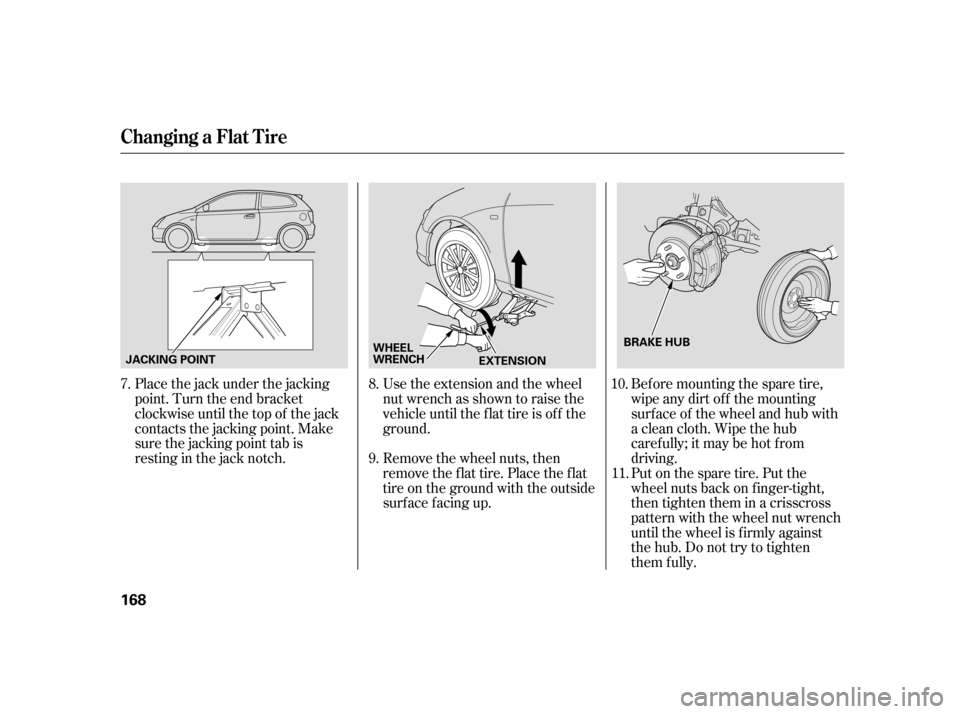
Place the jack under the jacking
point. Turn the end bracket
clockwise until the top of the jack
contacts the jacking point. Make
sure the jacking point tab is
restinginthejacknotch.Use the extension and the wheel
nut wrench as shown to raise the
vehicle until the f lat tire is of f the
ground.
Bef ore mounting the spare tire,
wipeanydirtoff themounting
surface of the wheel and hub with
a clean cloth. Wipe the hub
carefully;itmaybehotfrom
driving.
Put on the spare tire. Put the
wheel nuts back on f inger-tight,
then tighten them in a crisscross
pattern with the wheel nut wrench
until the wheel is f irmly against
the hub. Do not try to tighten
them f ully.
Remove the wheel nuts, then
remove the flat tire. Place the flat
tire on the ground with the outside
surface facing up.
7.
8. 9.10.
11.
Changing a Flat T ire
168 JACKING POINT
WHEEL
WRENCH
EXTENSION BRAKE HUB
�����—�����—�
���y�
�������������y���
�(���)�������y���
���
�y
Page 159 of 205
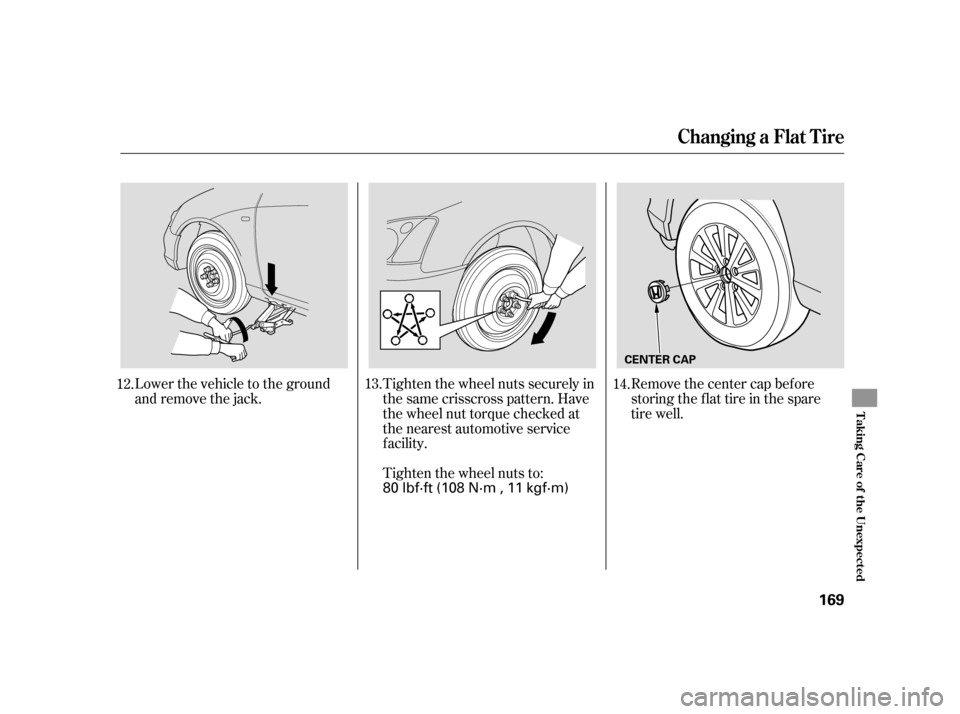
Lower the vehicle to the ground
and remove the jack.Tighten the wheel nuts securely in
the same crisscross pattern. Have
the wheel nut torque checked at
the nearest automotive service
f acility.
Tighten the wheel nuts to:Remove the center cap before
storing the f lat tire in the spare
tire well.
12.
13.
14.
Changing a Flat T ire
T aking Care of t he Unexpect ed
169
CENTER CAP
80 lbf·ft (108 N·m , 11 kgf·m)
�����—�����—�
���y�
�����������
�y���
�(���)�������y���
�����y
Page 160 of 205
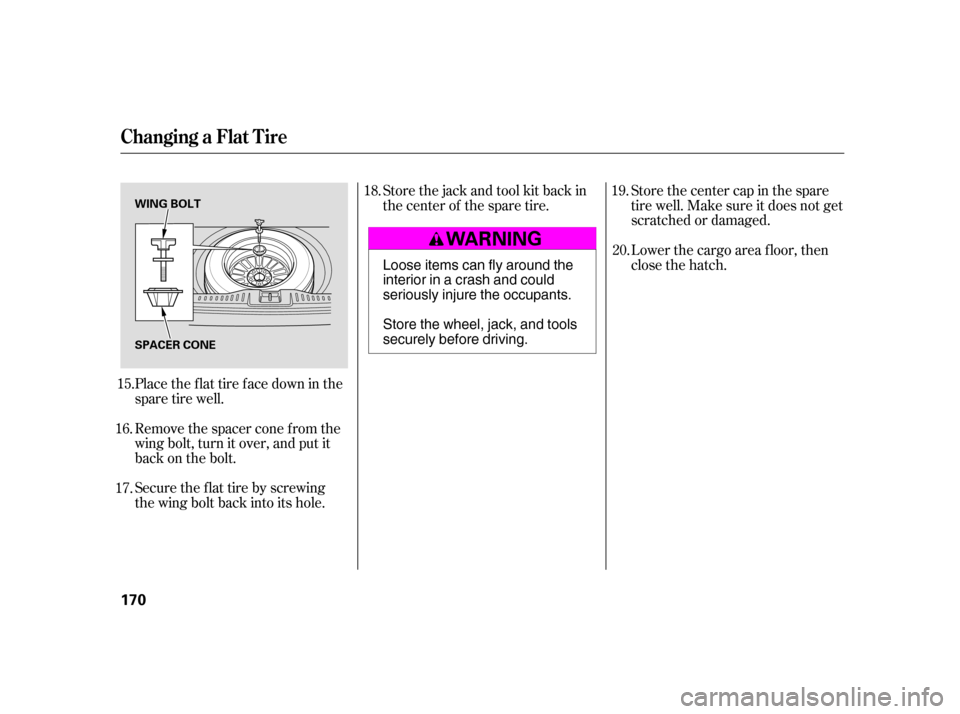
Place the flat tire face down in the
spare tire well.
Remove the spacer cone f rom the
wing bolt, turn it over, and put it
back on the bolt.
Securetheflattirebyscrewing
the wing bolt back into its hole.Store the jack and tool kit back in
the center of the spare tire.
Store the center cap in the spare
tire well. Make sure it does not get
scratched or damaged.
Lower the cargo area f loor, then
close the hatch.
15.
16.
17. 18. 19.
20.
Changing a Flat T ire
170WING BOLT
SPACER CONE
Loose items can fly around the
interior in a crash and could
seriously injure the occupants.
Store the wheel, jack, and tools
securely before driving.
�����—�����—�
���y�
�����������
�y���
�(���)�������y���
�����y
Page 169 of 205

However, if the brake pedal does not
f eel normal, you should take
immediate action. A problem in one
part of the system’s dual circuit
design will still give you braking at
two wheels. You will f eel the brake
pedal go down much f arther bef ore
the vehicle begins to slow down, and
you will have to press harder on the
pedal.
Slow down by shif ting to a lower
gear, and pull to the side of the road
when it is saf e. Because of the long
distance needed to stop, it is
hazardous to drive the vehicle. You
should have it towed and repaired as
soon as possible (seeon page ).
If you must drive the vehicle a short
distance in this condition, drive
slowly and caref ully.
If the brake system indicator comes
on while driving, the brake f luid level
is probably low. Press lightly on the
brake pedal to see if it f eels normal.
If it does, check the brake f luid level
thenexttimeyoustopataservice
station (see page ).
If the f luid level is low, take your
vehicle to a dealer, and have the
brake system inspected f or leaks or
worn brake pads. The brake system indicator
normally comes on when
you turn the ignition switch
to ON (II), and as a
reminder to check the
parking brake. It will stay
on if you do not f ully
release the parking brake.
144 186Emergency
Towing
Brake System Indicator
T aking Care of t he Unexpect ed
179
Canada
U.S.
�����—�����—�
���y�
�������������y���
�(���)�������y���
�����y
Page 176 of 205

�µ�µ
If your vehicle needs to be towed,
call a prof essional towing service or
organization. Never tow your vehicle
with just a rope or chain. It is very
dangerous.
The operator
loads your vehicle on the back of a
truck.
Thereareonlytwowaystotowyour
vehicle. If , due to damage, your vehicle must
be towed with the f ront wheels on
the ground, do the f ollowing:
Release the parking brake.
Shif t the transmission to Neutral.
With the f ront wheels on the ground,
it is best to tow the vehicle no farther
than 50 miles (80 km), and keep the
speedbelow35mph(55km/h).
The tow
truck uses two pivoting arms that go
under the tires (f ront or rear) and lif t
them of f the ground. The other two
tires remain on the ground. If your vehicle is equipped with a
f ront spoiler, remove it bef ore
towing so it is not damaged.Flat -bed Equipment
Wheel-lif t Equipment
This is the best way to trans-
port your vehicle.
T his is
an acceptable way to tow your
vehicle.
Emergency T owing
186 Improper towing preparation will
damage the transmission. Follow the
above procedure exactly. If you cannot
shif t the transmission or start the
engine, your vehicle must be
transported with the f ront wheels of f
the ground.
Trying to lif t or tow your vehicle by the
bumpers will cause serious damage.
The bumpers are not designed to
support the vehicle’s weight.
�����—�����—�
���y�
�������������y���
�(���)�������y���
�����y
Page 177 of 205
If you decide to tow your vehicle
with all f our wheels on the ground,
make sure you use a properly-
designed and attached tow bar.
Prepare the vehicle for towing as
described above, and leave the
ignition switch in Accessory (I) so
the steering wheel does not lock.
Make sure the radio and any items
plugged into the accessory power
socket are turned of f so they do not
rundownthebattery.
Emergency T owing
T aking Care of t he Unexpect ed
187
The steering system can be damaged if
the steering wheel is locked. Leave the
ignition switch in ACCESSORY (I), and
make sure the steering wheel turns
f reely bef ore you begin towing.
�����—�����—�
���y�
���������
�
�y���
�(���)�������y���
�����y
Page 181 of 205

�Î�Î �Î
�Î �Î �Î
Specif ications
192 Dimensions
Weights
Engine
Capacities
66.7 in (1,695 mm)
56.3 in (1,430 mm)
101.2 in (2,570 mm)
57.9 in (1,470 mm)
58.0 in (1,472 mm)
3.39 x 3.39 in (86.0 x 86.0 mm) 121.9 cu-in (1,998 cm
)
9.8 : 1 13.2 US gal (50
)
1.32 US gal (5.0
)
1.77 US gal (6.7
)
4.4 US qt (4.2
)
4.2 US qt (4.0)
5.6 US qt (5.3)
1.6 US qt (1.5)
1.8 US qt (1.7)
2.6 US qt (2.5
)
0.13 US gal (0.5
)
5.3 US qt (5.0
)
Length
Width
Height
Wheelbase
Track
Gross vehicle weight rating See the certification label attached
to the driver’s doorjamb.
Water cooled 4-stroke DOHC
i-VTEC 4-cylinder gasoline engine
Type
BorexStroke
Displacement
Compression ratio
Spark plugs
SKJ20DR-M11
IZFR6K-11 Fuel tank
Engine
coolant
Engine oil Manual
transmission
fluid
Windshield
washer reservoir
Including the coolant in the reserve tank and that remaining in the
engine.
Reserve tank capacity:
162.8 in (4,135 mm)
FrontRear Approx.
Change Manual
Total Manual
Change
Without filter
Total
ChangeTotal
NGK:
DENSO: 1: 2: 3:
U.S. models
Canadian models 1
23
Including filter
�����—�����—�
���y�
�������������y���
�(���)�������y���
�����y
Page 184 of 205

�µ�µ �µ �µ �µ �µ �µ �µ
�µ �µ �µ �µ
The temperature grades are A (the
highest), B, and C, representing the
tire’s resistance to the generation of
heat and its ability to dissipate heat
when tested under controlled
conditions on a specif ied indoor
laboratory test wheel. Sustained high
temperature can cause the material
of the tire to degenerate and reduce
tire life, and excessive temperature
can lead to sudden tire f ailure. The
grade C corresponds to a level of
perf ormance, which all passenger
vehicle tires must meet under the
Federal Motor Vehicle Saf ety
Standard No. 109. Grades B and A
represent higher levels of
perf ormance on the laboratory test
wheel than the minimum required by
law.
Warning: The temperature grade f or
this tire is established f or a tire that
is properly inf lated and not over-
loaded. Excessive speed, underinf la-
tion, or excessive loading, either separately or in combination, can
cause heat buildup and possible tire
f ailure.
Date of manufacture.
Tire type code.
Manuf acturer’s
identification mark.
This indicates that the tire
meets all requirements of
the U.S. Department of
Transportation.
Tire Identif ication Number (TIN) is
a group of numbers and letters that
look like the f ollowing example TIN.
Speed symbol (an
alphabetical code indicating
the maximum speed rating).
Load index (a numerical code
associated with the maximum
load the tire can carry).
Rim diameter in inches.
Tire construction code (R
indicates radial).
Whenever tires are replaced, they
should be replaced with tires of the
same size. Following is an example
of tire size with an explanation of
what each component means. Aspect ratio (the tire’s section
height as a percentage of its
width).
Tire width in millimeters.
Vehicletype(Pindicates
passenger vehicle).
The tires that came on your vehicle
have a number of markings. Those
you should be aware of are described
below. P 55 R 16 V DOT B97R
FW6X 2202
205 89
Temperature A,B,C
Tire Labeling
DOT T ire Quality Grading (U.S. Vehicles), T ire L abeling
T ire Ident if icat ion Number
Tire Size
T echnical Inf ormation
195
DOT B97R FW6X 2202
P205/55R16 89V
�����—�����—�
���y�
�������������y���
�(���)�������y���
�����y