Page 2 of 289
�Î
�Î
Only on vehicles equipped with Navigation System. Ref er to the Navigation System Owner’s Manual.
:
Your Vehicle at a Glance
4
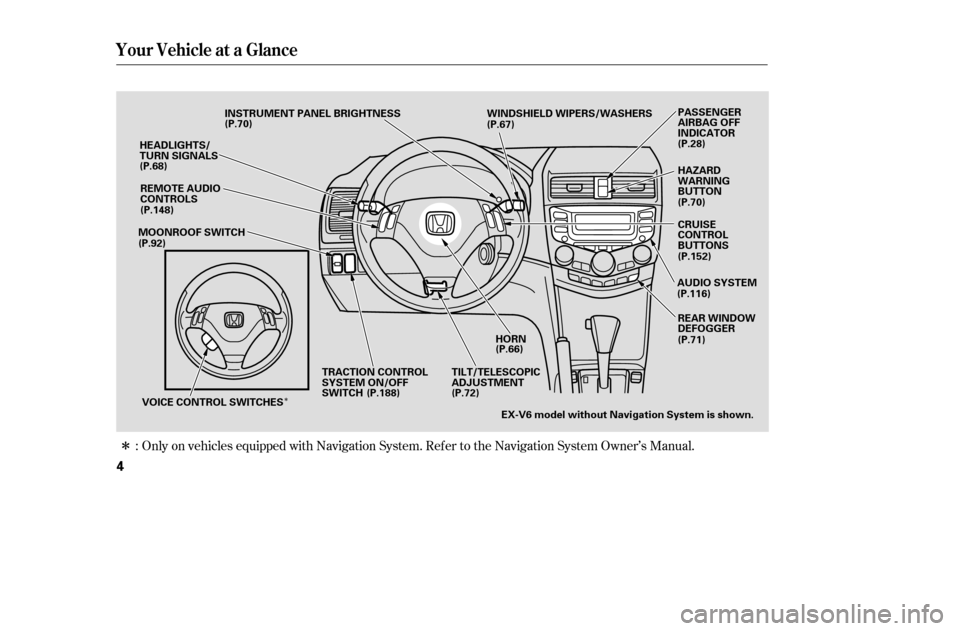
HORN
HEADLIGHTS/
TURN SIGNALS
TILT/TELESCOPIC
ADJUSTMENTEX-V6 model without Navigation System is shown. REAR WINDOW
DEFOGGER
INSTRUMENT PANEL BRIGHTNESS WINDSHIELD WIPERS/WASHERS
MOONROOF SWITCH
VOICE CONTROL SWITCHES TRACTION CONTROL
SYSTEM ON/OFF
SWITCH HAZARD
WARNING
BUTTON
AUDIO SYSTEM PASSENGER
AIRBAG OFF
INDICATOR
(P.70)
(P.68)
(P.148)
(P.92) (P.67)
(P.28)
(P.70) CRUISE
CONTROL
BUTTONS
(P.152)
(P.116)
(P.66)
(P.72)
(P.188)
REMOTE AUDIO
CONTROLS
(P.71)
�����—�����—�����y�
�������������y���
�(���%�������y���������y
Page 4 of 289
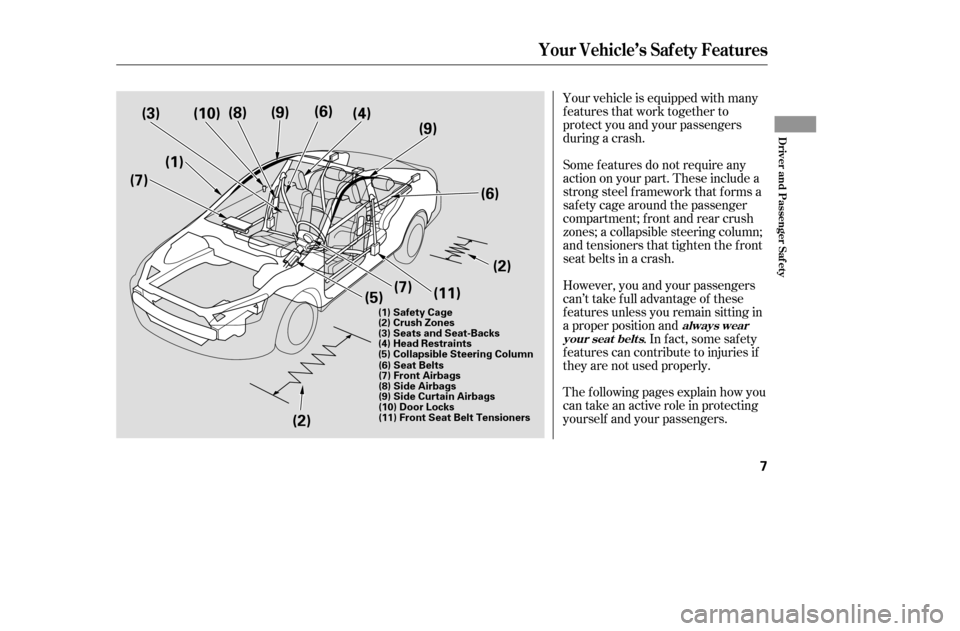
Your vehicle is equipped with many
features that work together to
protect you and your passengers
during a crash.
Some f eatures do not require any
action on your part. These include a
strong steel f ramework that f orms a
saf ety cage around the passenger
compartment; front and rear crush
zones; a collapsible steering column;
and tensioners that tighten the f ront
seat belts in a crash.
However, you and your passengers
can’t take f ull advantage of these
f eatures unless you remain sitting in
a proper position and. In fact, some safety
f eatures can contribute to injuries if
they are not used properly.
The f ollowing pages explain how you
cantakeanactiveroleinprotecting
yourself and your passengers.
Your Vehicle’s Saf ety Features
always wear
your seat belt s
Driver and Passenger Saf ety
7
(1)
(2)
(2)
(3) (4)
(5)(7)
(8)
(7) (10)
(11)
(9)
(6)
(9)
(6)
(1) Safety Cage
(2) Crush Zones
(3) Seats and Seat-Backs
(4) Head Restraints
(5) Collapsible Steering Column(6) Seat Belts
(7) Front Airbags
(8) Side Airbags
(9) Side Curtain Airbags
(10) Door Locks
(11) Front Seat Belt Tensioners
�����—�����—�����y�
�������������y���
�(���%�������y�����
���y
Page 6 of 289
CONT INUED
Your vehicle has a Supplemental
Restraint System (SRS) with f ront
airbags to help protect the heads and
chests of the driver and a front seat
passenger during a moderate to
severe f rontal collision (see pagef or more inf ormation on how
your f ront airbags work). Your vehicle also has side airbags to
help protect the upper torso of the
driver or a f ront seat passenger
during a moderate to severe side
impact (see page f or more
information on how your side airbags
work).
Your vehicle also has side curtain
airbags to help protect the heads of
the driver, f ront passenger, and
passengers in the outer rear seating
positions during a moderate to
severe side impact (see page f or
more inf ormation on how your side
curtain airbags work).
22 25
27
Your Vehicle’s Saf ety Features
Airbags
Driver and Passenger Saf ety
9
�����—�����—�����y�
�������������y���
�(���%�������y�����
���y
Page 10 of 289
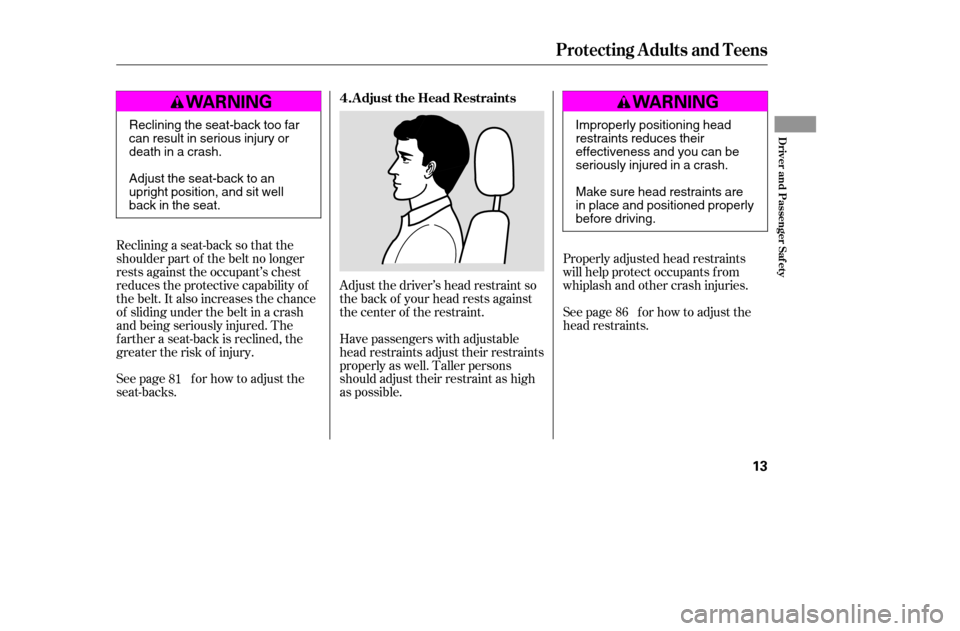
Adjust the driver’s head restraint so
the back of your head rests against
the center of the restraint.
Have passengers with adjustable
head restraints adjust their restraints
properly as well. Taller persons
should adjust their restraint as high
as possible.Properly adjusted head restraints
will help protect occupants f rom
whiplash and other crash injuries.
See page f or how to adjust the
head restraints.
See page f or how to adjust the
seat-backs.
Reclining a seat-back so that the
shoulder part of the belt no longer
rests against the occupant’s chest
reduces the protective capability of
the belt. It also increases the chance
of sliding under the belt in a crash
and being seriously injured. The
farther a seat-back is reclined, the
greater the risk of injury.
81 86
Protecting A dults and Teens
A djust the Head Restraints
4.
Driver and Passenger Saf ety
13
Improperly positioning head
restraints reduces their
effectiveness and you can be
seriously injured in a crash.
Make sure head restraints are
in place and positioned properly
before driving.
Reclining the seat-back too far
can result in serious injury or
death in a crash.
Adjust the seat-back to an
upright position, and sit well
back in the seat.
�����—�����—�����y�
���������
�
�y���
�(���%�������y�����
���y
Page 19 of 289

Af ter inf lating, the f ront airbags will
immediately def late, so they won’t
interf ere with the driver’s visibility,
or the ability to steer or operate
other controls.
The total time for inflation and
def lation is one-tenth of a second, so
f ast that most occupants are not
aware that the airbags deployed until
they see them lying in their laps.
During a f rontal crash, your seat belt
restrains your lower body and torso,
and the f ront airbag helps protect
your head and chest.
Although both airbags normally
inf late within a split second of each
other, it is possible f or only one
airbag to deploy.
This can happen if the severity of a
collision is at the margin, or
threshold, that determines whether
or not the airbags will deploy. In
such cases, the seat belt will provide
suf f icient protection, and the
supplemental protection of f ered by
the airbag would be minimal.
Only the driver’s airbag can deploy if
there is no passenger in the f ront
seat, or if the advanced airbag
system has turned the passenger’s
airbag off (see page ).
If you ever have a moderate to
severe f rontal collision, sensors will
detect the vehicle’s rapid
deceleration.
If the rate of deceleration is high
enough, the control unit will instantly
inf late the driver’s and f ront
passenger’s airbags, at the time and
with the f orce needed.
24
How Your Front Airbags Work
Additional Inf ormation About Your Airbags
22
�����—�����—�����y�
�������������y���
�(���%�������y���������y
Page 29 of 289

�µ
According to accident statistics,
children of all ages and sizes are
saf er when they are restrained in a
back seat. The National Highway
Traffic Safety Administration and
Transport Canada recommend that
all children age 12 and under be
properly restrained in a back seat.Front airbags have been designed to
help protect adults in a moderate to
severe f rontal collision. To do this,
the passenger’s f ront airbag is quite
large, and it can inflate with enough
f orce to cause very serious injuries.
Even though your vehicle has an
advanced front airbag system, which
can automatically turn the
passenger’s f ront airbag of f (see
page ), please f ollow the
guidelines below.
If
the airbag inf lates, it can hit the back
of the child seat with enough force
to kill or very seriously injure an
inf ant. If the vehicle seat is
too far forward, or the child’s head is
thrown f orward during a collision, an
inflating front airbag can strike the
child with enough f orce to kill or
very seriously injure a small child.
Whenever possible,
larger children should sit in the back
seat, on a booster seat if needed, and
be properly restrained with a seat
belt (see page f or important
inf ormation about protecting larger
children).
Children who ride in back are less
likely to be injured by striking
interior vehicle parts during a
collision or hard braking. Also,
children cannot be injured by an
inflating front airbag when they ride
in the back.
Some states have laws restricting
where children may ride.
45
28
The Passenger’s Front Airbag
Can Pose Serious Risks
All Children Should Sit in a Back
Seat
Protecting Children General Guidelines
Inf ant s
Never put a rear-f acing child seat int he f ront seat of a vehicle equippedwit h a passenger’s f ront airbag. Small Children
Placing a f orward-f acing child seat in
t he f ront seat of a vehicle equippedwit h a passenger’s f ront airbag canbe hazardous.
Larger ChildrenChildren who have outgrown childseat s are also at risk of being injuredor killed by an inf lat ing passenger’s
front airbag.
32
�����—�����—�����y�
�������������y���
�(���%�������y���������y
Page 33 of 289
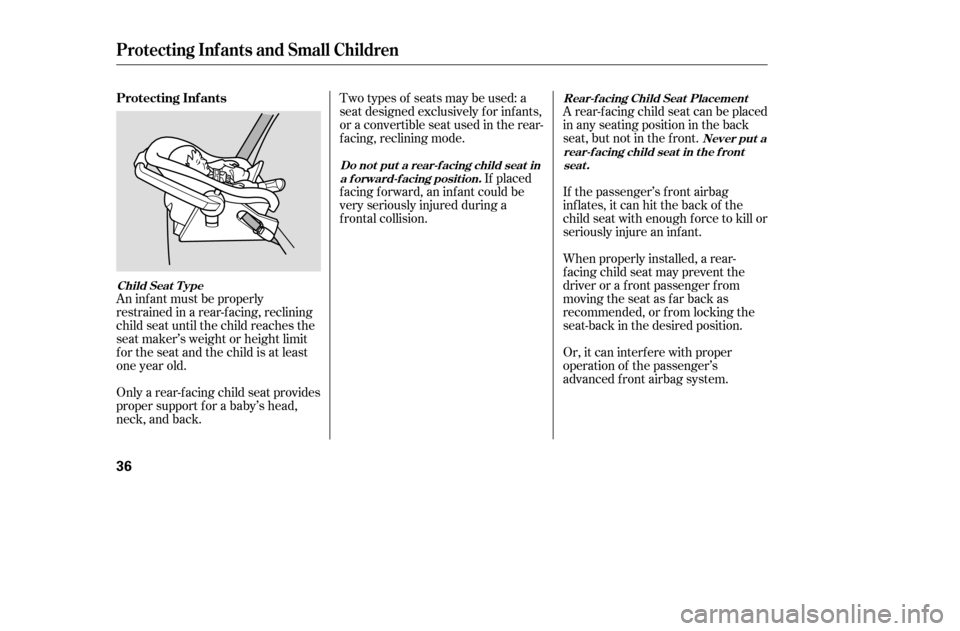
An inf ant must be properly
restrained in a rear-f acing, reclining
child seat until the child reaches the
seat maker’s weight or height limit
for the seat and the child is at least
one year old.
Only a rear-f acing child seat provides
proper support f or a baby’s head,
neck, and back.Two types of seats may be used: a
seat designed exclusively f or inf ants,
or a convertible seat used in the rear-
f acing, reclining mode.
If placed
f acing f orward, an inf ant could be
very seriously injured during a
f rontal collision. A rear-f acing child seat can be placed
in any seating position in the back
seat, but not in the f ront.
If the passenger’s f ront airbag
inflates, it can hit the back of the
child seat with enough f orce to kill or
seriously injure an inf ant.
When properly installed, a rear-
f acing child seat may prevent the
driver or a f ront passenger f rom
moving the seat as far back as
recommended, or f rom locking the
seat-back in the desired position.
Or, it can interf ere with proper
operation of the passenger’s
advanced front airbag system.
Protecting Inf ants
Child Seat T ype
Do not put a rear-f acing child seat in
a f orward-f acing position. Rear-f acing Child Seat Placement
Never put a
rear-f acing child seat in t he f ront seat .
Protecting Inf ants and Small Children
36
�����—�����—�����y�
���������
�
�y���
�(���%�������y���������y
Page 38 of 289
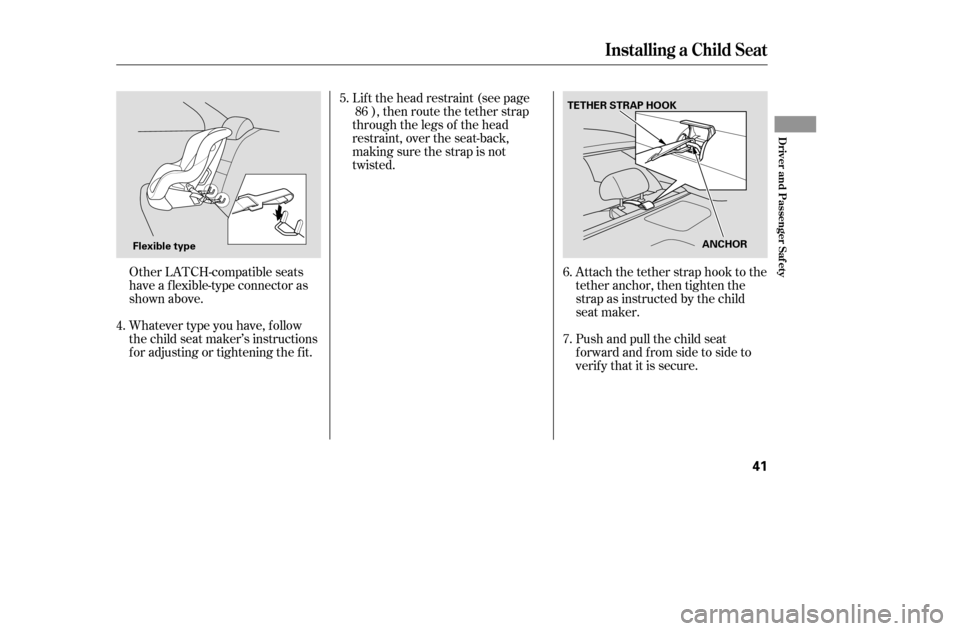
Lif t the head restraint (see page), then route the tether strap
through the legs of the head
restraint, over the seat-back,
making sure the strap is not
twisted.
Other LATCH-compatible seats
have a f lexible-type connector as
shown above.
Whatever type you have, f ollow
the child seat maker’s instructions
f or adjusting or tightening the f it. Attach the tether strap hook to the
tether anchor, then tighten the
strap as instructed by the child
seat maker.
Push and pull the child seat
f orward and f rom side to side to
verif y that it is secure.
4. 5.
6. 7.
86
Installing a Child Seat
Driver and Passenger Saf ety
41
Flexible type
TETHER STRAP HOOK
ANCHOR
�����—�����—�����y�
������
������y���
�(���%�������y���������y