2005 FORD TAURUS climate control
[x] Cancel search: climate controlPage 1 of 248

Introduction 4
Instrument Cluster 10
Warning and control lights 10
Gauges 13
Entertainment Systems 15
AM/FM stereo 15
AM/FM stereo cassette 16
AM/FM stereo with CD 19
CD changer 21
Climate Controls 24
Manual heating and air conditioning 24
Electronic automatic temperature control 26
Rear window defroster 28
Lights 30
Headlamps 30
Turn signal control 33
Bulb replacement 35
Driver Controls 46
Windshield wiper/washer control 46
Steering wheel adjustment 47
Power windows 48
Mirrors 50
Speed control 51
Message center 58
Locks and Security 73
Keys 73
Locks 73
Anti-theft system 83
Table of Contents
1
Table of Contents
Page 24 of 248
MANUAL HEATING AND AIR CONDITIONING SYSTEM
(IF EQUIPPED)
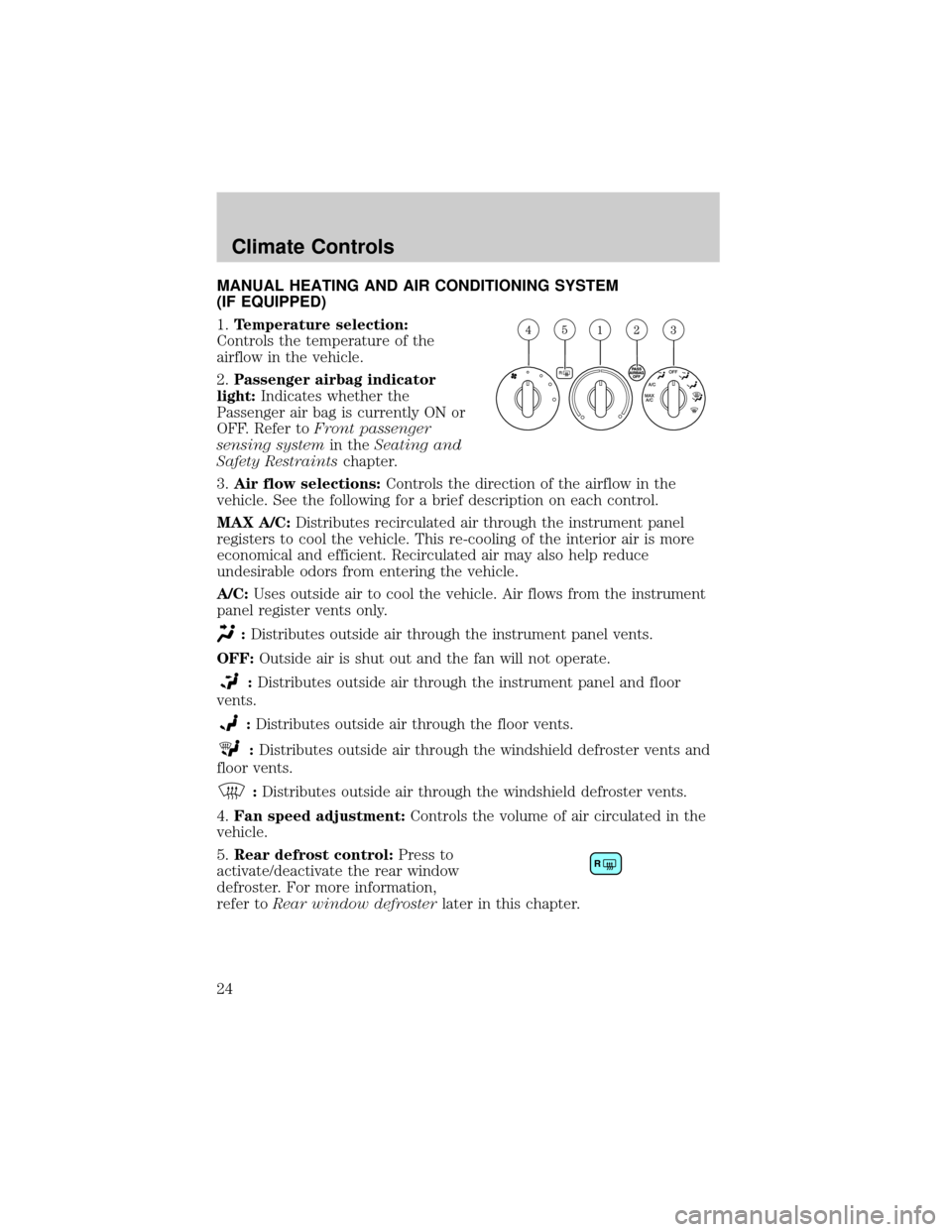
1.Temperature selection:
Controls the temperature of the
airflow in the vehicle.
2.Passenger airbag indicator
light:Indicates whether the
Passenger air bag is currently ON or
OFF. Refer toFront passenger
sensing systemin theSeating and
Safety Restraintschapter.
3.Air flow selections:Controls the direction of the airflow in the
vehicle. See the following for a brief description on each control.
MAX A/C:Distributes recirculated air through the instrument panel
registers to cool the vehicle. This re-cooling of the interior air is more
economical and efficient. Recirculated air may also help reduce
undesirable odors from entering the vehicle.
A/C:Uses outside air to cool the vehicle. Air flows from the instrument
panel register vents only.
:Distributes outside air through the instrument panel vents.
OFF:Outside air is shut out and the fan will not operate.
:Distributes outside air through the instrument panel and floor
vents.
:Distributes outside air through the floor vents.
:Distributes outside air through the windshield defroster vents and
floor vents.
:Distributes outside air through the windshield defroster vents.
4.Fan speed adjustment:Controls the volume of air circulated in the
vehicle.
5.Rear defrost control:Press to
activate/deactivate the rear window
defroster. For more information,
refer toRear window defrosterlater in this chapter.
Climate Controls
Climate Controls
24
Page 25 of 248

OPERATING TIPS
²To reduce fog build up on the windshield during humid weather, place
the air flow selector in the
position.
²To reduce humidity buildup within the cabin, do not drive with the
selector in the OFF or MAX A/C position.
²To improve A/C cool down, drive with the windows slightly open for
the first 2±3 minutes after starting the vehicle or until the vehicle has
ªaired out.º
²Do not put objects under the front seats that will interfere with the
airflow to the back seats.
²Remove any snow, ice or leaves from the air intake area at the base of
the windshield.
²For best cooling results when using the MAX A/C mode, move the
temperature control to full cold and initially set the fan to highest
speed, then adjust the temperature and fan to maintain comfort.
To aid in side window defogging/demisting in cold weather:
1. Select
.
2. Adjust the temperature control to maintain comfort.
3. Set the fan speed to the highest setting.
4. Direct the outer instrument panel vents towards the side windows.
To increase airflow to the outer instrument panel vents, close the vents
located in the middle of the instrument panel.
Do not place objects on top of the instrument panel as these
objects may become projectiles in a collision or sudden stop.
Climate Controls
25
Page 26 of 248
ELECTRONIC AUTOMATIC TEMPERATURE CONTROL (EATC)
SYSTEM (IF EQUIPPED)
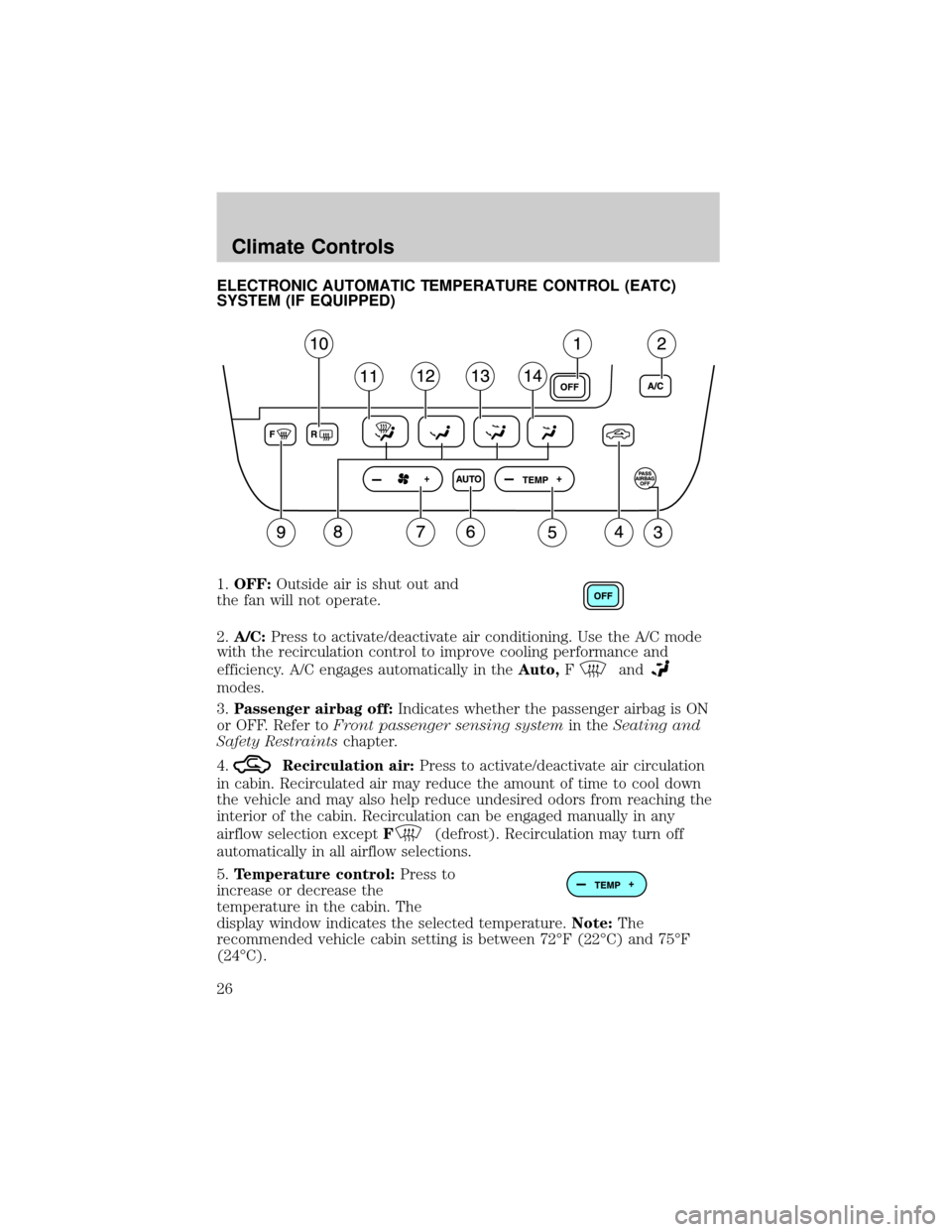
1.OFF:Outside air is shut out and
the fan will not operate.
2.A/C:Press to activate/deactivate air conditioning. Use the A/C mode
with the recirculation control to improve cooling performance and
efficiency. A/C engages automatically in theAuto,F
and
modes.
3.Passenger airbag off:Indicates whether the passenger airbag is ON
or OFF. Refer toFront passenger sensing systemin theSeating and
Safety Restraintschapter.
4.
Recirculation air:Press to activate/deactivate air circulation
in cabin. Recirculated air may reduce the amount of time to cool down
the vehicle and may also help reduce undesired odors from reaching the
interior of the cabin. Recirculation can be engaged manually in any
airflow selection exceptF
(defrost). Recirculation may turn off
automatically in all airflow selections.
5.Temperature control:Press to
increase or decrease the
temperature in the cabin. The
display window indicates the selected temperature.Note:The
recommended vehicle cabin setting is between 72ÉF (22ÉC) and 75ÉF
(24ÉC).
Climate Controls
26
Page 27 of 248
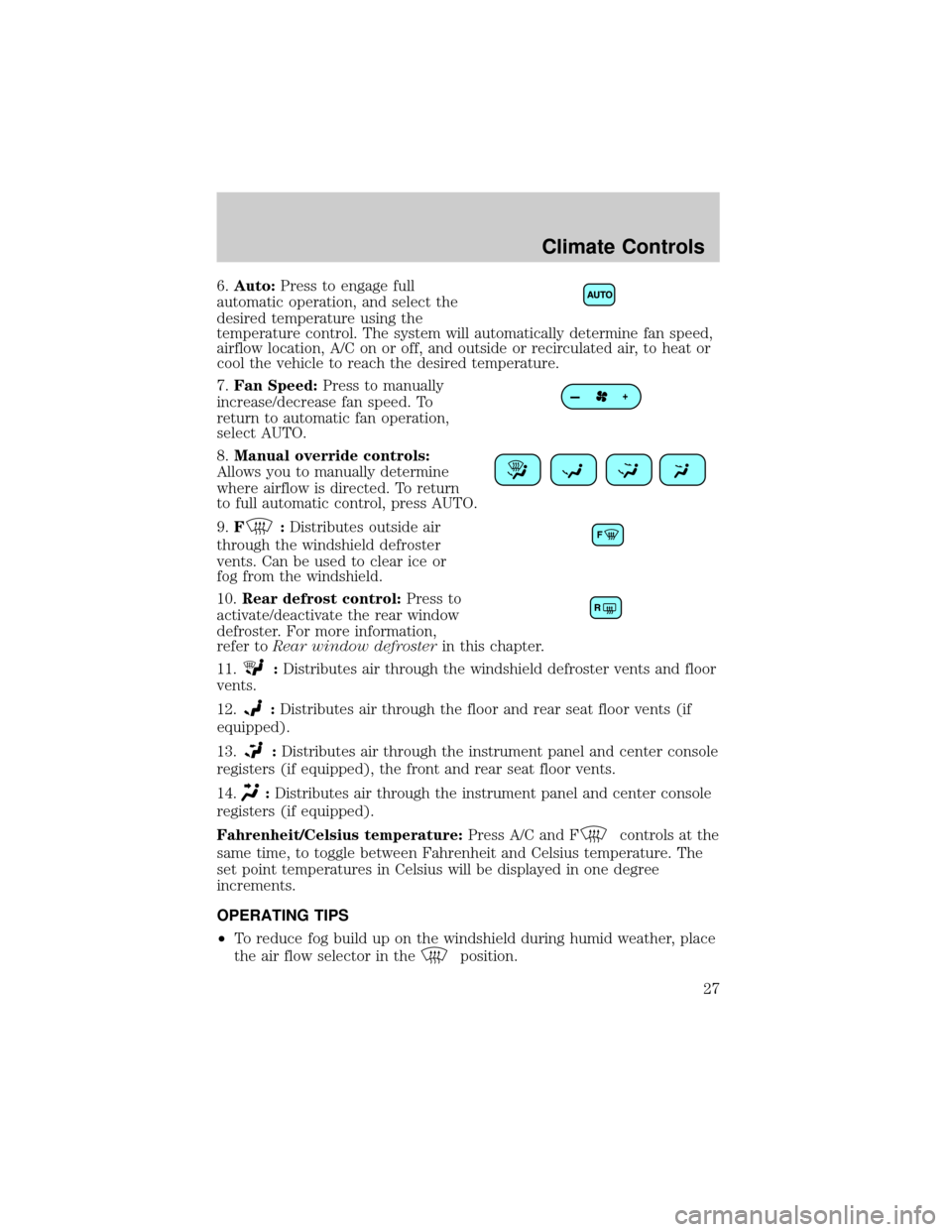
6.Auto:Press to engage full
automatic operation, and select the
desired temperature using the
temperature control. The system will automatically determine fan speed,
airflow location, A/C on or off, and outside or recirculated air, to heat or
cool the vehicle to reach the desired temperature.
7.Fan Speed:Press to manually
increase/decrease fan speed. To
return to automatic fan operation,
select AUTO.
8.Manual override controls:
Allows you to manually determine
where airflow is directed. To return
to full automatic control, press AUTO.
9.F
:Distributes outside air
through the windshield defroster
vents. Can be used to clear ice or
fog from the windshield.
10.Rear defrost control:Press to
activate/deactivate the rear window
defroster. For more information,
refer toRear window defrosterin this chapter.
11.
:Distributes air through the windshield defroster vents and floor
vents.
12.
:Distributes air through the floor and rear seat floor vents (if
equipped).
13.
:Distributes air through the instrument panel and center console
registers (if equipped), the front and rear seat floor vents.
14.
:Distributes air through the instrument panel and center console
registers (if equipped).
Fahrenheit/Celsius temperature:Press A/C and F
controls at the
same time, to toggle between Fahrenheit and Celsius temperature. The
set point temperatures in Celsius will be displayed in one degree
increments.
OPERATING TIPS
²To reduce fog build up on the windshield during humid weather, place
the air flow selector in the
position.
Climate Controls
27
Page 28 of 248

²Do not put objects under the front seats that will interfere with the
airflow to the back seats.
²Remove any snow, ice or leaves from the air intake area at the base of
the windshield.
²For maximum cooling performance (MAX A/C), select AUTO and set
to desired temperature. In the manual override mode, press
, A/C
and
, then set the temperature to 60ÉF (16ÉC) and the fan to
the highest setting. To improve the A/C cool down of the vehicle
cabin, drive with the windows slightly open for the first 2±3 minutes
after starting the vehicle or until the vehicle has ªaired out.º
To aid in side window defogging/demisting in cold weather:
1. Select
.
2. Select A/C.
3. Adjust the temperature control to maintain comfort.
4. Set the fan speed to the highest setting.
5. Direct the outer instrument panel vents towards the side windows.
To increase airflow to the outer instrument panel vents, close the vents
located in the middle of the instrument panel.
Do not place objects on top of the instrument panel as these
objects may become projectiles in a collision or sudden stop.
REAR WINDOW DEFROSTER
The rear defroster control is located
on the instrument panel and works
to clear the rear window of thin ice
and fog.
Do not use razor blades or other sharp objects to clean the inside
of the rear window or to remove decals from the inside of the
rear window. This may cause damage to the heated grid lines and
will not be covered by your warranty.
Activating the rear window defroster will also activate the heated mirrors
(if equipped). For more information refer toHeated outside mirrorsin
theDriver controls chapter.
R
Climate Controls
28
Page 29 of 248

CABIN AIR FILTER (IF EQUIPPED)
Your vehicle may be equipped with a Cabin air filter. The particulate air
filtration system is designed to reduce the concentration of airborne
particles such as dust, spores and pollen in the air being supplied to the
interior of the vehicle. The particulate filtration system gives the
following benefits to customers:
²Improves the customer's driving comfort by reducing particle
concentration
²Improves the interior compartment cleanliness
²Protects the climate control components from particle deposits
The filter is located just in front of the windshield under the cowl grille
on the passenger side of the vehicle.
For more information, or to replace the filter, see your Ford, Lincoln or
Mercury Dealer.
Climate Controls
29
Page 113 of 248

When the front passenger seat is
occupied and the sensing system
has turned off the passenger's
frontal airbag, the9passenger airbag
off9or9pass airbag off9indicator will
light and stay lit to remind you that
the front passenger frontal airbag is off. When the front passenger seat is
not occupied (empty seat) or in the event that the front passenger
frontal airbag is enabled (may inflate), the indicator light will be unlit.
The9pass airbag off9indicator light is located next to the climate
controls on the bottom right corner of the center stack of the instrument
panel. To confirm the indicator light is functional, it will momentarily
illuminate when the ignition is turned to the ON position.
The front passenger sensing system is designed to turn off the front
passenger's frontal airbag when a rear facing infant seat, a forward-facing
child restraint, or a booster seat is detected. If the child restraint has
been installed and the indicator is not lit, then turn the vehicle off,
remove the child restraint from the vehicle and reinstall the restraint
following the child restraint manufacturer's directions.
The front passenger sensing system is designed to enable (may inflate)
the right front passenger's frontal airbag anytime the system senses that
a person of adult size is sitting properly in the front passenger seat.
When the passenger sensing system has allowed the airbag to be
enabled, the indicator will be unlit and stay unlit to remind you that the
airbag is enabled (may inflate).
If a person of adult-size is sitting in the front passenger's seat, but the
9passenger airbag off9or9pass airbag off9indicator is lit, it is possible
that the person isn't sitting properly in the seat. If this happens, turn the
vehicle off and ask the person to place the seatback in the full upright
position, sit upright in the seat, centered on the seat cushion, with the
person's legs comfortably extended. Restart the vehicle and have the
person remain in this position for about two minutes. This will allow the
system to detect that person and enable the passenger's airbag. If the
indicator lamp remains lit even after this, the occupant should be advised
to ride in the rear seat.
After all occupants have adjusted their seats and put on safety belts, it's
very important that they continue to sit upright with their back against
the seatback, with their feet comfortably extended on the floor while the
vehicle is still in motion. Sitting improperly can increase the chance of
injury in a crash event. For example, if an occupant slouches, lies down,
turns sideways, sits forward, leans forward or sideways, or puts one or
both feet up, the chance of injury during a crash is greatly increased.
Seating and Safety Restraints
113