2005 FORD TAURUS instrument cluster
[x] Cancel search: instrument clusterPage 137 of 248
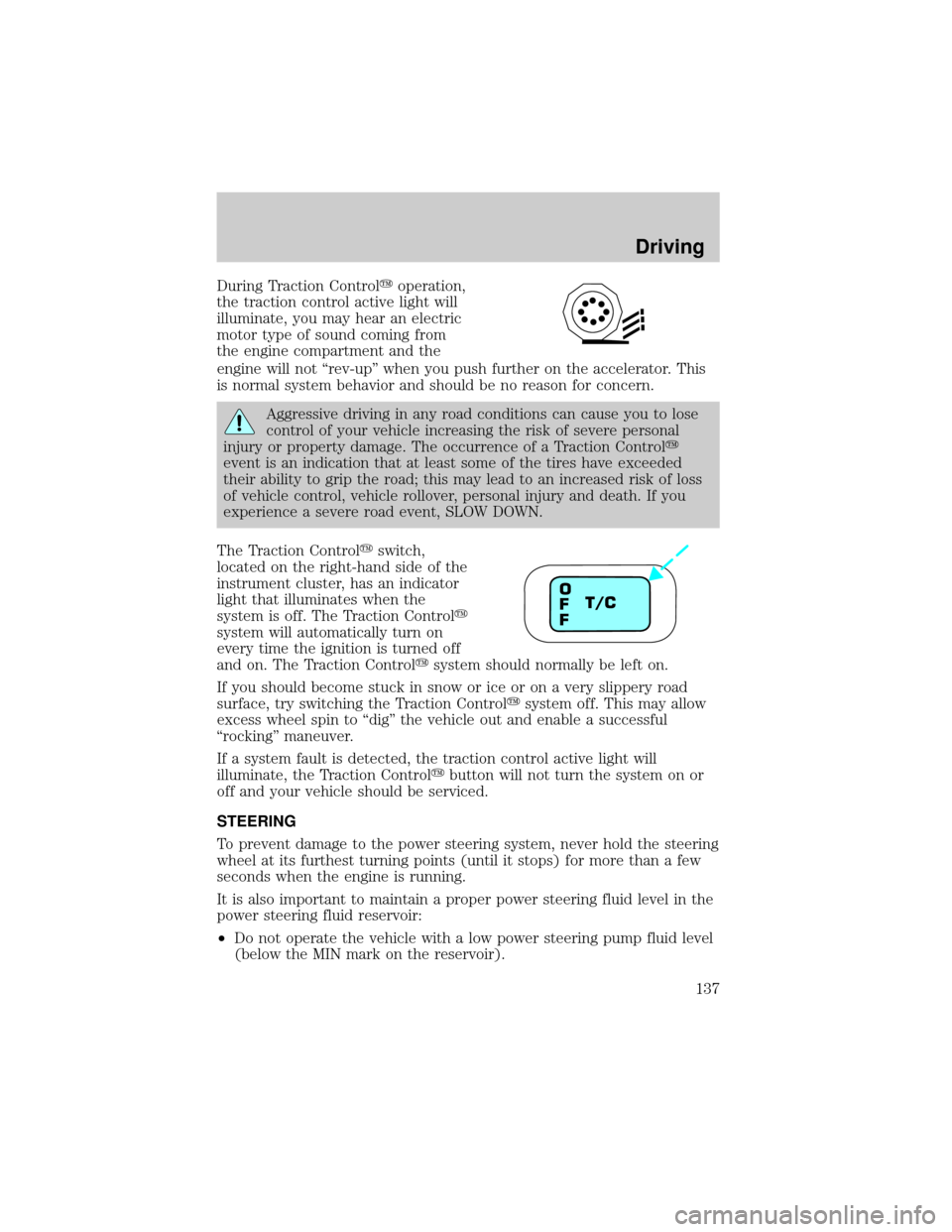
During Traction Controlyoperation,
the traction control active light will
illuminate, you may hear an electric
motor type of sound coming from
the engine compartment and the
engine will not ªrev-upº when you push further on the accelerator. This
is normal system behavior and should be no reason for concern.
Aggressive driving in any road conditions can cause you to lose
control of your vehicle increasing the risk of severe personal
injury or property damage. The occurrence of a Traction Controly
event is an indication that at least some of the tires have exceeded
their ability to grip the road; this may lead to an increased risk of loss
of vehicle control, vehicle rollover, personal injury and death. If you
experience a severe road event, SLOW DOWN.
The Traction Controlyswitch,
located on the right-hand side of the
instrument cluster, has an indicator
light that illuminates when the
system is off. The Traction Controly
system will automatically turn on
every time the ignition is turned off
and on. The Traction Controlysystem should normally be left on.
If you should become stuck in snow or ice or on a very slippery road
surface, try switching the Traction Controlysystem off. This may allow
excess wheel spin to ªdigº the vehicle out and enable a successful
ªrockingº maneuver.
If a system fault is detected, the traction control active light will
illuminate, the Traction Controlybutton will not turn the system on or
off and your vehicle should be serviced.
STEERING
To prevent damage to the power steering system, never hold the steering
wheel at its furthest turning points (until it stops) for more than a few
seconds when the engine is running.
It is also important to maintain a proper power steering fluid level in the
power steering fluid reservoir:
²Do not operate the vehicle with a low power steering pump fluid level
(below the MIN mark on the reservoir).
T/C O
F
F
Driving
137
Page 184 of 248
WINDOWS AND WIPER BLADES
The windshield, rear and side windows and the wiper blades should be
cleaned regularly. If the wipers do not wipe properly, substances on the
vehicle's glass or the wiper blades may be the cause. These may include
hot wax treatments used by commercial car washes, tree sap, or other
organic contamination. To clean these items, please follow these tips:
²The windshield, rear windows and side windows may be cleaned with
a non-abrasive cleaner such as Motorcraft Ultra Clear Spray Glass
Cleaner (ZC-23), available from your dealer.
²Do not use abrasives, as they may cause scratches.
²Do not use fuel, kerosene, or paint thinner to clean any parts.
²Wiper blades can be cleaned with isopropyl (rubbing) alcohol or
windshield washer solution. Be sure to replace wiper blades when they
appear worn or do not function properly.
Do not use sharp objects, such as a razor blade, to clean the
inside of the rear window or to remove decals, as it may cause
damage to the rear window defroster's heated grid lines.
INSTRUMENT PANEL AND CLUSTER LENS
Clean the instrument panel with a damp cloth, then dry with a dry cloth.
²Avoid cleaners or polish that increase the gloss of the upper portion of
the instrument panel. The dull finish in this area helps protect the
driver from undesirable windshield reflection.
Do not use chemical solvents or strong detergents when cleaning
the steering wheel or instrument panel to avoid contamination of
the air bag system.
²Be certain to wash or wipe your hands clean if you have been in
contact with certain products such as insect repellent and suntan
lotion in order to avoid possible damage to the interior painted
surfaces.
INTERIOR
For fabric, carpets, cloth seats, safety belts and seats equipped with side
air bags:
²Remove dust and loose dirt with a vacuum cleaner.
²Remove light stains and soil with Motorcraft Extra Strength
Upholstery Cleaner (ZC-41).
Cleaning
184
Page 208 of 248

in the United States) because it may cause these problems to become
more pronounced. If the problems persist, see your dealer or a qualified
service technician.
FFV engine (if equipped)
Your FFV will operate well on ordinary ªRegularº unleaded gasoline, but
only the highest quality fuel ethanol will provide the same level of
protection and performance. To identify if your vehicle is an FFV, check
your VIN or the label on the inside of your fuel filler door. When
checking the VIN, look for the engine type identifier (8th character). If
your vehicle is an FFV, then the character will be labeled as a ª2º.
If you operate your vehicle 50% or more of the time on ethanol, you
should follow a different maintenance schedule. See theScheduled
Maintenance Guidefor more information.
If you are experiencing a rough or rolling idle after start-up with the
outside temperature above 27É C (80É F), the idle should improve within
10 to 30 seconds. If the problems persist below this temperature, see
your dealer or a qualified service technician.
Cleaner air
Ford endorses the use of reformulated ªcleaner-burningº gasolines to
improve air quality.
Running out of fuel
Avoid running out of fuel because this situation may have an adverse
affect on powertrain components.
If you have run out of fuel:
²You may need to cycle the ignition from OFF to ON several times after
refueling, to allow the fuel system to pump the fuel from the tank to
the engine.
²The
indicator may come on. For more information on the
Service engine soonindicator, refer to theInstrument Cluster
chapter.
Fuel Filter
For fuel filter replacement, see your dealer or a qualified service
technician. Refer to the scheduled maintenance guide for the appropriate
intervals for changing the fuel filter.
Replace the fuel filter with an authorized Motorcraft part. The
customer warranty may be void for any damage to the fuel system
if an authorized Motorcraft fuel filter is not used.
Maintenance and Specifications
208
Page 213 of 248

sells, leases, trades vehicles, or supervises a fleet of vehicles are not
permitted to intentionally remove an emission control device or prevent
it from working. Information about your vehicle's emission system is on
the Vehicle Emission Control Information Decal located on or near the
engine. This decal identifies engine displacement and gives some tune up
specifications.
Please consult yourWarranty Guidefor complete emission warranty
information.
On board diagnostics (OBD-II)
Your vehicle is equipped with a computer that monitors the engine's
emission control system. This system is commonly known as the On
Board Diagnostics System (OBD-II). This OBD-II system protects the
environment by ensuring that your vehicle continues to meet
government emission standards. The OBD-II system also assists the
service technician in properly servicing your vehicle. When theCheck
engine/Service engine soonlight illuminates, the OBD-II system has
detected a malfunction. Temporary malfunctions may cause yourCheck
engine/Service engine soonlight to illuminate. Examples are:
1. The vehicle has run out of fuel. (The engine may misfire or run
poorly.)
2. Poor fuel quality or water in the fuel.
3. The fuel cap may not have been securely tightened.
These temporary malfunctions can be corrected by filling the fuel tank
with good quality fuel and/or properly tightening the fuel cap. After three
driving cycles without these or any other temporary malfunctions
present, theCheck engine/Service engine soonlight should turn off. (A
driving cycle consists of a cold engine startup followed by mixed
city/highway driving.) No additional vehicle service is required.
If theCheck engine/Service engine soonlight remains on, have your
vehicle serviced at the first available opportunity.
Readiness for Inspection/Maintenance (I/M) testing
In some localities, it may be a legal requirement to pass an I/M test of
the on-board diagnostics system. If your
indicator is on, refer to the
description in theWarning lights and chimessection of the
Instrument Clusterchapter. Your vehicle may not pass the I/M test with
the
indicator on.
If the vehicle's powertrain system or its battery has just been serviced,
the on-board diagnostics system is reset to a ªnot ready for I/M testº
Maintenance and Specifications
213
Page 245 of 248

recommendations ...................195
refill capacities ........................232
specifications ..................234±235
Exhaust fumes ..........................134
F
Flexible Fuel Vehicle (FFV) ....203
Floor mats ...................................69
Fluid capacities .........................232
Fuel ............................................203
calculating fuel economy .60, 209
cap ...........................................205
capacity ...................................232
choosing the right fuel ...........206
comparisons with EPA fuel
economy estimates .................211
detergent in fuel .....................208
filling your vehicle
with fuel ..................203, 205, 209
filter, specifications ........208, 231
fuel pump shut-off switch .....151
improving fuel economy ........209
octane rating ...........207, 235±236
quality ......................................207
running out of fuel .................208
safety information relating to
automotive fuels .....................203
Fuel - flex fuel vehicle
(FFV) .........................203, 206±207
Fuses ..........................................153
G
Garage Door Opener
(see Homelink wireless control
system) ........................................54
Gas cap (see Fuel cap) ............205
Gas mileage
(see Fuel economy) .................209Gauges .........................................13
H
Hazard flashers .........................151
Headlamps ...................................30
aiming ........................................32
autolamp system .......................30
bulb specifications ....................35
daytime running lights .............30
flash to pass ..............................31
high beam .................................31
replacing bulbs .........................37
turning on and off ....................30
Heating
heating and air conditioning
system .................................24, 26
Homelink wireless control
system ..........................................54
Hood ..........................................188
I
Ignition .......................130, 235±236
Infant seats
(see Safety seats) .....................120
Inspection/maintenance
(I/M) testing ..............................213
Instrument panel
cleaning ...................................184
cluster ........................................10
lighting up panel
and interior ...............................31
J
Jack ............................................159
positioning ...............................159
storage .....................................159
Jump-starting your vehicle ......165
Index
245