2005 FORD TAURUS child restraint
[x] Cancel search: child restraintPage 101 of 248
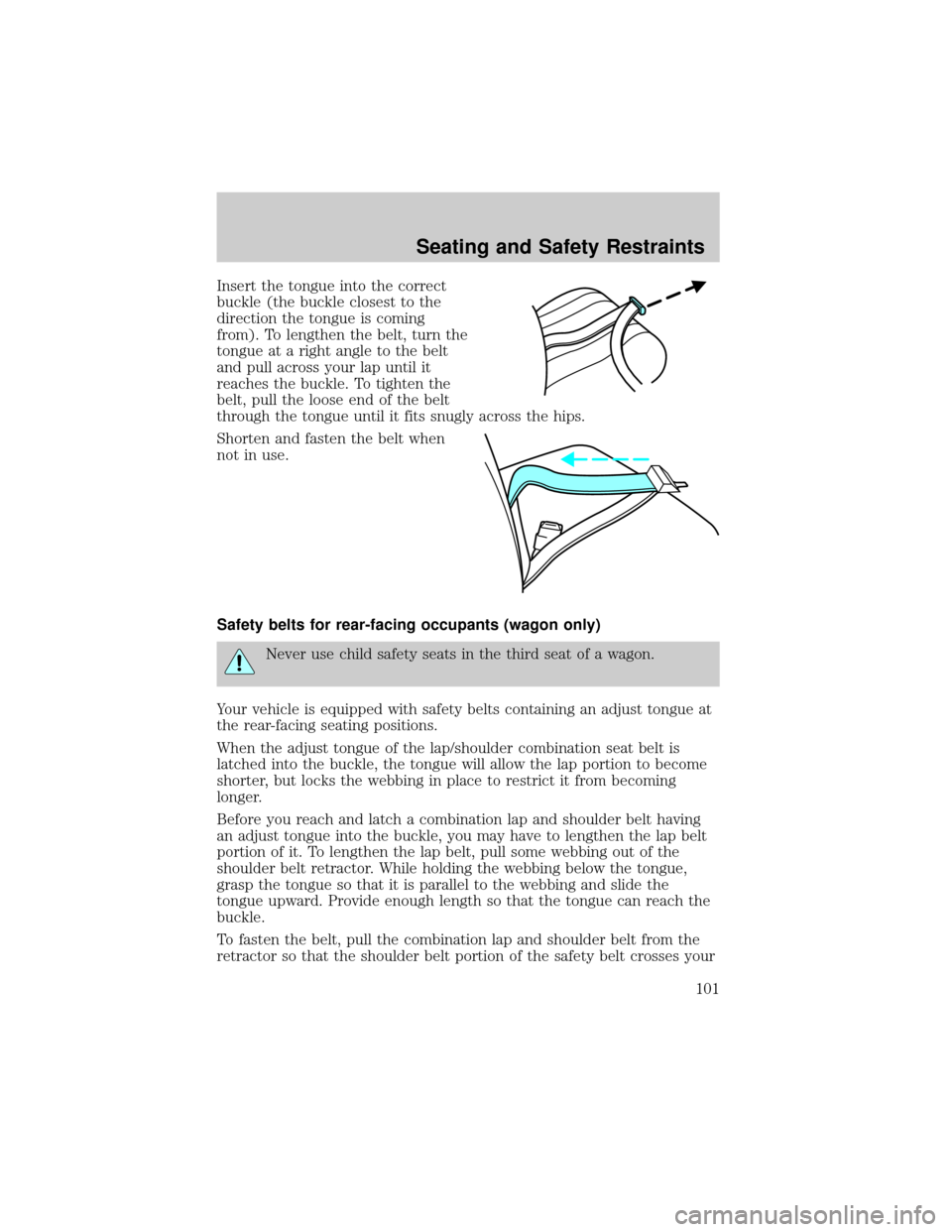
Insert the tongue into the correct
buckle (the buckle closest to the
direction the tongue is coming
from). To lengthen the belt, turn the
tongue at a right angle to the belt
and pull across your lap until it
reaches the buckle. To tighten the
belt, pull the loose end of the belt
through the tongue until it fits snugly across the hips.
Shorten and fasten the belt when
not in use.
Safety belts for rear-facing occupants (wagon only)
Never use child safety seats in the third seat of a wagon.
Your vehicle is equipped with safety belts containing an adjust tongue at
the rear-facing seating positions.
When the adjust tongue of the lap/shoulder combination seat belt is
latched into the buckle, the tongue will allow the lap portion to become
shorter, but locks the webbing in place to restrict it from becoming
longer.
Before you reach and latch a combination lap and shoulder belt having
an adjust tongue into the buckle, you may have to lengthen the lap belt
portion of it. To lengthen the lap belt, pull some webbing out of the
shoulder belt retractor. While holding the webbing below the tongue,
grasp the tongue so that it is parallel to the webbing and slide the
tongue upward. Provide enough length so that the tongue can reach the
buckle.
To fasten the belt, pull the combination lap and shoulder belt from the
retractor so that the shoulder belt portion of the safety belt crosses your
Seating and Safety Restraints
101
Page 105 of 248
Reasons given... Consider...
ªCrashes are rare eventsº36700 crashes occur every day.The
more we drive, the more we are
exposed to ªrareº events, even for
good drivers.1 in 4 of us will be
seriously injured in a crash during
our lifetime.
ªI'm not going farº3of4fatal crashes occur within25
miles (40 km) of home.
ªBelts are uncomfortableº We design our safety belts to enhance
comfort. If you are uncomfortable -
try different positions for the safety
belt upper anchorage and seatback
which should be as upright as
possible; this can improve comfort.
ªI was in a hurryºPrime time for an accident.
BeltMinder reminds us to take a few
seconds to buckle up.
ªSafety belts don't workºSafety belts,when used properly,
reduce risk of deathto front seat
occupants by45% in cars,and by
60% in light trucks.
ªTraffic is lightºNearly 1 of 2 deaths occur in
single-vehicle crashes,many when
no other vehicles are around.
ªBelts wrinkle my clothesº Possibly, but a serious crash can do
much more than wrinkle your clothes,
particularly if you are unbelted.
ªThe people I'm with don't
wear beltsºSet the example, teen deaths occur 4
times more often in vehicles with
TWO or MORE people. Children and
younger brothers/sisters imitate
behavior they see.
Seating and Safety Restraints
105
Page 108 of 248
there are no nicks, tears or cuts. Replace if necessary. All safety belt
assemblies, including retractors, buckles, front seat belt buckle
assemblies, buckle support assemblies (slide bar-if equipped), shoulder
belt height adjusters (if equipped), shoulder belt guide on seatback (if
equipped), child safety seat LATCH and tether anchors, and attaching
hardware, should be inspected after a collision. Ford Motor Company
recommends that all safety belt assemblies in use in vehicles involved in
a collision be replaced. However, if the collision was minor and a
qualified technician finds that the belts do not show damage and
continue to operate properly, they do not need to be replaced. Safety
belt assemblies not in use during a collision should also be inspected and
replaced if either damage or improper operation is noted.
Failure to inspect and if necessary replace the safety belt
assembly under the above conditions could result in severe
personal injuries in the event of a collision.
Refer toInteriorin theCleaningchapter.
AIR BAG SUPPLEMENTAL RESTRAINT SYSTEM (SRS)
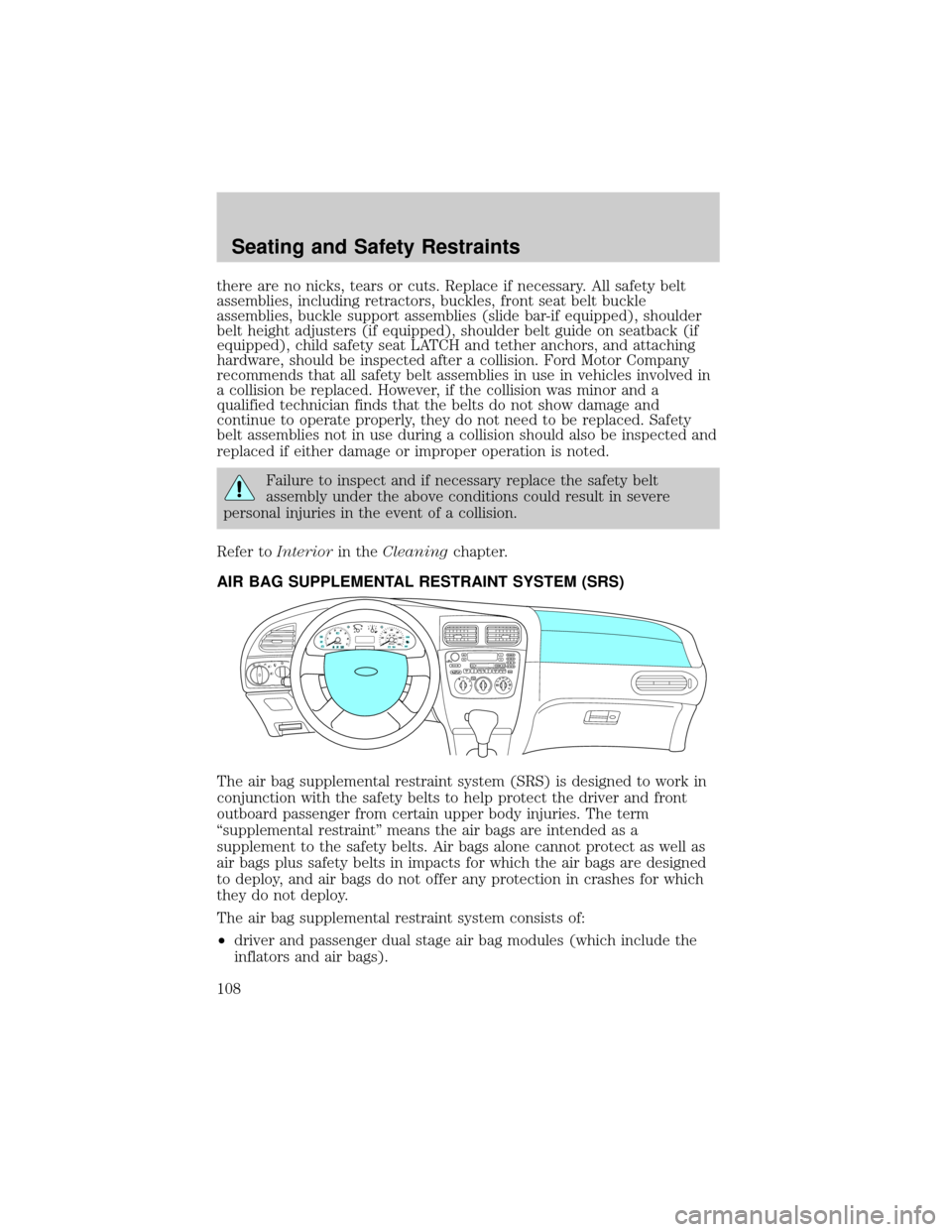
The air bag supplemental restraint system (SRS) is designed to work in
conjunction with the safety belts to help protect the driver and front
outboard passenger from certain upper body injuries. The term
ªsupplemental restraintº means the air bags are intended as a
supplement to the safety belts. Air bags alone cannot protect as well as
air bags plus safety belts in impacts for which the air bags are designed
to deploy, and air bags do not offer any protection in crashes for which
they do not deploy.
The air bag supplemental restraint system consists of:
²driver and passenger dual stage air bag modules (which include the
inflators and air bags).
Seating and Safety Restraints
108
Page 109 of 248
²side air bags (if equipped). Refer toSide air bag systemlater in this
chapter.
²one or more impact and safing sensors.
²the same indicator light, RCM (restraints control module) and
diagnostic unit used for the Personal safety system.
²Occupant Classification Sensor (OCS)
²Passenger air bag off indicator light.
The air bag supplemental restraints are an integral part of the Personal
Safety System. They are designed to be deployed in cases where the
Personal Safety System has determined the occupant conditions and
crash severity are appropriate to activate these devices. Refer to the
Personal Safety Systemsection in this chapter.
Important supplemental restraint system precautions
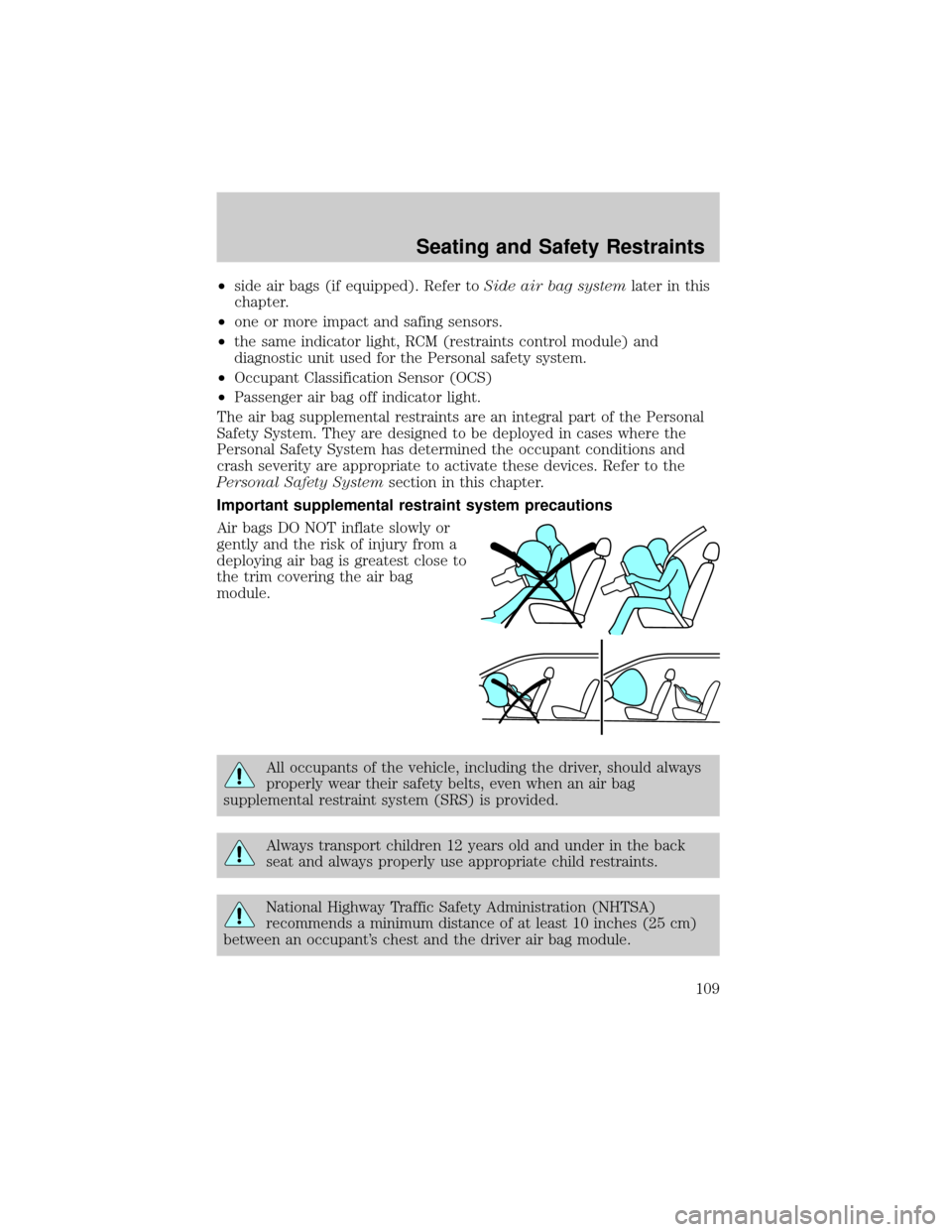
Air bags DO NOT inflate slowly or
gently and the risk of injury from a
deploying air bag is greatest close to
the trim covering the air bag
module.
All occupants of the vehicle, including the driver, should always
properly wear their safety belts, even when an air bag
supplemental restraint system (SRS) is provided.
Always transport children 12 years old and under in the back
seat and always properly use appropriate child restraints.
National Highway Traffic Safety Administration (NHTSA)
recommends a minimum distance of at least 10 inches (25 cm)
between an occupant's chest and the driver air bag module.
Seating and Safety Restraints
109
Page 111 of 248
Children and air bags
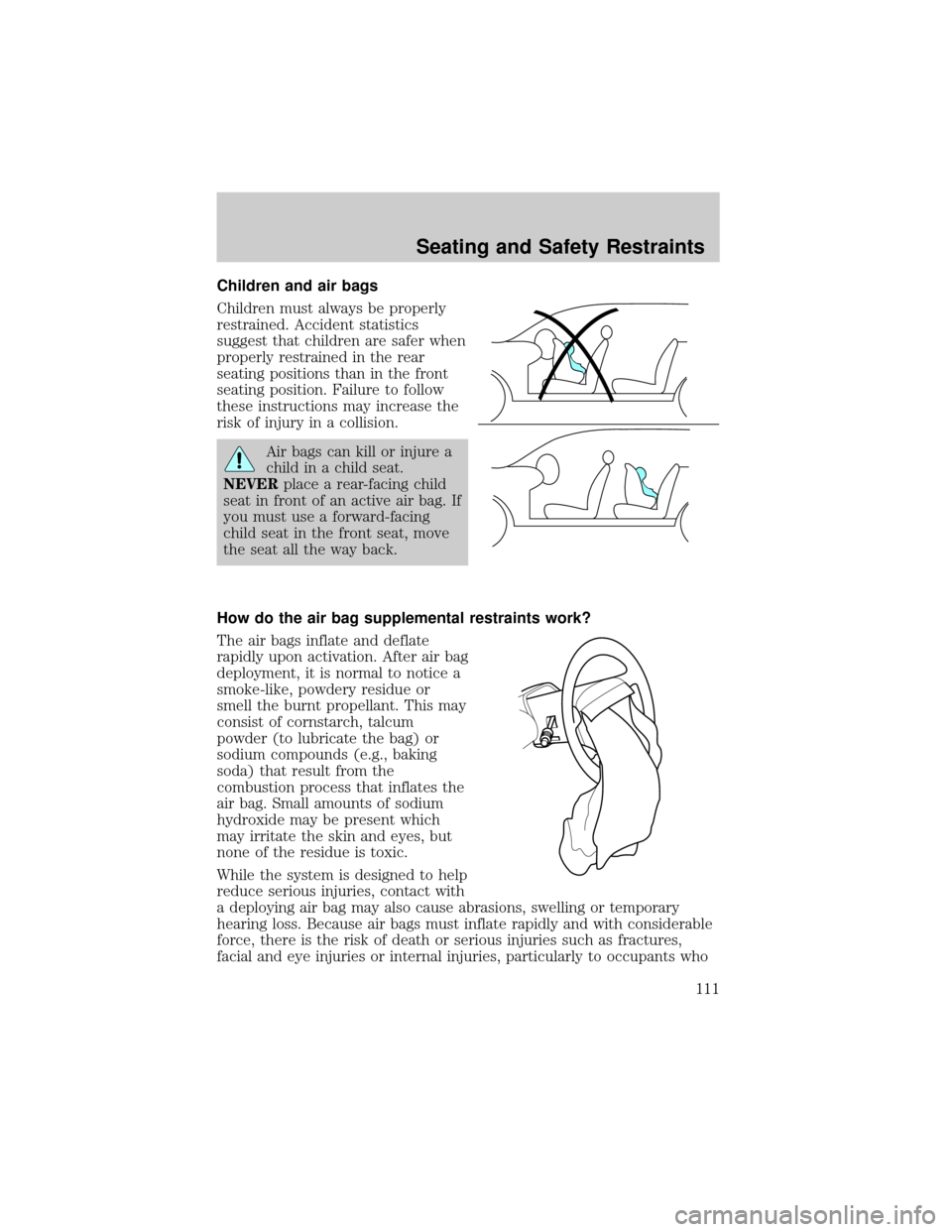
Children must always be properly
restrained. Accident statistics
suggest that children are safer when
properly restrained in the rear
seating positions than in the front
seating position. Failure to follow
these instructions may increase the
risk of injury in a collision.
Air bags can kill or injure a
child in a child seat.
NEVERplace a rear-facing child
seat in front of an active air bag. If
you must use a forward-facing
child seat in the front seat, move
the seat all the way back.
How do the air bag supplemental restraints work?
The air bags inflate and deflate
rapidly upon activation. After air bag
deployment, it is normal to notice a
smoke-like, powdery residue or
smell the burnt propellant. This may
consist of cornstarch, talcum
powder (to lubricate the bag) or
sodium compounds (e.g., baking
soda) that result from the
combustion process that inflates the
air bag. Small amounts of sodium
hydroxide may be present which
may irritate the skin and eyes, but
none of the residue is toxic.
While the system is designed to help
reduce serious injuries, contact with
a deploying air bag may also cause abrasions, swelling or temporary
hearing loss. Because air bags must inflate rapidly and with considerable
force, there is the risk of death or serious injuries such as fractures,
facial and eye injuries or internal injuries, particularly to occupants who
Seating and Safety Restraints
111
Page 112 of 248
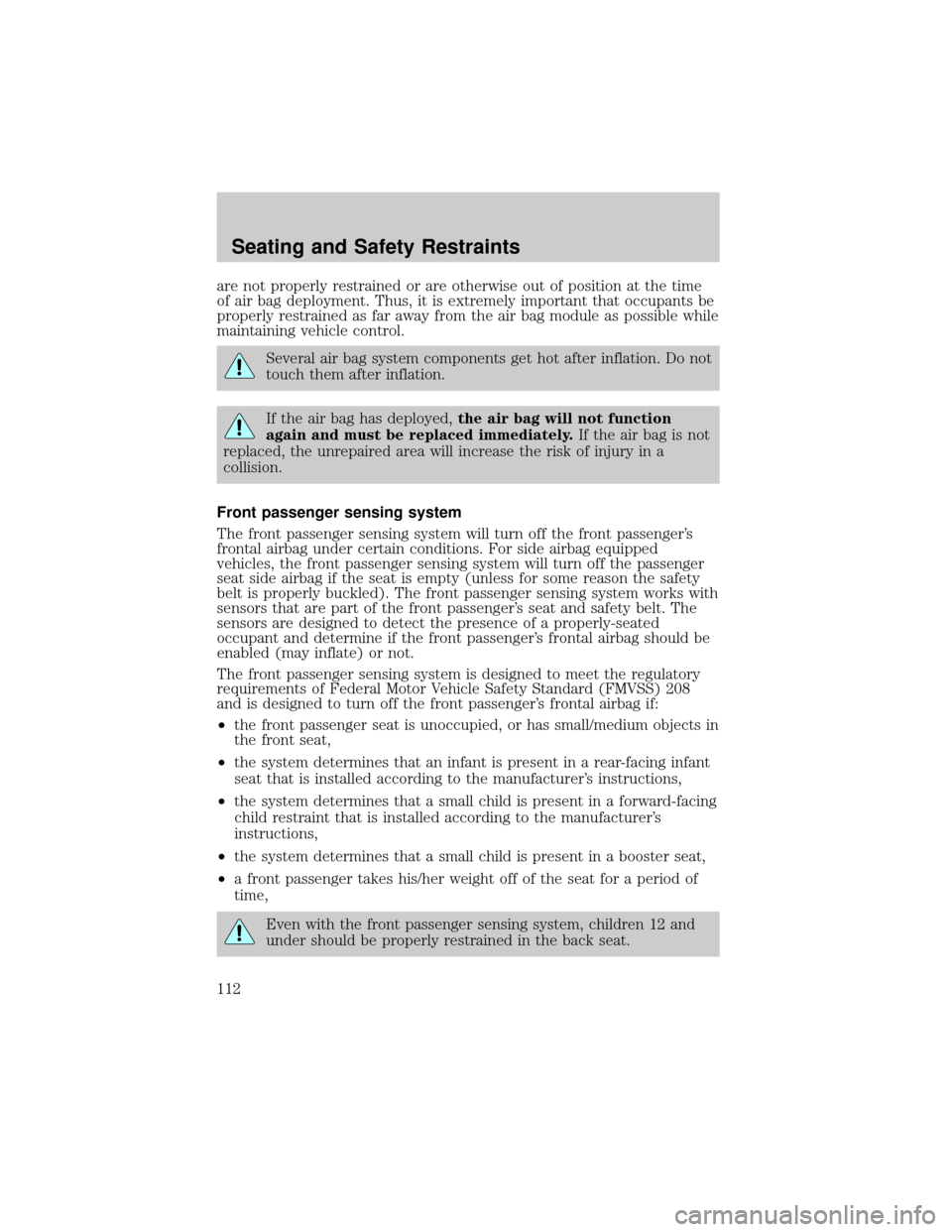
are not properly restrained or are otherwise out of position at the time
of air bag deployment. Thus, it is extremely important that occupants be
properly restrained as far away from the air bag module as possible while
maintaining vehicle control.
Several air bag system components get hot after inflation. Do not
touch them after inflation.
If the air bag has deployed,the air bag will not function
again and must be replaced immediately.If the air bag is not
replaced, the unrepaired area will increase the risk of injury in a
collision.
Front passenger sensing system
The front passenger sensing system will turn off the front passenger's
frontal airbag under certain conditions. For side airbag equipped
vehicles, the front passenger sensing system will turn off the passenger
seat side airbag if the seat is empty (unless for some reason the safety
belt is properly buckled). The front passenger sensing system works with
sensors that are part of the front passenger's seat and safety belt. The
sensors are designed to detect the presence of a properly-seated
occupant and determine if the front passenger's frontal airbag should be
enabled (may inflate) or not.
The front passenger sensing system is designed to meet the regulatory
requirements of Federal Motor Vehicle Safety Standard (FMVSS) 208
and is designed to turn off the front passenger's frontal airbag if:
²the front passenger seat is unoccupied, or has small/medium objects in
the front seat,
²the system determines that an infant is present in a rear-facing infant
seat that is installed according to the manufacturer's instructions,
²the system determines that a small child is present in a forward-facing
child restraint that is installed according to the manufacturer's
instructions,
²the system determines that a small child is present in a booster seat,
²a front passenger takes his/her weight off of the seat for a period of
time,
Even with the front passenger sensing system, children 12 and
under should be properly restrained in the back seat.
Seating and Safety Restraints
112
Page 113 of 248
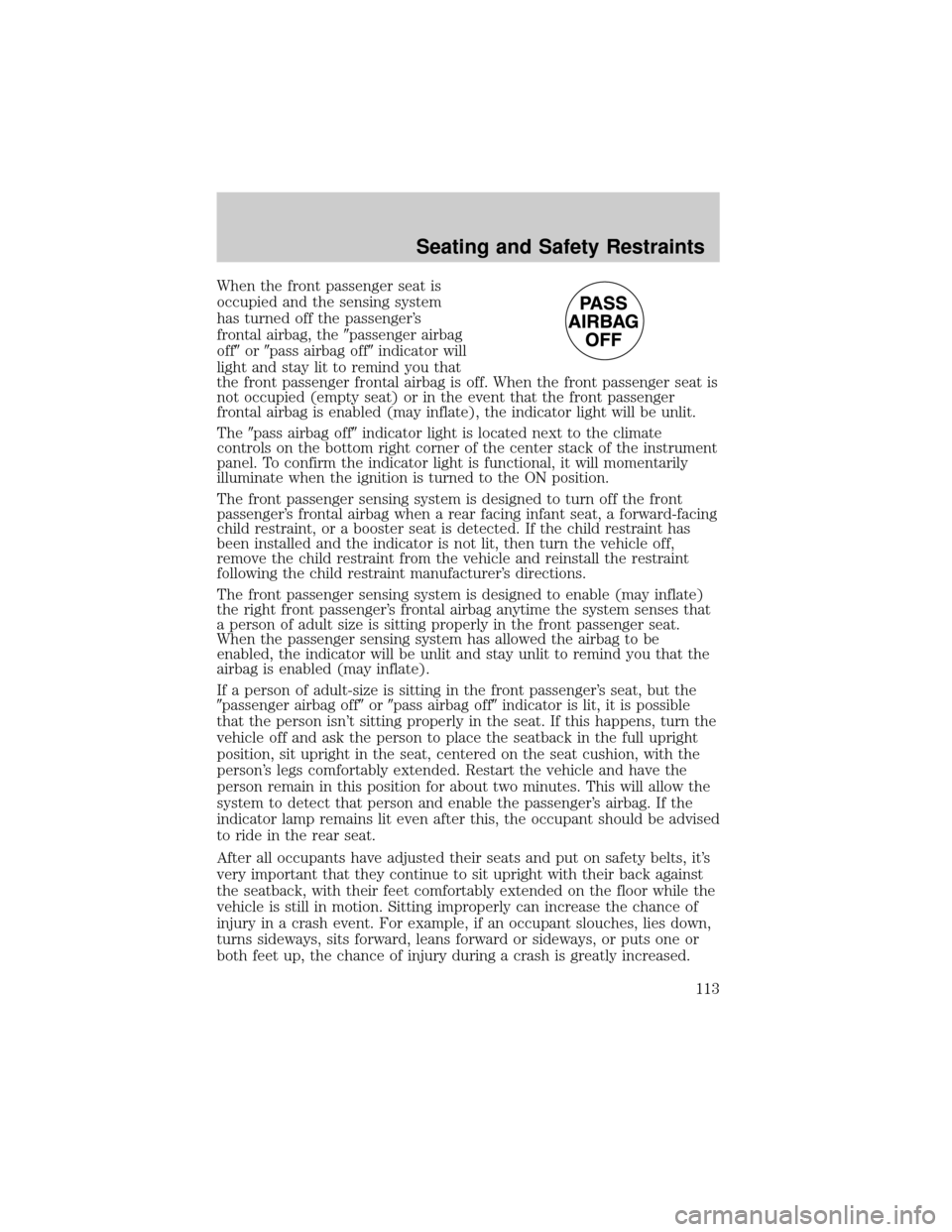
When the front passenger seat is
occupied and the sensing system
has turned off the passenger's
frontal airbag, the9passenger airbag
off9or9pass airbag off9indicator will
light and stay lit to remind you that
the front passenger frontal airbag is off. When the front passenger seat is
not occupied (empty seat) or in the event that the front passenger
frontal airbag is enabled (may inflate), the indicator light will be unlit.
The9pass airbag off9indicator light is located next to the climate
controls on the bottom right corner of the center stack of the instrument
panel. To confirm the indicator light is functional, it will momentarily
illuminate when the ignition is turned to the ON position.
The front passenger sensing system is designed to turn off the front
passenger's frontal airbag when a rear facing infant seat, a forward-facing
child restraint, or a booster seat is detected. If the child restraint has
been installed and the indicator is not lit, then turn the vehicle off,
remove the child restraint from the vehicle and reinstall the restraint
following the child restraint manufacturer's directions.
The front passenger sensing system is designed to enable (may inflate)
the right front passenger's frontal airbag anytime the system senses that
a person of adult size is sitting properly in the front passenger seat.
When the passenger sensing system has allowed the airbag to be
enabled, the indicator will be unlit and stay unlit to remind you that the
airbag is enabled (may inflate).
If a person of adult-size is sitting in the front passenger's seat, but the
9passenger airbag off9or9pass airbag off9indicator is lit, it is possible
that the person isn't sitting properly in the seat. If this happens, turn the
vehicle off and ask the person to place the seatback in the full upright
position, sit upright in the seat, centered on the seat cushion, with the
person's legs comfortably extended. Restart the vehicle and have the
person remain in this position for about two minutes. This will allow the
system to detect that person and enable the passenger's airbag. If the
indicator lamp remains lit even after this, the occupant should be advised
to ride in the rear seat.
After all occupants have adjusted their seats and put on safety belts, it's
very important that they continue to sit upright with their back against
the seatback, with their feet comfortably extended on the floor while the
vehicle is still in motion. Sitting improperly can increase the chance of
injury in a crash event. For example, if an occupant slouches, lies down,
turns sideways, sits forward, leans forward or sideways, or puts one or
both feet up, the chance of injury during a crash is greatly increased.
Seating and Safety Restraints
113
Page 117 of 248
Several air bag system components get hot after inflation. Do not
touch them after inflation.
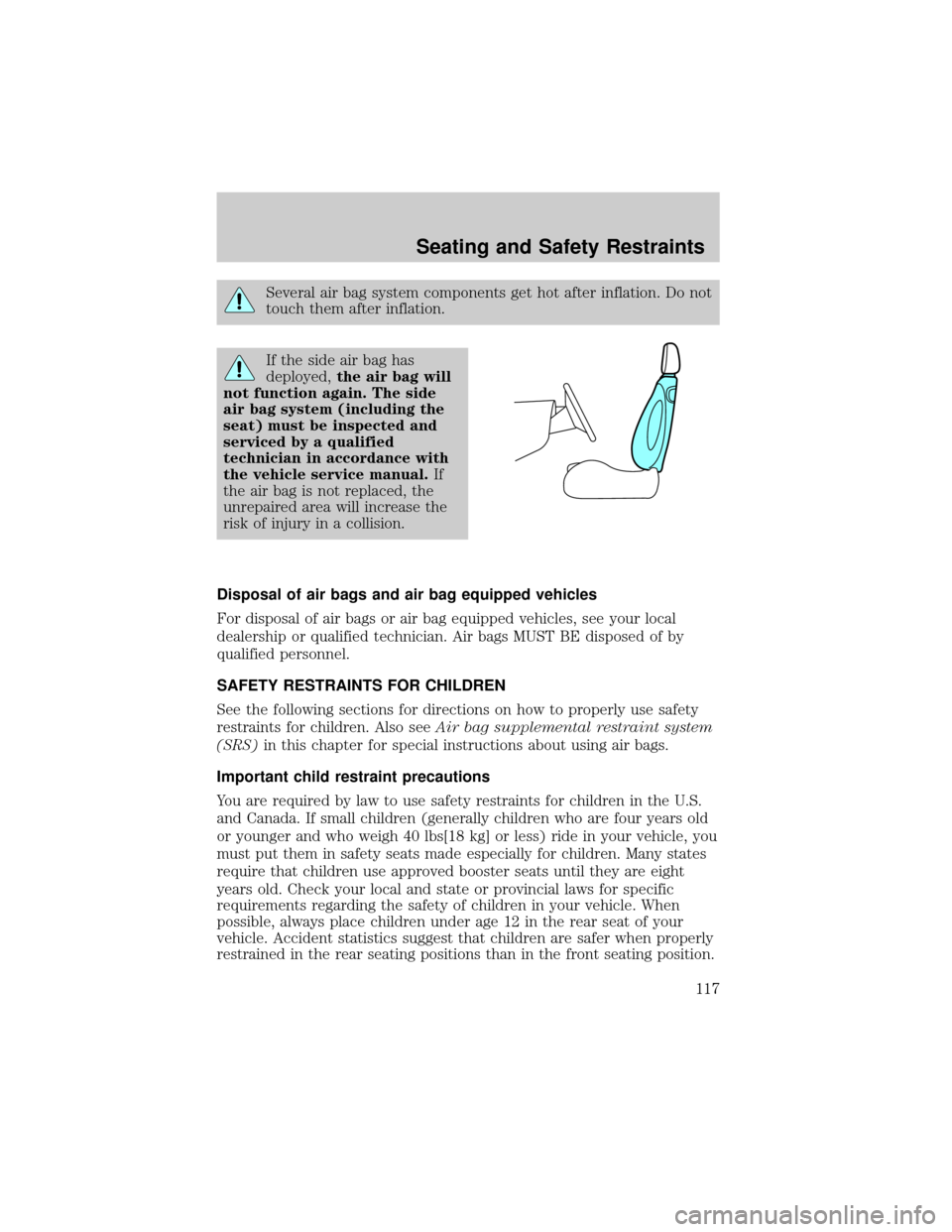
If the side air bag has
deployed,the air bag will
not function again. The side
air bag system (including the
seat) must be inspected and
serviced by a qualified
technician in accordance with
the vehicle service manual.If
the air bag is not replaced, the
unrepaired area will increase the
risk of injury in a collision.
Disposal of air bags and air bag equipped vehicles
For disposal of air bags or air bag equipped vehicles, see your local
dealership or qualified technician. Air bags MUST BE disposed of by
qualified personnel.
SAFETY RESTRAINTS FOR CHILDREN
See the following sections for directions on how to properly use safety
restraints for children. Also seeAir bag supplemental restraint system
(SRS)in this chapter for special instructions about using air bags.
Important child restraint precautions
You are required by law to use safety restraints for children in the U.S.
and Canada. If small children (generally children who are four years old
or younger and who weigh 40 lbs[18 kg] or less) ride in your vehicle, you
must put them in safety seats made especially for children. Many states
require that children use approved booster seats until they are eight
years old. Check your local and state or provincial laws for specific
requirements regarding the safety of children in your vehicle. When
possible, always place children under age 12 in the rear seat of your
vehicle. Accident statistics suggest that children are safer when properly
restrained in the rear seating positions than in the front seating position.
Seating and Safety Restraints
117