Page 13 of 72
2. When the glow plug pre-heat
indicator turns off, turn the key to 5
(START), then release the key as
soon as the engine starts. The glow
plugs will continue to be activated for two minutes after the glow plug
pre-heat indicator
has turned off. If the engine is not started
before the glow plug activation time ends, the glow plugs will need to be
reset by turning the key to 3 (OFF).
3. After the engine starts, allow it to idle for about 15 seconds. Do not
increase engine speed until the oil pressure gauge indicates normal
pressure.
STOPPING THE ENGINE
Turn the ignition to 3 (OFF). To prolong engine life (after extended high
speed or maximum GVW operation), it is recommended that a hot engine
be allowed to operate at low idle for about 7–10 minutes which would
allow sufficient time for the turbocharged engine to cool down.
COLD WEATHER OPERATION
Changing to a lighter grade engine oil also makes starting easier under
these conditions. Refer toEngine oil specificationsin theMaintenance
and Specificationssection of this supplement.
At temperatures below 20°F(–7°C), Number 2–D diesel fuel may thicken
enough to clog the fuel filter. Your vehicle is equipped with either an
FCM (E-Series) or an HFCM (F-Super Duty and Excursion) which acts
as a fuel filter/heater/water separator to keep the wax melted which will
help prevent fuel filter clogging. However, if the engine starts but stalls
after a short time and will not restart, the fuel filter(s) may be clogged.
For best results in cold weather, use Number 1–D diesel fuel or
“winterized”Number 2–D diesel fuel which has an additive to minimize
wax formation.
Your vehicle is also equipped with a bypass relief valve, located on the
fuel control module, which provides fuel flow to the engine if the fuel
pickup should become plugged by ice or wax. To allow this bypass valve
to function and avoid engine fuel starvation, it is recommended that,
during cold weather operation 32°F(0°C) or below, the fuel level in your
tank should not be allowed to drop below
1⁄4full. This will help prevent
air from entering the fuel system and stalling the engine.
In cold weather below 32°F (0°C) your diesel engine will slowly increase
to a higher idle speed if left idling in P (Park). As the engine warms-up,
Driving
13
Page 14 of 72
the engine sound level will decrease due to the activation of
PCM-controlled sound reduction features.
If your vehicle is operated in a heavy snow storm or blowing snow
conditions, the engine air induction may become partially clogged with
snow and/or ice. If this occurs, the engine may experience a significant
reduction in power output. At the earliest opportunity, clear all the snow
and/or ice away from the air induction inlet.
Operation in snow
Vehicle operation in heavy snowfall or in dry loose snow that may swirl
around the front of the vehicle may feed excessive amounts of snow into
the air intake system. This could plug the air cleaner with snow and
cause the engine to stall and/or lose power.
Refer toAir filter restriction gaugeandEngine air filterin the
Instrumentationsection of this supplement for more information.
Operation in standing water
Ingestion of water into the diesel engine can result in immediate and
severe damage to the engine. If driving through water, slow down to
avoid splashing water into the intake. If the engine stalls, and ingestion
of water into the engine is suspected, do not try to restart the engine.
Consult your dealer for service immediately.
Engine block heater (if equipped)
Refer to theDrivingchapter in theOwner’s Guide.
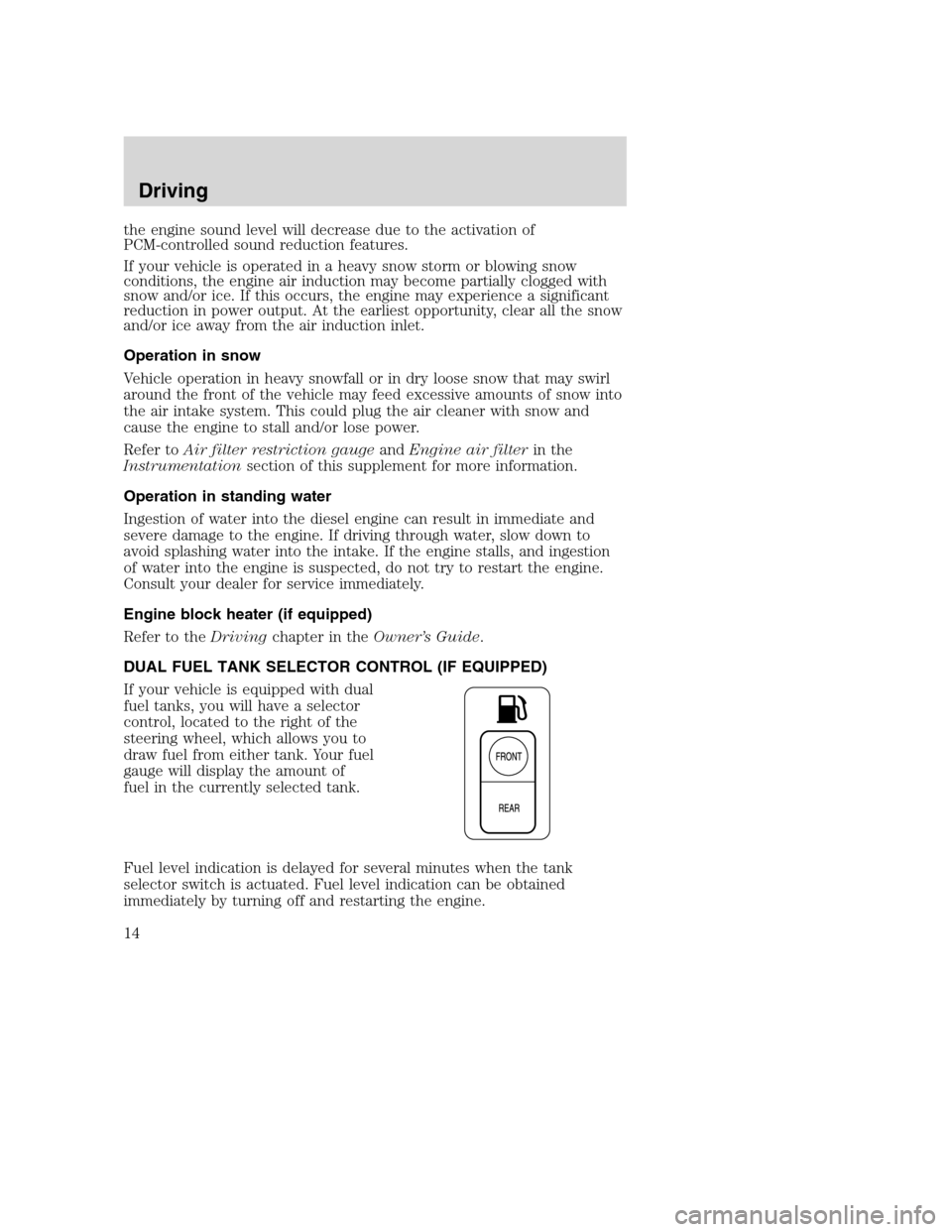
DUAL FUEL TANK SELECTOR CONTROL (IF EQUIPPED)
If your vehicle is equipped with dual
fuel tanks, you will have a selector
control, located to the right of the
steering wheel, which allows you to
draw fuel from either tank. Your fuel
gauge will display the amount of
fuel in the currently selected tank.
Fuel level indication is delayed for several minutes when the tank
selector switch is actuated. Fuel level indication can be obtained
immediately by turning off and restarting the engine.
Driving
14
Page 20 of 72
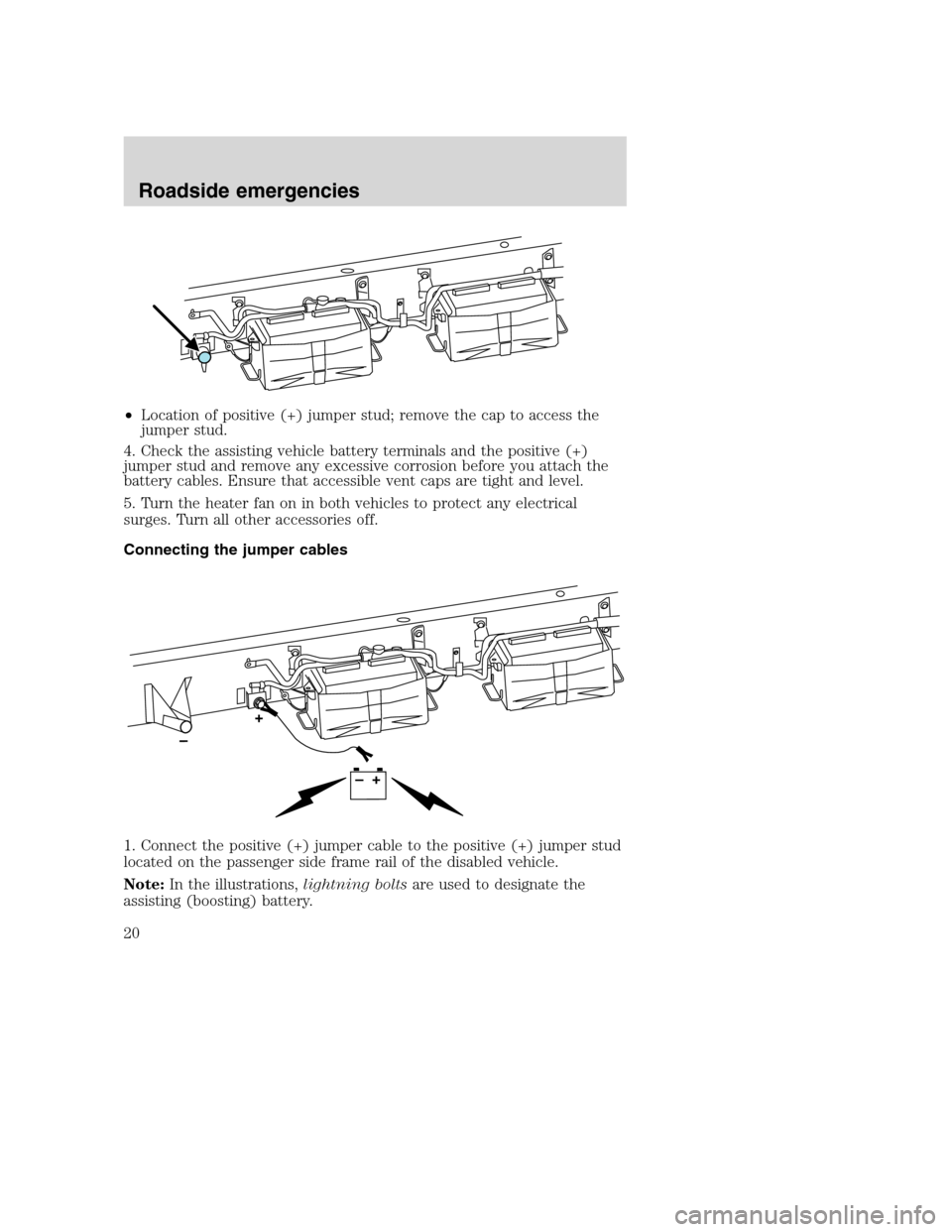
•Location of positive (+) jumper stud; remove the cap to access the
jumper stud.
4. Check the assisting vehicle battery terminals and the positive (+)
jumper stud and remove any excessive corrosion before you attach the
battery cables. Ensure that accessible vent caps are tight and level.
5. Turn the heater fan on in both vehicles to protect any electrical
surges. Turn all other accessories off.
Connecting the jumper cables
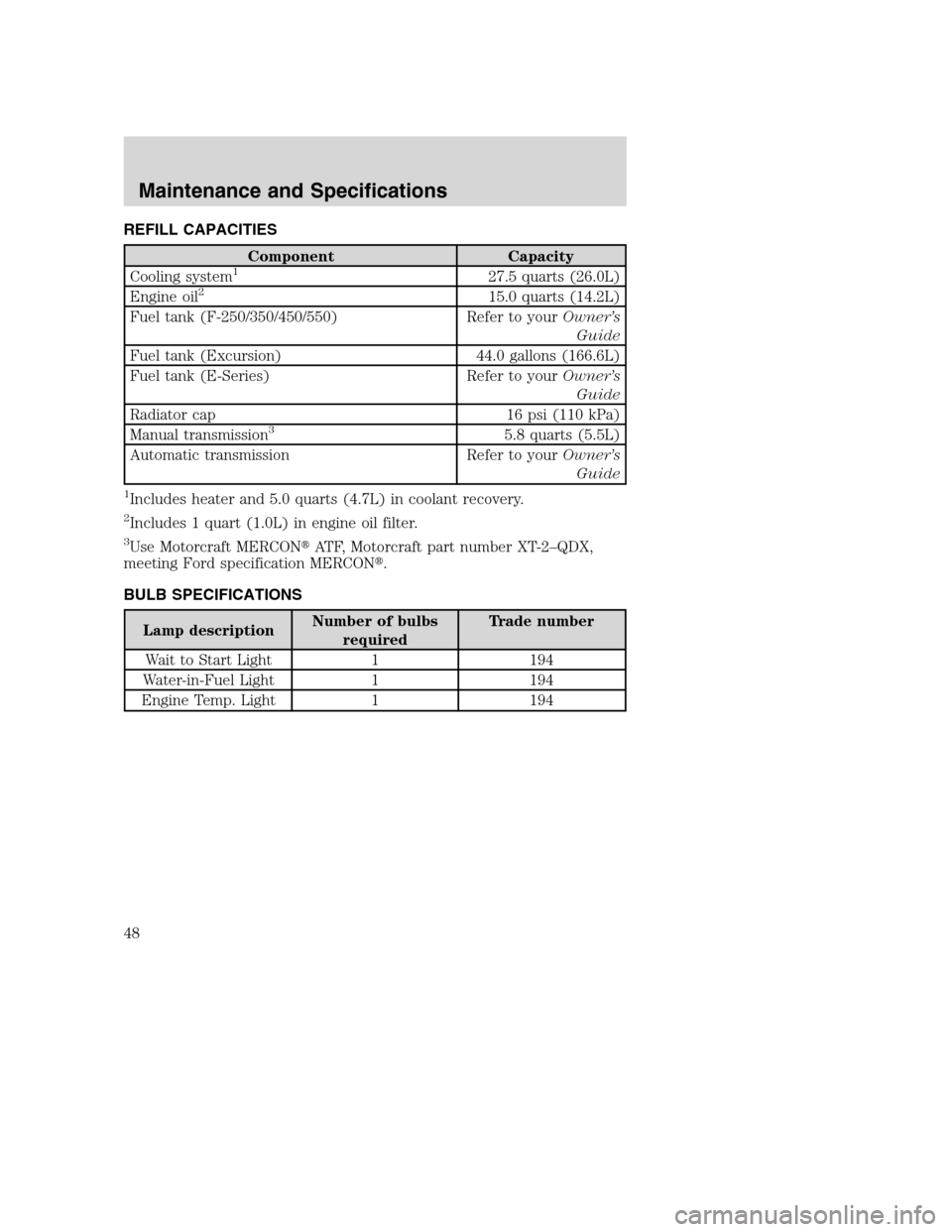
1. Connect the positive (+) jumper cable to the positive (+) jumper stud
located on the passenger side frame rail of the disabled vehicle.
Note:In the illustrations,lightning boltsare used to designate the
assisting (boosting) battery.
Roadside emergencies
20
Page 48 of 72
REFILL CAPACITIES
Component Capacity
Cooling system127.5 quarts (26.0L)
Engine oil215.0 quarts (14.2L)
Fuel tank (F-250/350/450/550) Refer to yourOwner’s
Guide
Fuel tank (Excursion) 44.0 gallons (166.6L)
Fuel tank (E-Series) Refer to yourOwner’s
Guide
Radiator cap 16 psi (110 kPa)
Manual transmission
35.8 quarts (5.5L)
Automatic transmission Refer to yourOwner’s
Guide
1Includes heater and 5.0 quarts (4.7L) in coolant recovery.
2Includes 1 quart (1.0L) in engine oil filter.
3Use Motorcraft MERCON�ATF, Motorcraft part number XT-2–QDX,
meeting Ford specification MERCON�.
BULB SPECIFICATIONS
Lamp descriptionNumber of bulbs
requiredTrade number
Wait to Start Light 1 194
Water-in-Fuel Light 1 194
Engine Temp. Light 1 194
Maintenance and Specifications
48
Page 53 of 72
•Check power steering fluid level
•Check washer spray, wiper operation and clean all wiper blades
(replace as necessary)
•Check parking brake for proper operation
•Check and lubricate all hinges, latches and outside locks
•Check and lubricate door rubber weatherstrips
•Check and clean body and door drain holes
•Check safety warning lamps (brake, ABS, air bag, safety belt) for
operation
•Check cooling system fluid level and coolant strength
•Check battery connections and clean if necessary
•Check clutch fluid level, if equipped
Multi-point Inspection
In order to keep your vehicle running right, it is important that you have
the systems on your vehicle checked regularly. This can help identify any
potential issue before there are any problems. Ford Motor Company
suggests the following multi-point inspection to be performed at every
scheduled maintenance as the way to ensure your vehicle keeps running
right.
Multi-point inspection - Recommended at every visit
•Check and top up fluid levels: brake, coolant recovery reservoir,
manual and automatic transmission, power steering and window
washer.
•Inspect tires for wear and check air pressure, including spare.
•Check exhaust system for leaks, damage, loose parts and foreign
materials.
•Check battery performance.
•Check operation of horn, exterior lamps, turn signals and hazard
warning lights.
•Check radiator, coolers and heater and air conditioning hoses.
•Inspect windshield washer spray and wiper operation.
•Check windshield for cracks, chips and pitting.
•Inspect for oil and fluid leaks.
•Inspect air cleaner filter.
General Owner’s Information
53