2005 FORD SUPER DUTY warning
[x] Cancel search: warningPage 2 of 72
California Proposition 65 Warning
WARNING:Engine exhaust, some of its constituents, and
certain vehicle components contain or emit chemicals known to
the State of California to cause cancer and birth defects or other
reproductive harm. Certain fluids contained in vehicles and certain
products of components contain or emit chemicals known to the State
of California to cause cancer and birth defects or other reproductive
harm.
Your new diesel engine will feel, drive and function somewhat differently
than a gasoline engine. Therefore it is very important that you read and
thoroughly familiarize yourself and others operating the vehicle with this
guide.
This guide will acquaint you with the 6.0L Power Stroke diesel engine. It
provides recommendations on engine care and operating procedures. For
complete vehicle information, also refer to theOwner’s Guideincluded
with the vehicle. It also describes equipment and gives specifications for
equipment that was in effect when this guide was approved for printing,
and should be considered a permanent part of the vehicle.
Some aftermarket products may cause severe engine and/or
transmission damage. There are various manufacturers offering
devices to increase turbocharger boost, exhaust brakes to
increase stopping/hauling capacity or other such devices to
increase the power/torque of the Power Stroke engine. Many
owners’ past experience with these products has been very poor.
Severe powertrain damage may result from the use of these
aftermarket products which will not be covered by the Ford
warranty.
Ford may discontinue models or change specifications without any notice
and without incurring obligations.
IMPORTANT NOTICE
Ford vehicles are suitable for producing ambulances only if equipped
with the Ford ambulance preparation package. In addition, Ford urges
ambulance manufacturers to follow the recommendation of theFord
Incomplete Vehicle Manual, Ford Truck Body Builder’s Layout Book
(and pertinent supplements) and theQualified Vehicle Modifiers
Guidelines. Using a Ford vehicle without the Ford ambulance
preparation package to produce an ambulance voids the Ford warranty
and could result in elevated underbody temperatures, fuel
Introduction
Introduction
2
Page 3 of 72
overpressurization and the risk of fuel expulsion and fires. To determine
whether the vehicle is equipped with the Ford ambulance preparation
package, inspect the information plate on the driver’s side door pillar.
Contact the manufacturer of your vehicle to determine whether the
ambulance manufacturer’s followed Ford’s recommendations.
WARNINGS
Throughout this guide, you will find warnings identified by the
symbol
. Warnings remind you to be especially careful to reduce the
risk of personal injury.
NEW VEHICLE BREAK-IN
Your vehicle does not need an extensive break-in. Try not to drive
continuously at the same speed for the first 1,600 km (1,000 miles) of
new vehicle operation. Vary your speed to allow parts to adjust
themselves to other parts.
Drive your new vehicle at least 800 km (500 miles) before towing a
trailer.
Do not add friction modifier compounds or special break-in oils during
the first few thousand kilometers (miles) of operation, since these
additives may prevent piston ring seating. SeeEngine oilin the
Maintenance and Specificationssection of this supplement for more
information on oil usage.
DIESEL ENGINE INFORMATION
The Diesel engine fuel system consists of:
•On F-Super Duty and Excursion vehicles,a frame-mounted
Horizontal Fuel Conditioner Module (HFCM)
•On E-Series vehicles,a Fuel Conditioner Module (FCM) mounted on
the driver-side of the transmission case
•an engine-mounted secondary fuel filter
•a unit injector for each cylinder
The FCM/HFCM acts as a primary fuel filter/water separator which
removes both water and impurities from the fuel. The engine-mounted
fuel filter and the FCM/HFCM filter should be changed at the
recommended service interval. Refer to theGeneral Owner’s
Informationsection of this supplement for more information.
Introduction
3
Page 8 of 72
Type B
Type C
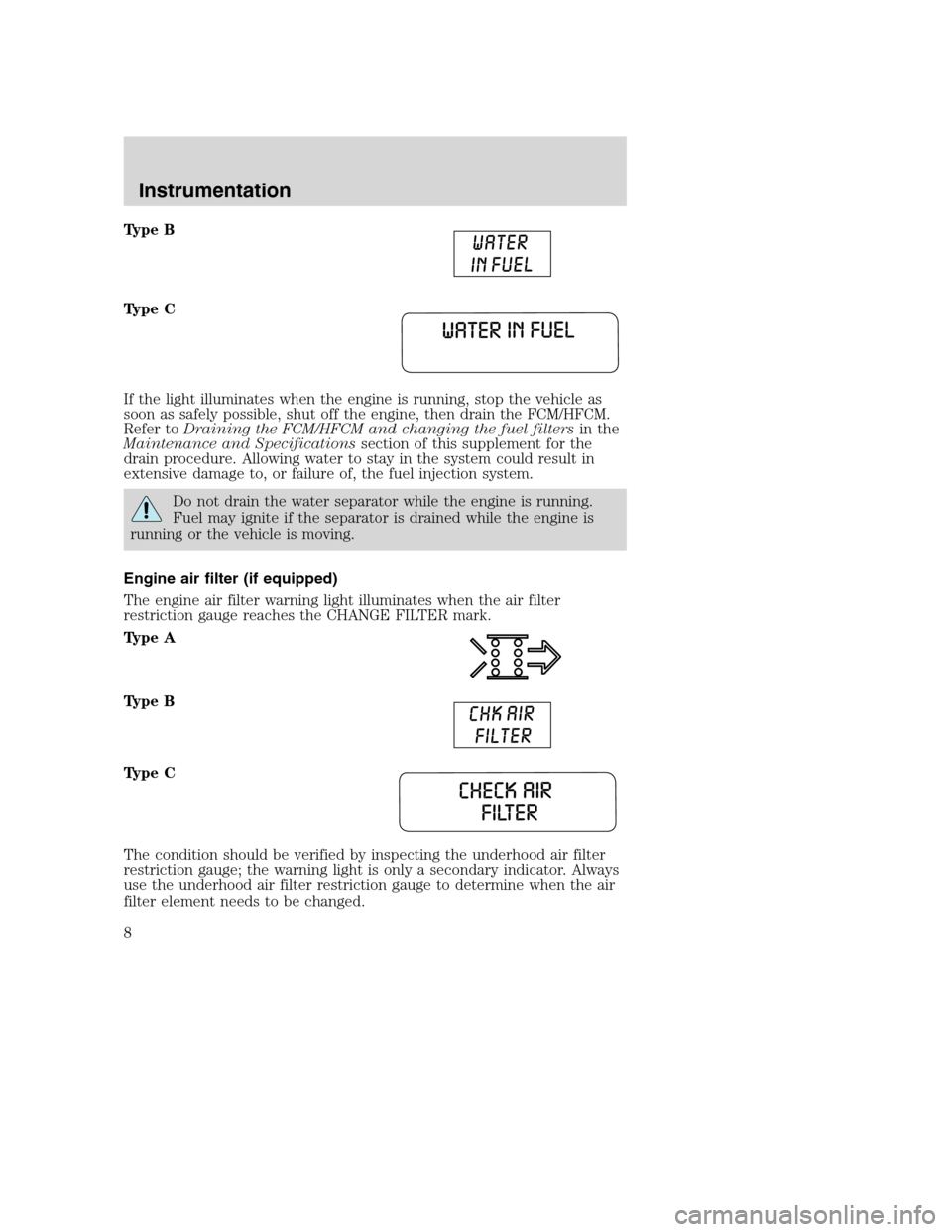
If the light illuminates when the engine is running, stop the vehicle as
soon as safely possible, shut off the engine, then drain the FCM/HFCM.
Refer toDraining the FCM/HFCM and changing the fuel filtersin the
Maintenance and Specificationssection of this supplement for the
drain procedure. Allowing water to stay in the system could result in
extensive damage to, or failure of, the fuel injection system.
Do not drain the water separator while the engine is running.
Fuel may ignite if the separator is drained while the engine is
running or the vehicle is moving.
Engine air filter (if equipped)
The engine air filter warning light illuminates when the air filter
restriction gauge reaches the CHANGE FILTER mark.
Type A
Type B
Type C
The condition should be verified by inspecting the underhood air filter
restriction gauge; the warning light is only a secondary indicator. Always
use the underhood air filter restriction gauge to determine when the air
filter element needs to be changed.
Instrumentation
8
Page 9 of 72
The vehicle may be driven with the engine air filter warning light
illuminated/or when the underhood air filter restriction gauge has moved
to the CHANGE FILTER mark for up to 400 km (250 miles) without
damaging the engine or related components. However, the air filter
element must be replaced at the earliest opportunity. Refer toAir filter
restriction gauge (if equipped)in this section of the supplement for
more information.
Transmission Tow/Haul Feature
(if equipped):Illuminates when
the Tow/Haul feature has been
selected. Refer to theDriving
chapter for transmission function and operation. If the light flashes
steadily or does not illuminate, have the transmission serviced soon, or
damage may occur.
Air filter restriction gauge (if equipped)
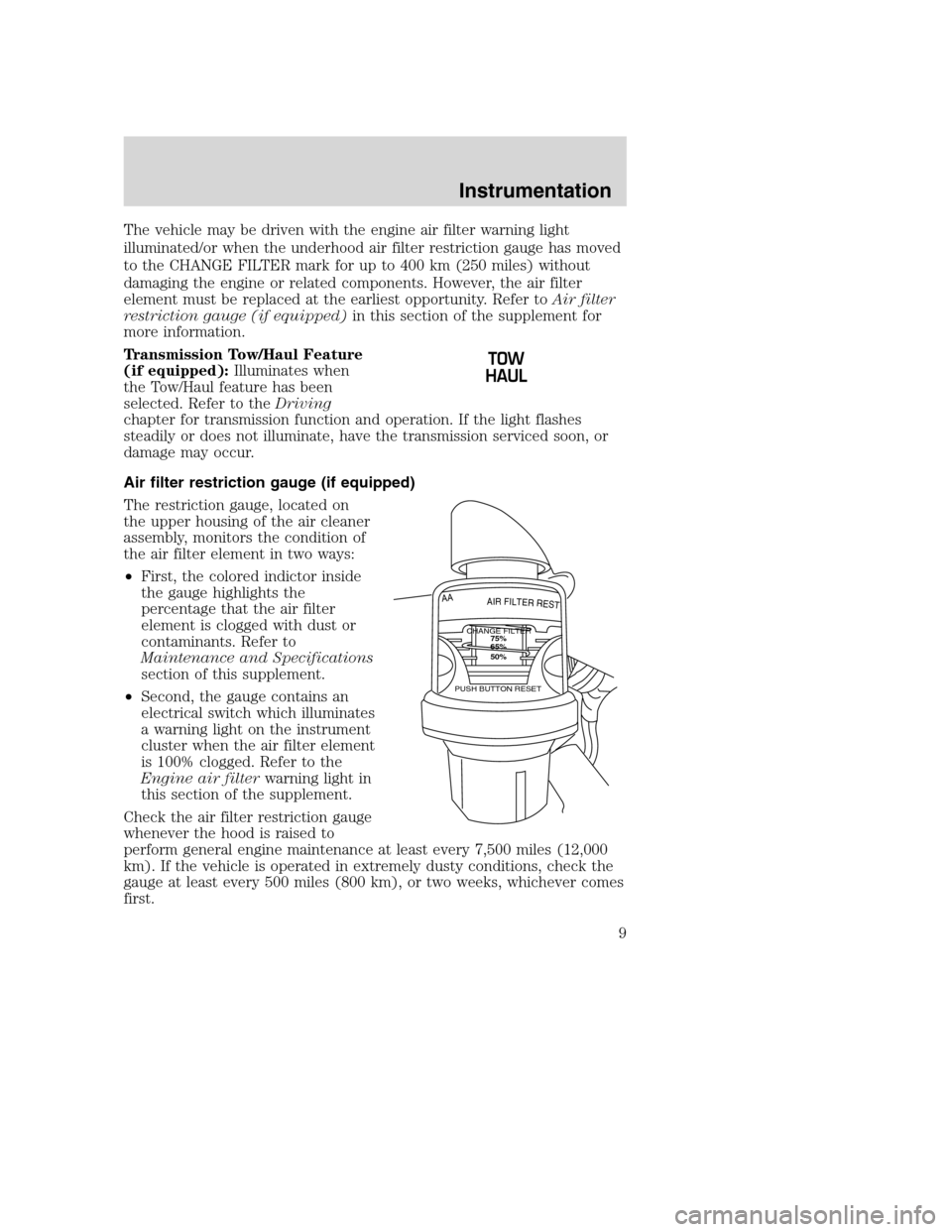
The restriction gauge, located on
the upper housing of the air cleaner
assembly, monitors the condition of
the air filter element in two ways:
•First, the colored indictor inside
the gauge highlights the
percentage that the air filter
element is clogged with dust or
contaminants. Refer to
Maintenance and Specifications
section of this supplement.
•Second, the gauge contains an
electrical switch which illuminates
a warning light on the instrument
cluster when the air filter element
is 100% clogged. Refer to the
Engine air filterwarning light in
this section of the supplement.
Check the air filter restriction gauge
whenever the hood is raised to
perform general engine maintenance at least every 7,500 miles (12,000
km). If the vehicle is operated in extremely dusty conditions, check the
gauge at least every 500 miles (800 km), or two weeks, whichever comes
first.
AIRFILTERRESTAA
CHANGE FILTER
PUSH BUTTON RESET75%
50%65%
Instrumentation
9
Page 10 of 72
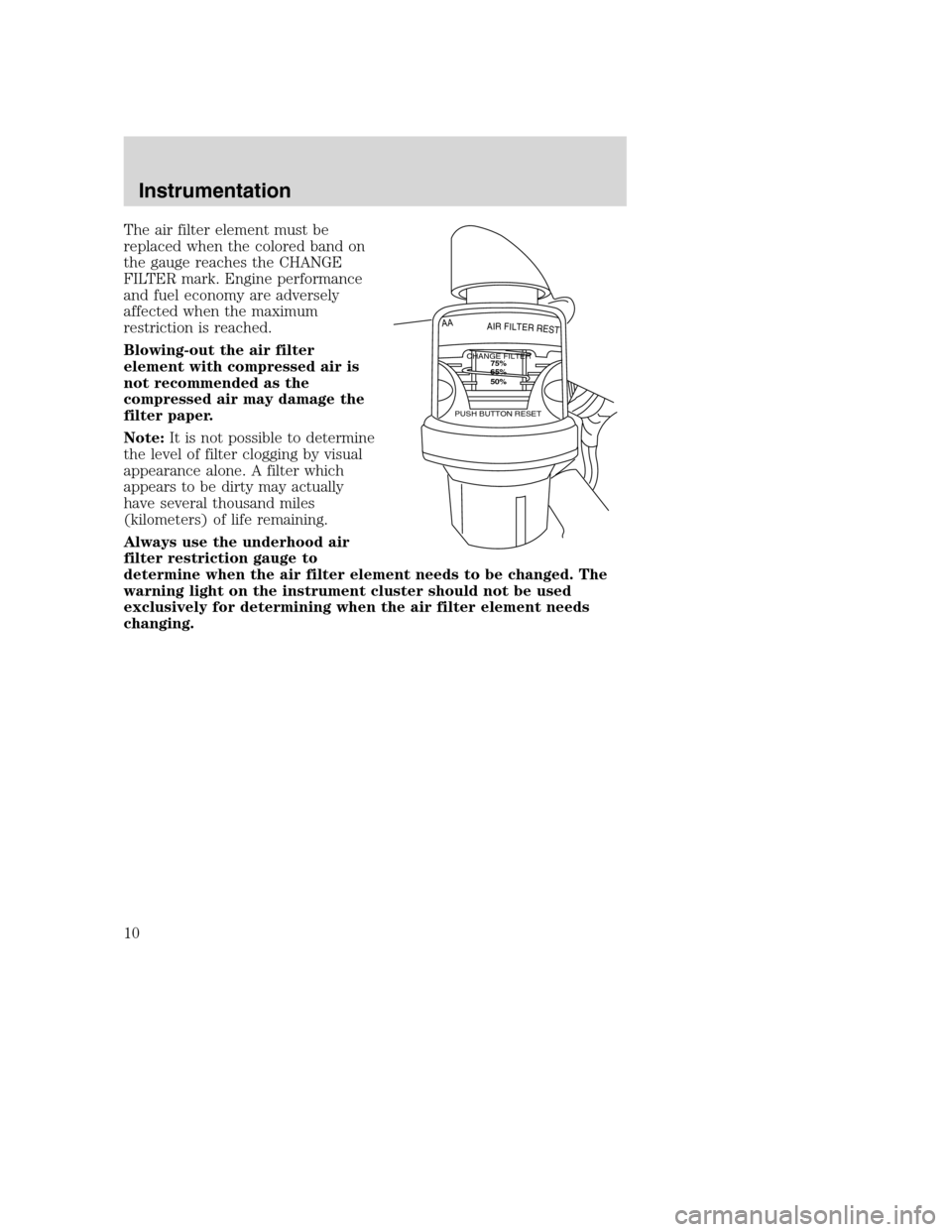
The air filter element must be
replaced when the colored band on
the gauge reaches the CHANGE
FILTER mark. Engine performance
and fuel economy are adversely
affected when the maximum
restriction is reached.
Blowing-out the air filter
element with compressed air is
not recommended as the
compressed air may damage the
filter paper.
Note:It is not possible to determine
the level of filter clogging by visual
appearance alone. A filter which
appears to be dirty may actually
have several thousand miles
(kilometers) of life remaining.
Always use the underhood air
filter restriction gauge to
determine when the air filter element needs to be changed. The
warning light on the instrument cluster should not be used
exclusively for determining when the air filter element needs
changing.
AIRFILTERRESTAA
CHANGE FILTER
PUSH BUTTON RESET75%
50%65%
Instrumentation
10
Page 11 of 72
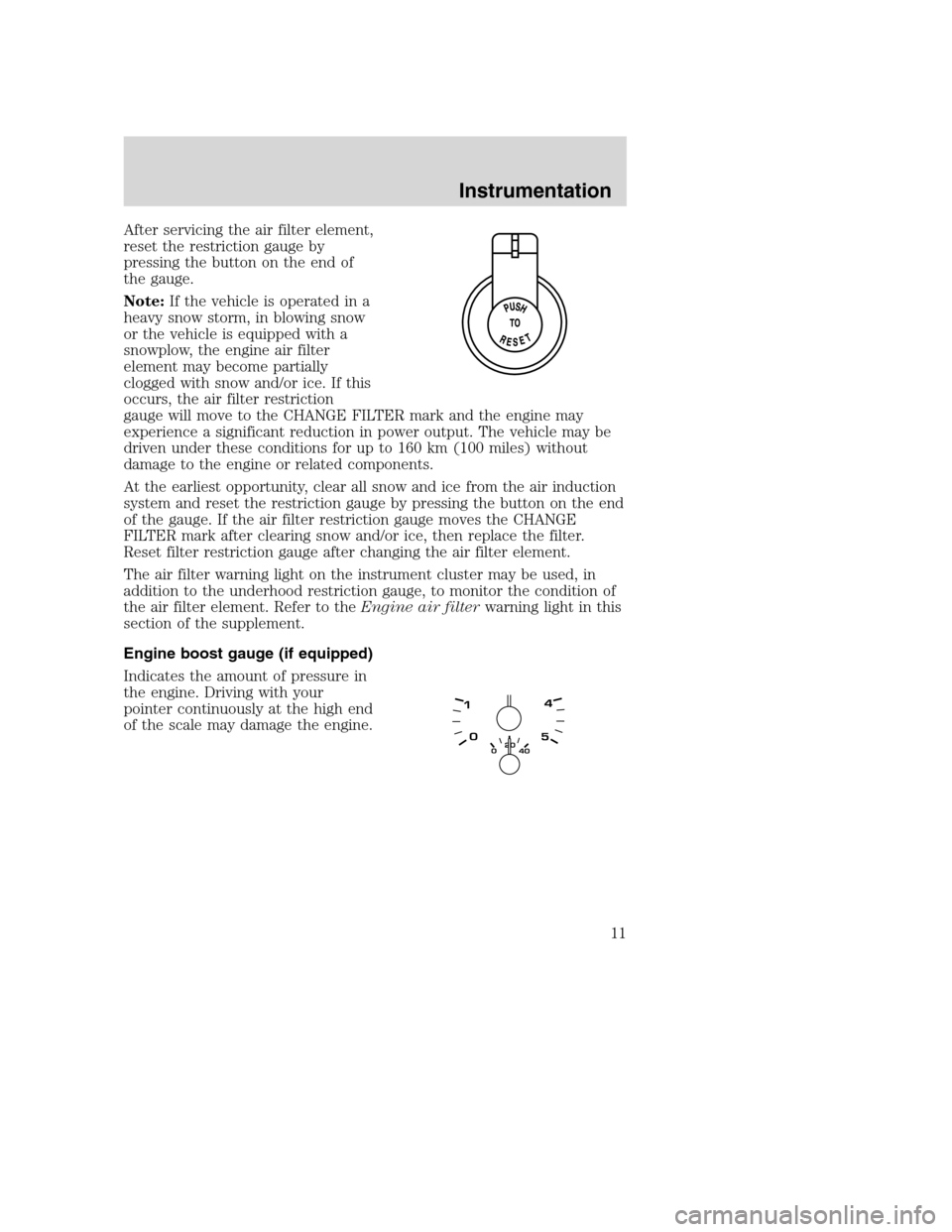
After servicing the air filter element,
reset the restriction gauge by
pressing the button on the end of
the gauge.
Note:If the vehicle is operated in a
heavy snow storm, in blowing snow
or the vehicle is equipped with a
snowplow, the engine air filter
element may become partially
clogged with snow and/or ice. If this
occurs, the air filter restriction
gauge will move to the CHANGE FILTER mark and the engine may
experience a significant reduction in power output. The vehicle may be
driven under these conditions for up to 160 km (100 miles) without
damage to the engine or related components.
At the earliest opportunity, clear all snow and ice from the air induction
system and reset the restriction gauge by pressing the button on the end
of the gauge. If the air filter restriction gauge moves the CHANGE
FILTER mark after clearing snow and/or ice, then replace the filter.
Reset filter restriction gauge after changing the air filter element.
The air filter warning light on the instrument cluster may be used, in
addition to the underhood restriction gauge, to monitor the condition of
the air filter element. Refer to theEngine air filterwarning light in this
section of the supplement.
Engine boost gauge (if equipped)
Indicates the amount of pressure in
the engine. Driving with your
pointer continuously at the high end
of the scale may damage the engine.
Instrumentation
11
Page 31 of 72
FUEL CONDITIONER MODULE (FCM - E-SERIES)/HORIZONTAL
FUEL CONDITIONING MODULE (HFCM - F-SUPER
DUTY/EXCURSION) - FUEL FILTER/WATER SEPARATOR
HFCM - F-Super Duty/Excursion
The vehicle is equipped with a Horizontal Fuel Conditioning Module
(HFCM) located on the frame-rail under the driver-side floorboard near
the transmission.
Water should be drained from the
module assembly whenever the
warning light comes on. The WATER
IN FUEL light will come on when
approximately 100 cc (0.2 pints) of water accumulates in the module.
Replace the fuel filters with Ford Part No. FD–4604. This part number
includes filters and seals for both the engine-mounted and
frame-mounted filters.
FCM - E-Series
The vehicle is equipped with a Fuel Conditioning Module (FCM) located
on the driver-side of the vehicle next to the transmission case.
Water should be drained from the
module assembly whenever the
warning light comes on. The WATER
IN FUEL light will come on when
approximately 100 cc (0.2 pints) of water accumulates in the module.
Replace the fuel filters with Ford Part No. FD–4604. This part number
includes filters and seals for both the engine-mounted filter and the FCM
filter.
DRAINING THE FCM/HFCM AND CHANGING THE FUEL FILTERS
Your vehicle is equipped with two fuel filters; one is mounted on top of
the engine.On F-Super Duty and Excursion vehicles,the second
filter, inside the HFCM, is mounted inside the frame rail under the
driver-side floorboard near the transmission.On E-Series vehicles,the
second filter, inside the FCM, is mounted on the driver-side of the
vehicle next to the transmission case.On all vehicles,both filters
should be replaced at the same time. The Motorcraft part number for the
replacement filters is FD-4604.
Maintenance and Specifications
31
Page 53 of 72
•Check power steering fluid level
•Check washer spray, wiper operation and clean all wiper blades
(replace as necessary)
•Check parking brake for proper operation
•Check and lubricate all hinges, latches and outside locks
•Check and lubricate door rubber weatherstrips
•Check and clean body and door drain holes
•Check safety warning lamps (brake, ABS, air bag, safety belt) for
operation
•Check cooling system fluid level and coolant strength
•Check battery connections and clean if necessary
•Check clutch fluid level, if equipped
Multi-point Inspection
In order to keep your vehicle running right, it is important that you have
the systems on your vehicle checked regularly. This can help identify any
potential issue before there are any problems. Ford Motor Company
suggests the following multi-point inspection to be performed at every
scheduled maintenance as the way to ensure your vehicle keeps running
right.
Multi-point inspection - Recommended at every visit
•Check and top up fluid levels: brake, coolant recovery reservoir,
manual and automatic transmission, power steering and window
washer.
•Inspect tires for wear and check air pressure, including spare.
•Check exhaust system for leaks, damage, loose parts and foreign
materials.
•Check battery performance.
•Check operation of horn, exterior lamps, turn signals and hazard
warning lights.
•Check radiator, coolers and heater and air conditioning hoses.
•Inspect windshield washer spray and wiper operation.
•Check windshield for cracks, chips and pitting.
•Inspect for oil and fluid leaks.
•Inspect air cleaner filter.
General Owner’s Information
53