2005 FORD SUPER DUTY stop start
[x] Cancel search: stop startPage 13 of 72
2. When the glow plug pre-heat
indicator turns off, turn the key to 5
(START), then release the key as
soon as the engine starts. The glow
plugs will continue to be activated for two minutes after the glow plug
pre-heat indicator
has turned off. If the engine is not started
before the glow plug activation time ends, the glow plugs will need to be
reset by turning the key to 3 (OFF).
3. After the engine starts, allow it to idle for about 15 seconds. Do not
increase engine speed until the oil pressure gauge indicates normal
pressure.
STOPPING THE ENGINE
Turn the ignition to 3 (OFF). To prolong engine life (after extended high
speed or maximum GVW operation), it is recommended that a hot engine
be allowed to operate at low idle for about 7–10 minutes which would
allow sufficient time for the turbocharged engine to cool down.
COLD WEATHER OPERATION
Changing to a lighter grade engine oil also makes starting easier under
these conditions. Refer toEngine oil specificationsin theMaintenance
and Specificationssection of this supplement.
At temperatures below 20°F(–7°C), Number 2–D diesel fuel may thicken
enough to clog the fuel filter. Your vehicle is equipped with either an
FCM (E-Series) or an HFCM (F-Super Duty and Excursion) which acts
as a fuel filter/heater/water separator to keep the wax melted which will
help prevent fuel filter clogging. However, if the engine starts but stalls
after a short time and will not restart, the fuel filter(s) may be clogged.
For best results in cold weather, use Number 1–D diesel fuel or
“winterized”Number 2–D diesel fuel which has an additive to minimize
wax formation.
Your vehicle is also equipped with a bypass relief valve, located on the
fuel control module, which provides fuel flow to the engine if the fuel
pickup should become plugged by ice or wax. To allow this bypass valve
to function and avoid engine fuel starvation, it is recommended that,
during cold weather operation 32°F(0°C) or below, the fuel level in your
tank should not be allowed to drop below
1⁄4full. This will help prevent
air from entering the fuel system and stalling the engine.
In cold weather below 32°F (0°C) your diesel engine will slowly increase
to a higher idle speed if left idling in P (Park). As the engine warms-up,
Driving
13
Page 30 of 72
975 industry specification. Aftermarket additives can damage the injector
system or engine. Repairs to correct the effects of using an aftermarket
product in your fuel may not be covered by your warranty.
Do not blend used engine oil with diesel fuel under any
circumstances.Blending used oil with the fuel will significantly increase
your vehicle’s exhaust emissions and reduce engine life due to increased
internal wear.
Many of the world’s automakers approved the World-wide Fuel Charter
that recommends diesel fuel specifications to provide improved
performance and emission control system protection for your vehicle.
Diesel fuel that meets the World-wide Fuel Charter should be used when
available. Ask your fuel supplier about fuel that meets the World-wide
Fuel Charter.
Fueling tips
If the engine fails to start in 30 seconds, turn the key to the OFF
position and wait 30 seconds before trying again.
Truck stops have pumps and nozzles designed for larger, heavy-duty
trucks. When refueling at truck stops: if the nozzle shuts off repeatedly
when refueling, wait 5–10 seconds; then use a slower rate of flow (don’t
depress the nozzle trigger as far).
If air is allowed to enter the fuel system (during fuel filter change or if
you run out of fuel) the engine will purge the trapped air as it runs. The
engine may run rough and produce white smoke while air is in the
system. This is normal and should correct itself in a short time.
An engine that suddenly becomes noisy or operates poorly after a fuel fill
could be using substandard fuel (i.e., high water content, low cetane
rating or gasoline in the fuel). Diesel fuel should be purchased from a
reputable station which sells a large amount of diesel fuel.
Care should be taken whenever diesel fuel is stored. Use only clean,
approved containers which will prevent the entry of dirt or water.
Diesel fuel must not be stored in a galvanized container. The fuel will
dissolve the zinc in a galvanized container. The zinc will then remain in
solution until it is run through the engine where it will be deposited in
the fuel injectors causing expensive-to-repair damage.
Diesel fuel dispensing nozzle fill rate
This truck is equipped with a fuel fill pipe which is able to accept fuel up
to 20 gallons per minute from an 1 1/8 inch fuel dispensing nozzle.
Pumping fuel at greater flow rates may result in premature nozzle
shut-off or spitback.
Maintenance and Specifications
30
Page 32 of 72
FCM/HFCM drain procedure
1. Stop the vehicle andshut offthe engine.
The vehicle must be stopped with the engine off when draining
the HFCM/FCM. Fuel may ignite if the separator is drained while
the engine is running or vehicle is moving.
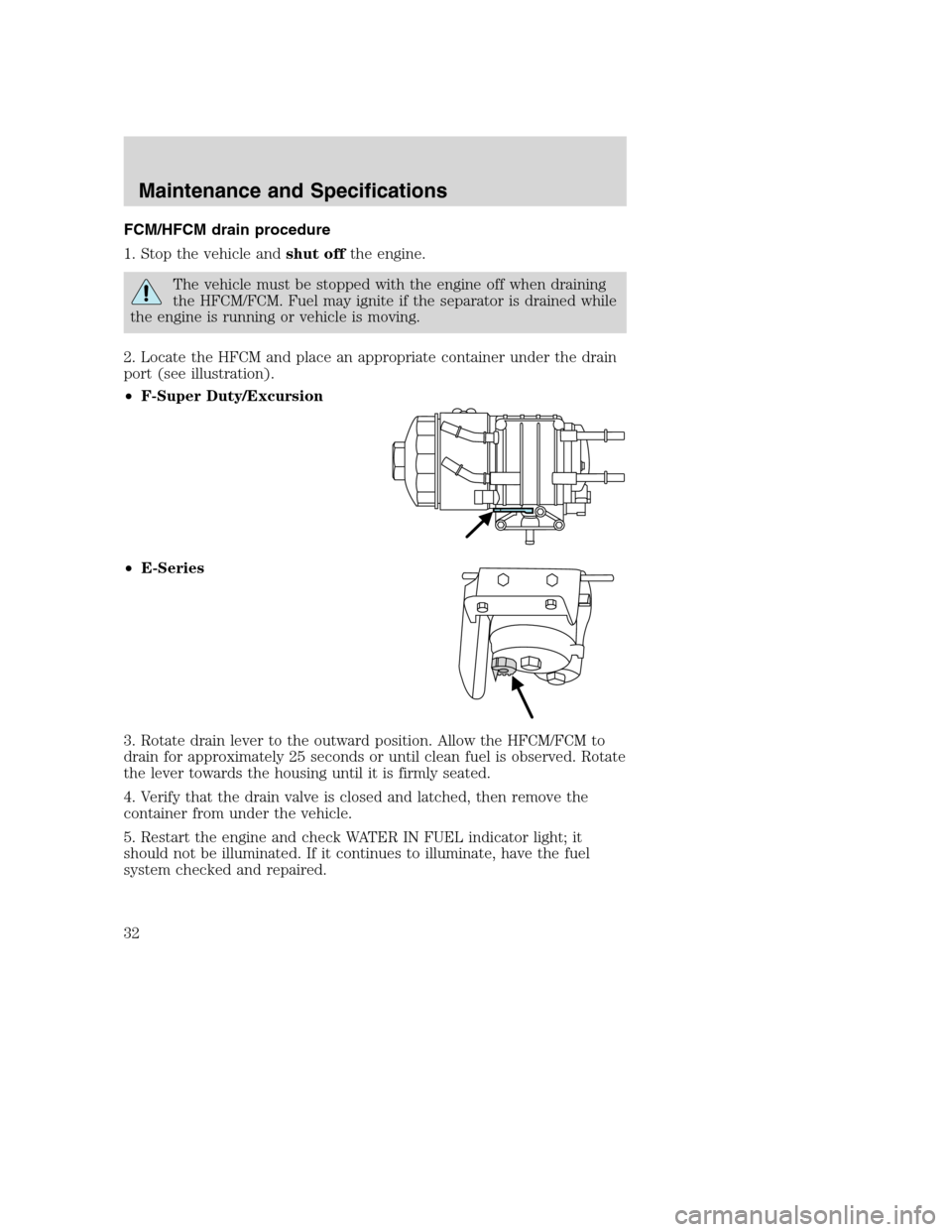
2. Locate the HFCM and place an appropriate container under the drain
port (see illustration).
•F-Super Duty/Excursion
•E-Series
3. Rotate drain lever to the outward position. Allow the HFCM/FCM to
drain for approximately 25 seconds or until clean fuel is observed. Rotate
the lever towards the housing until it is firmly seated.
4. Verify that the drain valve is closed and latched, then remove the
container from under the vehicle.
5. Restart the engine and check WATER IN FUEL indicator light; it
should not be illuminated. If it continues to illuminate, have the fuel
system checked and repaired.
Maintenance and Specifications
32
Page 45 of 72
The complexity of the diesel engine makes it so the owner is discouraged
from attempting to perform maintenance other than the services
described in this supplement.
If you experience difficult starting, rough idling, excessive exhaust
smoke, a decrease in engine performance or excess fuel consumption,
perform the following checks:
•a plugged air inlet system or engine air filter element.
•water in the fuel filter/water separator.
•a clogged fuel filter.
•contaminated fuel.
•air in the fuel system, due to loose connections.
•an open or pinched sensor hose.
•low engine oil level.
•wrong fuel or oil viscosity for climactic conditions.
If these checks do not help you correct the engine performance problem
you are experiencing, consult an authorized dealer.
FUELING
Do not use starting fluid such as ether or gasoline in the diesel
air intake system. Such fluids can cause immediate explosive
damage to the engine and possible personal injury.
If you fuel your vehicle at a truck stop, you may notice that the fuel
nozzle may shut off every 5–10 seconds. This is due to the flow rates
being designed for larger heavy duty trucks. You may have to fuel at a
slower rate (don’t depress the nozzle trigger fully).
Do not run your diesel vehicle out of fuel as this will allow air to enter
the fuel system which will make restarting difficult. Longer engine
cranking time may be required once air is in the fuel system. If air enters
the fuel system (either through running the fuel tank(s) empty or during
a fuel filter change), the engine will self-purge the trapped air once it
starts running. The engine may run roughly and produce white smoke
while air is in the fuel system; this is normal and should stop after a
short time.
MINOR TROUBLESHOOTING GUIDE
If the engine won’t crank
Turn on the headlights. If the lights are dim, do not go on at all or if
when the ignition is turned to 5 (START) the lights become dim or go
Maintenance and Specifications
45