2005 FORD SUPER DUTY maintenance
[x] Cancel search: maintenancePage 1 of 72
Introduction
2
Instrumentation
6
Driving
12
Roadside emergencies
19
Cleaning
25
Maintenance and Specifications
27
General Owner’s Information
50
Normal Scheduled Maintenance and Log 54
Exceptions 64
Special Operating Conditions and Log 65
Motorcraft Premium Gold Coolant Change Record 69
All rights reserved. Reproduction by any means, electronic or mechanical
including photocopying, recording or by any information storage and retrieval
system or translation in whole or part is not permitted without written
authorization from Ford Motor Company. Ford may change the contents without
notice and without incurring obligation.
Copyright © 2004 Ford Motor Company
Table of Contents
1
Table of Contents
Page 3 of 72
overpressurization and the risk of fuel expulsion and fires. To determine
whether the vehicle is equipped with the Ford ambulance preparation
package, inspect the information plate on the driver’s side door pillar.
Contact the manufacturer of your vehicle to determine whether the
ambulance manufacturer’s followed Ford’s recommendations.
WARNINGS
Throughout this guide, you will find warnings identified by the
symbol
. Warnings remind you to be especially careful to reduce the
risk of personal injury.
NEW VEHICLE BREAK-IN
Your vehicle does not need an extensive break-in. Try not to drive
continuously at the same speed for the first 1,600 km (1,000 miles) of
new vehicle operation. Vary your speed to allow parts to adjust
themselves to other parts.
Drive your new vehicle at least 800 km (500 miles) before towing a
trailer.
Do not add friction modifier compounds or special break-in oils during
the first few thousand kilometers (miles) of operation, since these
additives may prevent piston ring seating. SeeEngine oilin the
Maintenance and Specificationssection of this supplement for more
information on oil usage.
DIESEL ENGINE INFORMATION
The Diesel engine fuel system consists of:
•On F-Super Duty and Excursion vehicles,a frame-mounted
Horizontal Fuel Conditioner Module (HFCM)
•On E-Series vehicles,a Fuel Conditioner Module (FCM) mounted on
the driver-side of the transmission case
•an engine-mounted secondary fuel filter
•a unit injector for each cylinder
The FCM/HFCM acts as a primary fuel filter/water separator which
removes both water and impurities from the fuel. The engine-mounted
fuel filter and the FCM/HFCM filter should be changed at the
recommended service interval. Refer to theGeneral Owner’s
Informationsection of this supplement for more information.
Introduction
3
Page 4 of 72
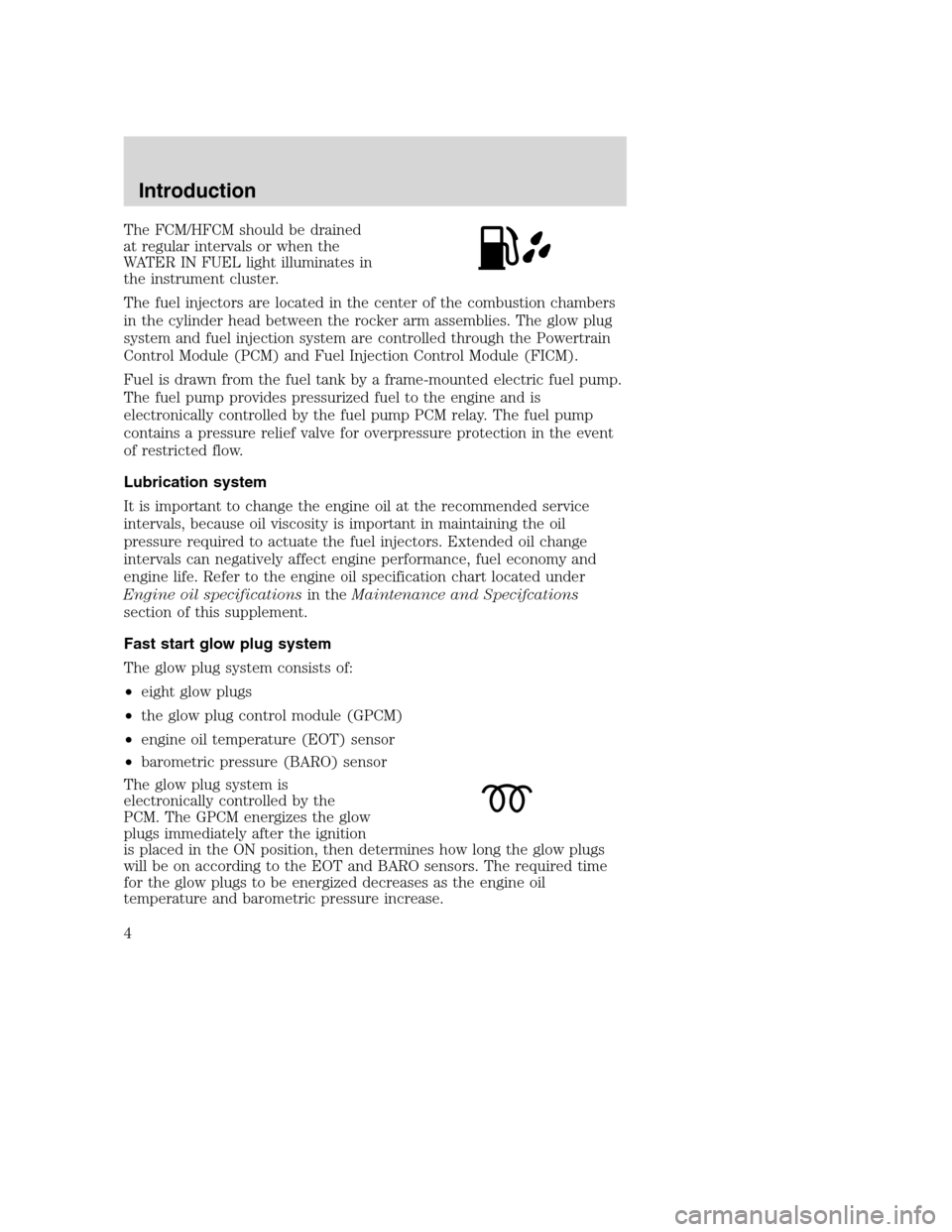
The FCM/HFCM should be drained
at regular intervals or when the
WATER IN FUEL light illuminates in
the instrument cluster.
The fuel injectors are located in the center of the combustion chambers
in the cylinder head between the rocker arm assemblies. The glow plug
system and fuel injection system are controlled through the Powertrain
Control Module (PCM) and Fuel Injection Control Module (FICM).
Fuel is drawn from the fuel tank by a frame-mounted electric fuel pump.
The fuel pump provides pressurized fuel to the engine and is
electronically controlled by the fuel pump PCM relay. The fuel pump
contains a pressure relief valve for overpressure protection in the event
of restricted flow.
Lubrication system
It is important to change the engine oil at the recommended service
intervals, because oil viscosity is important in maintaining the oil
pressure required to actuate the fuel injectors. Extended oil change
intervals can negatively affect engine performance, fuel economy and
engine life. Refer to the engine oil specification chart located under
Engine oil specificationsin theMaintenance and Specifcations
section of this supplement.
Fast start glow plug system
The glow plug system consists of:
•eight glow plugs
•the glow plug control module (GPCM)
•engine oil temperature (EOT) sensor
•barometric pressure (BARO) sensor
The glow plug system is
electronically controlled by the
PCM. The GPCM energizes the glow
plugs immediately after the ignition
is placed in the ON position, then determines how long the glow plugs
will be on according to the EOT and BARO sensors. The required time
for the glow plugs to be energized decreases as the engine oil
temperature and barometric pressure increase.
Introduction
4
Page 8 of 72
Type B
Type C
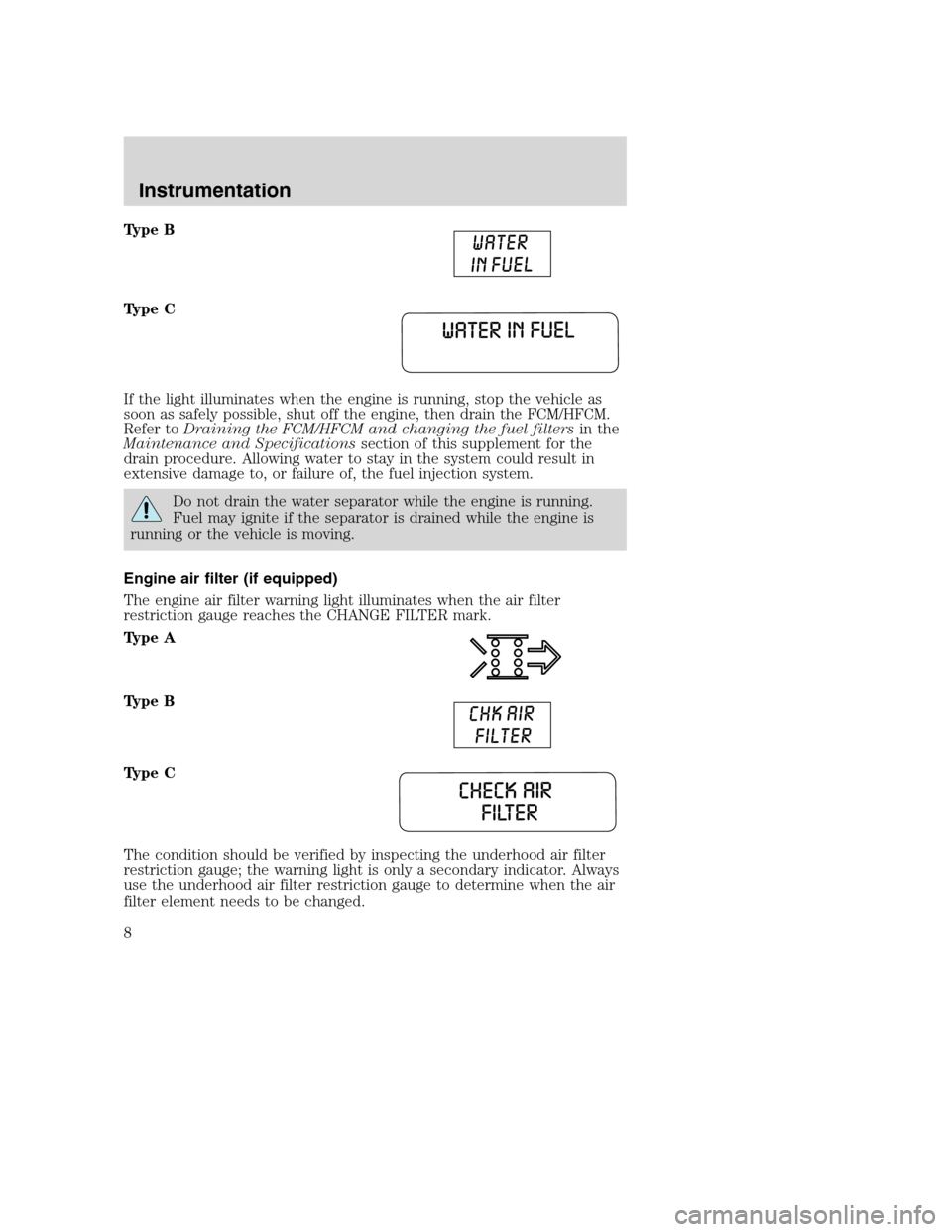
If the light illuminates when the engine is running, stop the vehicle as
soon as safely possible, shut off the engine, then drain the FCM/HFCM.
Refer toDraining the FCM/HFCM and changing the fuel filtersin the
Maintenance and Specificationssection of this supplement for the
drain procedure. Allowing water to stay in the system could result in
extensive damage to, or failure of, the fuel injection system.
Do not drain the water separator while the engine is running.
Fuel may ignite if the separator is drained while the engine is
running or the vehicle is moving.
Engine air filter (if equipped)
The engine air filter warning light illuminates when the air filter
restriction gauge reaches the CHANGE FILTER mark.
Type A
Type B
Type C
The condition should be verified by inspecting the underhood air filter
restriction gauge; the warning light is only a secondary indicator. Always
use the underhood air filter restriction gauge to determine when the air
filter element needs to be changed.
Instrumentation
8
Page 9 of 72
The vehicle may be driven with the engine air filter warning light
illuminated/or when the underhood air filter restriction gauge has moved
to the CHANGE FILTER mark for up to 400 km (250 miles) without
damaging the engine or related components. However, the air filter
element must be replaced at the earliest opportunity. Refer toAir filter
restriction gauge (if equipped)in this section of the supplement for
more information.
Transmission Tow/Haul Feature
(if equipped):Illuminates when
the Tow/Haul feature has been
selected. Refer to theDriving
chapter for transmission function and operation. If the light flashes
steadily or does not illuminate, have the transmission serviced soon, or
damage may occur.
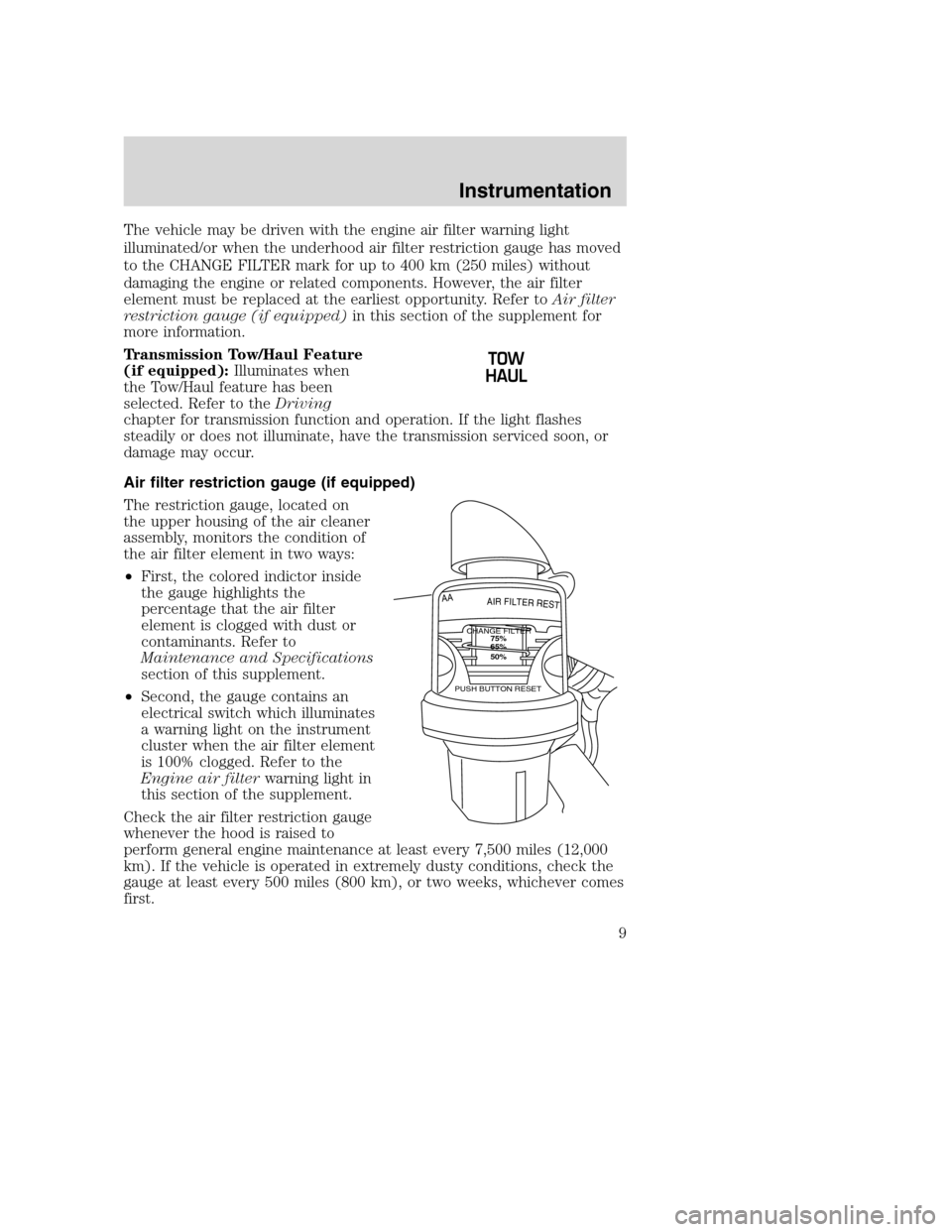
Air filter restriction gauge (if equipped)
The restriction gauge, located on
the upper housing of the air cleaner
assembly, monitors the condition of
the air filter element in two ways:
•First, the colored indictor inside
the gauge highlights the
percentage that the air filter
element is clogged with dust or
contaminants. Refer to
Maintenance and Specifications
section of this supplement.
•Second, the gauge contains an
electrical switch which illuminates
a warning light on the instrument
cluster when the air filter element
is 100% clogged. Refer to the
Engine air filterwarning light in
this section of the supplement.
Check the air filter restriction gauge
whenever the hood is raised to
perform general engine maintenance at least every 7,500 miles (12,000
km). If the vehicle is operated in extremely dusty conditions, check the
gauge at least every 500 miles (800 km), or two weeks, whichever comes
first.
AIRFILTERRESTAA
CHANGE FILTER
PUSH BUTTON RESET75%
50%65%
Instrumentation
9
Page 13 of 72
2. When the glow plug pre-heat
indicator turns off, turn the key to 5
(START), then release the key as
soon as the engine starts. The glow
plugs will continue to be activated for two minutes after the glow plug
pre-heat indicator
has turned off. If the engine is not started
before the glow plug activation time ends, the glow plugs will need to be
reset by turning the key to 3 (OFF).
3. After the engine starts, allow it to idle for about 15 seconds. Do not
increase engine speed until the oil pressure gauge indicates normal
pressure.
STOPPING THE ENGINE
Turn the ignition to 3 (OFF). To prolong engine life (after extended high
speed or maximum GVW operation), it is recommended that a hot engine
be allowed to operate at low idle for about 7–10 minutes which would
allow sufficient time for the turbocharged engine to cool down.
COLD WEATHER OPERATION
Changing to a lighter grade engine oil also makes starting easier under
these conditions. Refer toEngine oil specificationsin theMaintenance
and Specificationssection of this supplement.
At temperatures below 20°F(–7°C), Number 2–D diesel fuel may thicken
enough to clog the fuel filter. Your vehicle is equipped with either an
FCM (E-Series) or an HFCM (F-Super Duty and Excursion) which acts
as a fuel filter/heater/water separator to keep the wax melted which will
help prevent fuel filter clogging. However, if the engine starts but stalls
after a short time and will not restart, the fuel filter(s) may be clogged.
For best results in cold weather, use Number 1–D diesel fuel or
“winterized”Number 2–D diesel fuel which has an additive to minimize
wax formation.
Your vehicle is also equipped with a bypass relief valve, located on the
fuel control module, which provides fuel flow to the engine if the fuel
pickup should become plugged by ice or wax. To allow this bypass valve
to function and avoid engine fuel starvation, it is recommended that,
during cold weather operation 32°F(0°C) or below, the fuel level in your
tank should not be allowed to drop below
1⁄4full. This will help prevent
air from entering the fuel system and stalling the engine.
In cold weather below 32°F (0°C) your diesel engine will slowly increase
to a higher idle speed if left idling in P (Park). As the engine warms-up,
Driving
13
Page 27 of 72
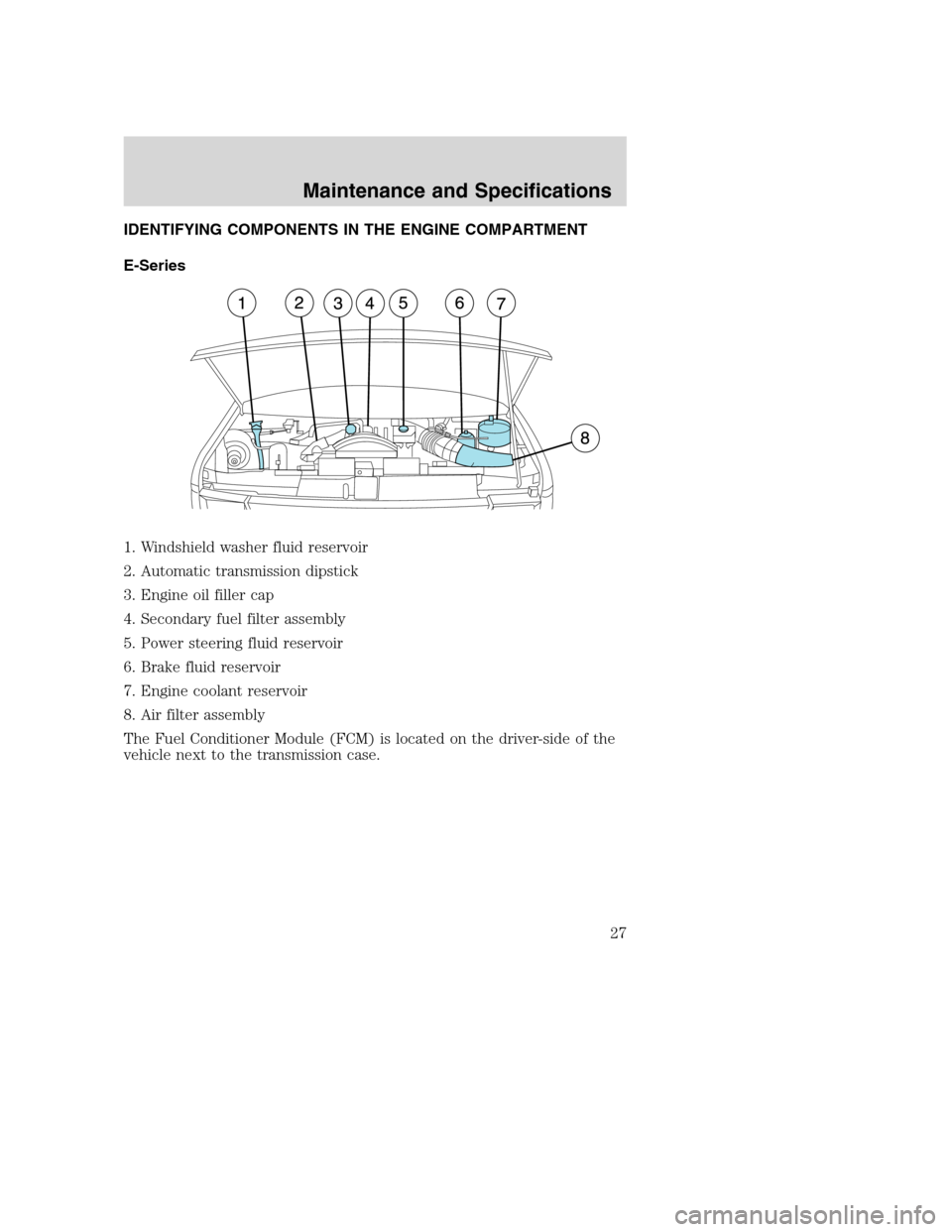
IDENTIFYING COMPONENTS IN THE ENGINE COMPARTMENT
E-Series
1. Windshield washer fluid reservoir
2. Automatic transmission dipstick
3. Engine oil filler cap
4. Secondary fuel filter assembly
5. Power steering fluid reservoir
6. Brake fluid reservoir
7. Engine coolant reservoir
8. Air filter assembly
The Fuel Conditioner Module (FCM) is located on the driver-side of the
vehicle next to the transmission case.
Maintenance and Specifications
Maintenance and Specifications
27
Page 28 of 72
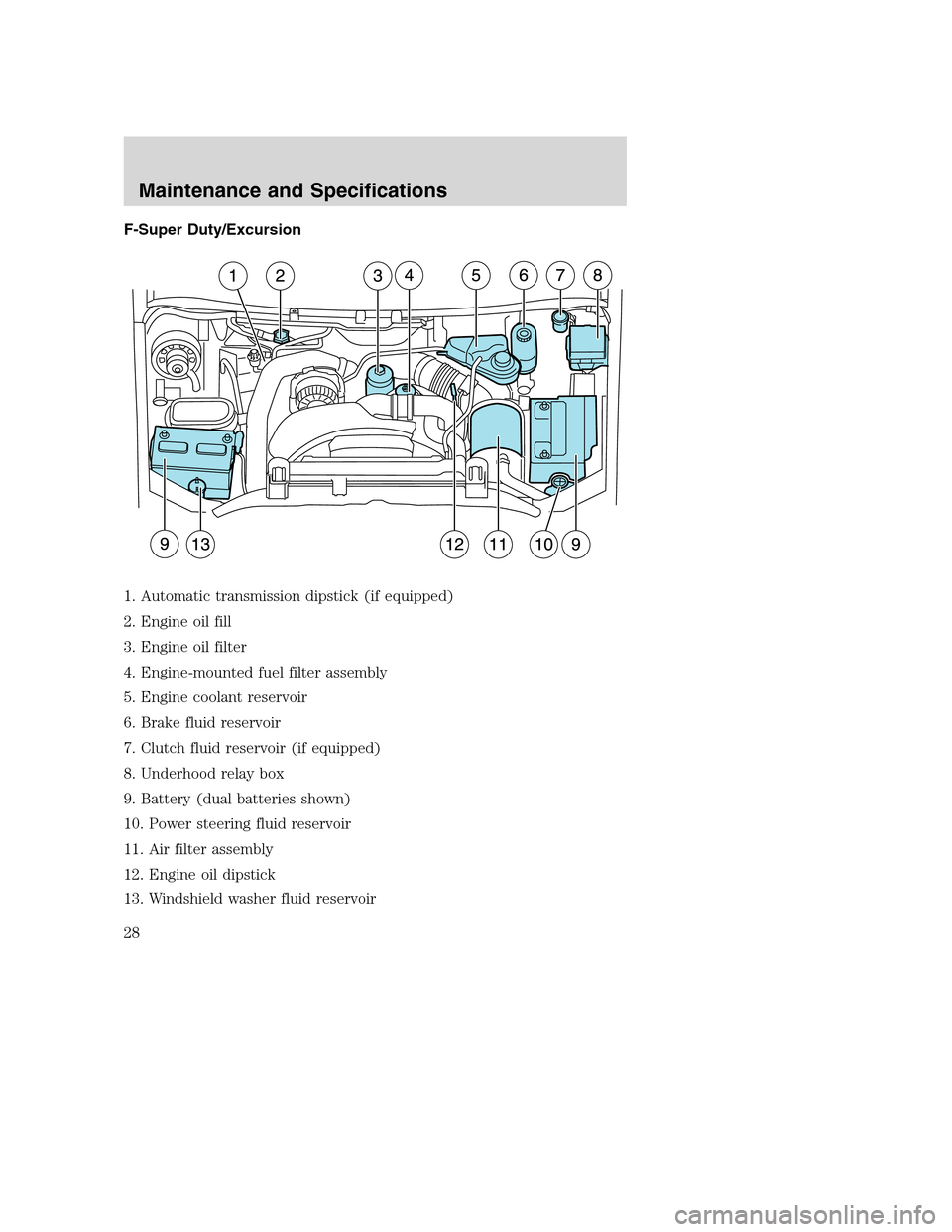
F-Super Duty/Excursion
1. Automatic transmission dipstick (if equipped)
2. Engine oil fill
3. Engine oil filter
4. Engine-mounted fuel filter assembly
5. Engine coolant reservoir
6. Brake fluid reservoir
7. Clutch fluid reservoir (if equipped)
8. Underhood relay box
9. Battery (dual batteries shown)
10. Power steering fluid reservoir
11. Air filter assembly
12. Engine oil dipstick
13. Windshield washer fluid reservoir
Maintenance and Specifications
28