2005 FORD ESCAPE lock
[x] Cancel search: lockPage 139 of 272
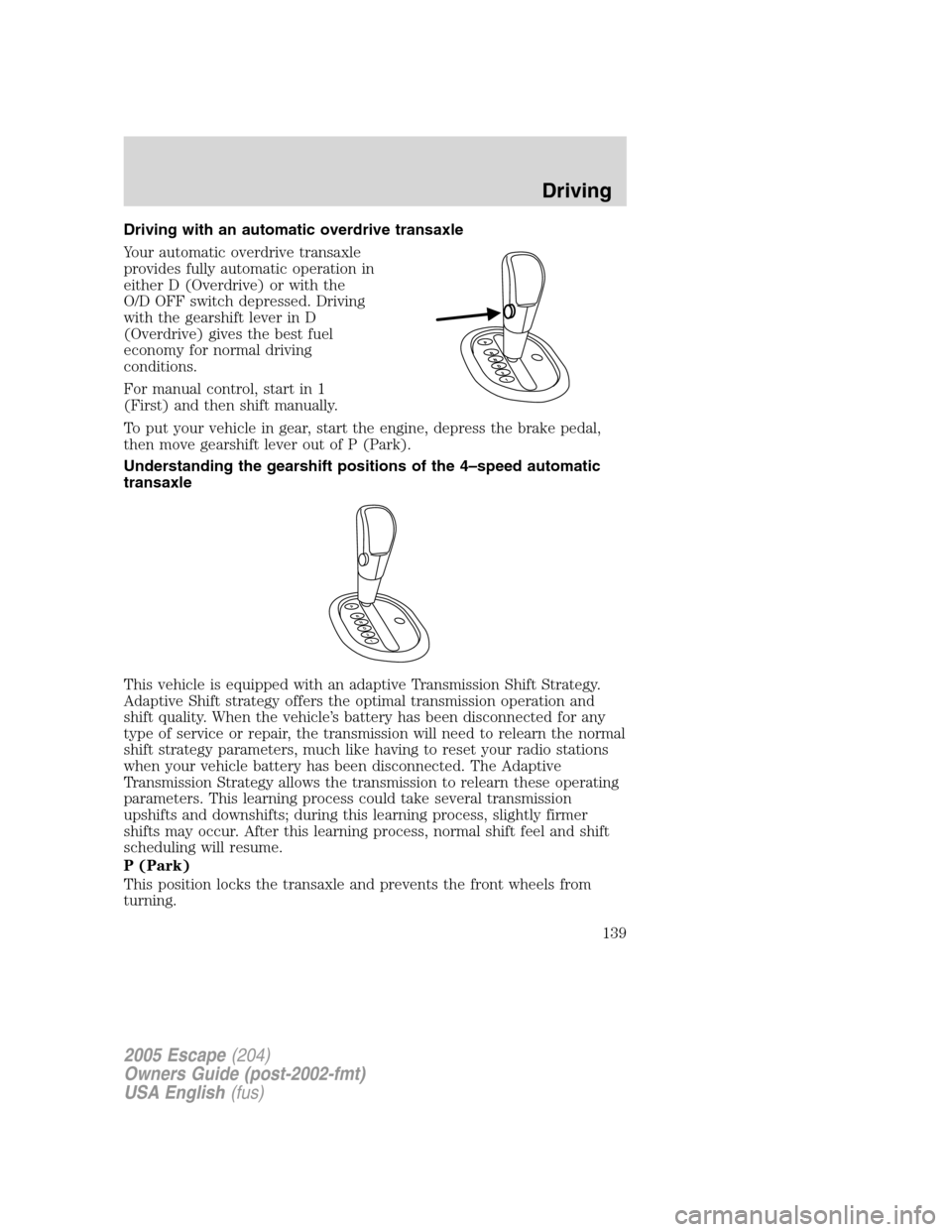
Driving with an automatic overdrive transaxle
Your automatic overdrive transaxle
provides fully automatic operation in
either D (Overdrive) or with the
O/D OFF switch depressed. Driving
with the gearshift lever in D
(Overdrive) gives the best fuel
economy for normal driving
conditions.
For manual control, start in 1
(First) and then shift manually.
To put your vehicle in gear, start the engine, depress the brake pedal,
then move gearshift lever out of P (Park).
Understanding the gearshift positions of the 4–speed automatic
transaxle
This vehicle is equipped with an adaptive Transmission Shift Strategy.
Adaptive Shift strategy offers the optimal transmission operation and
shift quality. When the vehicle’s battery has been disconnected for any
type of service or repair, the transmission will need to relearn the normal
shift strategy parameters, much like having to reset your radio stations
when your vehicle battery has been disconnected. The Adaptive
Transmission Strategy allows the transmission to relearn these operating
parameters. This learning process could take several transmission
upshifts and downshifts; during this learning process, slightly firmer
shifts may occur. After this learning process, normal shift feel and shift
scheduling will resume.
P (Park)
This position locks the transaxle and prevents the front wheels from
turning.
P
R
N
D
2
1
2005 Escape(204)
Owners Guide (post-2002-fmt)
USA English(fus)
Driving
139
Page 140 of 272

To put your vehicle in gear:
•Start the engine
•Depress the brake pedal
•Move the gearshift lever into the desired gear
To put your vehicle in P (Park):
•Come to a complete stop
•Move the gearshift lever and securely latch it in P (Park)
Always set the parking brake fully and make sure the gearshift is
latched in P (Park). Turn the ignition to the LOCK position and
remove the key whenever you leave your vehicle.
R (Reverse)
With the gearshift lever in R (Reverse), the vehicle will move backward.
Always come to a complete stop before shifting into and out of R
(Reverse).
N (Neutral)
With the gearshift lever in N (Neutral), the vehicle can be started and is
free to roll. Hold the brake pedal down while in this position.
D (Overdrive)
The normal driving position for the
best fuel economy. Transaxle
operates in gears one through four.
D (Overdrive) can be deactivated by
pressing the O/D OFF switch on the
side of the gearshift lever. This will
illuminate the O/D OFF light and
activate Drive.
Drive (O/D OFF switch pressed)
Drive is activated when the O/D OFF switch is pressed.
•This position allows for all forward gears except overdrive.
•O/D OFF light is illuminated.
•Provides engine braking.
•Use when driving conditions cause excessive shifting from O/D to
other gears. Examples: city traffic, hilly terrain, heavy loads, trailer
towing and when engine braking is required.
2005 Escape(204)
Owners Guide (post-2002-fmt)
USA English(fus)
Driving
140
Page 142 of 272
Do not rock the vehicle for more than a minute or damage to the
transmission and tires may occur, or the engine may overheat.
MANUAL TRANSAXLE OPERATION (IF EQUIPPED)
Using the clutch
Vehicles equipped with a manual transaxle have a starter interrupt
interlock that prevents cranking of the engine unless the clutch pedal is
depressed.
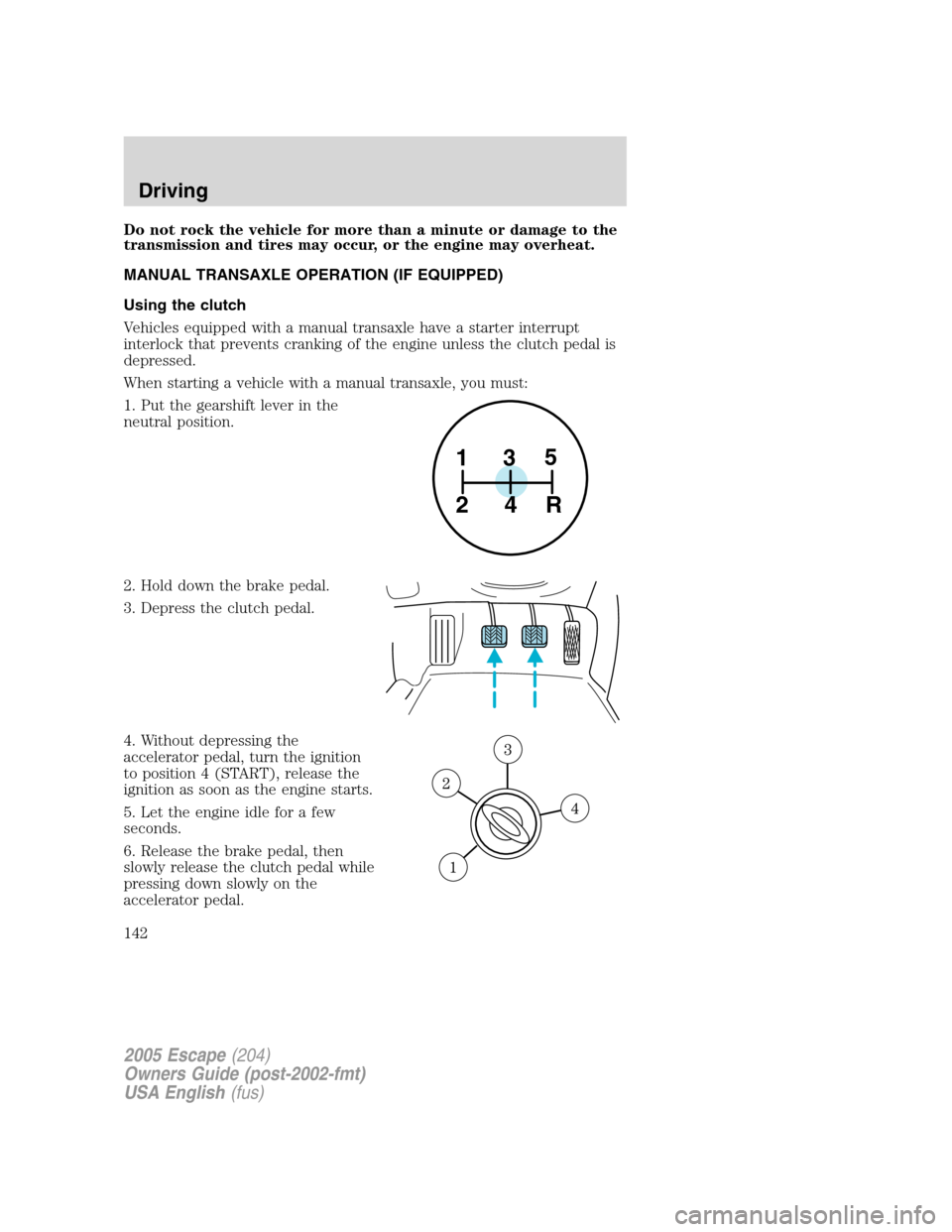
When starting a vehicle with a manual transaxle, you must:
1. Put the gearshift lever in the
neutral position.
2. Hold down the brake pedal.
3. Depress the clutch pedal.
4. Without depressing the
accelerator pedal, turn the ignition
to position 4 (START), release the
ignition as soon as the engine starts.
5. Let the engine idle for a few
seconds.
6. Release the brake pedal, then
slowly release the clutch pedal while
pressing down slowly on the
accelerator pedal.
1
24R35
2005 Escape(204)
Owners Guide (post-2002-fmt)
USA English(fus)
Driving
142
Page 143 of 272
Do not drive with your foot resting on the clutch pedal and do
not use the clutch pedal to hold your vehicle at a standstill while
waiting on a hill. These actions will seriously reduce clutch life.
Recommended shift speeds
Upshift according to the following charts for best fuel economy:
Upshifts when accelerating (recommended for best fuel
economy)
1-2 22 km/h (14 mph)
2-3 40 km/h (25 mph)
3-4 55 km/h (34 mph)
4-5 70 km/h (44 mph)
Upshifts when cruising (recommended for best fuel economy)
1-2 19 km/h (12 mph)
2-3 31 km/h (19 mph)
3-4 46 km/h (29 mph)
4-5 61 km/h (38 mph)
Reverse
Make sure that your vehicle is at a complete stop before you shift
into R (Reverse). Failure to do so may damage the transaxle.
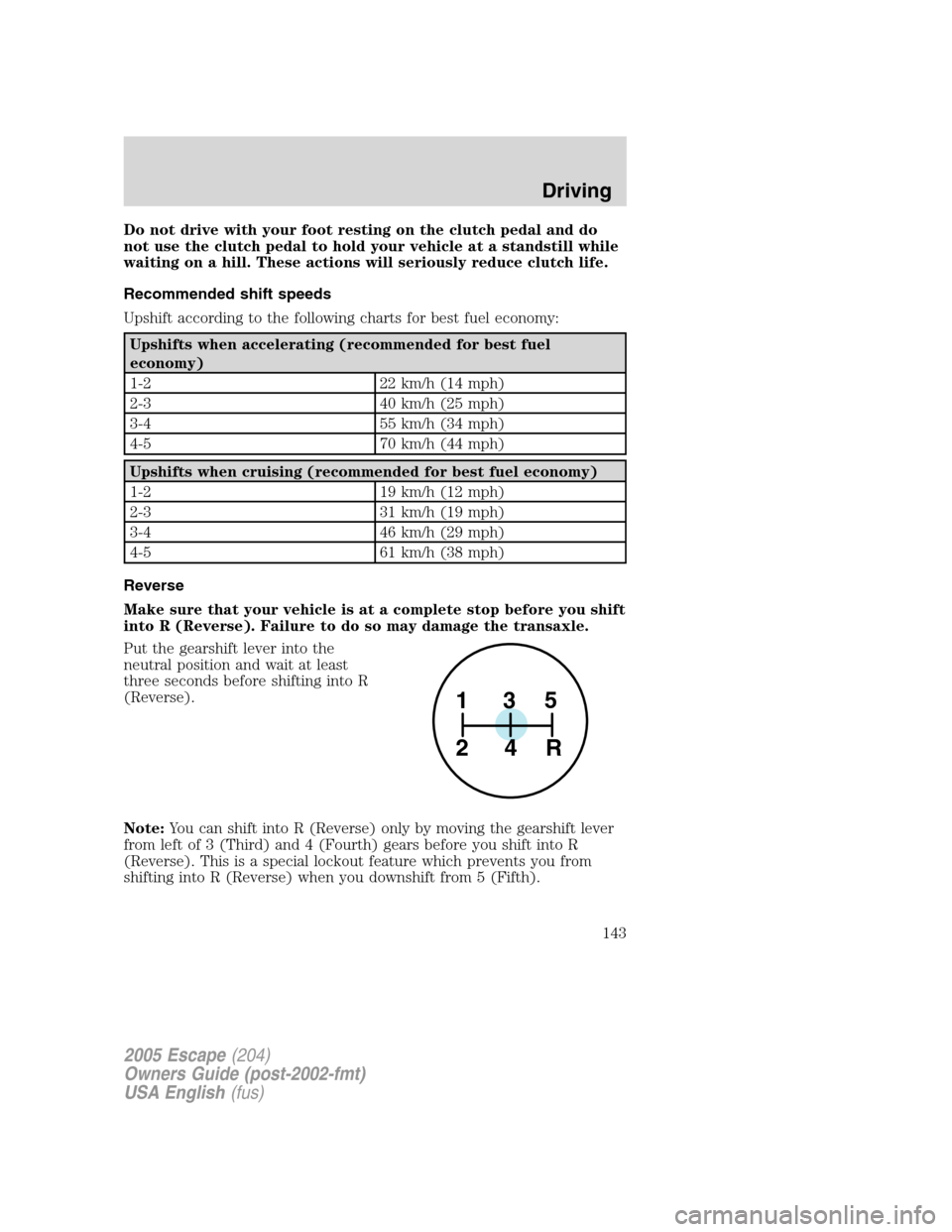
Put the gearshift lever into the
neutral position and wait at least
three seconds before shifting into R
(Reverse).
Note:You can shift into R (Reverse) only by moving the gearshift lever
from left of 3 (Third) and 4 (Fourth) gears before you shift into R
(Reverse). This is a special lockout feature which prevents you from
shifting into R (Reverse) when you downshift from 5 (Fifth).
1
24R35
2005 Escape(204)
Owners Guide (post-2002-fmt)
USA English(fus)
Driving
143
Page 145 of 272
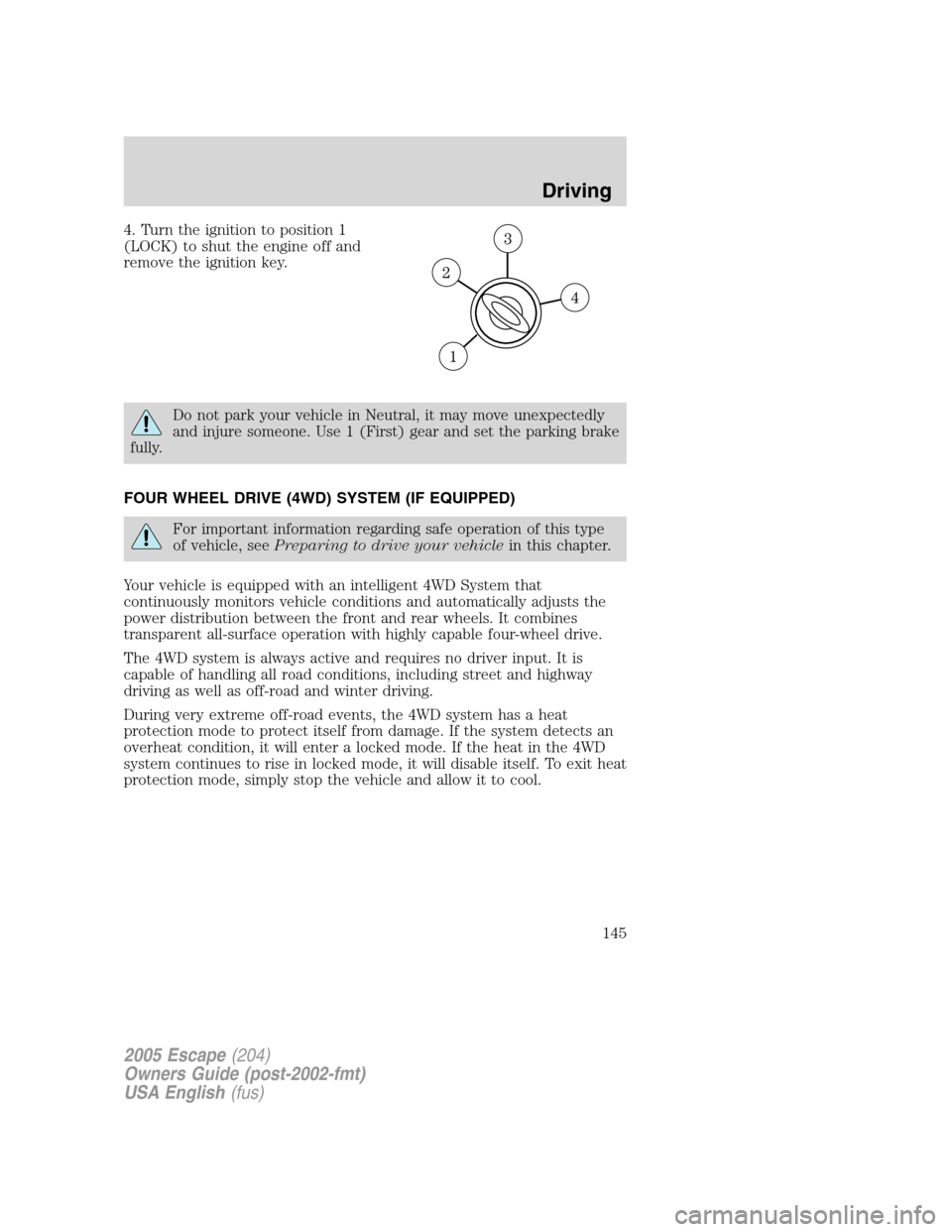
4. Turn the ignition to position 1
(LOCK) to shut the engine off and
remove the ignition key.
Do not park your vehicle in Neutral, it may move unexpectedly
and injure someone. Use 1 (First) gear and set the parking brake
fully.
FOUR WHEEL DRIVE (4WD) SYSTEM (IF EQUIPPED)
For important information regarding safe operation of this type
of vehicle, seePreparing to drive your vehiclein this chapter.
Your vehicle is equipped with an intelligent 4WD System that
continuously monitors vehicle conditions and automatically adjusts the
power distribution between the front and rear wheels. It combines
transparent all-surface operation with highly capable four-wheel drive.
The 4WD system is always active and requires no driver input. It is
capable of handling all road conditions, including street and highway
driving as well as off-road and winter driving.
During very extreme off-road events, the 4WD system has a heat
protection mode to protect itself from damage. If the system detects an
overheat condition, it will enter a locked mode. If the heat in the 4WD
system continues to rise in locked mode, it will disable itself. To exit heat
protection mode, simply stop the vehicle and allow it to cool.
2005 Escape(204)
Owners Guide (post-2002-fmt)
USA English(fus)
Driving
145
Page 146 of 272

4WD system indicator lights
Indicator light - Type A
Indicator light - Type B
•Illuminatescontinuously when 4WD system is locked (i.e. permanent
four wheel drive) due to heat protection mode.
•Blinks continuouslywhen 4WD system is disengaged (i.e. two wheel
drive) due to heat protection mode.
•Blinks several times every minutewhen 4WD system requires
service. Please bring your vehicle to your local dealer for service.
4WD system messages in Message Center (if equipped)
•SERVICE 4X4orSERVICE 4WD
Displayed when 4WD system requires service. Please bring your
vehicle to your local dealer for service.
•4X4 LOCKED TEMPORARILYor4WD LOCKED TEMPORARILY
Displayed when 4WD system is locked (i.e. permanent four wheel
drive) due to heat protection mode.
•4X4 DISABLED TEMPORARILYor4WD DISABLED
TEMPORARILY
Displayed when 4WD system is disengaged (i.e. two wheel drive) due
to heat protection mode.
•4X4 AUTO RESTOREDor4WD AUTO RESTORED
Displayed when normal 4WD system function is restored when heat
protection mode is exited.
Driving off-road with truck and utility vehicles
4WD vehicles are specially equipped for driving on sand, snow, mud and
rough terrain and have operating characteristics that are somewhat
different from conventional vehicles, both on and off the road.
How your vehicle differs from other vehicles
Truck and utility vehicles can differ from some other vehicles. Your
vehicle may be higher to allow it to travel over rough terrain without
getting hung up or damaging underbody components.
The differences that make your vehicle so versatile also make it handle
differently than an ordinary passenger car.
4x4
2005 Escape(204)
Owners Guide (post-2002-fmt)
USA English(fus)
Driving
146
Page 148 of 272
If your vehicle gets stuck
If your vehicle gets stuck in mud or snow it may be rocked out by
shifting between forward and reverse gears, stopping between shifts, in a
steady pattern. Press lightly on the accelerator in each gear.
Do not rock the vehicle if the engine is not at normal operating
temperature or damage to the transmission may occur.
Do not rock the vehicle for more than a few minutes or damage
to the transmission and tires may occur or the engine may
overheat.
Always set the parking brake fully and make sure the gearshift is
latched in P (Park). Turn the ignition to the LOCK position and
remove the key whenever you leave your vehicle.
If the parking brake is fully released, but the brake warning lamp
remains illuminated, the brakes may not be working properly.
See your dealer or a qualified service technician.
Do not spin the wheels at over 56 km/h (35 mph). The tires may
fail and injure a passenger or bystander.
Emergency maneuvers
•In an unavoidable emergency situation where a sudden sharp turn
must be made, remember to avoid“over-driving”your vehicle, i.e.,
turn the steering wheel only as rapidly and as far as required to avoid
the emergency. Excessive steering will result in less vehicle control,
not more. Additionally, smooth variations of the accelerator and/or
brake pedal pressure should be utilized if changes in vehicle speed are
called for. Avoid abrupt steering, acceleration or braking which could
result in an increased risk of loss of vehicle control, vehicle rollover
and/or personal injury. Use all available road surface to return the
vehicle to a safe direction of travel.
•In the event of an emergency stop, avoid skidding the tires and do not
attempt any sharp steering wheel movements.
2005 Escape(204)
Owners Guide (post-2002-fmt)
USA English(fus)
Driving
148
Page 151 of 272

When climbing a steep slope or hill,
start in a lower gear rather than
downshifting to a lower gear from a
higher gear once the ascent has
started. This reduces strain on the
engine and the possibility of stalling.
If you do stall out, Do not try to
turnaround because you might roll
over. It is better to back down to a
safe location.
Apply just enough power to the wheels to climb the hill. Too much
power will cause the tires to slip, spin or lose traction, resulting in loss of
vehicle control.
Descend a hill in the same gear you
would use to climb up the hill to
avoid excessive brake application
and brake overheating. Do not
descend in neutral; instead,
disengage overdrive or manually
shift to a lower gear. When
descending a steep hill, avoid
sudden hard braking as you could
lose control. When you brake hard,
the front wheels can’t turn and if
they aren’t turning, you won’tbe
able to steer. The front wheels have to be turning in order to steer the
vehicle. Rapid pumping of the brake pedal will help you slow the vehicle
and still maintain steering control.
If your vehicle has anti-lock brakes, apply the brakes steadily. Do not
“pump”the brakes.
Driving on snow and ice
4WD vehicles have advantages over 2WD vehicles in snow and ice but
can skid like any other vehicle.
Should you start to slide while driving on snowy or icy roads, turn the
steering wheel in the direction of the slide until you regain control.
Avoid sudden applications of power and quick changes of direction on
snow and ice. Apply the accelerator slowly and steadily when starting
from a full stop.
Avoid sudden braking as well. Although a 4WD vehicle may accelerate
better than a two-wheel drive vehicle in snow and ice, it won’t stop any
2005 Escape(204)
Owners Guide (post-2002-fmt)
USA English(fus)
Driving
151