Page 152 of 272
faster, because as in other vehicles, braking occurs at all four wheels. Do
not become overconfident as to road conditions.
Make sure you allow sufficient distance between you and other vehicles
for stopping. Drive slower than usual and consider using one of the lower
gears. In emergency stopping situations, avoid locking of the wheels. Use
a“squeeze”technique, push on the brake pedal with a steadily increasing
force which allows the wheels to brake yet continue to roll so that you
may steer in the direction you want to travel. If you lock the wheels,
release the brake pedal and repeat the squeeze technique. If your vehicle
is equipped with a Four Wheel Anti-Lock Brake System (ABS), apply the
brake steadily. Do not“pump”the brakes. Refer to theBrakessection of
this chapter for additional information on the operation of the anti-lock
brake system.
Never drive with chains on the front tires of 4WD vehicles without also
putting them on the rear tires. This could cause the rear to slide and
swing around during braking.
Tires, Replacement Requirements
Do not use a size and type of tire and wheel other than that
originally provided by Ford Motor Company because it can affect
the safety and performance of your vehicle, which could result in an
increased risk of loss of vehicle control, vehicle rollover and/or serious
personal injury or death.
Do not use a size and type of tire and wheel other than that originally
provided by Ford Motor Company because it can affect the safety and
performance of your vehicle, which could lead to loss of vehicle control
or rollover and serious injury. Make sure all tires and wheels on the
vehicle are of the same size, type, tread design and load-carrying
capacity. If you have questions regarding tire replacement, see an
authorized Ford or Lincoln/Mercury dealer.
If you nevertheless decide to equip your 4WD for off-road use with tires
larger than what Ford Motor Company recommends, you should not use
these tires for highway driving.
If you use any tire/wheel combination not recommended by Ford Motor
Company, it may adversely affect vehicle handling and could cause
steering, suspension, axle or transfer case failure as well as the increased
risk of loss of vehicle control.
Do not use“aftermarket lift kits”or other suspension modifications,
whether or not they are used with larger tires and wheels.
2005 Escape(204)
Owners Guide (post-2002-fmt)
USA English(fus)
Driving
152
Page 153 of 272
These“aftermarket lift kits”could adversely affect the vehicle’s handling
characteristics, which could lead to loss of vehicle control or rollover and
serious injury.
Tires can be damaged during off-road use. For your safety, tires that are
damaged should not be used for highway driving because they are more
likely to blow out or fail.
You should carefully observe the recommended tire inflation pressure
found on the safety compliance certification label attached to the left
front door lock facing or door latch post pillar. Failure to follow tire
pressure recommendations can adversely affect the way your vehicle
handles. Do not exceed the Ford Motor Company recommended pressure
even if it is less than the maximum pressure allowed for the tire.
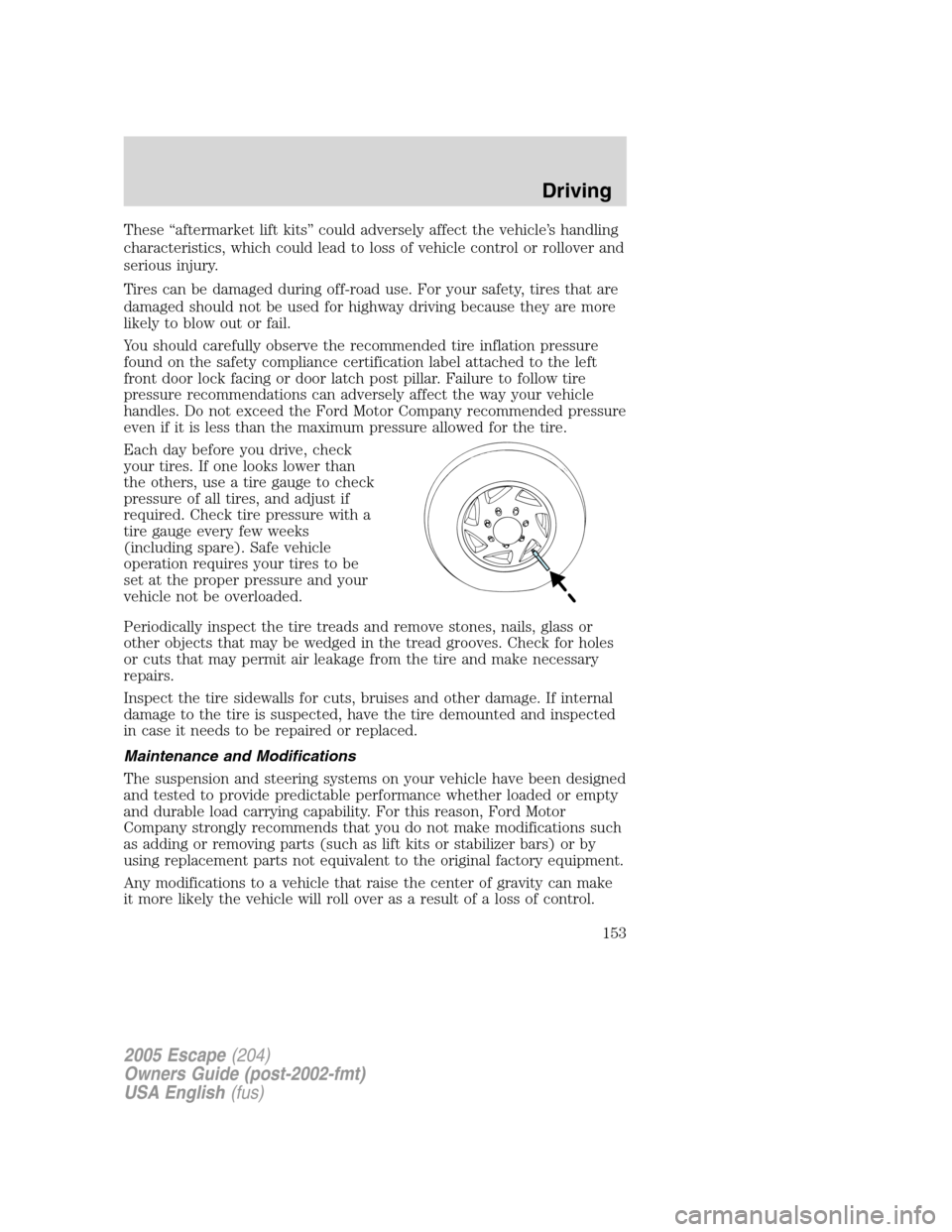
Each day before you drive, check
your tires. If one looks lower than
the others, use a tire gauge to check
pressure of all tires, and adjust if
required. Check tire pressure with a
tire gauge every few weeks
(including spare). Safe vehicle
operation requires your tires to be
set at the proper pressure and your
vehicle not be overloaded.
Periodically inspect the tire treads and remove stones, nails, glass or
other objects that may be wedged in the tread grooves. Check for holes
or cuts that may permit air leakage from the tire and make necessary
repairs.
Inspect the tire sidewalls for cuts, bruises and other damage. If internal
damage to the tire is suspected, have the tire demounted and inspected
in case it needs to be repaired or replaced.
Maintenance and Modifications
The suspension and steering systems on your vehicle have been designed
and tested to provide predictable performance whether loaded or empty
and durable load carrying capability. For this reason, Ford Motor
Company strongly recommends that you do not make modifications such
as adding or removing parts (such as lift kits or stabilizer bars) or by
using replacement parts not equivalent to the original factory equipment.
Any modifications to a vehicle that raise the center of gravity can make
it more likely the vehicle will roll over as a result of a loss of control.
2005 Escape(204)
Owners Guide (post-2002-fmt)
USA English(fus)
Driving
153
Page 154 of 272
Ford Motor Company recommends that caution be used with any vehicle
equipped with a high load or device (such as ladder racks or pickup box
cover).
Failure to maintain your vehicle properly may void the warranty, increase
your repair cost, reduce vehicle performance and operational capabilities
and adversely affect driver and passenger safety. Frequent inspection of
vehicle chassis components is recommended if the vehicle is subjected to
heavy off-road usage.
REVERSE SENSING SYSTEM (IF EQUIPPED)
The Reverse Sensing System (RSS) sounds a tone to warn the driver of
obstacles near the rear bumper when R (Reverse) is selected and the
vehicle is moving at speeds less than 5 km/h (3 mph). The system is not
effective at speeds above 5 km/h (3 mph) and may not detect certain
angular or moving objects.
To help avoid personal injury, please read and understand the
limitations of the reverse sensing system as contained in this
section. Reverse sensing is only an aid for some (generally large and
fixed) objects when moving in reverse on a flat surface at“parking
speeds”. Inclement weather may also affect the function of the RSS;
this may include reduced performance or a false activation.
To help avoid personal injury, always use caution when in
reverse and when using the RSS.
This system is not designed to prevent contact with small or
moving objects. The system is designed to provide a warning to
assist the driver in detecting large stationary objects to avoid damaging
the vehicle. The system may not detect smaller objects, particularly
those close to the ground.
Certain add-on devices such as large trailer hitches, bike or
surfboard racks and any device that may block the normal
detection zone of the RSS system may create false beeps.
2005 Escape(204)
Owners Guide (post-2002-fmt)
USA English(fus)
Driving
154
Page 168 of 272
GETTING ROADSIDE ASSISTANCE
To fully assist you should you have a vehicle concern, Ford Motor
Company offers a complimentary roadside assistance program. This
program is separate from the New Vehicle Limited Warranty. The service
is available:
•24–hours, seven days a week
•for the New Vehicle Limited Warranty period of three years or
60,000 km (36,000 miles), whichever occurs first on Ford and Mercury
vehicles, and four years or 80,000 km (50,000 miles) on Lincoln
vehicles.
Roadside assistance will cover:
•changing a flat tire
•jump-starts
•lock-out assistance
•limited fuel delivery
•towing of your disabled vehicle to the nearest Ford Motor Company
dealership, or your selling dealer if within 56.3 km (35 miles) of the
nearest Ford Motor Company dealership (one tow per disablement).
Even non-warranty related tows, like accidents or getting stuck in the
mud or snow, are covered (some exclusions apply, such as impound
towing or repossession).
Canadian customers refer to your Owner Information Guide for
information on:
•coverage period
•exact fuel amounts
•towing of your disabled vehicle
•emergency travel expense reimbursement
•travel planning benefits
2005 Escape(204)
Owners Guide (post-2002-fmt)
USA English(fus)
Roadside Emergencies
Roadside Emergencies
168
Page 173 of 272
The fuses are coded as follows:
Fuse/Relay
LocationFuse Amp
RatingPassenger Compartment Fuse
Panel Description
1 15A* Trailer tow park lamps
2 5A* Not used
3 15A* Front and rear park lamps
4 10A* Ignition switch
5 2A* Powertrain Control Module (PCM
relay), Fuel pump relay, Main fan
relay, High/Low speed fan relay 2,
PATS module
6 15A* Center High-Mounted Stop Lamp
(CHMSL), Stop lamps, PCM,
Anti-lock Brake System (ABS),
Speed control, Brake On-Off
switch
2005 Escape(204)
Owners Guide (post-2002-fmt)
USA English(fus)
Roadside Emergencies
173
Page 174 of 272
Fuse/Relay
LocationFuse Amp
RatingPassenger Compartment Fuse
Panel Description
7 10A* Instrument cluster, Diagnostic
connector, Power mirror switch,
Radio
8—Not used
9 30A** Power door locks, Power seats
10 15A* Heated mirrors
11 15A* Sunroof
12 5A* Radio
13—Not used
14—Not used
15 30A** Power windows
16 15A* Subwoofer
17 15A* Low beams
18 10A* 4x4
19—Not used
20 15A* Horn
21 10A* Rear wiper motor, Rear wiper
washer
22 10A* Electrochromatic mirror,
Instrument cluster
23 5A* Not used
24 20A* Cigar lighter
25 20A* Front wiper motor, Front wiper
washer
26 5A* Climate control system mode
switch
27 5A* Canister vent, Speed control
cancel switch
28 10A* Instrument cluster
29 10A* Reverse park aid
30 5A* Not used
31—Not used
2005 Escape(204)
Owners Guide (post-2002-fmt)
USA English(fus)
Roadside Emergencies
174
Page 175 of 272
Fuse/Relay
LocationFuse Amp
RatingPassenger Compartment Fuse
Panel Description
32 10A* Brake-Transmission shift lock
33 15A* Air bag module, Passenger Air bag
Deactivation (PAD) indicator
lamp, Occupant Classification
Sensor (OCS)
34 5A* ABS module, Evac and Fill, Speed
control
35 5A* Heated seats module, 4x4
* Mini fuse ** Cartridge fuse
Power distribution box
The power distribution box is
located in the engine compartment.
The power distribution box contains
high-current fuses that protect your
vehicle’s main electrical systems
from overloads.
Always disconnect the battery before servicing high current
fuses.
To reduce risk of electrical shock, always replace the cover to
the Power Distribution Box before reconnecting the battery or
refilling fluid reservoirs.
If the battery has been disconnected and reconnected, refer to the
Batterysection of the chapter.
2005 Escape(204)
Owners Guide (post-2002-fmt)
USA English(fus)
Roadside Emergencies
175
Page 176 of 272
The high-current fuses are coded as follows.
Fuse/Relay
LocationFuse Amp
RatingPower Distribution Box
Description
1 25A* I/P fuse panel (RUN/START)
2 25A* Headlamp power
3 25A* High beams, Turn signals, Interior
lamps, Headlamp power
4 5A* Keep Alive Power (KA PWR)
5 15A* Heated Exhaust Gas Oxygen
(HEGO) sensors
6 20A* Fuel pump
7 40A** RUN/ACC relay -
Electrochromatic mirror, Cigar
lighter, Front and rear wipers
8 30A** Powertrain Control Module
(PCM), Injectors and coil
9 15A* Alternator
10 30A* Heated seats
11 10A* PCM
12 20A* Power point #1
13 20A* Fog lamps
14 15A* A/C clutch, A/C relay
1530A* Anti-lock Brake System (ABS)
solenoid
17 50A** Ignition (main)
18 40A** Blower motor
2005 Escape(204)
Owners Guide (post-2002-fmt)
USA English(fus)
Roadside Emergencies
176


