2005 FIAT DUCATO 244 electro
[x] Cancel search: electroPage 116 of 258
115GETTING THE BEST OUT OF YOUR VEHICLE
Moving the lever back to position D
the gearbox instantly resumes the au-
tomatic mode selecting the ratio ac-
cording to the driving characteristics.
IMPORTANTThe electronic con-
trol unit is programmed to change
gear one at a time, therefore repeat-
ed fast actuations will not result in re-
peated engagements of the gears. The
higher or lower gear is engaged mov-
ing the lever to the (+) or (–) position
when the previous request has been
performed.
In the event of a fault to the sequen-
tial manual system, the system will se-
lect the automatic mode.FAILURE INDICATIONS
Automatic gearbox faults are indi-
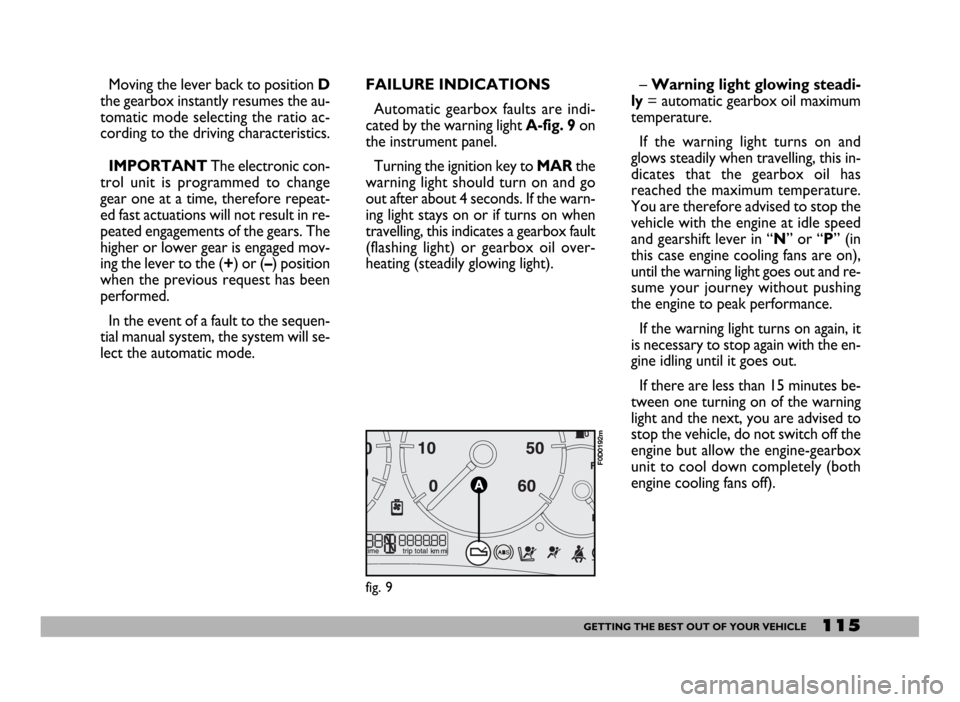
cated by the warning light A-fig. 9 on
the instrument panel.
Turning the ignition key to MARthe
warning light should turn on and go
out after about 4 seconds. If the warn-
ing light stays on or if turns on when
travelling, this indicates a gearbox fault
(flashing light) or gearbox oil over-
heating (steadily glowing light).– Warning light glowing steadi-
ly= automatic gearbox oil maximum
temperature.
If the warning light turns on and
glows steadily when travelling, this in-
dicates that the gearbox oil has
reached the maximum temperature.
You are therefore advised to stop the
vehicle with the engine at idle speed
and gearshift lever in “N” or “P” (in
this case engine cooling fans are on),
until the warning light goes out and re-
sume your journey without pushing
the engine to peak performance.
If the warning light turns on again, it
is necessary to stop again with the en-
gine idling until it goes out.
If there are less than 15 minutes be-
tween one turning on of the warning
light and the next, you are advised to
stop the vehicle, do not switch off the
engine but allow the engine-gearbox
unit to cool down completely (both
engine cooling fans off).
fig. 9
F0D0192m
Page 118 of 258
117GETTING THE BEST OUT OF YOUR VEHICLE
CONSTRUCTION FEATURES
DUCATO automatic gearbox is con-
trolled electronically with four for-
ward gears and reverse.
It is controlled by an electronic con-
trol unit which handles:
– the torque distributor;
– gearshifting;
– specific programmes.
The gearbox is coupled with a flow
power torque distributor with piloted
antislip device which makes it possible
to obtain demultiplication ratios.
The characteristic of this gearbox
which works without idle gear enables:
– higher compactness and weight re-
duction;
– improved output due to less fric-
tion;
– lower stress of transmission com-
ponents.GENERAL FEATURES
Electronic gearbox control makes it
possible to obtain gearshifting suited
to momentary engine characteristics
with a certain elasticity.
The electronic control unit has the
following task:
– adapting the oil pressure for
gearshifting to the engine torque;
– activating safety functions;
– defining the manual gearshifting
programme;
– system diagnostics.
For controlling these operating log-
ics the control unit uses the follow-
ing signals:
– engine rpm;
– engine temperature;
– engine torque;
– vehicle speed;
– gearbox oil temperature;– gearshift lever position;
– accelerator pedal position;
– brake pedal position.
The control unit also communicates
with the injection system electronic
control unit.
Conditions of use analysed by
the control unit
The control unit analyses each single
condition of use of the vehicle, dis-
criminating it on the basis of the sig-
nals received from the various sensors.
Analysed conditions are the follow-
ing:
– starting (position/accelerator ped-
al changing speed);
– acceleration (accelerator pedal
completely pushing down speed);
– full load (number of engine full load
kickdown signals or position mainte-
nance time);
Page 119 of 258
118GETTING THE BEST OUT OF YOUR VEHICLE
– braking (accelerator pedal release
time and braking system operation);
– type of programme (gearshift se-
lector lever position);
– winter driving (driving wheel
torque reduction);
– driving with trailer or uphill (vehi-
cle speed in relation to transmitted
torque)
– driving downhill (vehicle accelera-
tion in relation to the position of the
accelerator pedal);
– driving in towns or queues (accel-
erator pedal position and vehicle
speed);
– gear required by the driver
(gearshift lever position);
– cold starting (engine temperature).Gearshift programme control
To optimise vehicle handling the
electronic control unit has the fol-
lowing memorised programmes:
– automatic operation;
– manual operation;
– winter driving (to be selected
through buttonWINTER);
– engine warming up;
– protection against excessive gear-
box oil temperature .Automatic programme
This comprises 16 gearshifting pro-
grammes.
In relation to the vehicle speed and
torque transmitted, the control unit
detects the slope of the road surface
and depending on the sporty features
chosen, it autonomously chooses the
programme most suited to the situa-
tion.
During gearshifting, the gearbox con-
trol unit asks the injection control unit
to momentarily reduce the torque.
The duration of torque reduction
varies depending on the travelling con-
ditions.
Page 135 of 258
134GETTING THE BEST OUT OF YOUR VEHICLE
VEHICLE STORAGE
The following precautions should be
taken if the vehicle will not be used for
several months:
– park the vehicle in covered, dry and
if possible well-ventilated premises;
– engage a gear;
– remove the cables from the battery
(first remove the cable to the negative
terminal) and check the battery
charge. If the vehicle is to be stored
for long periods the charge of the bat-
tery should be checked every month
and recharged if it falls below 12.5 V;– make sure the handbrake is not en-
gaged;
– clean and protect the painted parts
using protective wax;
– clean and protect the shiny metal
parts using special compounds readi-
ly available;
– sprinkle talcum powder on the rub-
ber windscreen and rear window
wiper blades and lift them off the glass;
– slightly open the windows;
– cover the vehicle with a cloth or
perforated plastic sheet. Do not use
sheets of non-perforated plastic as
they do not allow moisture on the ve-
hicle body to evaporate;– inflate the tyres to 0.5 bar above
the normal specified pressure and
check it at intervals;
– do not drain the engine cooling sys-
tem.
IMPORTANTWhere relevant,
switch off the electronic vehicle alarm
with the remote control and deacti-
vate the system by turning the emer-
gency key to OFF (see “Electronic
alarm” in section “Getting to know
your vehicle”).
Page 136 of 258

135IN AN EMERGENCY
I I
N N
A A
N N
E E
M M
E E
R R
G G
E E
N N
C C
Y Y
EMERGENCY
START-UP
DIESEL VERSIONS
Emergency start-ups cannot be per-
formed on versions with a diesel en-
gine; contact aFiat Dealership.
PETROL VERSIONS
If the Fiat CODE cannot deactivate
the engine immobiliser, the Yand
Uwarning lights stay on and the en-
gine will not start. Follow the emer-
gency start-up procedure to start the
engine.
Read the whole procedure care-
fully before trying to carry it out.
If you make a mistake, you must turn
the ignition key back to STOPand re-
peat the whole operation from the be-
ginning (step 1).1) Read the 5-figure electronic code
given on the CODE card.
2) Turn the ignition key to MAR.
3)Press and hold down the accel-
erator pedal. Warning light
Uwill
come on for about 8 seconds, and
then go out. At this point release the
accelerator pedal and get ready to
count the flashes of the warning light
U.
4) Count the number of flashes that
corresponds to the first figure of the
code on the CODE card, then press
the accelerator pedal and keep it there
until the warning light
Ucomes on
for four seconds and then goes out;
release the accelerator pedal.
5) Warning light
Uwill start flash-
ing again: after it has flashed the num-
ber of times that corresponds to the
second figure on the CODE card,
press the accelerator pedal and keep
it pressed.
6) Do the same for the remaining fig-
ures on the CODE card.7) Once the final figure has been en-
tered, keep the accelerator pedal
pressed. Warning light
Uwill light up
for four seconds and then go out; re-
lease the accelerator pedal.
8)Warning light
Uwill flash rapid-
ly for about 4 seconds to indicate that
the operation has been completed
correctly.
9) Start the engine by turning the ig-
nition key from MARto AVV.
If, however, the warning light
U
stays on, turn the ignition key to
STOPan repeat the procedure from
step 1).
IMPORTANT After an emergency
start-up, you should contact a Fiat
Dealership otherwise you will have
to repeat the procedure described
each time you want to start the en-
gine.
Page 166 of 258

165VEHICLE MAINTENANCE
ANNUAL
INSPECTION
SCHEDULE
The following annual inspection
schedule is required for vehicles trav-
elling 15,000 Kmapprox. a year. The
schedule includes the following oper-
ations:
– check tyre condition and wear and
adjust pressure, if required (including
spare wheel);
– check operation of lights (head-
lights, direction indicators, hazard
lights, boot light, passenger compart-
ment light, instrument panel lights,
etc.);
– check windscreen wiper/washer
and adjust nozzles;
– check position and wear of wind-
screen/rear window wiper blades;
– check front pad conditions and
wear;
– check for bonnet and boot lock
cleanness, lever cleanness and lubri-
cation;– inspect conditions of: engine, gear-
box, transmission, piping (exhaust, fu-
el feed, brakes), rubber parts (boots,
sleeves, bushings, etc.), brake and fu-
el line hoses;
– check battery charge status;
– check conditions of various control
belts;
– check and top up fluid levels (en-
gine coolant, brakes, windscreen
washer, battery, etc.);
– check and top up engine oil;
– replace pollen filter.
ADDITIONAL
CHECKS
Every 1,000 km or before long
trips, check and top up as necessary:
– engine coolant level
– brake fluid level
– power steering fluid level
– battery electrolyte level
– windscreen washer fluid
– tyre pressure and conditions.
Every 3,000 km or before long
trips, check and top up as necessary:
engine oil
Every 10,000 kmor at cwarning
light coming on (diesel engines only):
bleed water from fuel filter.
You are recommended to use FL
Seleniaproducts designed and pro-
duced for Fiat vehicles (see the “Ca-
pacities” table in the “Technical Spec-
ifications” section).
Page 167 of 258

166VEHICLE MAINTENANCE
IMPORTANT - Pollen filter
If the vehicle is often used in dusty
or extremely polluted environments,
you should change the filter element
more frequently. It should be changed
especially if the amount of air intro-
duced into the passenger compart-
ment has decreased.
IMPORTANT - Diesel filter
Refuelling with diesel fuel not com-
plying with the grade of purity pre-
scribed by European Specification
EN590 might make it necessary to re-
place the filter more frequently than
indicated in the Service Schedule.
IMPORTANT - Battery
The charge in your battery should be
checked, where possible at the start
of the winter, to limit the risk of the
battery electrolyte freezing.
This check should be carried out
more frequently if the vehicle is mainly
used for short trips or if it is fitted
with accessories that permanently
take in electricity even when the igni-
tion key is removed, especially in the
case of after market accessories.You should check the battery fluid
(electrolyte) level more frequently
than shown in the Service Schedule if
the vehicle is used in hot climates or
particularly demanding conditions.
IMPORTANTAs concerns Camp-
ing Car versions, due to high electric
absorption, observe indications rele-
vant to battery contained in para-
graphs "Vehicle storage" (section
"Getting the best out of your vehicle")
and "Battery – Checking the charge"
(section "Vehicle maintenance").
Maintenance of your ve-
hicle should be entrusted
to a Fiat Dealership. For
ordinary routine maintenance
operations which you are able to
carry out yourself, ensure that
you have the necessary tools and
original Fiat spare parts and flu-
ids available. Do not carry out
servicing operations if you have
no experience.IMPORTANT - Engine oil
Change the engine oil more fre-
quently than shown in the Service
Schedule if the vehicle is normally dri-
ven in one of the following particular-
ly severe conditions:
– towing a trailer
– on dusty roads
– short distances (less than 7-8 km)
repeated and with external tempera-
tures below zero.
– frequently idling engines or long
distance low speed driving (e. g. taxis
or door-to-door deliveries) or in case
of a long term inactivity replace engine
oil more frequently than required on
Scheduled Maintenance Plan.
IMPORTANT - Air cleaner
Replace the air cleaner more fre-
quently if the vehicle is used on dusty
roads.
If you are in doubt about how often
the engine oil or the air cleaner should
be changed in relation to how you use
the vehicle, contact a Fiat Dealer-
ship.
Page 175 of 258

174VEHICLE MAINTENANCE
REPLACING THE BATTERY
If required, replace the battery with
a genuine spare part presenting the
same specifications. If a battery with
different specifications is fitted, the fre-
quencies shown in the “Service Sched-
ule” will no longer be valid. Refer to
the instructions provided by the bat-
tery manufacturer.
Batteries contain sub-
stances that are very
harmful for the environ-
ment. You are advised to have the
battery changed at a Fiat Dealer-
ship. It is properly equipped for
disposing of used batteries in an
environmentally-friendly way that
complies with the law.
Incorrect fitting of elec-
trical and electronic ac-
cessories can seriously
damage the vehicle. If you want
to add accessories after buying
the vehicle antitheft system, ra-
dio, free-hand phone kit, etc.) vis-
it a Fiat Dealership. They can sug-
gest the most suitable acces-
sories to get and check whether
the electric system can support
the required load or whether a
higher capacity battery is re-
quired.
The liquid in the battery is
poisonous and corrosive.
Do not let it touch the skin or eyes.
Do not bring naked flames or pos-
sible sources or sparks near the bat-
tery: risk of fire and explosion.
WARNING
fig. 15
F0D0244m
BATTERY
Fiat Ducato battery is of the “Limit-
ed maintenance” and is fitted with in-
dicator A-fig. 15to check the elec-
trolyte level and the charge.
Under normal conditions of use it
does not require topping up with dis-
tilled water. However, check it peri-
odically through the control optical in-
dicator that is placed on the battery
cover and must be dark with a cen-
tral green area.
If the indicator is a bright colour, or
dark without the green central area,
contact a Fiat Dealership.