2005 FIAT DUCATO 244 electro
[x] Cancel search: electroPage 31 of 258

30GETTING TO KNOW YOUR VEHICLE
INSTRUMENTS
ENGINE COOLANT
TEMPERATURE
GAUGE fig. 29
Under normal conditions, the needle
should hover around the middle of the
scale.
If it approaches the red section, it
means that the engine is being over-
taxed and you should reduce your de-
mand on it.
Also travelling too slowly when the
outside temperature is very hot can
cause the needle to approach the red
sector. In this case, it is better to stop
and turn the engine off. After a few
moments you can start the engine
again and accelerate slightly.SPEEDOMETER
fig. 30- left-hand drive versions
fig. 31- right-hand drive versions.
REV COUNTER fig. 32
IMPORTANT The electronic sys-
tem progressively blocks fuel flow to
prevent engine from overrevving. This
will lead to a progressive loss of en-
gine power. If the situation persists
even after the measures
you have taken, turn off
the engine and have the vehicle
seen at a Fiat Dealership.
fig. 29
F0D0150m
fig. 30
F0D0149m
fig. 31
F0D0153m
fig. 32
F0D0151m
Page 40 of 258
39GETTING TO KNOW YOUR VEHICLE
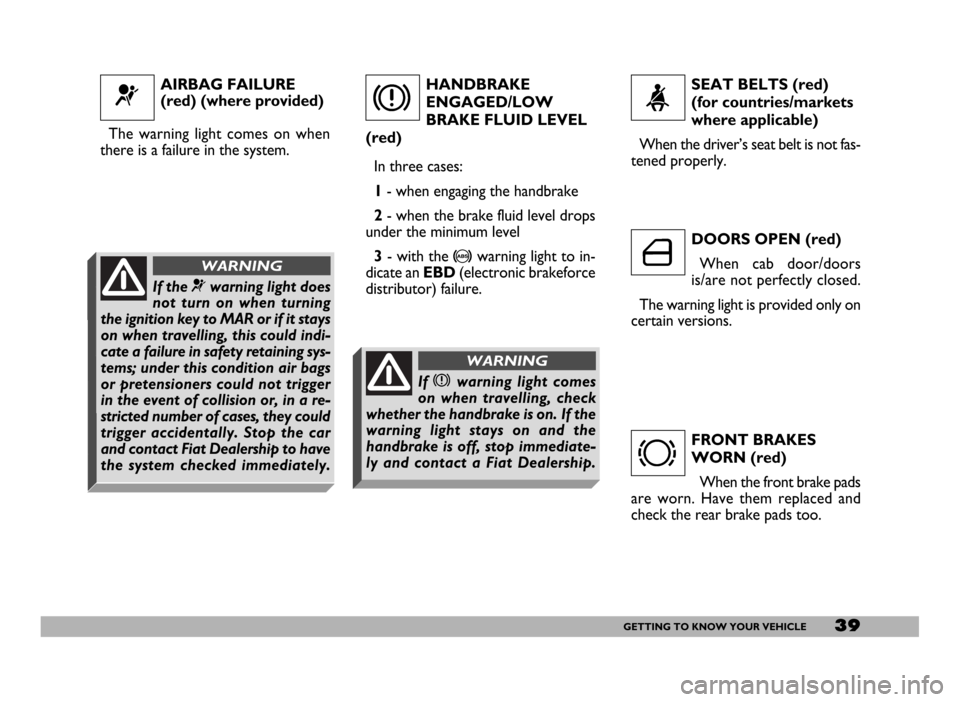
AIRBAG FAILURE
(red) (where provided)
The warning light comes on when
there is a failure in the system.
¬
HANDBRAKE
ENGAGED/LOW
BRAKE FLUID LEVEL
(red)
In three cases:
1- when engaging the handbrake
2- when the brake fluid level drops
under the minimum level
3- with the
>warning light to in-
dicate an EBD(electronic brakeforce
distributor) failure.SEAT BELTS (red)
(for countries/markets
where applicable)
When the driver’s seat belt is not fas-
tened properly.
DOORS OPEN (red)
When cab door/doors
is/are not perfectly closed.
The warning light is provided only on
certain versions.
FRONT BRAKES
WORN (red)
When the front brake pads
are worn. Have them replaced and
check the rear brake pads too.
x<
´
d
If the ¬warning light does
not turn on when turning
the ignition key to MAR or if it stays
on when travelling, this could indi-
cate a failure in safety retaining sys-
tems; under this condition air bags
or pretensioners could not trigger
in the event of collision or, in a re-
stricted number of cases, they could
trigger accidentally. Stop the car
and contact Fiat Dealership to have
the system checked immediately.
WARNING
If xwarning light comes
on when travelling, check
whether the handbrake is on. If the
warning light stays on and the
handbrake is off, stop immediate-
ly and contact a Fiat Dealership.
WARNING
Page 41 of 258

40GETTING TO KNOW YOUR VEHICLE
WATER IN DIESEL
FUEL (amber)
(diesel versions)
When there is water in the diesel fil-
ter. The light should come on when
the ignition key is turned to MAR and
go out after a few seconds.ABS (WHEEL
ANTILOCKING
SYSTEM)
FAILURE (amber)
The warning light comes on when
there is a failure in the ABS system. In
this case, the normal braking system
continues to work although without
the ABS assistance but you should
have the vehicle seen to at a Fiat
Dealershipas soon as possible.
The warning light should come on
when the ignition key is turned to
MARand should go out after ap-
proximately 2 seconds.
c
The presence of water in
diesel fuel can cause se-
vere damage to the en-
gine fuel feed system. Conse-
quently, you should go to a Fiat
Dealership as soon as the
c
warning light comes on to have
the system relieved. Warning
light coming on immediately af-
ter refuelling probably indicates
the presence of water in the tank:
turn the engine off and contact a
Fiat Dealership.
>
FIAT CODE
(amber)
The warning light comes on in three
cases (when the ignition key is at
MAR):
1.One flash - the key code has been
recognised. The engine can be start-
ed.
2.Fixed light - the key code has not
been recognised. Follow the emer-
gency procedure to start the engine
(see “In an emergency”).
3. Flashing - the vehicle is not pro-
tected by the device. The engine can
however be started.
Y
Vehicles with ABS are fitted
with electronic brakeforce
distributor (EBD). The >and x
warning lights come on at the same
time when the engine is running to
indicate that there is an EBD sys-
tem failure. In this case violent
braking may be accompanied by
early rear wheel locking with the
possibility of skidding. Drive ex-
tremely carefully to the nearest Fi-
at Dealership to have the system
checked.
WARNING
Page 61 of 258
60GETTING TO KNOW YOUR VEHICLE
– a control unit connected to the
heater/ventilation unit for automatic
operation;
– an electronic control unit to check
and adjusted the integrated heater
burner;
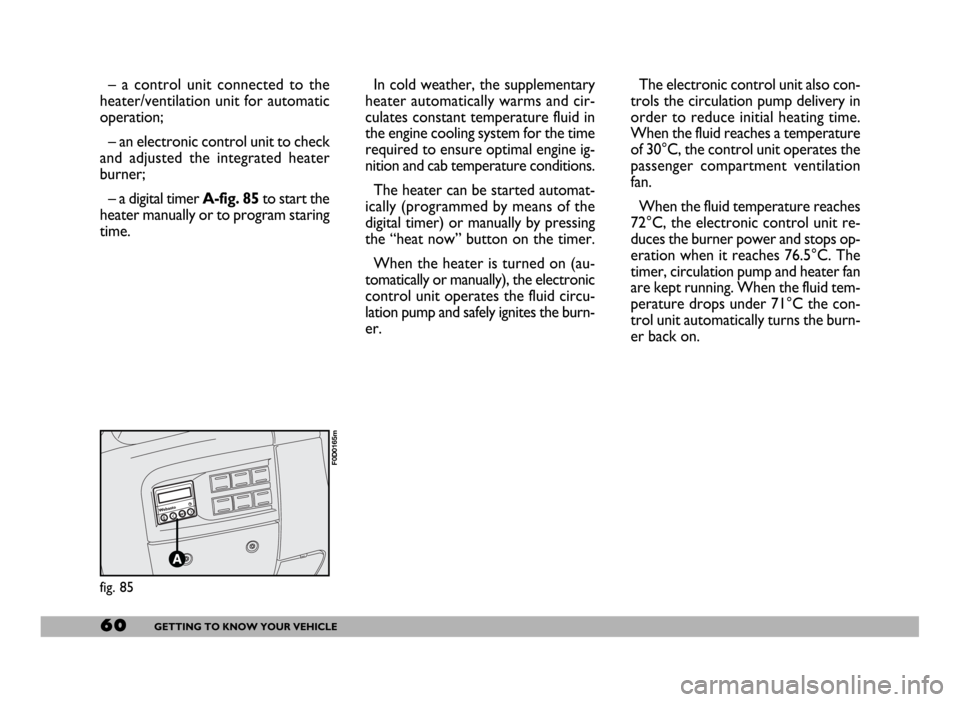
– a digital timer A-fig. 85to start the
heater manually or to program staring
time.In cold weather, the supplementary
heater automatically warms and cir-
culates constant temperature fluid in
the engine cooling system for the time
required to ensure optimal engine ig-
nition and cab temperature conditions.
The heater can be started automat-
ically (programmed by means of the
digital timer) or manually by pressing
the “heat now” button on the timer.
When the heater is turned on (au-
tomatically or manually), the electronic
control unit operates the fluid circu-
lation pump and safely ignites the burn-
er.The electronic control unit also con-
trols the circulation pump delivery in
order to reduce initial heating time.
When the fluid reaches a temperature
of 30°C, the control unit operates the
passenger compartment ventilation
fan.
When the fluid temperature reaches
72°C, the electronic control unit re-
duces the burner power and stops op-
eration when it reaches 76.5°C. The
timer, circulation pump and heater fan
are kept running. When the fluid tem-
perature drops under 71°C the con-
trol unit automatically turns the burn-
er back on.
fig. 85
F0D0165m
Page 65 of 258
64GETTING TO KNOW YOUR VEHICLE
– Always remember to turn the
heater off when refuelling or standing
in service stations to avoid fires and
explosions.
– Do not park the vehicle over in-
flammable material such as paper, dry
grass or leaves: fire risk!
– The temperature near the heater
must never exceed 120°C (e.g. during
painting operations in a workshop
oven). Higher temperatures could
damage the electronic control unit
components.
– When the engine is off, the heater
runs off the battery: it is consequently
important to run the engine for a cer-
tain period of time in order to restore
the battery charge.– Follow the prescriptions in “Vehi-
cle maintenance” section at paragraph
“Engine coolant level” to check the
coolant level. The coolant in the cir-
cuit must contain at least 10% an-
tifreeze fluid.
– Maintenance and repairs must al-
ways be carried out by a Fiat Deal-
ershipand only genuine spare parts
must be used.
MAINTENANCE
Have the heater checked at a Fiat
Dealership periodically (always be-
fore winter). This will ensure safe and
cheap running and long appliance life.
The heater burns fuel in the
same way as the engine,
though, of course, to a lesser degree
and therefore to avoid intoxication
and suffocation, never use the sup-
plementary heater in closed areas,
garages or workshops not equipped
with specific exhaust evacuation
devices even for short periods of
time.
WARNING
Page 69 of 258

68GETTING TO KNOW YOUR VEHICLE
IMPORTANTThe cruise control
can be engaged only with speeds high-
er than 40 km/h.
The device is automatically discon-
nected in one of the following cases:
– pressing the brake pedal;
– pressing the clutch pedal;
– inadvertently moving the automat-
ic gearbox selector to N. A special horn warns any people near
the vehicle that the driver is manoeu-
vring it.
Through four sensors located in the
bumper, the system detects the dis-
tance between the vehicle and possi-
ble obstacles; the driver is warned by
an intermittent acoustic signal with in-
creasing frequency, which is automat-
ically activated when the reverse gear
is engaged.CRUISE CONTROL
GENERAL FEATURES
The cruise control, with electronic
control, allows driving the vehicle at
a desired speed, without pressing the
accelerator pedal. This allows reduc-
ing the driving fatigue on motorways,
especially during long journeys, be-
cause the memorised speed is auto-
matically maintained.
Never set gear selector to
N (vehicles fitted with au-
tomatic gearbox) when the vehicle
is moving.
WARNING
The Cruise Control must be
activated only when the
traffic and the path allow keeping,
for a distance long enough, a con-
stant speed in complete safety.
WARNING
Page 71 of 258

70GETTING TO KNOW YOUR VEHICLE
To increase the memorised
speed
The speed memorised can be in-
creased in two ways:
1 -pressing the accelerator and then
memorising the new speed reached
(pressing button + for more than
three seconds);
2 -pressing briefly button +: each
pressing will correspond to a slight in-
crease in speed (about 2.5 km/h) while
pressing continuously will correspond
to a continuous speed increase. Re-
leasing the button the new speed will
be memorised automatically.
To reduce the memorised
speed
The speed memorised can be re-
duced in two ways:
1 -disengaging the device (for in-
stance pressing the brake pedal) and
then memorising the new speed
(pressing button +for more than
three seconds);
2 -pressing button –until reaching
the new speed which will be memo-
rised automatically.To set to zero the memorised
speed
The memorised speed is automati-
cally reset:
– turning the engine off;
– pressing buttonOFF.Do not engage the device in town or
in busy flowing traffic conditions.
When travelling with the
cruise control on, do not
move the gearshift lever to neutral
and to not move the automatic
gearbox selector to N. We suggest
to engage the cruise control only
when the traffic and road condi-
tions allow doing it in complete
safety and so: straight and dry
roads, freeways or motorways,
smooth flowing traffic and even as-
phalt.
WARNING
The cruise control can be en-
gaged only with speeds high-
er than 40 km/h. The device may on-
ly be engaged in 4
thor 5thgear, de-
pending on the speed of the vehicle.
On vehicles with electronic automat-
ic gearbox it can only be engaged
with selector to D, in automatic mode
without then moving the selector
manually, or with 3
rdor 4thgear in se-
quential operation. Travelling down-
hill with the device engaged, the ve-
hicle speed may increase more than
the memorised one, due to the
change in the engine load.
WARNING
Page 90 of 258

89GETTING TO KNOW YOUR VEHICLE
Warning light >alone,
with the engine running,
normally indicates a fault in the
ABS system only. In this case, the
braking system is still efficient,
though without the anti-locking de-
vice. Under these conditions, per-
formance of the EBD system may
be reduced. In this case too, you are
advised to go immediately to the
nearest Fiat Dealership, driving in
such a way to avoid sharp braking
to have the system checked over.
WARNING
If the xbrake fluid low
warning light comes on,
stop the vehicle immediately and
contact the nearest Fiat Dealership.
Fluid leaks from the hydraulic sys-
tem, in fact, can compromise brake
system operation, both traditional
systems and systems with ABS.
WARNING
Braking while cornering always re-
quires extreme care even when using
ABS.
The most important advice to follow
is this:
If you follow these tips you will be
able to brake better in any situation.
IMPORTANTVehicles fitted with
ABS shall only be fitted with wheel rims,
tyres and brake pads of the make and
model approved by the vehicle manu-
facturer.The system is completed with an elec-
tronic brakeforce distributor called
EBD which improves braking system
performance by means of the ABSsys-
tem control unit and sensors.
When the ABS cuts in, and
you feel the brake pedal
pulsating, do not remove your foot,
but keep it pressed. In doing so you
will stop in the shortest amount of
space possible under the current
road conditions.
WARNING
The vehicle is fitted with an
electronic brakeforce dis-
tributor (EBD). The >and x
warning lights come on at the same
time when the engine is running to
indicate that there is an EBD sys-
tem failure. In this case violent
braking may be accompanied by
early rear wheel locking with the
possibility of skidding. Drive ex-
tremely carefully to the nearest Fi-
at Dealership to have the system
checked.
WARNING