2005 FIAT DUCATO 244 electro
[x] Cancel search: electroPage 91 of 258
90GETTING TO KNOW YOUR VEHICLE
FRONT AND SIDE
AIRBAGS
FRONT AIRBAGS
Description and operation
The front airbag (driver’s and passen-
ger’s) is a safety device which comes in-
to action in the event of a head-on col-
lision.
It consists of a cushion that inflates
instantaneously contained in a special
recess:
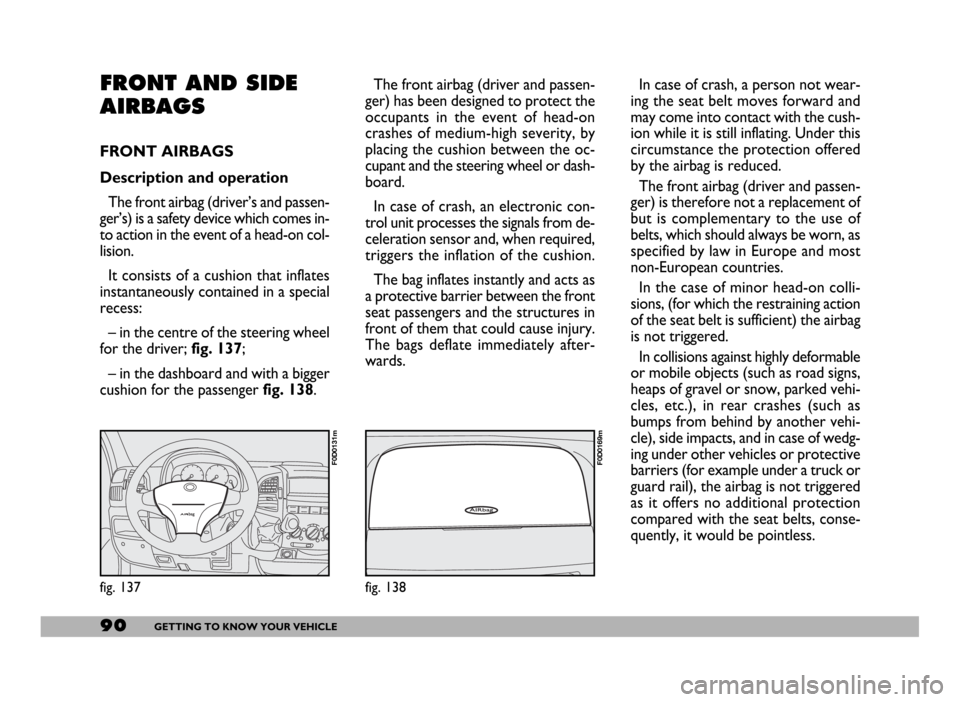
– in the centre of the steering wheel
for the driver; fig. 137;
– in the dashboard and with a bigger
cushion for the passenger fig. 138.The front airbag (driver and passen-
ger) has been designed to protect the
occupants in the event of head-on
crashes of medium-high severity, by
placing the cushion between the oc-
cupant and the steering wheel or dash-
board.
In case of crash, an electronic con-
trol unit processes the signals from de-
celeration sensor and, when required,
triggers the inflation of the cushion.
The bag inflates instantly and acts as
a protective barrier between the front
seat passengers and the structures in
front of them that could cause injury.
The bags deflate immediately after-
wards.
fig. 137
F0D0131m
fig. 138
F0D0169m
In case of crash, a person not wear-
ing the seat belt moves forward and
may come into contact with the cush-
ion while it is still inflating. Under this
circumstance the protection offered
by the airbag is reduced.
The front airbag (driver and passen-
ger) is therefore not a replacement of
but is complementary to the use of
belts, which should always be worn, as
specified by law in Europe and most
non-European countries.
In the case of minor head-on colli-
sions, (for which the restraining action
of the seat belt is sufficient) the airbag
is not triggered.
In collisions against highly deformable
or mobile objects (such as road signs,
heaps of gravel or snow, parked vehi-
cles, etc.), in rear crashes (such as
bumps from behind by another vehi-
cle), side impacts, and in case of wedg-
ing under other vehicles or protective
barriers (for example under a truck or
guard rail), the airbag is not triggered
as it offers no additional protection
compared with the seat belts, conse-
quently, it would be pointless.
Page 92 of 258
91GETTING TO KNOW YOUR VEHICLE
Therefore, failure to come into ac-
tion in the above circumstances does
not mean that the system is not work-
ing properly.
Airbag system efficiency is constant-
ly monitored by an electronic control
unit.
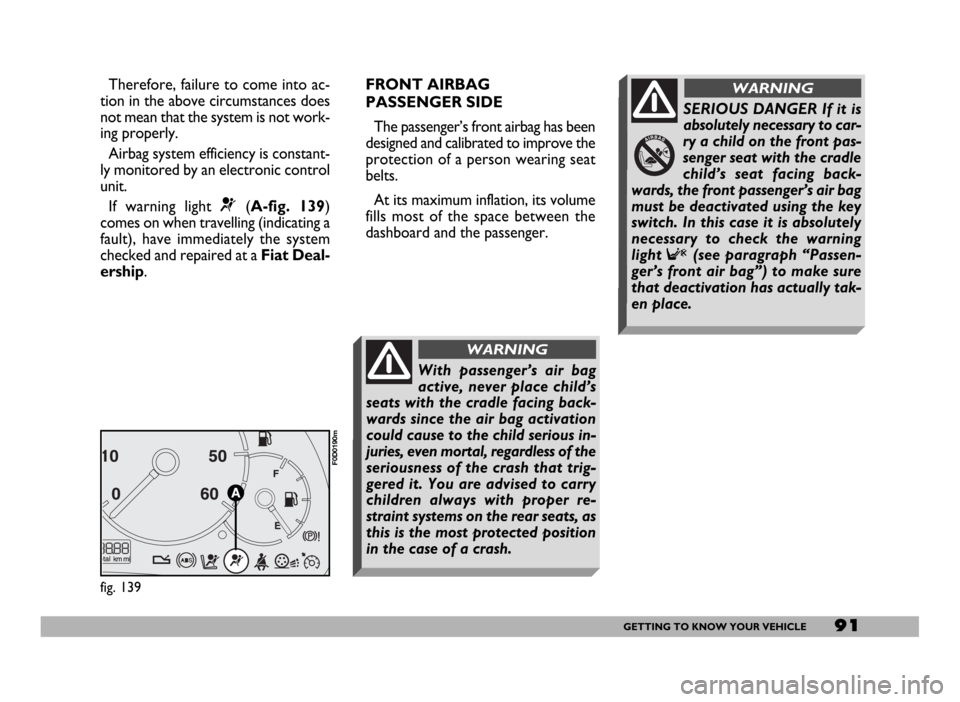
If warning light
¬(A-fig. 139)
comes on when travelling (indicating a
fault), have immediately the system
checked and repaired at a Fiat Deal-
ership.FRONT AIRBAG
PASSENGER SIDE
The passenger’s front airbag has been
designed and calibrated to improve the
protection of a person wearing seat
belts.
At its maximum inflation, its volume
fills most of the space between the
dashboard and the passenger.
fig. 139
F0D0190m
SERIOUS DANGER If it is
absolutely necessary to car-
ry a child on the front pas-
senger seat with the cradle
child’s seat facing back-
wards, the front passenger’s air bag
must be deactivated using the key
switch. In this case it is absolutely
necessary to check the warning
light
F(see paragraph “Passen-
ger’s front air bag”) to make sure
that deactivation has actually tak-
en place.
WARNING
With passenger’s air bag
active, never place child’s
seats with the cradle facing back-
wards since the air bag activation
could cause to the child serious in-
juries, even mortal, regardless of the
seriousness of the crash that trig-
gered it. You are advised to carry
children always with proper re-
straint systems on the rear seats, as
this is the most protected position
in the case of a crash.
WARNING
Page 94 of 258

93GETTING TO KNOW YOUR VEHICLE
In the event of low speed side colli-
sions (for which seat belts are suffi-
cient protection), the airbag is not trig-
gered. Also in this case, it is important
to wear seat belts at all times. This will
ensure correct positioning of the pas-
senger and prevent being projected
from the vehicle in the event of very
violent crashes.
The side bag (driver and passenger)
is therefore not a replacement of but
is complementary to the use of belts,
which should always be worn, as spec-
ified by law in Europe and most non-
European countries.GENERAL WARNINGS
The front and/or side airbags
may be deployed if the vehicle is
subject to heavy knocks or acci-
dents involving the underbody
area, such as for example violent
shocks against steps, kerbs or low
obstacles, falling of the vehicle in
big holes or sags in the road.
Triggering of the airbags re-
leases a small amount of powder.
This powder is not harmful and
does not indicate the start of fire.
The unfold cushion surface and
the vehicle interiors could be cov-
ered by dusty remains: this dust
could irritate skin and eyes. In
case of contact, wash yourself us-
ing neutral soap and water.The airbag system has a validity
of 14 years as to the pyrotechnic
charge and 10 years as to the coil
contact (see the plate set on the
left front door post near hinges).
As these dates approach, con-
tact Fiat Dealership for replace-
ment.
If an accident has triggered the
airbag, contact a Fiat Dealership
so that the whole safety device,
electronic control unit, belt, pre-
tensioners can be replaced and
have the electric system checked
over.
All control, repair and replace-
ment operations concerning the
airbags must only be carried out
at a Fiat Dealership.
If you are having the vehicle
scrapped, have the airbag system
deactivated at a Fiat Dealership
first.
Page 95 of 258
94GETTING TO KNOW YOUR VEHICLE
If the vehicle changes owner-
ship, the new owner must be in-
formed of the method of use of
airbags and the above warnings
and also be given this Owner
Handbook.
The triggering of pretensioners
and front and side airbags is de-
cided in a differentiated manner
by the electronic control unit, de-
pending on the type of crash. The
failure to deploy one or more of
them does not mean that the sys-
tem is not working properly.
If the ¬warning light does
not turn on when turning
the ignition key to MAR or if it stays
on when travelling, this could indi-
cate a failure in safety retaining sys-
tems; under this condition air bags
or pretensioners could not trigger
in the event of collision or, in a re-
stricted number of cases, they could
trigger accidentally. Stop the car
and contact Fiat Dealership to have
the system checked immediately.
WARNING
If the vehicle has been
stolen or an attempt to
steal it has been made, if it has
been subjected to vandals or floods,
have the airbag system checked by
Fiat Dealership.
WARNING
Do not apply stickers or
other objects to the steer-
ing wheel or to the airbag console
on the passenger’s side. Never trav-
el with objects on your lap, in front
of your chest or with a pipe, pencil,
etc. between your lips; injury may
result in the event of the airbag be-
ing triggered.
WARNING
Always keep your hands on
the steering wheel rim
when driving, so that if the airbag
is triggered, it can inflate without
meeting any obstacles which could
cause serious harm to you. Do not
drive with the body bent forwards,
keep the seat back rest in the erect
position and lean your back well
against it.
WARNING
When the passenger’s front
airbag is active (passenger
front airbag deactivation switch at
ON), the
Fwarning light will
come on for approx. 4 seconds and
flash for other four seconds when
the ignition key is turned to MAR to
remind the driver that the passen-
ger’s front and side airbags (where
provided) will be fired in the event
of a crash. The warning light should
go off immediately afterwards.
WARNING
Page 102 of 258
101GETTING TO KNOW YOUR VEHICLE
RADIO
TRANSMITTERS AND
CELLULAR
TELEPHONES
Cellular telephones and other radio
transceiver equipment (e.g. HAM ra-
dio system) must not be used inside
the vehicle unless a separate aerial is
mounted on the outside of the vehicle.
IMPORTANTThe use of cellular
telephones, HAM transmitters or oth-
er similar devices inside the passenger
compartment (without external aeri-
al) produces RF electromagnetic fields
which, amplified by the resonance ef-
fects inside the passenger compart-
ment may cause vehicle electrical sys-
tem to malfunction.
Moreover, the transmission and re-
ceiving quality deteriorates due to the
screening effect of the vehicle body. Have the cellular phone and the con-
nections to the system installed by a
Fiat Dealership.
The hands-free tele-
phone you purchase will
need to be compatible
with your cellular telephone.
Have the cellular tele-
phone and the connec-
tions to the system in-
stalled by a Fiat Dealership only.
This will ensure the best results
and prevent problems which
could impair vehicle safety.
ROOF RACK/
SKI RACK
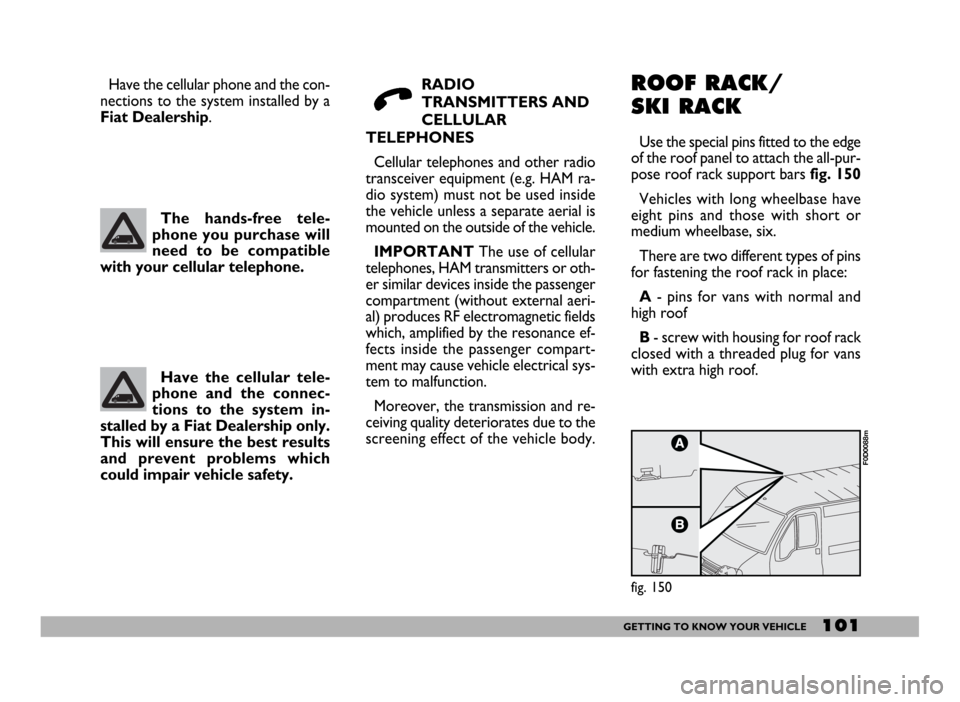
Use the special pins fitted to the edge
of the roof panel to attach the all-pur-
pose roof rack support bars fig. 150
Vehicles with long wheelbase have
eight pins and those with short or
medium wheelbase, six.
There are two different types of pins
for fastening the roof rack in place:
A- pins for vans with normal and
high roof
B- screw with housing for roof rack
closed with a threaded plug for vans
with extra high roof.
fig. 150
F0D0088m
Page 111 of 258

110GETTING THE BEST OUT OF YOUR VEHICLE
STARTING
After starting the engine, with the en-
gine idling and keeping the brake ped-
al pressed, move the gearshift lever to
position D. Release the brake pedal
and gradually press the accelerator
pedal.
IMPORTANT Movement of the
lever from position Pis allowed only
with the ignition key at MARand the
button on the lever and the brake ped-
al pressed. STOPPING THE VEHICLE
To stop the vehicle, simply press the
brake pedal regardless of the position
of the gearshift lever.
IMPORTANTRemoving the igni-
tion key is only allowed with the
gearshift lever in position Pand for a
maximum time of 30 seconds from
when the engine is turned off P, when
the door is opened a buzzer will sound
for about 15 seconds to alert the dri-
ver.
In the case of an emergency (faults,
flat battery, etc.) the ignition key can
be removed from the switch fitting a
screwdriver in hole infig. 3set under
the ignition switch and pressing up-
wards Do not attempt to ob-
tain peak performance
until the engine has
reached normal operating tem-
perature.
fig. 3
F0D0236m
With the engine idling, also
on a level surface, and the
gearshift lever in position D or R,
the vehicle tends to move if the
brake pedal is not kept pressed.
WARNING
ELECTRONIC
AUTOMATIC
GEARBOX
(2.8 JTD versions
only)
The automatic gearbox fitted on Fi-
at Ducato features four speeds plus
reverse with self-adapting control (i.e.
capable of adapting to the driver’s dri-
ving style), which transmits power
continuously and with very fast elec-
tro-hydraulic gear engagement times.
STARTING THE ENGINE
The engine can be started only with
the gearshift lever in the P or Nposi-
tion.
For safety reasons, it is advisable to
start the engine with the brake pedal
pressed.
IMPORTANTWhen moving off af-
ter starting the engine, do not press
the accelerator pedal before and dur-
ing the movement of the gearshift
lever. This is particularly important
when the engine is cold.
Page 114 of 258
113GETTING THE BEST OUT OF YOUR VEHICLE
N - Neutral
This corresponds to the neutral po-
sition of a standard manual gearbox.
This position is to be used if the ve-
hicle is to be pushed or towed.
With the engine idling and
the gearshift lever at N the
vehicle tends to move by inertia if
it is not on a level surface: keep the
brake pedal pressed when the lever
is at N.
WARNING
D - Forward gear
This is the position to be used when
driving forward normally. The elec-
tronic control unit controls automat-
ic engagement of the 4 gears depend-
ing on the position of the accelerator,
driving speed, engine rpm, longitudinal
and transversal acceleration and the
type of road.
The electronic gearbox can chose
between different operating pro-
grammes, which range between com-
fortable economy driving and sporty
driving coming into operation between
the lowest and the highest speed.
Pressing the accelerator pedal quick-
ly the gearbox will immediately select
the sportier programme to meet the
request for increased performance. To
disengage the function release the ac-
celerator by at least 1/4 of the stroke. In the same way, during braking a
lower gear is engaged to better exploit
the braking action of the engine. If
there is another bend the new ratio
will be engaged already when slowing
down before the bend, this way at the
end of the bend the gearbox will not
have to shift gear to cope with accel-
eration.
Kickdown
To obtain optimum acceleration, for
example when overtaking, the gearbox
will kickdown by two gears simply by
quickly pressing fully home the accel-
erator pedal (in 1/10 of a second).
Engagement of the next longer ratio
will take place when the maximum
rpm limit is reached.
With the engine at idle
speed and the gearshift
lever at D, the vehicle tends to move
also on a level surface: keep the
brake pedal pressed until moving off.
WARNING
Page 115 of 258
114GETTING THE BEST OUT OF YOUR VEHICLE
SEQUENTIAL MANUAL
OPERATION
For the sequential manual operation
mode, move the lever to the left sec-
tor B-fig. 4with two positions:
(+) = engagement of the higher ra-
tio;
(–) = engagement of the lower ratio.
Moving the gearshift lever to the
manual sector is only possible from
position D: the ratio selected by the
automatic gearbox when the lever is
moved will remain engaged.
When the sequential manual mode is
selected, the display shows the en-
gaged gear fig. 6.
To select the higher ratio move the
lever in the (+) direction and to shift
down move the lever to (–).IMPORTANTIf the request to
downshift would cause engine
overevving, this is eliminated by the
electronic control unit. Moreover, if
the manually engaged gear causes en-
gine overevving, the electronic control
unit will shift gear automatically to the
most appropriate one (AUTO-UP).
When the sequential man-
ual mode has been set and
a high gear is engaged, to acceler-
ate rapidly, for example to over-
take, it is necessary to downshift
by hand: the kickdown feature
cannot be engaged!
WARNING
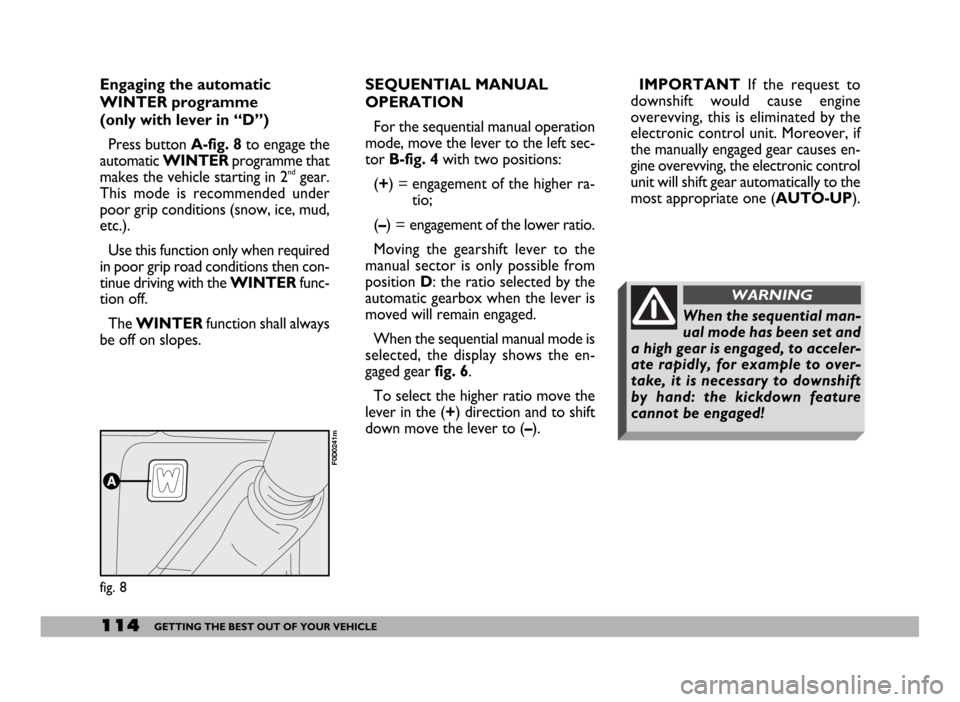
Engaging the automatic
WINTER programme
(only with lever in “D”)
Press button A-fig. 8to engage the
automatic WINTERprogramme that
makes the vehicle starting in 2
ndgear.
This mode is recommended under
poor grip conditions (snow, ice, mud,
etc.).
Use this function only when required
in poor grip road conditions then con-
tinue driving with the WINTERfunc-
tion off.
The WINTERfunction shall always
be off on slopes.
fig. 8
F0D0241m