Page 103 of 264

CD/DVD DISC MAINTENANCE
To keep the CD/DVD discs in good condition, take the
following precautions:
1. Handle the disc by its edge; avoid touching the
surface.
2. If the disc is stained, clean the surface with a soft cloth,
wiping from center to edge.
3. Do not apply paper, paper CD labels, or tape to the
disc; avoid scratching the disc.
4. Do not use solvents such as benzine, thinner, cleaners,
or antistatic sprays.
5. Store the disc in its case after playing.
6. Do not expose the disc to direct sunlight.
7. Do not store the disc where temperatures may become
too high.
RADIO ANTENNA
The radio antenna is located in the windshield.
RADIO OPERATION AND CELLULAR PHONES
Under certain conditions, the operation of a cellular
phone in your vehicle can cause erratic or noisy perfor-
mance from your radio. This condition may be lessened
or eliminated by relocating the cellular phone antenna.
This condition is not harmful to the radio. If your radio
performance does not satisfactorily“clear”by the repo-
sitioning of the antenna, it is recommended that the radio
volume be turned down or off during cellular phone
operation.
UNDERSTANDING YOUR INSTRUMENT PANEL 103
4
Page 106 of 264

Panel
Air is directed through the outlets in the instrument
panel. These outlets can be adjusted to direct air
flow.
Bi-Level
Air is directed through the instrument panel and
floor outlets. A small amount of air is also directed
through the defrost outlets.
NOTE:There is a varying temperature differential be-
tween the upper and lower outlets for added comfort.
The warmer air goes to the floor outlets. This feature
provides improved comfort during sunny but cool con-
ditions.
Floor
Air is directed through the floor outlets with a
lesser amount through the defrost outlets.Floor/Defrost
Air is directed through the windshield defrost and
the floor outlets. This setting works best in cold or
snowy conditions that require extra heat at the
windshield. This setting is good for maintaining comfort
while reducing moisture on the windshield.
Windshield Defrost
Air is directed through the windshield defrost
outlet. Use this mode with maximum fan and
temperature settings for best windshield defrosting.
NOTE:The air conditioning compressor operates in this
mode. This dehumidifies the air to help dry the wind-
shield. To improve fuel economy, leave in the Defrost
mode only when necessary.
A/C Pushbutton
With the fan control in the ON position, pushing
the A/C button turns on the air conditioning
compressor. An indicator light above the button
106 UNDERSTANDING YOUR INSTRUMENT PANEL
Page 107 of 264

shows that the Air Conditioning compressor is on. Con-
ditioned air is now directed through the outlets selected.
Pushing the button a second time turns the compressor
OFF.
Slight changes in engine speed or power may be noticed
when the compressor is on. This is a normal occurrence
since the compressor will cycle on and off to maintain
comfort and increase fuel economy.
NOTE:If your air conditioning performance seems
lower than expected, check the front of the A/C con-
denser for an accumulation of dirt or insects.
Rear Window Defroster
Press the button once to turn on the Rear Window
Defroster and a second time to turn it off. A light
above the button shows that the Rear Defroster is On.NOTE:The defroster turns off automatically after 15
minutes of operation. Each later activation will allow 71⁄2
minutes of operation.
CAUTION!
To avoid damaging the electrical conductors, do not
use scrapers, sharp instruments, or abrasive window
cleaners on the interior surface of the rear window.
Labels can be peeled off by soaking with warm
water.
Operating Tips
When operating the system during the winter months,
make sure the air intake, at the right side of the hood, is
free of ice, slush, snow or other obstructions such as
leaves. Leaves collected in the air-intake plenum may
reduce air flow and plug the plenum water drains.
UNDERSTANDING YOUR INSTRUMENT PANEL 107
4
Page 109 of 264
STARTING AND OPERATING
CONTENTS
�Starting Procedures.....................111
▫If Engine Fails To Start.................112
▫After Starting........................114
�Transmission Shifting....................114
▫Recommended Shift Speeds..............115
▫Skip Shift Light.......................115
�Parking Brake.........................116
�Brake System..........................117
▫Brake Pad Break-In....................121�Power Steering........................121
�Tire Safety Information...................122
▫Tire Markings........................122
▫Tire Identification Number (TIN)..........125
▫Tire Loading And Tire Pressure...........126
�Ti re s—General Information................130
▫Tire Pressure.........................130
▫Tire Inflation Pressures.................131
▫Radial-Ply Tires......................134
5
Page 112 of 264
instrument panel and release when the engine starts. If
the engine has not started within 3 seconds, slightly
depress the accelerator pedal while continuing to crank.
If the engine fails to start within 10 seconds, turn the key
to the“OFF”position, wait 5 seconds, then repeat the
normal starting procedure.If Engine Fails to Start
NOTE:The Remote Keyless Entry Transmitter MUST be
used to unlock the vehicle and disarm the alarm system.
In the event of a lost or defective Remote Keyless
Transmitter, the security system can be momentarily
disarmed to allow the vehicle to be started.
See the paragraph on the Vehicle Theft Security System in
Section 2 of this manual
Engine Start Button
112 STARTING AND OPERATING
Page 114 of 264

After Starting
The idle speed will automatically decrease as the engine
warms up.
WARNING!
Never pour fuel or other flammable liquid into the
throttle body air inlet opening in an attempt to start
the vehicle. This could result in flash fire causing
serious personal injury.
TRANSMISSION SHIFTING
NOTE:The parking brake should be engaged and the
gear selector placed in REVERSE before leaving the
vehicle, especially on an incline.
Fully depress the clutch pedal before you shift gears. As
you release the clutch pedal, lightly depress the accelera-
tor pedal.Be sure the transmission is in FIRST gear, (not THIRD),
when starting from a standing position. Damage to the
clutch can result from starting in THIRD.
For most city driving you will find it easier to use only
the lower gears. For steady highway driving with light
accelerations, 6th gear is recommended.
Never drive with your foot resting on the clutch pedal, or
try to hold the vehicle on a hill with the clutch pedal
partially engaged. This will cause abnormal wear on the
clutch.
Never shift into REVERSE until the vehicle has come to a
complete stop.
NOTE:During cold weather, until the transmission
lubricant has warmed, you may have difficulty shifting.
This is normal and not harmful to the transmission.
114 STARTING AND OPERATING
Page 115 of 264

Recommended Shift Speeds
To use your manual transmission for fuel economy it
should be upshifted as listed below. Shift at the vehicle
speeds listed for acceleration. Earlier upshifts during
cruise conditions (relatively steady speeds) will result in
increased fuel economy, and may be used as indicated.
MANUAL TRANSMISSION
RECOMMENDED SHIFT SPEEDS
1-2 2-3 3-4 4-5 5-6
MPH 17––27 42
(km/h) (27)––(43) (68)
Higher upshift speeds may be used to obtain a desired
acceleration rate.
Skip Shift Light
There are times when you must shift directly from First to
Fourth gear instead of from First to Second. An amber
(LED) arrow on the instrument cluster will light up
during these times. This is to help you get the best
possible fuel economy.
The shift arrow will light up when engine coolant is
higher than 106°F (41°C), vehicle speed is greater than 12
MPH and less than 20 MPH, engine speed is less than
1322 RPM, you are in 1st gear and you are at 1/4 throttle
or less.
When the arrow is lit, the shift mechanism will only
allow shifts from First to Fourth gears. After you shift to
Fourth gear, you can press the clutch in and shift to
another forward gear.
Downshifting - Proper downshifting will improve fuel
economy and prolong engine life.
STARTING AND OPERATING 115
5
Page 116 of 264
To maintain a safe speed and prolong brake life, down-
shift to maintain a safe speed when descending a steep
grade.
WARNING!
Skipping more than one gear while downshifting,
could cause you to lose control of your vehicle. You
could have an accident.
CAUTION!
If you skip more than one gear while downshifting
or downshift at too high an engine speed, you could
damage the engine, transmission, or clutch.
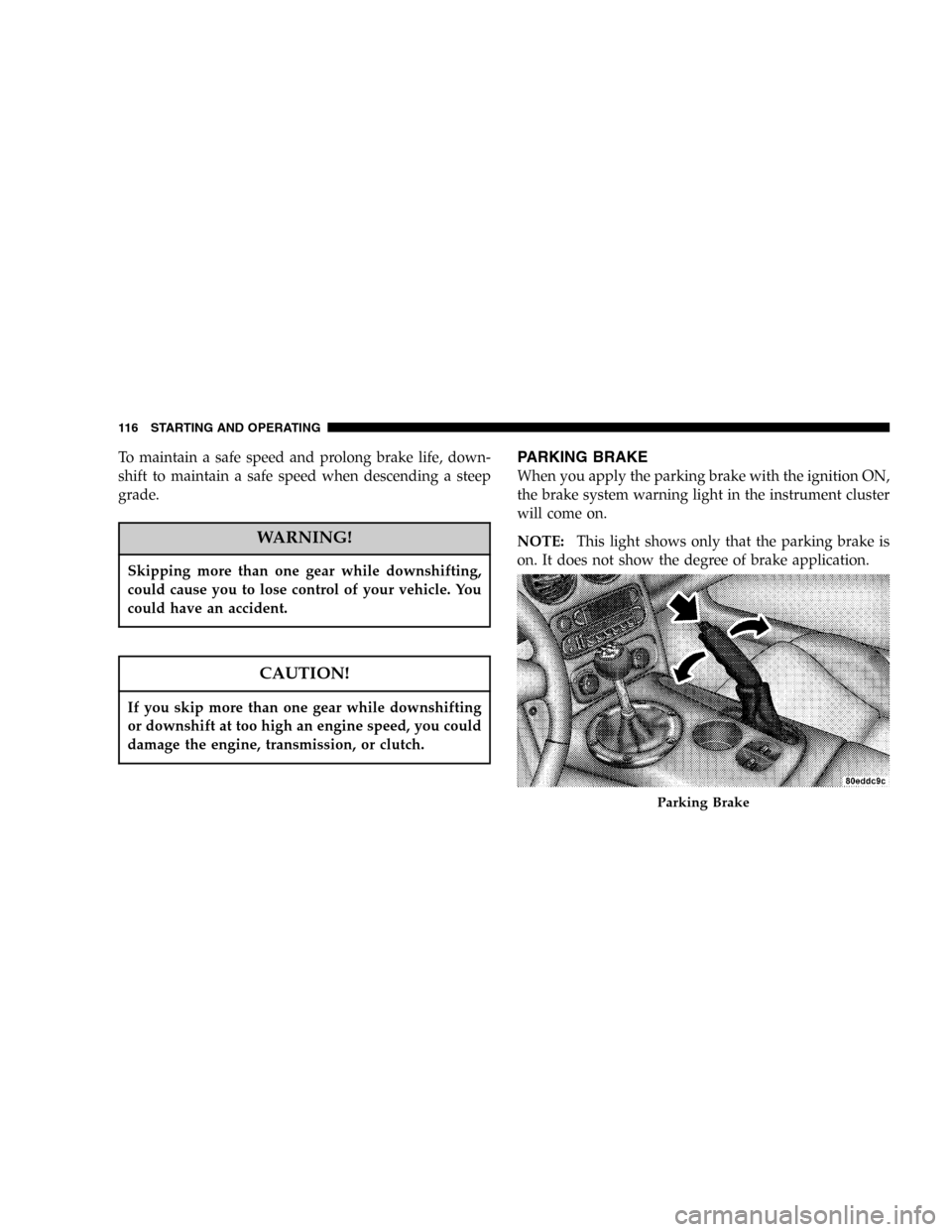
PARKING BRAKE
When you apply the parking brake with the ignition ON,
the brake system warning light in the instrument cluster
will come on.
NOTE:This light shows only that the parking brake is
on. It does not show the degree of brake application.
Parking Brake
116 STARTING AND OPERATING