2005 DODGE STRATUS COUPE warning lights
[x] Cancel search: warning lightsPage 179 of 396
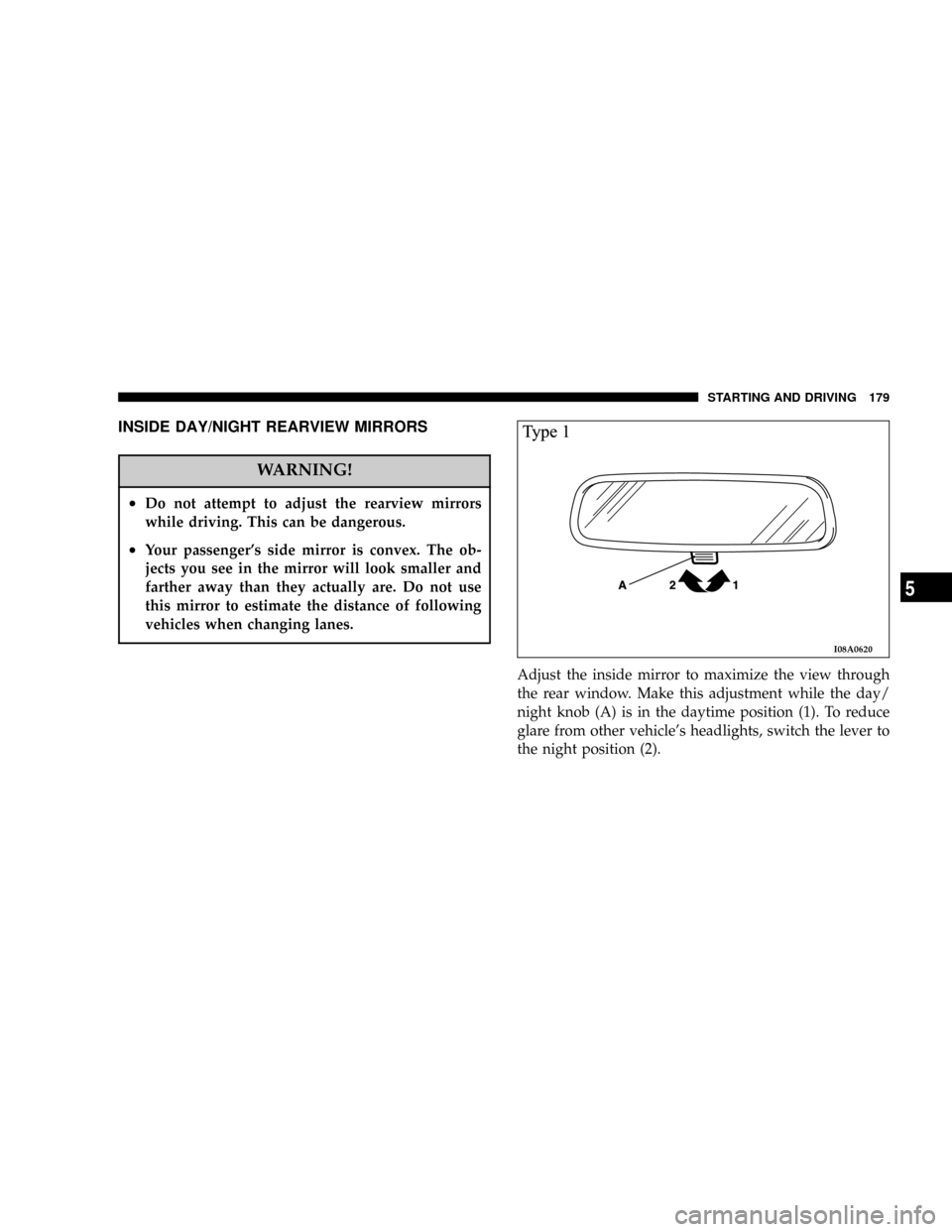
INSIDE DAY/NIGHT REARVIEW MIRRORS
WARNING!
²Do not attempt to adjust the rearview mirrors
while driving. This can be dangerous.
²Your passenger's side mirror is convex. The ob-
jects you see in the mirror will look smaller and
farther away than they actually are. Do not use
this mirror to estimate the distance of following
vehicles when changing lanes.
Adjust the inside mirror to maximize the view through
the rear window. Make this adjustment while the day/
night knob (A) is in the daytime position (1). To reduce
glare from other vehicle's headlights, switch the lever to
the night position (2).
I08A0620
STARTING AND DRIVING 179
5
Page 202 of 396

Check wheel nuts for tightness and tires (including spare
tire) for proper pressure. Maintain specified tire inflation
pressures. Replace tires before they are excessively worn.
Lights
Have someone observe the operation of all exterior lights
while you activate the controls. Check the turn signals
and highbeam indicators on the instrument panel.
Fluid leaks
Check the area under the vehicle after overnight parking
for fuel, water, oil, or other fluid leaks. Make sure all fluid
levels are at the proper levels. Also, if fuel leaks are
detected, the cause should be located and corrected
immediately.
Driver
Do not drive if you are tired or sleepy. Do not drive if you
have been drinking or taking drugs. Unless you are alert
and able to concentrate on your driving, you could have
an accident, resulting in serious or fatal injury to yourself
and others.
SAFE DRIVING TECHNIQUES
Even this vehicle's safety equipment, and your safest
driving, cannot guarantee that you can avoid accident or
injury. However, we recommend that you give extra
attention to the following, to help maximize the safety of
you and your passengers:
1. Drive defensively. Be aware of traffic, road and
weather conditions. Leave adequate stopping distance
for your vehicle.
2. Before changing lanes, check your mirrors and flash
the proper turn-signal light.
3. While driving, watch the behavior of other drivers,
bicyclists and pedestrians.
4. During an emergency stop, switch on the hazard
warning flasher.
5. When leaving the vehicle, set the parking brake and
place the gearshift lever into low gear.
In vehicles with an automatic transaxle, place the selector
lever in the ªPº (PARK) position. Remove the key.
202 STARTING AND DRIVING
Page 204 of 396

over curbs or parking stop blocks. Always use caution
when traveling up or down sharp inclines as your
bumper may contact the road surface.
2. Maintain specified tire inflation pressures. Replace
tires before they are excessively worn.
3. If you plan to drive in another country, comply with
the vehicle registration laws and confirm the availability
of the correct fuel.
OPERATION DURING COLD WEATHER
1. Check the battery, including terminals and cables.
During extremely cold weather, the battery capacity will
decrease. Also, the battery power level may drop because
more power is needed for cold starting and operation.
Before driving the vehicle, check to see if the engine runs
at the proper speed and if the headlights are at their usual
intensity. Charge or replace the battery if necessary.
During cold weather, it is possible that a discharged
battery could freeze.
WARNING!
The battery gives off explosive hydrogen gas. Any
spark or flame can cause the battery to explode,
which could seriously injury or kill you.
Always wear protective clothes and a face shield
when doing battery maintenance, or let a skilled
technician do it.
2. Manual transaxles may be more difficult to shift
during cold weather operation. This is normal and shift
effort will become easier as the transaxle reaches a
normal operating temperature.
Maintain low-speed operation at first to allow the trans-
axle oil to be distributed to all lubrication points.
3. Check the engine antifreeze.
If there is a shortage of coolant due to leakage or engine
overheating, add high-quality ethylene glycol antifreeze
and water. The recommended ratio is about 50% water
and 50% anti-freeze. This ratio provides adequate corro-
sion, boiling, and freeze protection.
204 STARTING AND DRIVING
Page 205 of 396

WARNING!
Never open the radiator cap when the radiator is hot.
You could be seriously burned.
TRAILER TOWING
Warranty Requirements
The Manufacturer's Passenger Vehicle Warranty will
apply to vehicles used to tow trailers for non-commercial
use. However the following conditions must be met:
²The maximum trailer load for vehicles with manual
transaxles is 1,000 lbs (454 kg).
²The maximum trailer load for vehicles with automatic
transaxles is 1,000 lbs (454 kg).
²The maximum frontal area of the trailer cannot exceed
20 square feet (1.86 square meters).
²If using a manual transaxle vehicle for trailer towing,
all starts must be in FIRST gear to avoid excessive
clutch slippage.The trailer tongue load must be considered as part of the
tow vehicle load capacity when loading the vehicle.
NOTE:Check the automatic transmission fluid level
before towing. Fluid discoloration, or a burnt odor,
shows the need for transmission fluid replacement.
WARNING!
Connecting trailer brakes to your vehicle's hydraulic
brake lines can overload your brake system and
cause it to fail. You might not have brakes when you
need them and could have an accident.
Whenever you pull a trailer, regardless of the trailer size,
stop lights and turn signals on the trailer are recom-
mended for motoring safety.
STARTING AND DRIVING 205
5
Page 281 of 396

connection. You wouldn't be able to start your vehicle,
and the bad ground could damage the electrical systems.
CAUTION!
Check the other vehicle. It must have a 12-volt
battery. If the other system isn't 12-volts, both sys-
tems can be damaged.
3. You could be injured if the vehicles move. Set the
parking brake firmly on each vehicle. Put an automatic
transaxle in ªPº (PARK) or a manual transaxle in ªNº
(Neutral). Turn the ignition key to the ªLOCKº position.
WARNING!
Turn the ignition key to the ªLOCKº position on
both vehicles.
Use care to make sure that the cables or your clothes
are never caught by the fan or drive belt. Personal
injury could result.
NOTE: Turn off all lights, heater and other electrical
loads. This will avoid sparks and help save both batter-
ies.
4. Make sure battery electrolyte is at the proper level.
(See ªBatteryº on page 325.)
WARNING!
If electrolyte fluid is not visible, or appears to be
frozen, do not attempt jump starting.
The battery might rupture or explode if the tempera-
ture is below the freezing point or if it is not filled to
the proper level.
EMERGENCIES 281
8
Page 290 of 396

Engine compartment Fuse location tableNo. Symbol Electrical system Capacity
1
Fuse (+B) 60A
2
Radiator fan motor 50A
3
Anti-lock braking system 60A
4
Ignition switch 40A
5
Electric window controls 30A
6
Fog lights 15A
7Ð Ð Ð
8
Horn 15A
9
Engine control 20A
10
Air conditioning 10A
11
Stop lights 15A
12
ÐÐ
13
Alternator 7.5A
14
Hazard warning flasher 10A
15
Automatic transaxle 20A
16
Headlights high beam (right) 10A
17
Headlights high beam (left) 10A
18
Headlights low beam (right) 10A
19
Headlights low beam (left) 10A
20
Position lights (right) 7.5A
21
Position lights (left) 7.5AN29B2642
Engine compartment fuse location
290 EMERGENCIES
Page 392 of 396

Engine coolant......................... 322
Engine coolant level warning light.......... 109
Engine coolant temperature gauge.......108,113
Engine hood release...................... 42
Engine oil and oil filter.................. 318
Engine overheating..................... 279
Engine serial number.................... 373
Engine specifications.................... 377
Exhaust system.....................332,377
Fluid
Automatic transaxle fluid............... 329
Brake fluid.......................... 323
Clutch fluid......................... 324
Fog light switch........................ 125
Front fog lamp indicator lamp............. 116
Front seat adjustment..................... 57
Fuel
Filler Cap........................... 150
Fuel economy........................ 151
Fuel filler............................ 39
Fuel gauge.......................108,111
Fuel hoses.......................... 315Fuel selection........................ 146
Low-fuel warning light..............109,115
Fuses................................ 286
Fusible links.......................... 287
Garage Door Opener.................... 134
GasCap .............................. 150
Gasoline/Oxygenate Blends............... 148
Gauges.........................108,111,113
Gear positions......................... 158
General maintenance
Maintenance service................... 318
General vehicle data..................... 375
Glove compartment..................215,216
Handling of Compact Discs............... 234
Hazard warning flasher switch............. 126
Hazard warning light.................109,114
Head restraints......................... 66
Headlights (Type 1)..................... 295
Headlights
Aiming............................. 297
Dimmer............................ 124
392 INDEX
Page 393 of 396

Headlight flasher (high/low beam)........ 123
Switch............................. 122
Heater............................... 238
High beam indicator..................109,114
High-mounted stoplights
Bulb capacity........................ 293
Homelink Transmitter................... 134
Horn switch........................... 134
Ignition switch......................... 151
Indicator and warning light............... 109
Inside day/night rearview mirrors.......... 179
Instrument cluster...................... 108
Instrument panel light dimmer control....... 127
Intermittent Wipers..................... 129
Jack
Jacking points........................ 270
Jacking up the car..................... 270
Storage............................. 266
Key reminder chime..................... 152
Keyless entry system..................... 29Keys..............................23,152
Labeling............................. 372
Lap Belts.............................. 87
Lights
Bulb chart........................... 293
Dome light/Reading light............... 131
Headlights.......................... 122
Reading lamps....................... 133
Low-fuel warning light................109,115
Luggage hooks......................... 217
Malfunction Indicator Light............... 314
Manual, Service........................ 385
Manual transaxle
Oil ................................ 331
Possible driving speed................. 171
Shift points (recommended speed)........ 169
Meters............................... 108
Mirrors
Vanity mirror........................ 213
Mopar Parts........................315,383
INDEX 393