Page 180 of 288

180 STARTING AND OPERATINGFuel Filter with Water SeparatorCheck the water separator when the fuel indicator
lamp does not go out or comes on while the engine
is running. For more information on the indicator
lamp .
The interval for changing the fuel filter is reduced to
10,000 miles (about 15,000 km).
Diesel Fuels for Use at Very Low TemperaturesAt very low temperatures the fluidity of No. 2 diesel
fuel may become insufficient due to parraffin
separation. For this reason the vehicle comes equipped
with a fuel preheater. It permits a troublefree engine
operation to a temperature of approximately 14 °F (–
10 °C) when using No. 2 diesel fuel.
To avoid malfunctions, No. 2 diesel fuel of a lowered
cloud point is marketed during the cold season.
A t tem pera tures below 1 4 ° F (–1 0 °C) us e win teriz ed or
No. 1 diesel fuel only. If not available, a certain
quantity of kerosene or fuel flow improver may be
added. Mixing only to be done within the vehicle’s fuel
tank. Kerosene has to be filled in before the diesel fuel.
Engine power may drop according to the proportion of
kerosene. For this reason, keep percentage of kerosene
added to the minimum necessitated by the ambient
temperature.
WARNING!
Under no circumstances should gasoline be mixed
with diesel fuel.
Due to the high pressure and high temperature in
the injection system, there is a risk of fire and
explosion.
In addition, there is a risk of engine damage.
Always follow basic safety rules when working
with any combustible material.
Page 181 of 288

STARTING AND OPERATING 181
5
The following information can be used as a reference,
if adding of kerosene becomes necessary. The mixing
ratios shown refer to the total mixture.
Ambient temperature:
14 °F to –4 °F (–10 °C to –20 °C)No. 2 Diesel Fuel: 70%
Kerosene: 30%
Ambient temperature:
below –4 °F to (–20 °C)No. 2 Diesel Fuel: 50 %
Kerosene: 50 %
Even in extreme climatic conditions, the maximum
mixture ratio should not exceed 50 %.
Adding of kerosene to No. 1 diesel fuel is not
recommended even at low temperatures.Do not blend other specific fuel additives with diesel fuel
except for fuel flow improver. They only result in unnecessary
cost, and may be harmful to the engine operation.
REFUELING1. Fuel filler neck
2. Fuel filler capThe fuel filler neck (1) is located behind the fuel filler flap
next to the driver’s door. The fuel filler flap can be opened
when the driver’s door is open. Turn the fuel filler cap (2)
on the fuel filler neck (1) coun terclockwise and take it off.
For cargo/passenger vans, place the fuel filler cap (2) in
the holder on the inside of the fuel filler flap.When you have finished refueling, install the fuel filler
cap (2).
CAUTION!
Damage or malfunctions resulting from poor fuel
quality or from blending specific fuel additives
are not covered by the Sprinter Warranty.
Page 182 of 288

182 STARTING AND OPERATINGNOTE: Only fill the fuel tank until the fill nozzle cuts
off, do not overfill.
NOTE: Holder on the inside of the fuel filler flap only
for cargo/passenger vans.
CapacityFuel tank including reserve fuel about 26.4 US gal
(100 l).PROGRAMMED TOP SPEED (OPTIONAL)NOTE: The top speed of this vehicle can be
electronically limited to a speed between 19 mph
(30 km / h) and 82 mph (132 km / h). The vehicle’s
electronic speed controller should be programmed
only by a qualified technician by an authorized
Sprinter Dealer.
When programming the electronic speed controller,
the circumference of the specific tires actually mounted
on the vehicle must be determined and that
circumference must be correctly programmed into the
vehicle’s electronic speed controller. It is critical that
the correct tire circumference be programmed
accurately into the vehicle’s electronic speed
controller. Accurate tire circumference information
should be confirmed each time the electronic speed
controller is programmed and each time new wheels or
tires are mounted on the vehicle.
WARNING!
Always handle fuel with great care.
Shut off the engine and the auxiliary heater before
refueling.
Fuel is flammable and explosive. Keep open
flames away from the fuel.
Refrain from smoking as well as use of any
electrical equipment (such as cell phones). This
also applies to places where the characteristic
smell of fuel is evident.
If diesel fumes are noticed inside the vehicle, have
the cause traced and rectified immediately by an
authorized Sprinter Dealer.
Page 183 of 288

STARTING AND OPERATING 183
5
BLEEDING DIESEL FUEL SYSTEMIf the fuel tank was run empty, the diesel fuel system
must be bled after refueling before starting the engine.– Turn the key in the ignition lock to position 2 for at
least 30 seconds.– Return the key to position 0.– Start the engine three to four times.
The malfunction indicator light (MIL) ± must go
out.
NOTE: Too many attempts to start the engine could
drain the battery. If the engine does not start after
several attempts, consult an authorized Sprinter
Dealer.
WARNING!
Possible tire damage resulting in serious personal
injury or death may occur if the vehicle’s electron-
ic speed controller is programmed at a speed
above the maximum speed allowed by the manu-
facturer of the specific tires mounted on the vehi-
cle. The maximum speed of the tires prescribed by
the tire manufacturer must be determined and ac-
curately programmed into the electronic speed
controller. The electronic speed controller must
never be programmed at a speed greater than the
maximum allowable tire speed as prescribed by
the manufacturer of the specific tires mounted on
the vehicle.
Page 184 of 288
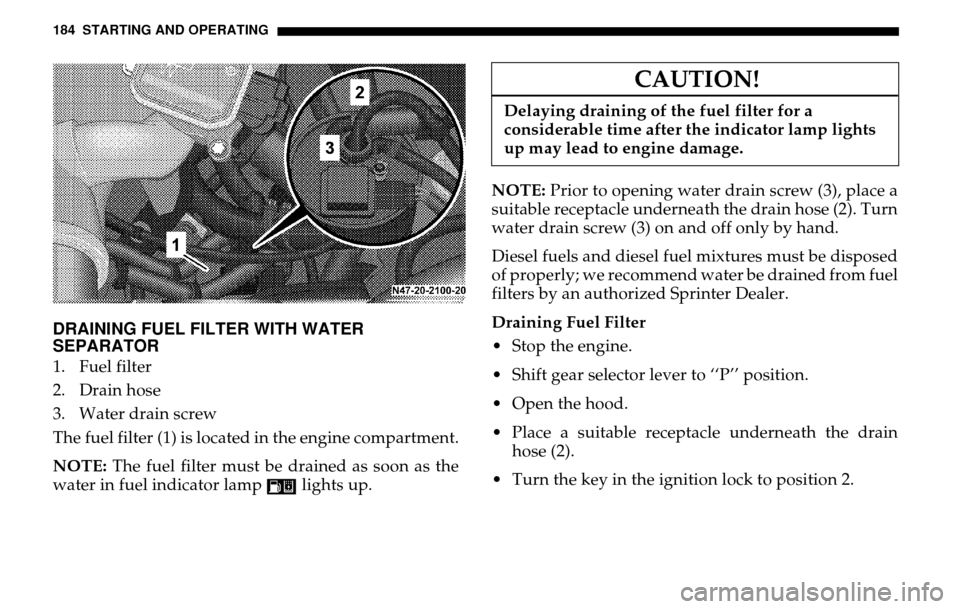
184 STARTING AND OPERATINGDRAINING FUEL FILTER WITH WATER
SEPARATOR1. Fuel filter
2. Drain hose
3. Water drain screw
The fuel filter (1) is located in the engine compartment.
NOTE: The fuel filter must be drained as soon as the
water in fuel indicator lamp lights up. NOTE:
Prior to opening water drain screw (3), place a
suitable receptacle underneath the drain hose (2). Turn
water drain screw (3) on and off only by hand.
Diesel fuels and diesel fuel mixtures must be disposed
of properly; we recommend water be drained from fuel
filters by an authorized Sprinter Dealer.
Draining Fuel Filter
Stop the engine.
Shift gear selector lever to ‘‘P’’ position.
Open the hood.
Place a suitable receptacle underneath the drain hose (2).
Turn the key in the ignition lock to position 2.
CAUTION!
Delaying draining of the fuel filter for a
considerable time after the indicator lamp lights
up may lead to engine damage.
Page 185 of 288

STARTING AND OPERATING 185
5
Open immediately the water drain screw (3) about 1 turn (counterclockwise) until fluid emerges. Ensure
that the fluid is collected in the receptacle.
Close the water drain screw (3) as soon as about 0.25 US qt (0.2 liters) are emerged.
After draining, return the key in the ignition lock to position 0.
Dispose of the collected fluid in an environmentally responsible manner.
If the filter is still saturated, drain the filter once more.
After draining, the engine may run briefly but stall for
lack of fuel. If this occurs, bleed the system.
NOTE: Should the water in the fuel indicator lamp
still not go out after the fuel filter has been drained
twice, the cause should be examined by an authorized
Sprinter Dealer.
Bleeding the Diesel Fuel SystemThe diesel fuel system must be bled before starting the
engine.
Turn the key in the ignition lock position 2 for at
least 30 seconds.
Return the key to position 0.
Start the engine three to four times. The engine control unit indicator lamp ± must go out.
NOTE: Too many attempts to start the engine could
drain the battery. If the engine does not start after
several attempts, consult an authorized Sprinter
Dealer.
Page 187 of 288

STARTING AND OPERATING 187
5
Vehicle and Trailer Weights and RatingsGross Vehicle Weight Rating (GVWR) is the maximum
permissible vehicle weight: 8,550 lbs (3,878 kgs),
9,990 lbs (4,531 kgs) or 10,200 lbs (4,627 kgs).
NOTE: The weight of your Sprinter is indicated on the
type plate. For type plate, see Identification Labels.
Gross Vehicle Weight (GVW): comprises weight of
vehicle including fuel, tools, spare wheel, installed
accessories, passengers, cargo and trailer tongue. It
must never exceed the GVWR.
Gross Axle Weight Rating (GAWR) is the maximum
permissible axle weight: Gross Trailer Weight (GTW) is the maximum
permissible trailer weight to be towed:
5,000 lbs. (2,260 kgs)
Trailer Tongue Weight Rating (TWR) is the maximum
permissible weight of the trailer tongue:
500 lbs. (225 kgs) limit for Sprinter approved hitch
receiver.
Loading a TrailerWhen loading a trailer, you should observe that
neither the permissible GTW, nor the GVWR are
exceeded.
Maximum permissible values are listed on the safety
compliance certification labels for the vehicle and for
the trailer to be towed. The lowest value listed must be
selected when determining how the vehicle and trailer
are loaded.
We recommend loading the trailer in such a manner
that it has a tongue weight (TW) between 10% and 15%
of the GTW.
The tongue weight at the hitch ball must be added to
the GVW to prevent exceeding your Sprinter tow
vehicle’s rear GAWR.
Type GVWR GAWR (FA) GAWR (RA)
2500
C/HC / SHC 8,550 lbs
3,878 kgs 3,860 lbs
(1,751 kgs) 5,360 lbs
(2,431 kgs)
3500
C/HC / SHC 9,990 lbs
4,531 kgs 3,860 lbs
(1,751 kgs) 7,060 lbs
(3,202 kgs)
10,200 lbs 4,627 kgs 3,860 lbs
(1,751 kgs) 7,060 lbs
(3,202 kgs)
Page 216 of 288
216 MAINTAINING YOUR VEHICLELegend For Engine Compartment
1. Windshield washer system fluid reservoir.
2. Maintenance indicator for air cleaner element (Optional).
3. Oil dipstick.
4. Oil filler neck.
5. Ribbed V-belt. Auxiliary drive (Optional) refer to “Auxiliary
drive“. 6. Fuel filter with water separator.
7. Hydraulic brake fluid reservoir.
8. Coolant reservoir.
9. Battery
The auxiliary battery is located underneath the
front passenger seat (optional equipment).
10. Fuse box (These special fuses should only be replaced at by
an authorized Sprinter Dealer).