Page 68 of 288

68 UNDERSTANDING THE FEATURES OF YOUR VEHICLEHEADLAMP RANGE CONTROLSee Section 4, Understanding Your Instrument Panel,
for switch locations. The range of the headlamps can be
adjusted to the load in the vehicle.
Turn the thumbwheel down to
headlamp beam down.
Turn the thumbwheel up to
headlamp beam up.
When the vehicle is not loaded (driver only), the
thumbwheel must be in position 0. Where necessary, adjust the headlamp range with the
thumbwheel to 82 yards (75 m).
Always keep the headlamp range less than 110 yards
(100 m), so that oncoming traffic is not blinded.
FOG LAMP SWITCH (OPTIONAL)See Section 4, Understanding Your Instrument Panel,
for switch locations.
Lamp switch position õ
To switch on:
Press the upper section of the switch.
To switch off:
Press the lower section.
WARNING!
Be sure the hood is properly closed before driving.
If the hood is not fully latched, it could fly up
when the vehicle is moving and block your for-
ward vision. Be sure all hood latches are latched
fully before driving.
When closing the hood, use extreme caution not to
catch hands or fingers.
Page 80 of 288
80 UNDERSTANDING THE FEATURES OF YOUR VEHICLEManual Sun Roof (Optional)
– To open, turn the handwheel counterclockwise. Maximum opening = turn until the stop is reached.– To close, turn the handwheel clockwise until the stop
is reached.
Electric Sun Roof (Optional)See Section 4, Understanding Your Instrument Panel,
for switch locations.
Place the key in position 2 in the
ignition lock.
To open the electric sun roof:
Keep switch pressed upward until
the sun roof has reached the desired
position or the end position.
To close the electric sun roof:
Keep switch pressed downward until the sun roof has
reached the desired position or is completely closed.
WARNING!
Never allow fingers or other body parts, or any ob-
ject to project through the sun roof opening. Inju-
ry may result.
Make sure that nobody can be trapped when
closing the sun roof.
Page 90 of 288

90 UNDERSTANDING YOUR INSTRUMENT PANELLegend For Instruments And Controls
1. Left-hand air vent.
2. Multifunction switch.
3. Speed control .
4. Hood release lever .
5. Instrument cluster, refer to "Instrument Cluster and Indicator Lamps".
6. Hazard warning flasher switch .
7. Steering wheel with horn, front driver airbag .
8. Fuse box .
9. Windshield wiper switch, refer to "Windshield Wiper Switch".
10. Ignition lock/starter switch .
11. Center air vents .
12. Upper air vents .
13. Radio, see individual manual. 14. Temperature control switch
.
15. Airflow control switch .
16. Air distribution switch .
17. Temperature sensor, automatic heating control / air conditioning, regulated .
18. Air conditioning switch .
19. Heater booster switch .
20. Residual engine heat utilization switch .
21. Gear selector lever (automatic transmission)
22. Timer for auxiliary heater .
23. Electrical outlet .
24. Ashtray .
25. Cup holder .
26. Front passenger airbag .
27. Right-hand air vent .
28. Glove compartment .
NOTE: For layout of switches, see previous page.
Page 94 of 288
94 UNDERSTANDING YOUR INSTRUMENT PANELMulti-Function Indicator
WARNING!
Never operate buttons (1, 2, 3 and 4) in the multi-
function indicator while driving.
To operate these buttons the driver must reach
through the steering wheel, which could
significantly impede its movement.
Your attention will also be diverted from the road
and traffic conditions.
This could cause you to lose control of the vehicle
and could lead to an accident and result in severe
personal injuries or death.
For this reason, make sure that the traffic
conditions are safe before pressing the buttons, so
that nobody may be endangered.
When possible, reach around the steering wheel
to operate the multi-function indicator buttons.
Do not rest your head or chest on the steering
wheel or dashboard when operating the buttons.
Page 120 of 288
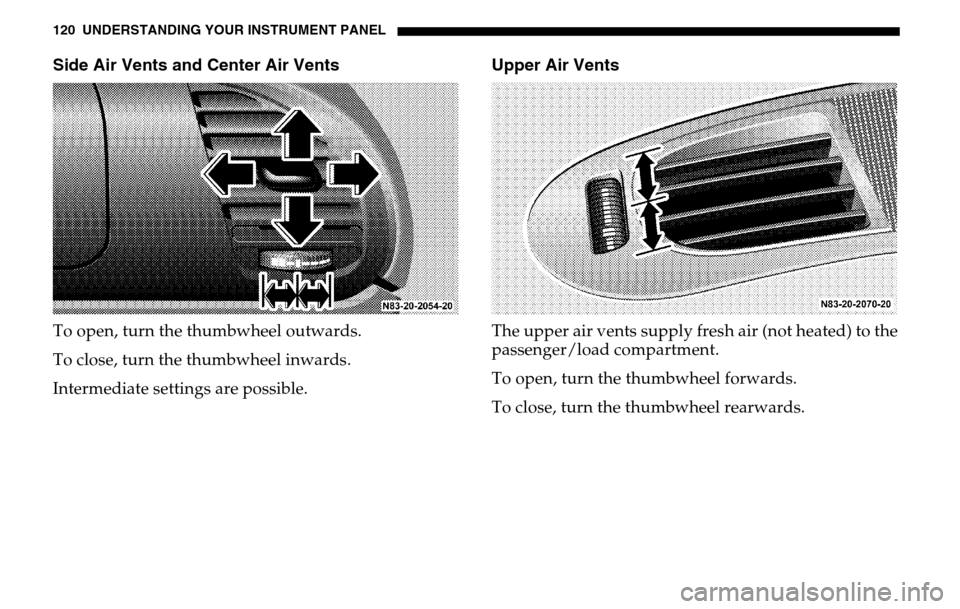
120 UNDERSTANDING YOUR INSTRUMENT PANELSide Air Vents and Center Air VentsTo open, turn the thumbwheel outwards.
To close, turn the thumbwheel inwards.
Intermediate settings are possible.
Upper Air VentsThe upper air vents supply fresh air (not heated) to the
passenger/load compartment.
To open, turn the th umbwheel forwards.
To close, turn the thumbwheel rearwards.
Page 140 of 288

140 STARTING AND OPERATING
�Deactivating the Acceleration Skid
Control (ASR) . . . . . . . . . . . . . . . . . . . . . . . . . . . 168�Brake Assist System (BAS)
(vehicle type 2500 only) . . . . . . . . . . . . . . . . . . . 169�Indicator Lamp Electronic Stability Program
(ESP) (type 2500 vehicles only) . . . . . . . . . . . . 170�Electronic Stability Program (ESP)
(vehicle type 2500 only) . . . . . . . . . . . . . . . . . . . 171
��
Auxiliary Drive (Optional) . . . . . . . . . . . . . . . . . . 172
��
Steering . . . . . . . . . . . . . . . . . . . . . . . . . . . . . . . . . . 173
��
Wheels and Tires . . . . . . . . . . . . . . . . . . . . . . . . . . 173�Tire Grip . . . . . . . . . . . . . . . . . . . . . . . . . . . . . . . 175�Hydroplaning . . . . . . . . . . . . . . . . . . . . . . . . . . . 175
��
Tire Pressures . . . . . . . . . . . . . . . . . . . . . . . . . . . . . 175�Tire Pressures of Loaded Vehicle in PSI (kPa) . . . 177�Vehicle type 2500 C/HC/SHC . . . . . . . . . . . . 177�Vehicle type 3500 C/HC/SHC . . . . . . . . . . . . 177�Comfort Tire Pressures in PSI (kPa) . . . . . . . . 178�Comfort Tire Pressures in PSI (kPa) . . . . . . . . 178
��
Snow Chains . . . . . . . . . . . . . . . . . . . . . . . . . . . . . . 179
��
Fuel Requirements . . . . . . . . . . . . . . . . . . . . . . . . . 179�Fuel Filter with Water Separator . . . . . . . . . . . 180�Diesel Fuels for Use at Very Low
Temperatures . . . . . . . . . . . . . . . . . . . . . . . . . . . 180
��
Refueling . . . . . . . . . . . . . . . . . . . . . . . . . . . . . . . . . 181�Capacity . . . . . . . . . . . . . . . . . . . . . . . . . . . . . . . . 182
��
Programmed Top Speed (Optional) . . . . . . . . . . 182
��
Bleeding Diesel Fuel System . . . . . . . . . . . . . . . . . 183
��
Draining Fuel Filter with Water Separator . . . . . 184�Bleeding the Diesel Fuel Syst em . . . . . . . . . . . 185
��
Permissible Roof Load . . . . . . . . . . . . . . . . . . . . . . 186
��
Trailer Towing . . . . . . . . . . . . . . . . . . . . . . . . . . . . 186�Trailer Hitches (Optional) . . . . . . . . . . . . . . . . . 186�Electrical Connections (Optional) . . . . . . . . . . 186�Vehicle and Trailer Weights and Ratings . . . . 187�Loading a Trailer . . . . . . . . . . . . . . . . . . . . . . . . 187�Checking Weights of Vehicle and Trailer . . . . 188�Attaching a Trailer . . . . . . . . . . . . . . . . . . . . . . . 188�Towing a Trailer . . . . . . . . . . . . . . . . . . . . . . . . . 189�Parking a Trailer . . . . . . . . . . . . . . . . . . . . . . . . . 191
��
Emissions Control System (Catalytic Converter) 192
��
Inhalation of Exhaust Gas . . . . . . . . . . . . . . . . . . . 192
��
Fording (Wading Capability) . . . . . . . . . . . . . . . . 192
��
Body Builder Guideline . . . . . . . . . . . . . . . . . . . . . 193�A Special Note Concerning Vehicle
Alteration . . . . . . . . . . . . . . . . . . . . . . . . . . . . . . . 194
Page 146 of 288

146 STARTING AND OPERATINGNOTE: After selecting any driving position from "N"
or "P", wait a moment to allow the gear to fully engage
before accelerating, especially when the engine is cold.Accelerator PositionPartial throttle, for early upshifting and normal
acceleration
Full throttle, for later upshifting and rapid acceleration
Kickdown, (depressing the accelerator beyond full
throttle) for downshifting to a lower gear and
maximum acceleration. Once the desired speed is
attained, ease up on the accelerator, the transmission
shifts up again.StoppingFor brief stops, such as at traffic lights, leave the
transmission in gear and hold vehicle with the service
brake.
For longer stops with the engine idling, shift into "N"
or "P" and hold the vehicle with the service brake.
When stopping the vehicle on an uphill grade, do not
hold it with the accelerator, use the brake. This avoids
unnecessary transmission heat build up.
ManeuveringTo maneuver in tight areas, such as when pulling into
a parking space, control the vehicle speed by gradually
releasing the brakes. Acce lerate gently and never
abruptly step on the accelerator.
To rock a vehicle out of soft ground (mud or snow),
alternately shift from forward to reverse, while
applying slight partial throttle.
WARNING!
Getting out of your vehicle with the gear selector le-
ver not fully engaged in position "P" is dangerous.
Also, when parked on an incline, position "P" alone
may not prevent your vehicle from moving, possibly
hitting people or objects.Always set the parking brake in addition to
shifting to position "P".
When parked on an incline, also turn front wheel
against curb.
Page 148 of 288

148 STARTING AND OPERATINGNOTE: Coasting the vehicle, or driving with gear
selector lever in "N" can result in transmission damage
that is not covered by the Sprinter Warranty.
w The transmission automatically upshifts through
5th gear. Position "D" provides optimum driving
characteristics under all normal operating
conditions.Gear Selection for Special CircumstancesThe transmission gear ranges for special circumstances can
be selected by pushing the gear selector lever to the right or
the left with the gear selector lever in position "D".The gear range currently selected is indicated in the
instrument cluster display.
Briefly press gear selector lever in the ç direction:
The transmission downshifts, one gear range at a time,
in the order "4", "3", "2", "1".
Press and hold gear selector lever in the ç direction:
The transmission will shift to a gear range which
favorably accelerates or de celerates the vehicle. This
way downshiftings can be caused. Briefly press gear selector lever in the
æ direction:
The transmission will shift from the current gear range
to the next higher gear range. If the transmission is
already in gear range "D", an additional upshift of one
gear is not possible.
Press and hold gear selector lever in the æ direction:
The transmission will shift from the current gear range
directly to gear range "D".
NOTE: With transmission in gear range "D", "4" or "3",
upshifting from 1st to 2nd to 3rd gear is delayed
depending on vehicle speed and engine temperature.
This allows the catalytic converter to heat up more
quickly to operating temperatures.
During the brief warm-up period this delayed upshift
and increased engine noise might be perceived as a
malfunction. However, neither the engine nor
WARNING!
On slippery road surfaces, never downshift in order
to slow the vehicle down. This could result in drive
wheel slip and reduced vehicle control. Your vehi-
cle’s ABS will not prevent this type of loss of control.