Page 198 of 288

198 WHAT TO DO IN EMERGENCIESCHANGING THE TIREIf you get a flat tire while driving, gradually decrease
your speed. Hold the steering wheel firmly and slowly
move to a safe place on the side of the road. The
pressure of the spare wheel always has to be checked
regularly (at least after every tenth time at the filling
station).
WARNING!
Only certain tires meeting the tire size/load/speed
rating specifications contained in the Tire Pres-
sure Tables are certified to conform to FMVSS 120
for the Sprinter vehicle at this time. Please check
your side walls of your originally equipped tires
for specific makes/sizes, and speed load ratings
when you need to replace your tires.
To prevent accident, injury or possible death, use
only the correct tires for your tire replacement.
WARNING!
The jack is designed exclusively for jacking up the
vehicle at the jack take-up brackets built into ei-
ther side of the vehicle. To help avoid personal in-
jury, use the jack only to lift the vehicle during a
wheel change. Never get beneath the vehicle
while it is supported by the jack only.
Keep hands and feet away from the area under the
lifted vehicle. Always firmly set parking brake
and block wheels before raising vehicle with jack.
Do not disengage parking brake while the vehicle
is raised.
Always use the jack on a level surface.
Do not change wheels on either steep uphill or
downhill grades. Be sure that the jack arm end is
fully seated in the jack take-up bracket. The
vehicle may begin to move and fall from the jack
which could cause serious or fatal personal injury
and property damage.
Always lower the vehicle onto sufficient capacity
jack stands before working under the vehicle.
Page 199 of 288

WHAT TO DO IN EMERGENCIES 199
6
Procedure:
1. Park the vehicle on a firm, level, non-slippery surface.
2. Switch on the hazard warning flasher switch, apply the parking brake, and place the transmission
selector in "P".
3. Everyone must leave the vehicle before you jack it up.
4. Everyone must leave the danger zone, before jacking the vehicle. 5. The vehicle must be safeguarded in accordance
with legal regulations (such as using a warning
triangle).
6. Prevent vehicle from rolling away by blocking wheels with wheel chocks (not supplied with
vehicle) or sizable wood block or stone.
On a level road, place one chock in front of and one
behind the wheel that is diagonally opposite to the
wheel being changed.
When changing a wheel on mild uphill or downhill
grades, place chocks on the downhill side blocking
both wheels of the other axle.
Do not jack the vehicle up more than 1.2 in (30
mm) between the tire and the surface. Otherwise,
the vehicle may tip over and may cause serious
injury or death to you or others.
Precautions when changing a wheel:
For the torque, refer to
"Installing a wheel ";
Do not damage, grease or oil wheel bolts or their
threads.
WARNING!
Do not change wheels on either steep uphill or
downhill grades. The vehicle may begin to move
and fall from the jack which could cause personal
injury and property damage.
Page 200 of 288
200 WHAT TO DO IN EMERGENCIESSpare Wheel Location
NOTE: Lug wrench and jack, refer to "Vehicle Tool
Kit". For reasons of safety, check at regular intervals
that the spare wheel is properly secured.
WARNING!
If the rear cargo doors are opened to 90° (detent
position), the rear lights will be concealed. The ve-
hicle is then not sufficiently safeguarded at the
rear and may only be seen by other road users
when they are close to the vehicle. This could lead
to an accident.
The vehicle must then be clearly marked in
accordance with state and local laws, e.g., with a
warning triangle.
WARNING!
The spare wheel holder should be reattached once
the wheel has been changed.
Regularly check the spare wheel fastening.
A loose spare wheel or spare wheel holder could
be loosen or could move around the vehicle
interior uncontrollably in the event of sudden
braking, a rapid change in direction or an
accident. This increases the risk of injury to
vehicle occupants and other road users in these
situations.
Do not use retreaded/remolded tires. This process
does not always permit previous damage to be
detected. Therefore vehicle safety cannot be
guaranteed if retreaded/remolded tires are fitted.
Page 201 of 288
WHAT TO DO IN EMERGENCIES 201
6
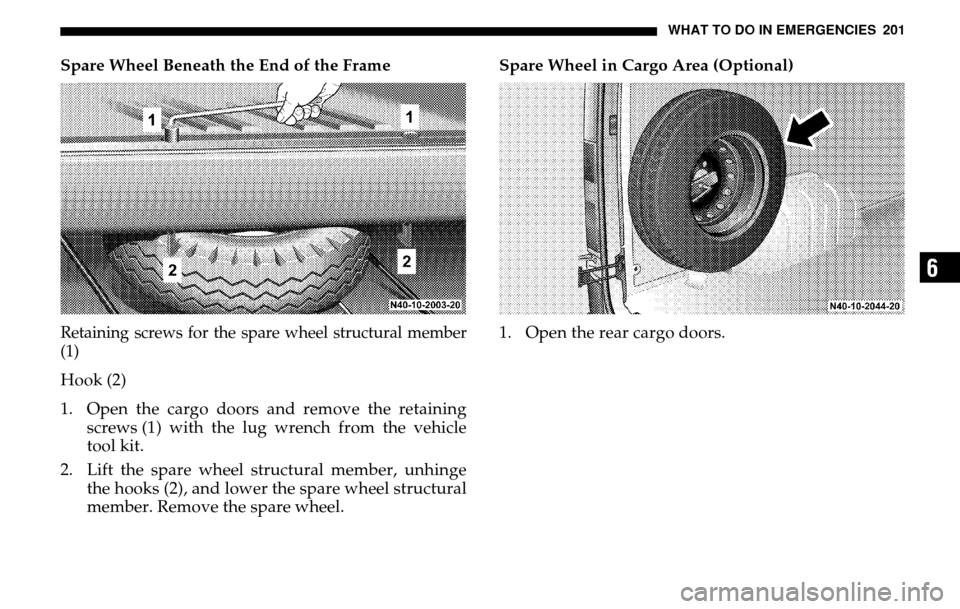
Spare Wheel Beneath the End of the FrameRetaining screws for the spare wheel structural member
(1)Hook (2)
1. Open the cargo doors and remove the retaining screws (1) with the lug wrench from the vehicle
tool kit.
2. Lift the spare wheel structural member, unhinge the hooks (2), and lower the spare wheel structural
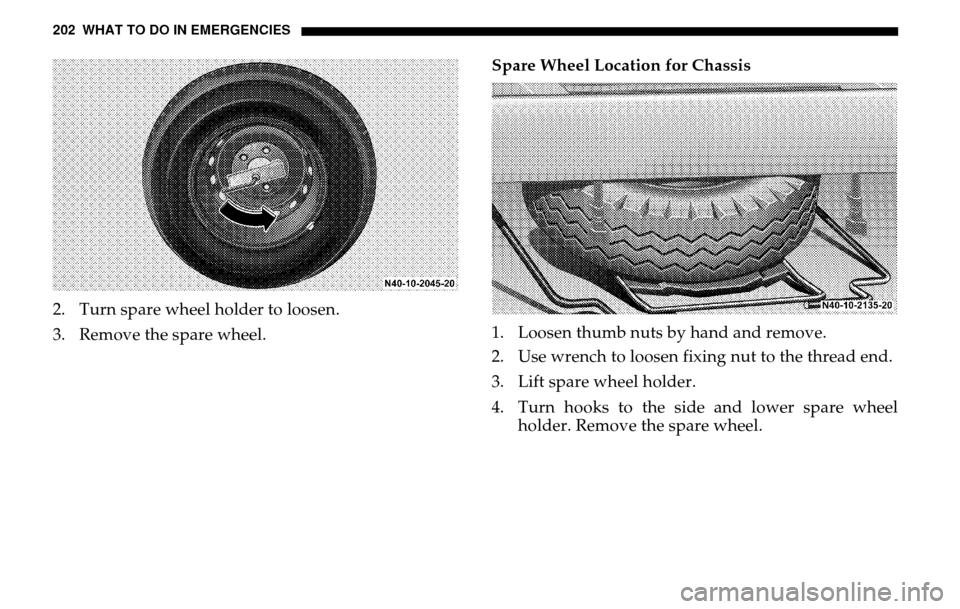
member. Remove the spare wheel. Spare Wheel in Cargo Area (Optional)
1. Open the rear cargo doors.
Page 202 of 288
202 WHAT TO DO IN EMERGENCIES2. Turn spare wheel holder to loosen.
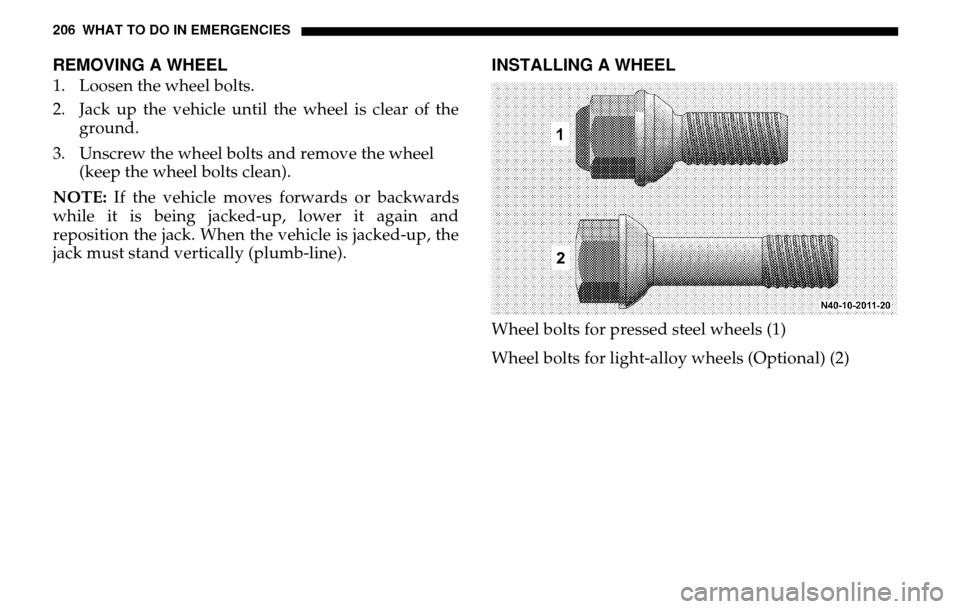
3. Remove the spare wheel. Spare Wheel Location for Chassis
1. Loosen thumb nuts by hand and remove.
2. Use wrench to loosen fixing nut to the thread end.
3. Lift spare wheel holder.
4. Turn hooks to the side and lower spare wheel
holder. Remove the spare wheel.
Page 203 of 288

WHAT TO DO IN EMERGENCIES 203
6
JACK Using the Jack
The jack is located together with the vehicle tool kit
under the hatch in the front passenger footwell, refer to
"Vehicle Tool Kit".
1. Loosen the wheel bolts before raising the vehicle.
2. Close the release valve on the jack.
3. Assemble the pump leve r provided and insert it
into the socket on the jack.
4. Secure the lever by turning it clockwise in the socket.
Position the jack under the appropriate jack point and
raise the vehicle by pumping the lever.
WARNING!
To avoid the risk of serious or fatal injuries or vehicle
damage, please bear the fo llowing points in mind:
The jack is intended only for raising the vehicle briefly, for instance, when changing a wheel. If it is
not designed to enable work to be carried out
underneath the vehicle.
Do not crawl under the jacked-up vehicle. For work
under the vehicle, stands must be used.
The jack must be placed on a firm, flat surface only.
Do not change wheels on uphill or downhill gradients under any circumstances.
Make sure that no persons are present in the vehicle when jacking up the vehicle.
Do not start the engine while the vehicle is raised.
Make sure that the distance between the underside of the tires and the ground does not exceed 1.2 in (30
mm). Otherwise the vehicle may tip over.
Page 206 of 288
206 WHAT TO DO IN EMERGENCIESREMOVING A WHEEL1. Loosen the wheel bolts.
2. Jack up the vehicle until the wheel is clear of the ground.
3. Unscrew the wheel bolts and remove the wheel
(keep the wheel bolts clean).
NOTE: If the vehicle moves forwards or backwards
while it is being jacked-up, lower it again and
reposition the jack. When the vehicle is jacked-up, the
jack must stand vertically (plumb-line).
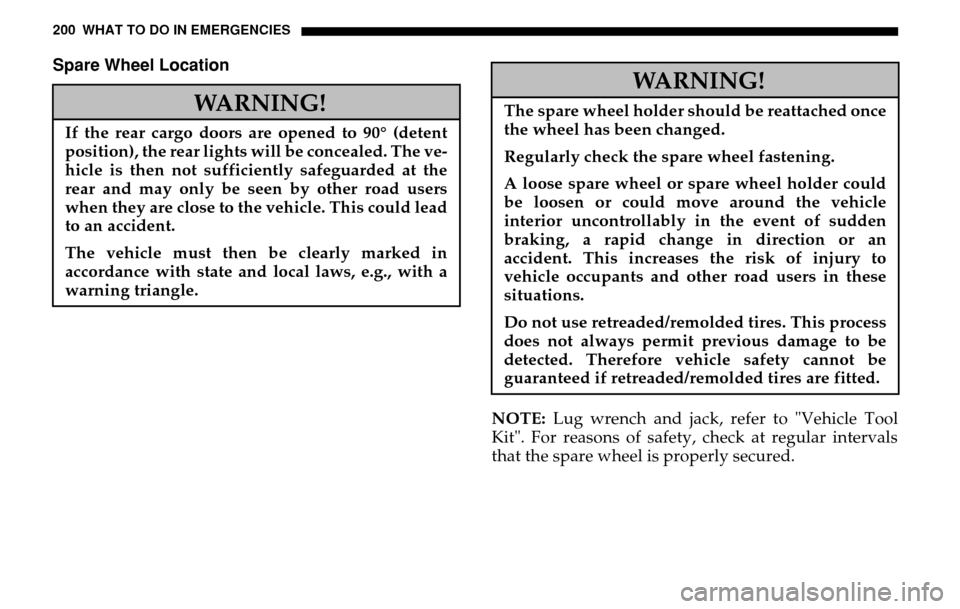
INSTALLING A WHEELWheel bolts for pressed steel wheels (1)
Wheel bolts for light-alloy wheels (Optional) (2)
Page 207 of 288
WHAT TO DO IN EMERGENCIES 207
6
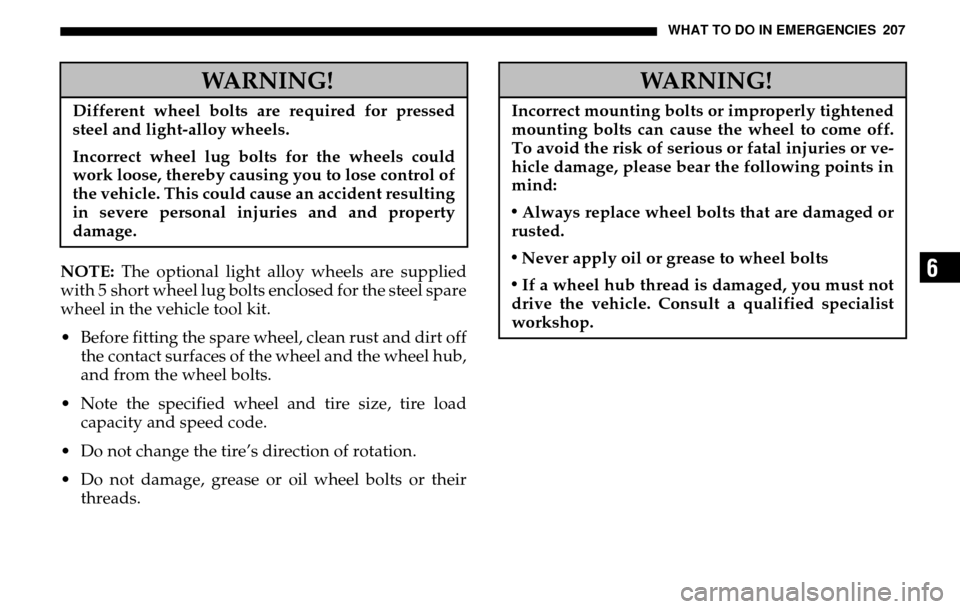
NOTE: The optional light alloy wheels are supplied
with 5 short wheel lug bolts enclosed for the steel spare
wheel in the vehicle tool kit.
Before fitting the spare wheel, clean rust and dirt off the contact surfaces of the wheel and the wheel hub,
and from the wheel bolts.
Note the specified wheel and tire size, tire load capacity and speed code.
Do not change the tire’s direction of rotation.
Do not damage, grease or oil wheel bolts or their threads.
WARNING!
Different wheel bolts are required for pressed
steel and light-alloy wheels.
Incorrect wheel lug bolts for the wheels could
work loose, thereby causing you to lose control of
the vehicle. This could cause an accident resulting
in severe personal injuries and and property
damage.
WARNING!
Incorrect mounting bolts or improperly tightened
mounting bolts can cause the wheel to come off.
To avoid the risk of serious or fatal injuries or ve-
hicle damage, please bear the following points in
mind:• Always replace wheel bolts that are damaged or
rusted.• Never apply oil or grease to wheel bolts• If a wheel hub thread is damaged, you must not
drive the vehicle. Consult a qualified specialist
workshop.