2005 CHRYSLER CROSSFIRE SRT ignition
[x] Cancel search: ignitionPage 143 of 280

Synchronizing ESP
If the power supply was interrupted (battery discon-
nected or discharged), the BAS/ESP malfunction indica-
tor light may be illuminated with the engine running. To
re-synchronize the ESP, and cancel the malfunction indi-
cator light, the steering angle sensor will need to be
recalibrated.
1. Turn the ignition switch to the ON/RUN position.
2. Rotate the steering wheel to the center position.
3. Rotate the steering wheel completely to the left, and
then rotate the steering wheel completely to the right.
4. Bring the steering wheel back to the center position.
5. The BAS/ESP malfunction indicator light will go out.
If the BAS/ESP malfunction indicator light is still illumi-
nated, the vehicle should be serviced at an authorized
dealer.
ESP Control switch
The ESP control switch is located in the center console.
When the ESP is switched off, the warning light in the
instrument cluster comes on. When the ESP is switched
on, the warning light goes out.
To improve the vehicle’s traction when driving with
snow chains, or starting off in deep snow, sand, or gravel,
switch off the ESP by pressing the upper half of the ESP
switch. The ESP warning light will then be continuously
STARTING AND OPERATING 143
5
Page 145 of 280

In the case of an emergency brake maneuver, keep
continuous full pressure on the brake pedal. In this
manner only can the ABS be most effective.
On slippery road surfaces, the ABS will respond even
with light brake pedal pressure because of the in-
creased likelihood of locking wheels. The pulsating
brake pedal can be an indication of hazardous road
conditions and functions as a reminder to take extra
care while driving.
WARNING!
Significant over- or under-inflation of tires, or mix-
ing sizes of front or rear tires or wheels on the
vehicle can reduce braking effectiveness. Maintain
proper tire pressure and always use the tires and
wheels specified in this manual for your vehicle.
The anti-lock brake system conducts a low-speed self-test
at about 12 mph (20 km/h). If you have your foot lightly
on the brake while this test is occurring, you may feel
slight pedal movement. The movement can be moreapparent on ice and snow. The anti-lock brake system
pump motor makes a low humming noise during opera-
tion, which is normal.
WARNING!
Pumping of the brake pedal will diminish the effec-
tiveness of the anti-lock brakes and may lead to an
accident. Pumping makes the stopping distance
longer. Just press firmly on your brake pedal when
you need to slow down or stop.
NOTE:During severe braking conditions, a pulsing
sensation may occur and a clicking noise will be heard.
This is normal, indicating that the anti-lock brake system
is functioning.
The ABS malfunction indicator light in the instrument
cluster comes on with the key in the ignition switch
turned to the ON/RUN position, and should go out with
the engine running. If the ABS light does not illuminate
STARTING AND OPERATING 145
5
Page 161 of 280

NOTE:The fuel tank filler tube has a restricting door
about 2 inches (50 mm) down from the opening. If fuel is
poured from a portable container, the container should
have a flexible nozzle long enough to force open the
restricting door.
CAUTION!
To avoid fuel spillage and overfilling, do not“top
off”the fuel tank after filling.
With the key in the ignition switch turned to the ON/
RUN position, the fuel reserve warning light comes on. It
should go out immediately when the engine is running.
If the warning light does not go out after starting the
engine, or if it comes on while driving, it indicates that
the fuel level is down to the reserve quantity of approxi-
mately 2.1 gallons (8 liters).
Leaving the engine running and the fuel cap open can
cause the CHECK ENGINE light to illuminate.
NOTE:
•
When the fuel nozzle“clicks”or shuts off, the fuel
tank is full.
•Tighten the gas cap until you hear a single click. This
is an indication that the gas cap is properly tightened.
The CHECK ENGINE light will come on if the gas cap
is not properly secured. Make sure that the gas cap is
tightened each time the vehicle is refueled.
WARNING!
•Never have any smoking materials lit in or near
the vehicle when the gas cap is removed or the
tank is filled.
•Never add fuel to the vehicle when the engine is
running.
•A fire may result if gasoline is pumped into a
portable container that is inside of a vehicle. You
could be burned. Always place gas containers on
the ground outside the vehicle while filling.
STARTING AND OPERATING 161
5
Page 166 of 280

HAZARD WARNING FLASHER
The flasher switch is located in the console. Push in
the flasher switch and all front and rear directional
signals will flash. Press the flasher switch a second
time to turn the flashers off.
Do not use this emergency warning system when the
vehicle is in motion. Use it when your vehicle is disabled
and is creating a safety hazard for other motorists.
If it is necessary to leave the vehicle to go for service, the
flasher system will continue to operate with the ignition
key removed and the vehicle locked.
NOTE:With extended use, the flasher may run down
your battery.
IF YOUR ENGINE OVERHEATS
During severe operating conditions and stop-and-go city
traffic, the coolant temperature may rise close to the red
area on the gauge.
The engine should not be operated with the coolant
temperature in the red area. Doing so may cause serious
damage which is not covered by the DaimlerChrysler
Limited Warranty.
In any of the following situations, you can reduce the
potential for overheating by taking the appropriate ac-
tion.
•On the highways–Slow down and use the highest
gear possible.
•In city traffic–While stopped, put the transmission in
Neutral, but do not increase engine idle speed.
•In city traffic–While moving, shift into the highest
gear possible to reduce engine RPM.
166 WHAT TO DO IN EMERGENCIES
Page 169 of 280

Sealing tire with TIREFIT
1. Set the parking brake and turn on the hazard warning
flashers.
2. Move the transmission selector lever to the PARK
position and turn off the engine.
3. Remove the TIREFIT kit and electric air pump from
the area below the cargo compartment carpet.
4. Open flap (2) on the electric air pump.
5. Pull the power plug (4) and air hose (5) along with the
pressure gauge out of the air pump housing.
6. Screw the air hose (5) onto the hose connection on the
TIREFIT sealant bottle (1).
7. Holding the sealant bottle by the top, insert it down-
wards into the recess (3) on the air pump.
8. Unscrew the valve cap from the valve on the deflated
tire.
9. Screw the filler hose from the sealant bottle on the tire
valve.10. Insert the power plug (4) into the power point on the
instrument panel.
11. Turn the ignition key to the ON/RUN position.
12. Press the switch on the air pump to 1. The air pump
should start to inflate the tire.
13. After five minutes, the tire should be inflated to at
least 26 psi (180 kPa) on the pressure gauge.
14. If the tire doesn’t inflate to this level, press the air
pump switch to 0, disconnect the TIREFIT system from
the tire, and drive the vehicle back and forth approxi-
mately 30 feet (9.1 m) to distribute the sealant more
evenly within the tire.
15. Attach the air pump hose directly to the tire, press the
switch to 1, and inflate the tire again.NOTE:If a tire
pressure of 26 psi (180 kPa) is not reached after five
minutes, the tire is too badly damaged. Do not attempt to
drive the vehicle further, and call for assistance.
WHAT TO DO IN EMERGENCIES 169
6
Page 170 of 280

16. If a tire pressure of 26 psi (180 kPa) is obtained, press
the air pump switch to 0, turn the ignition switch to the
OFF/LOCK position, and disconnect the TIREFIT sys-
tem.
17. Drive the vehicle for about 10 minutes to ensure
optimum distribution of the tire sealant within the tire.
18. Check the pressure in the tire. If the pressure is above
19 psi (130 kPa), inflate the tire to the pressure indicated
on the tire pressure label on the driver side latch pillar.
19. Have the tire inspected at the earliest opportunity at
an authorized dealer or tire service center.
NOTE:Do not exceed 50 mph (80 km/h) until the tire
has been inspected.
NOTE:If a pressure of at least 19 psi (130 kPa) cannot
be maintained in the tire, the tire is too badly damaged.
Do not attempt to drive the vehicle further, and call for
assistance.
NOTE:Do not operate the electric air pump for more
than eight minutes to avoid overheating. The air pump
may be used again once it has cooled down.
NOTE:Replace the TIREFIT sealant bottle once every
four years to assure optimum operation of the system.
NOTE:If TIREFIT is liquid, clean water and a damp
cloth will remove the material from the vehicle or tire and
wheel components. Once TIREFIT sealing material has
dried, it can easily be peeled off and properly discarded.
Preparations for Jacking
WARNING!
Getting under a jacked-up vehicle is dangerous. The
vehicle could slip off the jack and fall on you. You
could be crushed. Never get any part of your body
under a vehicle that is on a jack. Never start or run
the engine while the vehicle is on a jack. If you need
to get under a raised vehicle, take it to a service
facility where it can be raised on a lift.
170 WHAT TO DO IN EMERGENCIES
Page 174 of 280

NOTE:Before storing the jack, it should be fully
collapsed.
6. Ensure proper tire pressure.
WARNING!
Raising the vehicle higher than necessary can make
the vehicle less stable. It could slip off the jack and
hurt someone near it. Raise the vehicle only enough
to make the necessary repair.
WARNING!
A loose jack or tool thrown forward in a collision or
hard stop could endanger the occupants of the ve-
hicle. Always stow the jack parts and tools in the
places provided.
JUMP-STARTING THE BATTERY
WARNING!
Take care to avoid the radiator cooling fan whenever
the hood is raised. It can start any time the ignition
switch is on. You can be hurt by the fan.
CAUTION!
Do not try to push or tow your vehicle to get it
started. Your vehicle cannot be started this way.
Pushing with another vehicle may damage the trans-
mission or the rear of your vehicle. If your vehicle
has a discharged (dead) battery, booster cables may
be used to obtain a start from another vehicle. This
type of start can be dangerous if done improperly, so
follow the procedure carefully.
174 WHAT TO DO IN EMERGENCIES
Page 175 of 280
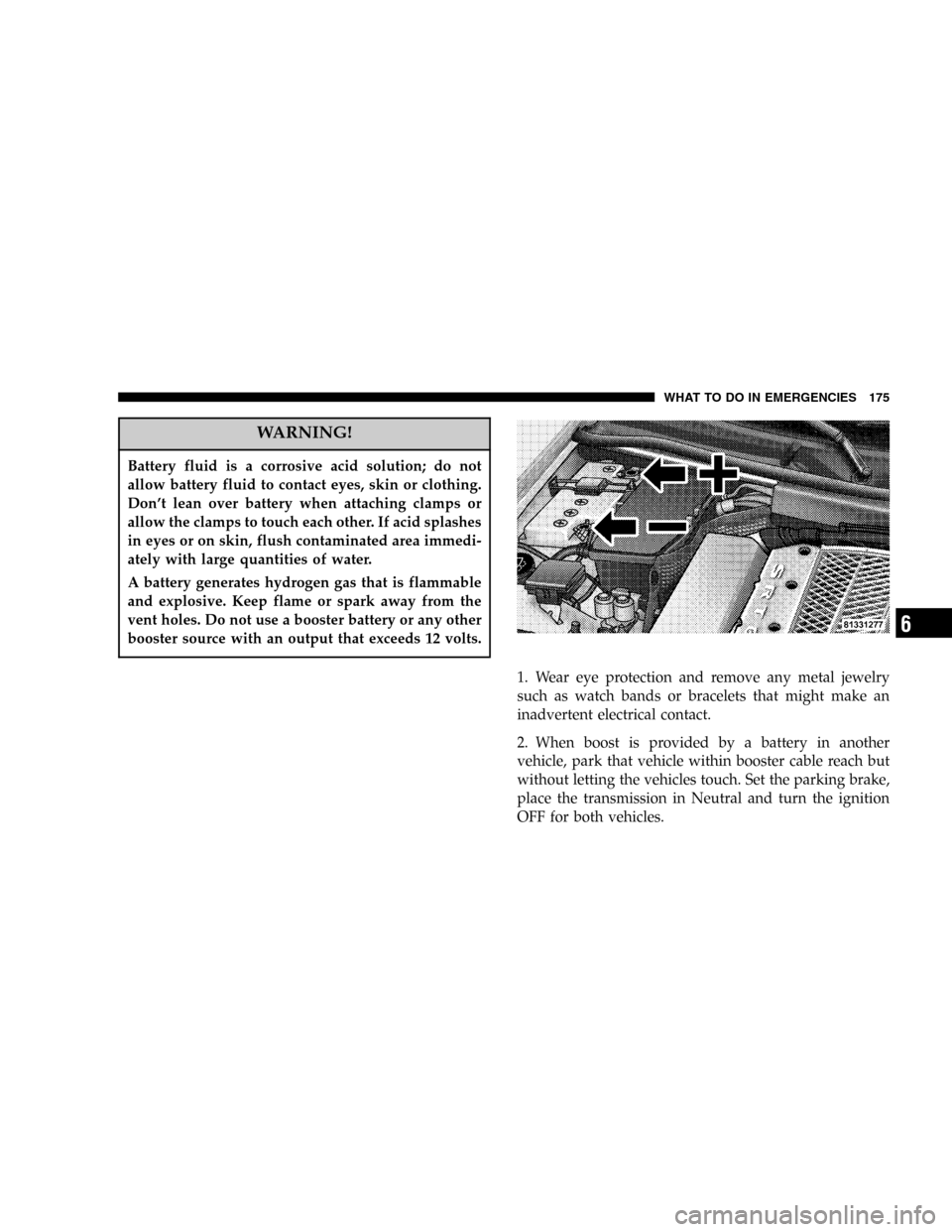
WARNING!
Battery fluid is a corrosive acid solution; do not
allow battery fluid to contact eyes, skin or clothing.
Don’t lean over battery when attaching clamps or
allow the clamps to touch each other. If acid splashes
in eyes or on skin, flush contaminated area immedi-
ately with large quantities of water.
A battery generates hydrogen gas that is flammable
and explosive. Keep flame or spark away from the
vent holes. Do not use a booster battery or any other
booster source with an output that exceeds 12 volts.
1. Wear eye protection and remove any metal jewelry
such as watch bands or bracelets that might make an
inadvertent electrical contact.
2. When boost is provided by a battery in another
vehicle, park that vehicle within booster cable reach but
without letting the vehicles touch. Set the parking brake,
place the transmission in Neutral and turn the ignition
OFF for both vehicles.
WHAT TO DO IN EMERGENCIES 175
6