Page 74 of 280

EXTERIOR LIGHTS
Headlights and Parking Lights
When the headlight switch is turned clockwise from OFF
to the first position, the parking lights, taillights, side
marker lights, license plate lights and instrument panel
lights are all illuminated.
The headlights turn on when the switch is turned to the
second position.
Lights-On Reminder
If the headlights or parking lights are left on after the
ignition is turned off, a warning will sound if the driver’s
door is opened.
Daytime Running Lights (Where Applicable)
The low beam headlights, parking lights, side marker
lights, taillights and license plate lights are automatically
switched on whenever the vehicle is started and the
transmission gear selector is in a driving position.
For nighttime driving, the exterior lights switch should
be in the low beam position to permit activation of the
high beam headlights.
Fog Lights
To operate the fog lights, pull the headlight
switch out one stop, with the parking lights
and/or low beam headlights on. A light to the
lower left of the headlight switch will illumi-
nate when the fog lights are on.
To turn off the fog lights, push the headlight switch in
fully. Selecting high beam headlights will also turn off the
fog lights.
74 UNDERSTANDING THE FEATURES OF YOUR VEHICLE
Page 75 of 280
Standing Lights
When the vehicle is parked on the street, the standing
lights (left or right side parking lights) can be turned on,
making your vehicle more visible to passing vehicles.
To operate the standing lights, turn the headlight switch
counterclockwise one stop (right lamps) or two stops (left
lamps) from the OFF position. To turn off the standing
lights, return the headlight switch to the OFF position.
The standing lights cannot be operated when the ignition
switch is in the ON/RUN position.
CAUTION!
Standing lamps are intended for short term use
when parking. If these lights are left on for a long
period of time, your car’s battery may drain, causing
a possible starting problem. Assure that the head-
lamp switch is in the OFF position when leaving the
vehicle.
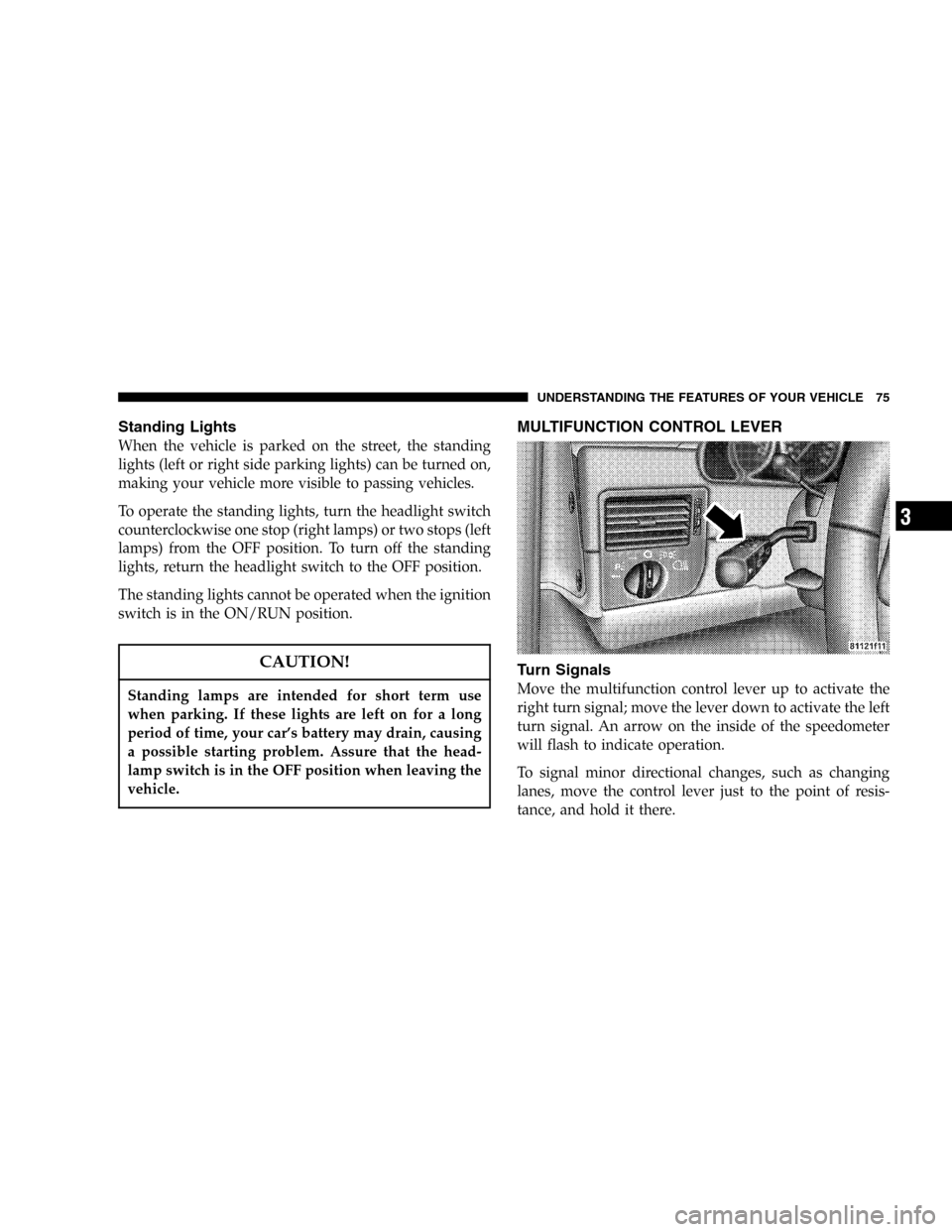
MULTIFUNCTION CONTROL LEVER
Turn Signals
Move the multifunction control lever up to activate the
right turn signal; move the lever down to activate the left
turn signal. An arrow on the inside of the speedometer
will flash to indicate operation.
To signal minor directional changes, such as changing
lanes, move the control lever just to the point of resis-
tance, and hold it there.
UNDERSTANDING THE FEATURES OF YOUR VEHICLE 75
3
Page 83 of 280

The malfunction indicator lamp for the Electronic Stabil-
ity Program is combined with the BAS. The yellow
BAS/ESP malfunction indicator light in the instrument
cluster and the yellow ESP warning light in the speed-
ometer dial come on with the key in the ignition switch
turned to the ON/RUN position. They should go out
with the engine running. If the BAS/ESP malfunction
indicator light comes on continuously with the engine
running, a malfunction has been detected in either sys-
tem.
If the malfunction indicator light stays illuminated, have
the BAS and ESP checked at your authorized dealer as
soon as possible.ELECTRONIC STABILITY PROGRAM (ESP)
WARNING!
ESP cannot prevent the natural laws of physics from
acting on the vehicle, nor can it increase the traction
afforded. The ESP cannot prevent accidents, includ-
ing those resulting from excessive speed in turns, or
hydroplaning. Only a safe, attentive, and skillful
driver can prevent accidents. The capabilities of an
ESP-equipped vehicle must never be exploited in a
reckless or dangerous manner which could jeopar-
dize the user’s safety or the safety of others.
The ESP enhances directional control and reduces driving
wheel spin of the vehicle under various driving condi-
tions.
UNDERSTANDING THE FEATURES OF YOUR VEHICLE 83
3
Page 85 of 280

If the ESP warning light begins to flash during accelera-
tion, ease up on the accelerator and apply as little throttle
as possible. Be sure to adapt your speed and driving to
the prevailing road conditions. When the ESP warning
light is illuminated continuously, the ESP is switched off.
To return to the enhanced vehicle stability offered by ESP,
press the lower half of the switch (the ESP warning light
in the speedometer dial goes out). Avoid spinning one
drive wheel. This may cause serious damage to the drive
train and is not covered by the DaimlerChrysler war-
ranty.
CAUTION!
If the vehicle is towed with the front axle raised, the
engine must be shut off (key in the ignition switch to
the OFF/LOCK or ACC position). Otherwise the ESP
will immediately be engaged and will apply the rear
wheel brakes.
Synchronizing ESP
If the power supply was interrupted (battery discon-
nected or discharged), the BAS/ESP malfunction indica-
tor light may be illuminated with the engine running. To
re-synchronize the ESP, and cancel the malfunction indi-
cator light, the steering angle sensor will need to be
recalibrated.
1. Turn the ignition switch to the ON/RUN position.
2. Rotate the steering wheel to the center position.
3. Rotate the steering wheel completely to the left, and
then rotate the steering wheel completely to the right.
4. Bring the steering wheel back to the center position.
5. The BAS/ESP malfunction indicator light will go out.
If the BAS/ESP malfunction indicator light is still illumi-
nated, the vehicle should be serviced at an authorized
dealer.
UNDERSTANDING THE FEATURES OF YOUR VEHICLE 85
3
Page 88 of 280
To Deactivate
A soft tap on the brake pedal, or normal brake pressure
while slowing the vehicle, will deactivate the speed
control without erasing the memory. Pushing the speed
control lever forward or turning the key in the ignition
switch to the OFF/LOCK position will turn off the speed
control and erase the memory.
To Resume Speed
To resume a previously set speed, pull the speed control
lever toward you, and then release. The resume feature
can be used at any speed above 20 mph (30 km/h).
NOTE:Moving the gear selector lever to the“N”
position will switch the speed control off.
88 UNDERSTANDING THE FEATURES OF YOUR VEHICLE
Page 90 of 280

WARNING!
A moving garage door can cause injury to people and
pets in the path of the door. People or pets could be
seriously or fatally injured. Only use this transceiver
with a garage door opener that has a“stop and
reverse”feature, as required by federal safety stan-
dards. This includes most garage door opener mod-
els manufactured after 1982. Do not use a garage
door opener without these safety features, as it could
cause injury or death. Call toll-free 1–800–355–3515
or, on the internet at www.homelink.com for safety
information and assistance.
Programming The Universal Transceiver
For best results, install a new battery in the hand-held
transmitter before programming. If your garage door
opener (located in the garage) is equipped with an
antenna, make sure that the antenna is hanging straight
down.
1. Turn off the engine.
WARNING!
Vehicle exhaust contains carbon monoxide, a danger-
ous gas. Do not run the vehicle’s engine while
programming the transceiver. Exhaust gas can cause
serious injury or death.
WARNING!
Your motorized door or gate will open and close
while you are programming the universal trans-
ceiver. Do not program the transceiver if people or
pets are in the path of the door or gate. A moving
door or gate can cause serious injury or death to
people and pets or damage to objects.
2. Turn the ignition to the ON/RUN position.
3. Erase the factory test codes by pressing the two
outside buttons. Release the buttons when the light in the
overhead console display begins to flash (about 20 sec-
onds).
90 UNDERSTANDING THE FEATURES OF YOUR VEHICLE
Page 97 of 280
INSTRUMENT CLUSTER
The instrument cluster displays are activated by either
opening the door, pressing the left button within the
cluster, or turning the key in the ignition switch to the
ON/RUN position.
UNDERSTANDING YOUR INSTRUMENT PANEL 97
4
Page 98 of 280

INSTRUMENT CLUSTER DESCRIPTION
1. Low Windshield Washer System Fluid Level
Warning Light
With the key in the ignition switch turned to
the ON/RUN position, the indicator light
comes on. It should go out when the engine
is running.
If the indicator light does not go out after starting the
engine, or if it comes on while driving, the fluid reservoir
is less than
1⁄4filled.
The reservoir should be refilled at the next opportunity
with commercially available premixed windshield
washer solvent/antifreeze or water, depending on ambi-
ent temperature.
The reservoir for the windshield washer system is located
in the engine compartment and the cap is marked with
the above symbol.
WARNING!
Do not overfill the washer reservoir. Do not attempt
to fill to the top of the filler neck. Fluid may leak out
onto the floor or driveway causing a potential slip
and fall hazard. When the indicator light first illu-
minates, the maximum fill amount is 1 Gallon (4
Liters).
2. Low Tire Pressure Indicator Light
The tire pressure monitor (TPM) system uses
wireless technology to monitor tire pressure
levels. Sensors, mounted to each wheel as
part of the valve stem, transmit tire pressure
readings to a receiver located in the vehicle.
If the light is illuminated, the pressure in one of the tires
on the vehicle has dropped to at least 25% below the
recommended pressure on the vehicle’s tire label. Addi-
tionally, the indicator light will illuminate if a fault has
been detected in the TPM system.
98 UNDERSTANDING YOUR INSTRUMENT PANEL