Page 380 of 460
Used Replacement Wheels
{CAUTION:
Putting a used wheel on your vehicle is
dangerous. You cannot know how it has been
used or how far it has been driven. It could fail
suddenly and cause a crash. If you have to
replace a wheel, use a new GM original
equipment wheel.
Tire Chains
{CAUTION:
Do not use tire chains. There is not enough
clearance. Tire chains used on a vehicle
without the proper amount of clearance can
cause damage to the brakes, suspension or
other vehicle parts. The area damaged by the
tire chains could cause you to lose control of
your vehicle and you or others may be injured
in a crash.
Use another type of traction device only if its
manufacturer recommends it for use on your
vehicle and tire size combination and road
conditions. Follow that manufacturer’s
instructions. To help avoid damage to your
vehicle, drive slowly, readjust or remove the
device if it is contacting your vehicle, and do
not spin your vehicle’s wheels. If you do nd
traction devices that will t, install them on the
front tires.
5-64
Page 387 of 460

3. Tilt the retainer at the end of the cable to remove
the compact spare tire, so it can be pulled up
through the wheel opening.
If your vehicle is an AWD vehicle, after removing
the compact spare tire, turn the wrench clockwise to
raise the cable back up. On an AWD vehicle, you
can not store a full-size tire under the vehicle.
It should be stowed inside the vehicle by the cable
provided. See “Storing the Flat Tire on an
All-Wheel-Drive Vehicle” underStoring a Flat or
Spare Tire and Tools on page 5-80for more
information.If you have a front-wheel-drive vehicle, the hoist is
used to store a full-size or a at road tire under
the vehicle. See “Storing the Flat Tire on an
Front-Wheel-Drive Vehicle” underStoring a Flat or
Spare Tire and Tools on page 5-80for more
information.
4. Remove the compact spare tire from the cable.
If the compact spare tire will not lower, check under the
vehicle to see if the tire is hanging loose and the
cable end and spring under the wheel plate are missing.
If so, the secondary latch system is engaged. See
Secondary Latch System on page 5-78.
To continue changing the at tire, seeRemoving the
Flat Tire and Installing the Spare Tire on page 5-72.
5-71
Page 400 of 460
Storing the Tools
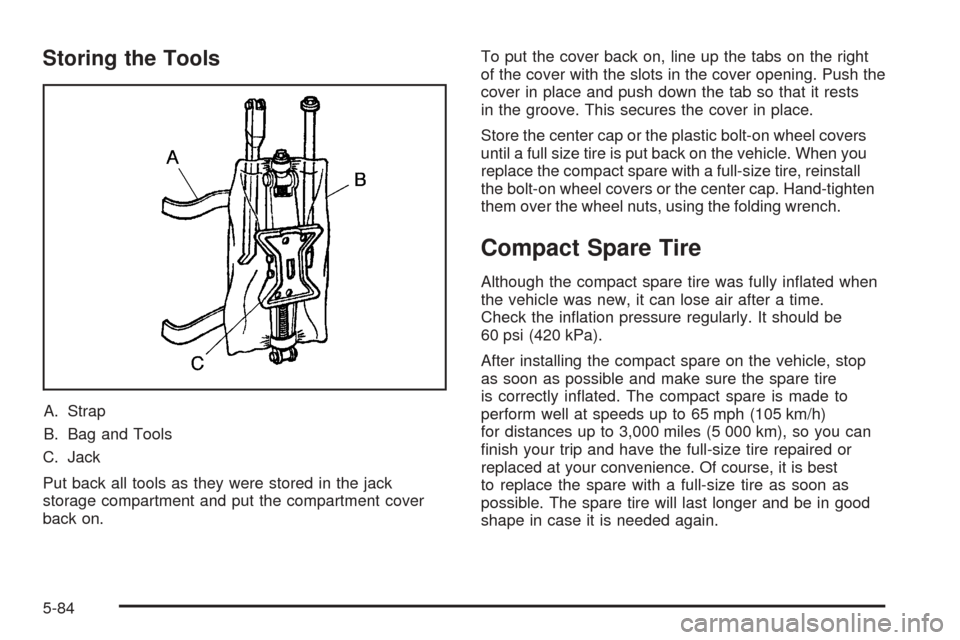
A. Strap
B. Bag and Tools
C. Jack
Put back all tools as they were stored in the jack
storage compartment and put the compartment cover
back on.To put the cover back on, line up the tabs on the right
of the cover with the slots in the cover opening. Push the
cover in place and push down the tab so that it rests
in the groove. This secures the cover in place.
Store the center cap or the plastic bolt-on wheel covers
until a full size tire is put back on the vehicle. When you
replace the compact spare with a full-size tire, reinstall
the bolt-on wheel covers or the center cap. Hand-tighten
them over the wheel nuts, using the folding wrench.
Compact Spare Tire
Although the compact spare tire was fully inated when
the vehicle was new, it can lose air after a time.
Check the ination pressure regularly. It should be
60 psi (420 kPa).
After installing the compact spare on the vehicle, stop
as soon as possible and make sure the spare tire
is correctly inated. The compact spare is made to
perform well at speeds up to 65 mph (105 km/h)
for distances up to 3,000 miles (5 000 km), so you can
nish your trip and have the full-size tire repaired or
replaced at your convenience. Of course, it is best
to replace the spare with a full-size tire as soon as
possible. The spare tire will last longer and be in good
shape in case it is needed again.
5-84