Page 273 of 400
When replacing the fuel cap, turn it clockwise until it
clicks. Make sure the cap is fully installed. The
diagnostic system can determine if the fuel cap has
been left off or improperly installed. This would allow fuel
to evaporate into the atmosphere. SeeMalfunction
Indicator Lamp on page 3-42.
The CHECK GAS CAP message will be displayed on
the Driver Information Center (DIC) if the fuel cap is not
properly installed. SeeDIC Warnings and Messages
on page 3-54for more information.
{CAUTION:
If a re starts while you are refueling, do not
remove the nozzle. Shut off the ow of fuel by
shutting off the pump or by notifying the
station attendant. Leave the area immediately.
Notice:If you need a new fuel cap, be sure to get
the right type. Your dealer can get one for you.
If you get the wrong type, it may not t properly.
This may cause your malfunction indicator lamp to
light and may damage your fuel tank and emissions
system. SeeMalfunction Indicator Lamp on
page 3-42.
Filling a Portable Fuel Container
{CAUTION:
Never ll a portable fuel container while it is in
your vehicle. Static electricity discharge from
the container can ignite the gasoline vapor.
You can be badly burned and your vehicle
damaged if this occurs. To help avoid injury to
you and others:
Dispense gasoline only into approved
containers.
Do not ll a container while it is inside a
vehicle, in a vehicle’s trunk, pickup bed, or
on any surface other than the ground.
Bring the ll nozzle in contact with the
inside of the ll opening before operating
the nozzle. Contact should be maintained
until the lling is complete.
Do not smoke while pumping gasoline.
5-9
Page 277 of 400

A. Clutch Master Cylinder Reservoir (If Equipped). See
Hydraulic Clutch on page 5-20.
B. Windshield Washer Fluid Reservoir. See “Adding
Washer Fluid” underWindshield Washer Fluid
on page 5-33.
C. Brake Fluid Reservoir. See “Brake Fluid” under
Brakes on page 5-34.
D. Coolant Surge Tank and Pressure Cap. SeeEngine
Coolant on page 5-21.
E. Engine Air Cleaner/Filters. SeeEngine Air
Cleaner/Filter on page 5-18.
F. Power Steering Fluid Reservoir. SeePower Steering
Fluid on page 5-31.
G. Engine Oil Fill Cap. See “When to Add Engine Oil”
underEngine Oil on page 5-13.
H. Engine Oil Dipstick. See “Checking Engine Oil”
underEngine Oil on page 5-13.
I. Engine Compartment Fuse Block. SeeEngine
Compartment Fuse Block on page 5-89.
J. Passenger Compartment Air Filter (Out of View).
SeePassenger Compartment Air Filter on page 3-31.
K. Battery. SeeBattery on page 5-37.Engine Oil
If the LOW OIL LEVEL message on the Driver
Information Center (DIC) comes on, it means you need
to check your engine oil level right away. For more
information, seeDriver Information Center (DIC)
on page 3-49.
You should check your engine oil level regularly; this is
an added reminder.
Checking Engine Oil
It is a good idea to check your engine oil level every
time you get fuel. In order to get an accurate reading,
the oil must be warm and the vehicle must be on
level ground.
The engine oil dipstick handle is a yellow loop. See
Engine Compartment Overview on page 5-12for
the location of the engine oil dipstick.
1. Turn off the engine and give the oil a few minutes
to drain back into the oil pan. If you do not do this,
the oil dipstick might not show the actual level.
2. Pull out the dipstick and clean it with a paper towel
or a cloth, then push it back in all the way. Remove
it again, keeping the tip down.
5-13
Page 293 of 400
{CAUTION:
Adding only plain water to your cooling
system can be dangerous. Plain water, or
some other liquid such as alcohol, can boil
before the proper coolant mixture will. Your
vehicle’s coolant warning system is set for the
proper coolant mixture. With plain water or the
wrong mixture, your engine could get too hot
but you would not get the overheat warning.
Your engine could catch re and you or others
could be burned. Use a 50/50 mixture of clean,
drinkable water and DEX-COOL
®coolant.
Notice:In cold weather, water can freeze and crack
the engine, radiator, heater core and other parts.
Use the recommended coolant and the proper
coolant mixture.
{CAUTION:
You can be burned if you spill coolant on hot
engine parts. Coolant contains ethylene glycol
and it will burn if the engine parts are hot
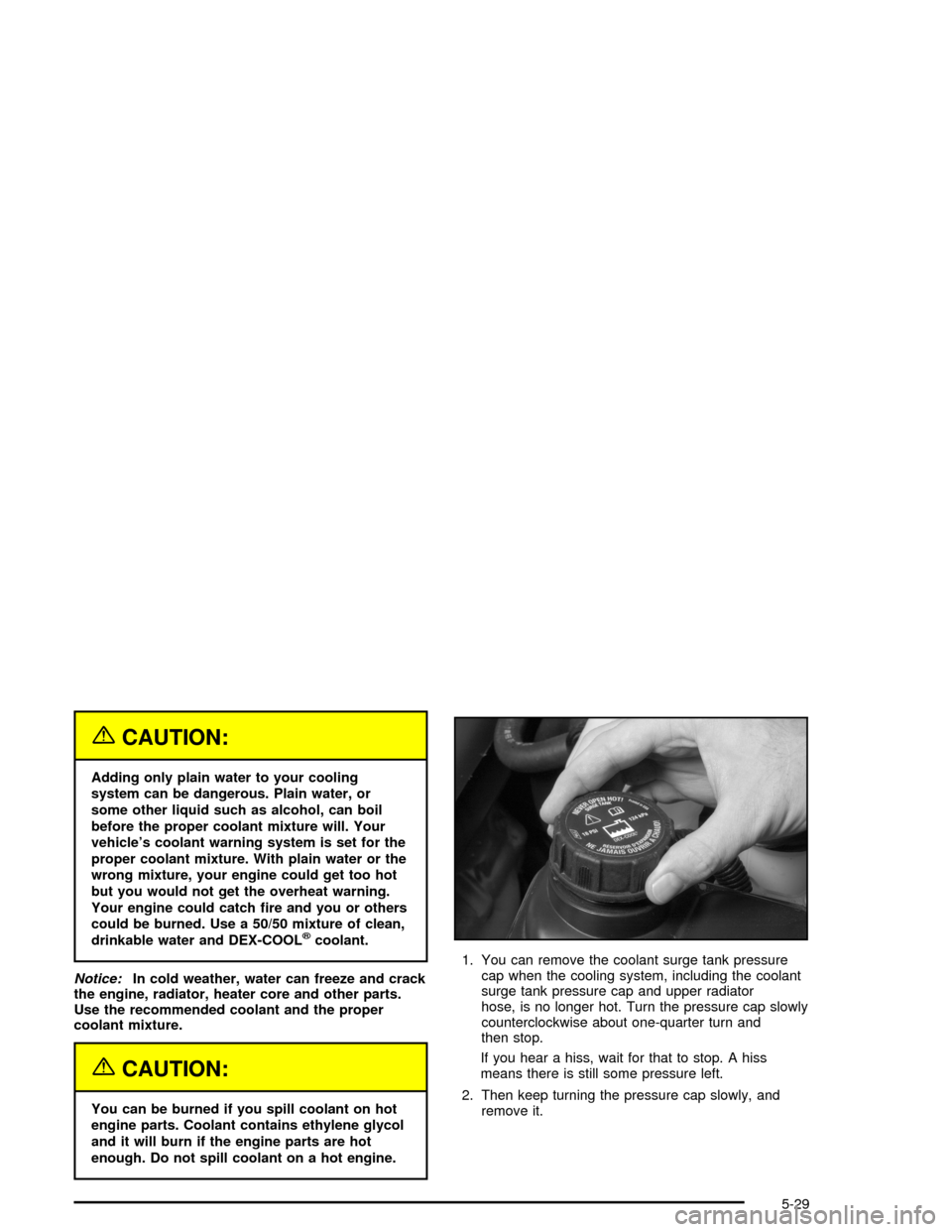
enough. Do not spill coolant on a hot engine.1. You can remove the coolant surge tank pressure
cap when the cooling system, including the coolant
surge tank pressure cap and upper radiator
hose, is no longer hot. Turn the pressure cap slowly
counterclockwise about one-quarter turn and
then stop.
If you hear a hiss, wait for that to stop. A hiss
means there is still some pressure left.
2. Then keep turning the pressure cap slowly, and
remove it.
5-29
Page 303 of 400
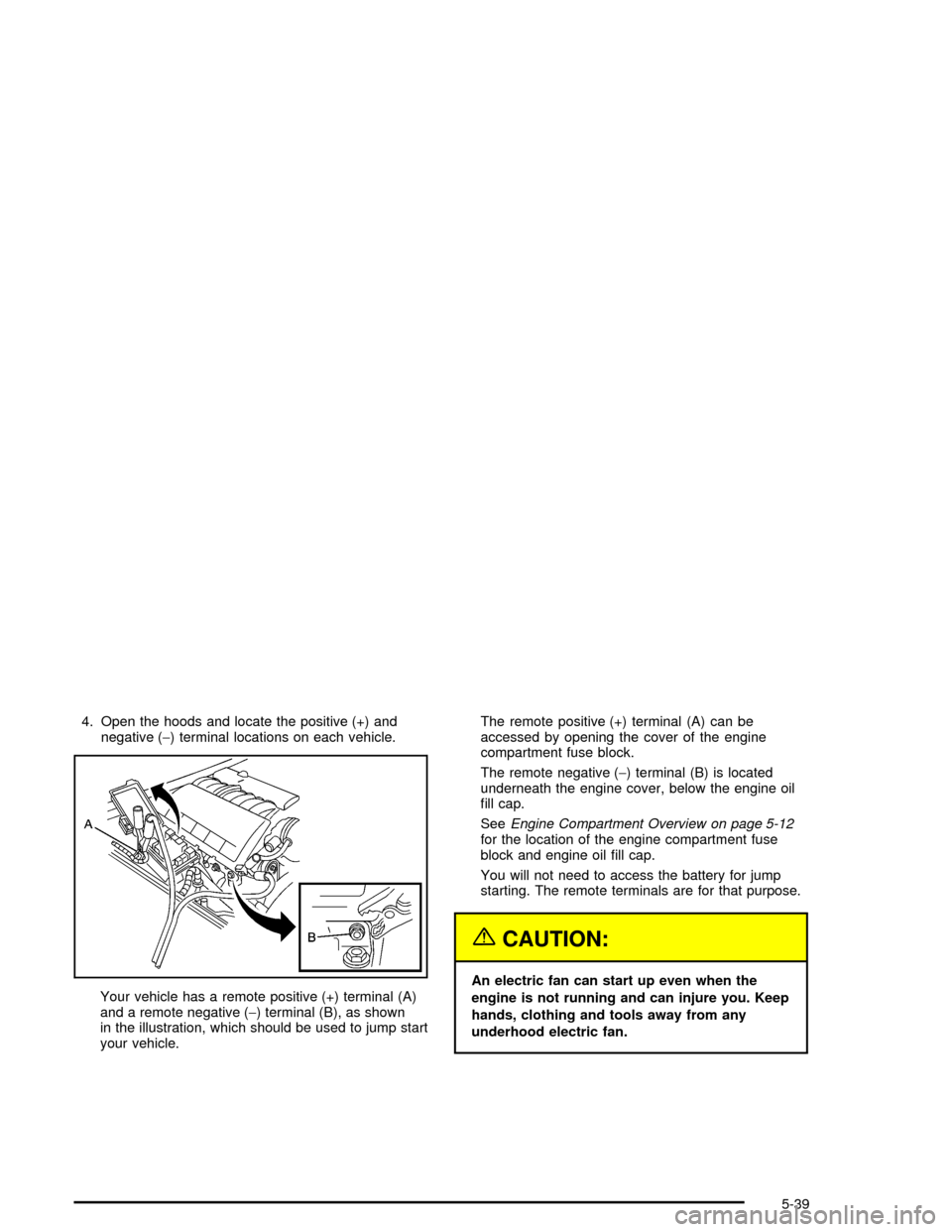
4. Open the hoods and locate the positive (+) and
negative (−) terminal locations on each vehicle.
Your vehicle has a remote positive (+) terminal (A)
and a remote negative (−) terminal (B), as shown
in the illustration, which should be used to jump start
your vehicle.The remote positive (+) terminal (A) can be
accessed by opening the cover of the engine
compartment fuse block.
The remote negative (−) terminal (B) is located
underneath the engine cover, below the engine oil
ll cap.
SeeEngine Compartment Overview on page 5-12
for the location of the engine compartment fuse
block and engine oil ll cap.
You will not need to access the battery for jump
starting. The remote terminals are for that purpose.
{CAUTION:
An electric fan can start up even when the
engine is not running and can injure you. Keep
hands, clothing and tools away from any
underhood electric fan.
5-39
Page 306 of 400
Notice:If the jumper cables are connected or
removed in the wrong order, electrical shorting may
occur and damage the vehicle. The repairs would
not be covered by your warranty. Always connect
and remove the jumper cables in the correct
order, making sure that the cables do not touch
each other or other metal.
A. Heavy, Unpainted Metal Engine Part or Remote
Negative (−) Terminal
B. Good Battery or Remote Positive (+) and
Negative (−) Terminals
C. Dead Battery or Remote Positive (+) TerminalTo disconnect the jumper cables from both vehicles, do
the following:
1. Disconnect the black negative (−) cable from the
vehicle that had the dead battery.
2. Disconnect the black negative (−) cable from the
vehicle with the good battery.
3. Disconnect the red positive (+) cable from the
vehicle with the good battery.
4. Disconnect the red positive (+) cable from the other
vehicle.
5. Return the engine fuse block cover to its original
position.
Jumper Cable Removal
5-42
Page 310 of 400
To replace a high-beam or front parking/turn signal/DRL
bulb, do the following:
1. Turn the wheel to allow access to the wheel well.
2. Access the high-beam or front parking/turn signal
bulbs by removing the access panel. To do this,
remove the three outer fasteners and ip back
the cover.3. Remove the outer cover to expose the high-beam
headlamp bulb socket once the access cover has
been removed.
4. Remove the headlamp
bulb by releasing the
outer tabs from
the socket.
5. Remove the front parking/turn signal bulb by turning
the bulb socket counterclockwise.
6. Replace the high-beam headlamp bulb with a new
bulb and reattach to the bulb socket.
Replace the front parking/turn signal bulb by turning
the bulb socket clockwise.
7. Reverse the Steps 2 through 4 to reinstall.
5-46
Page 311 of 400
Sidemarker Lamps
To replace a front sidemarker bulb, do the following:
1. Turn the wheel to allow access to the wheel well.
2. Remove the ve fasteners along the outer edge of
the wheel well.
3. Pull back the wheel well trim.
4. Reach in and locate the sidemarker bulb.5. Remove the bulb socket by turning it
counterclockwise.
6. Remove the bulb by
pushing in on the tab
on the bulb socket
and then remove
the bulb.
7. Replace with a new bulb.
8. Replace the bulb socket by turning it clockwise into
the bulb assembly.
9. Replace the fasteners into the wheel well trim.
When replacing the fasteners, the two largest
fasteners will be replaced in the two bottom
positions of the wheel well trim. If not, you will nd
that the fasteners do not t properly.
5-47
Page 312 of 400

Taillamps, Turn Signal, and
Stoplamps
To replace a stoplamp, taillamp/turn signal bulb, do the
following:
1. Remove the screw from the top of the lamp
assembly.
2. Tilt out the lamp assembly.
3. Turn the bulb socket one-quarter turn
counterclockwise and pull it out.4. Pull the bulb straight out to remove it from the
socket.
5. Push the new bulb in the bulb socket until it snaps
into place.
6. Reinstall the lamp assembly by rst lining up the
tabs on the bottom of the lamp assembly with the
tabs in the vehicle, then slide it in.
7. Replace the screw at the top of the lamp assembly.
Replacement Bulbs
Exterior Lamp Bulb Number
Front Parking/Turn Signal/DRL 5702KA
Headlamp, High-Beam H9
Stoplamp/Taillamp/Turn Signal 3057KK
For replacement bulbs not listed here, contact your
dealer.
Windshield Replacement
Keep in mind that your windshield is part of the Head-Up
Display (HUD) system. If you ever have to get your
windshield replaced, be sure to get one that is designed
for HUD or your HUD image may look blurred or out
of focus.
5-48