2005 CHEVROLET ASTRO CARGO VAN stop start
[x] Cancel search: stop startPage 208 of 370
Maintenance When Trailer Towing
Your vehicle will need service more often when you’re
pulling a trailer. See the Maintenance Schedule for more
on this. Things that are especially important in trailer
operation are automatic transmission uid (don’t overll),
engine oil, axle lubricant, belt, cooling system and brake
system. Each of these is covered in this manual, and the
Index will help you nd them quickly. If you’re trailering,
it’s a good idea to review these sections before you start
your trip.
Check periodically to see that all hitch nuts and bolts
are tight.
Trailer Wiring Harness
If you have the optional trailering package, your vehicle
will have an eight-wire harness, including the center
high-mounted stoplamp battery feed wire. The harness is
stored on the passenger’s side of the vehicle near the
rear wheel well. This harness has a 30 amp battery feed
wire and no connector, and should be wired by a qualied
electrical technician. After choosing an aftermarket trailer
mating connector pair, have the technician attach one
connector to the eight-wire trailer harness and the other
connector to the wiring harness on the trailer.
Be sure the wiring harness on the trailer is taped or
strapped to the trailer’s frame rail and leave it loose
enough so the wiring doesn’t bend or break, but not so
loose that it drags on the ground. The eight-wire harnessmust be routed out of your vehicle between the rear door
and the oor, with enough of the harness left on both
sides so that the trailer or the body won’t pull it.
If you do not have the optional trailering package, your
vehicle will still have a trailering harness. The harness
is located near the passenger’s side rear wheel
well. It consists of six wires that may be used by
after-market trailer hitch installers.
The technician can use the following color code chart
when connecting the wiring harness to your trailer.
Brown: Rear lamps
Yellow: Left stoplamp and turn signal
Dark Green: Right stoplamp and turn signal
White (Heavy Gage): Ground
Light Green: Back-up lamps
White (Light Gage): Center High-Mounted Stoplamp
Blue: Auxiliary circuit (eight-wire harness only)
Orange: Fused auxiliary (eight-wire harness only)
Store the harness in its original place. Wrap the
harness together and tie it neatly so it won’t
be damaged.
4-44
Page 209 of 370
Service............................................................5-3
Doing Your Own Service Work.........................5-4
Adding Equipment to the Outside of Your
Vehicle......................................................5-5
Fuel................................................................5-5
Gasoline Octane............................................5-5
Gasoline Specications....................................5-5
California Fuel...............................................5-5
Additives.......................................................5-6
Fuels in Foreign Countries...............................5-6
Filling the Tank..............................................5-7
Filling a Portable Fuel Container.......................5-9
Checking Things Under the Hood....................5-10
Hood Release..............................................5-10
Engine Compartment Overview.......................5-12
Engine Oil...................................................5-13
Engine Cover...............................................5-17
Engine Air Cleaner/Filter................................5-21
Automatic Transmission Fluid.........................5-23
Engine Coolant.............................................5-25
Radiator Pressure Cap..................................5-28
Engine Overheating.......................................5-28
Cooling System............................................5-30
Engine Fan Noise.........................................5-34Power Steering Fluid.....................................5-35
Windshield Washer Fluid................................5-36
Brakes........................................................5-37
Battery........................................................5-40
Jump Starting...............................................5-41
All-Wheel Drive..............................................5-45
Rear Axle.......................................................5-46
Front Axle......................................................5-47
Bulb Replacement..........................................5-48
Halogen Bulbs..............................................5-48
Headlamps and Sidemarker Lamps.................5-48
Front Turn Signal and Parking Lamps..............5-52
Taillamps, Turn Signal, Stoplamps and
Back-up Lamps.........................................5-52
Replacement Bulbs.......................................5-54
Windshield Wiper Blade Replacement..............5-54
Tires..............................................................5-55
Tire Sidewall Labelling...................................5-56
Tire Terminology and Denitions.....................5-59
Ination - Tire Pressure.................................5-61
Tire Inspection and Rotation...........................5-63
When It Is Time for New Tires.......................5-64
Buying New Tires.........................................5-65
Section 5 Service and Appearance Care
5-1
Page 224 of 370
If you are in an area of extreme cold, where the
temperature falls below−20°F (−29°C), it is
recommended that you use either an SAE 5W-30
synthetic oil or an SAE 0W-30 oil. Both will provide
easier cold starting and better protection for your engine
at extremely low temperatures.
Engine Oil Additives
Do not add anything to your oil. The recommended oils
with the starburst symbol that meet GM Standard
GM6094M are all you will need for good performance
and engine protection.
When to Change Engine Oil
If any one of these are true for you, use the short
trip/city maintenance schedule:
Most trips are less than 5 miles (8 km). This is
particularly important when outside temperatures
are below freezing.
Most trips include extensive idling, such as frequent
driving in stop-and-go traffic.
You frequently tow a trailer or use a carrier on top
of your vehicle.
The vehicle is used for delivery service, police, taxi,
or other commercial application.
Driving under these conditions causes engine oil to
break down sooner. If any one of these is true for your
vehicle, then you need to change your oil and lter
every 3,000 miles (5 000 km) or 3 months — whichever
occurs rst.
If none of them is true, use the long trip/highway
maintenance schedule. Change the oil and lter every
7,500 miles (12 500 km) or 12 months — whichever
occurs rst. Driving a vehicle with a fully warmed engine
under highway conditions will cause engine oil to
break down slower.
5-16
Page 302 of 370
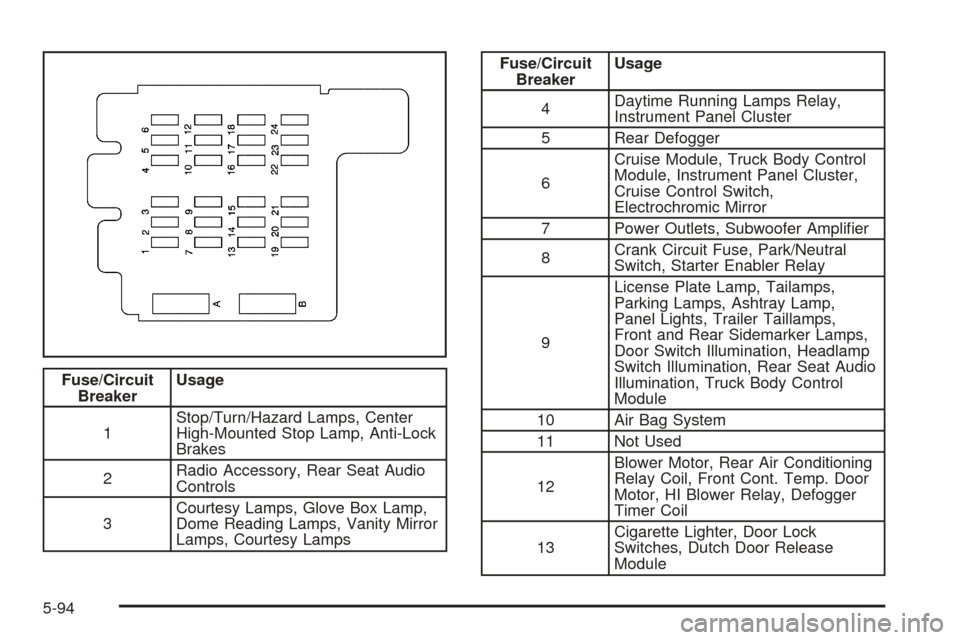
Fuse/Circuit
BreakerUsage
1Stop/Turn/Hazard Lamps, Center
High-Mounted Stop Lamp, Anti-Lock
Brakes
2Radio Accessory, Rear Seat Audio
Controls
3Courtesy Lamps, Glove Box Lamp,
Dome Reading Lamps, Vanity Mirror
Lamps, Courtesy Lamps
Fuse/Circuit
BreakerUsage
4Daytime Running Lamps Relay,
Instrument Panel Cluster
5 Rear Defogger
6Cruise Module, Truck Body Control
Module, Instrument Panel Cluster,
Cruise Control Switch,
Electrochromic Mirror
7 Power Outlets, Subwoofer Amplier
8Crank Circuit Fuse, Park/Neutral
Switch, Starter Enabler Relay
9License Plate Lamp, Tailamps,
Parking Lamps, Ashtray Lamp,
Panel Lights, Trailer Taillamps,
Front and Rear Sidemarker Lamps,
Door Switch Illumination, Headlamp
Switch Illumination, Rear Seat Audio
Illumination, Truck Body Control
Module
10 Air Bag System
11 Not Used
12Blower Motor, Rear Air Conditioning
Relay Coil, Front Cont. Temp. Door
Motor, HI Blower Relay, Defogger
Timer Coil
13Cigarette Lighter, Door Lock
Switches, Dutch Door Release
Module
5-94
Page 306 of 370
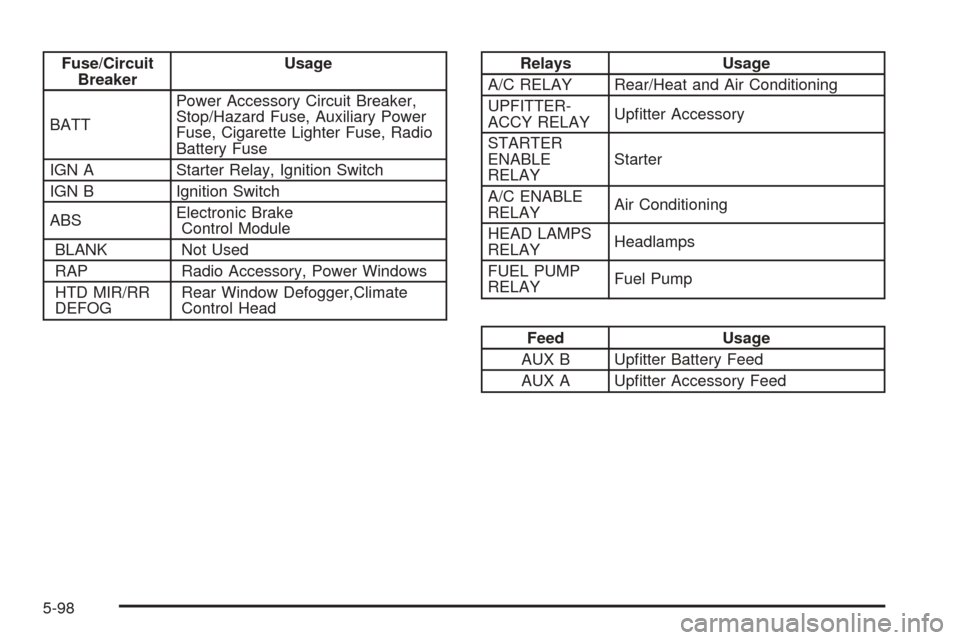
Fuse/Circuit
BreakerUsage
BATTPower Accessory Circuit Breaker,
Stop/Hazard Fuse, Auxiliary Power
Fuse, Cigarette Lighter Fuse, Radio
Battery Fuse
IGN A Starter Relay, Ignition Switch
IGN B Ignition Switch
ABSElectronic Brake
Control Module
BLANK Not Used
RAP Radio Accessory, Power Windows
HTD MIR/RR
DEFOGRear Window Defogger,Climate
Control HeadRelays Usage
A/C RELAY Rear/Heat and Air Conditioning
UPFITTER-
ACCY RELAYUptter Accessory
STARTER
ENABLE
RELAYStarter
A/C ENABLE
RELAYAir Conditioning
HEAD LAMPS
RELAYHeadlamps
FUEL PUMP
RELAYFuel Pump
Feed Usage
AUX B Uptter Battery Feed
AUX A Uptter Accessory Feed
5-98
Page 368 of 370
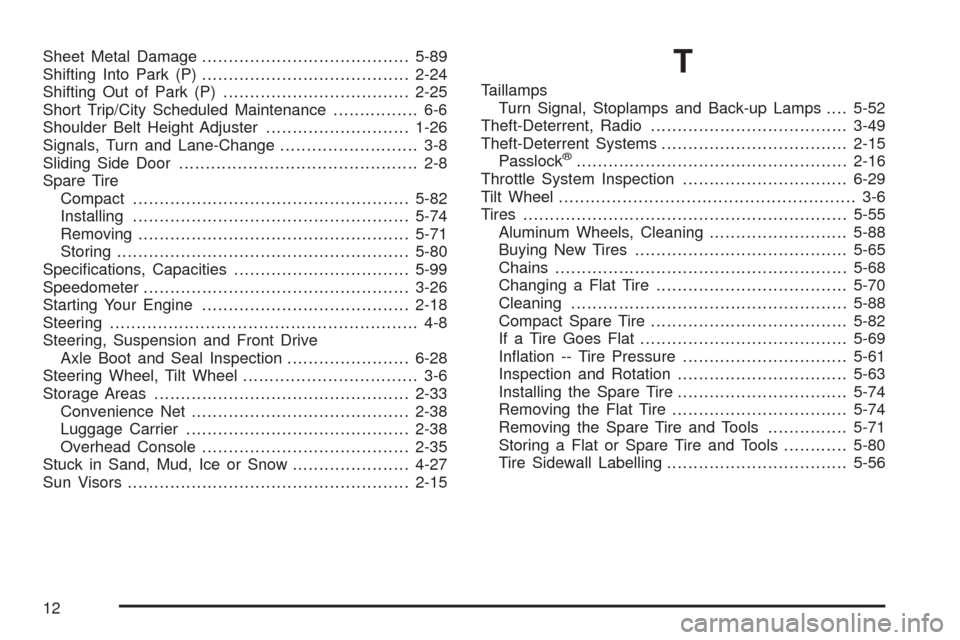
Sheet Metal Damage.......................................5-89
Shifting Into Park (P).......................................2-24
Shifting Out of Park (P)...................................2-25
Short Trip/City Scheduled Maintenance................ 6-6
Shoulder Belt Height Adjuster...........................1-26
Signals, Turn and Lane-Change.......................... 3-8
Sliding Side Door............................................. 2-8
Spare Tire
Compact....................................................5-82
Installing....................................................5-74
Removing...................................................5-71
Storing.......................................................5-80
Specications, Capacities.................................5-99
Speedometer..................................................3-26
Starting Your Engine.......................................2-18
Steering.......................................................... 4-8
Steering, Suspension and Front Drive
Axle Boot and Seal Inspection.......................6-28
Steering Wheel, Tilt Wheel................................. 3-6
Storage Areas................................................2-33
Convenience Net.........................................2-38
Luggage Carrier..........................................2-38
Overhead Console.......................................2-35
Stuck in Sand, Mud, Ice or Snow......................4-27
Sun Visors.....................................................2-15T
Taillamps
Turn Signal, Stoplamps and Back-up Lamps....5-52
Theft-Deterrent, Radio.....................................3-49
Theft-Deterrent Systems...................................2-15
Passlock
®...................................................2-16
Throttle System Inspection...............................6-29
Tilt Wheel........................................................ 3-6
Tires.............................................................5-55
Aluminum Wheels, Cleaning..........................5-88
Buying New Tires........................................5-65
Chains.......................................................5-68
Changing a Flat Tire....................................5-70
Cleaning....................................................5-88
Compact Spare Tire.....................................5-82
If a Tire Goes Flat.......................................5-69
Ination -- Tire Pressure...............................5-61
Inspection and Rotation................................5-63
Installing the Spare Tire................................5-74
Removing the Flat Tire.................................5-74
Removing the Spare Tire and Tools...............5-71
Storing a Flat or Spare Tire and Tools............5-80
Tire Sidewall Labelling..................................5-56
12